Child Bitten by a Dog: What Makes Pediatric Dog Bite Cases Different
Child Bitten by a Dog: What Makes Pediatric Dog Bite Cases Different
Educational information only, not legal advice. Every Oregon dog-bite case depends on the facts, the child’s injuries, the dog’s history, and the records preserved early.
Quick Answer
Pediatric dog-bite cases are often different because the injury pattern, healing process, and proof issues can all look different from an adult claim.
In many child cases, the most important differences involve:
- where the child was bitten,
- whether the bite may leave a visible scar,
- what emotional or behavioral changes show up later,
- how parents preserve records over time,
- and how parent-paid medical expenses fit into the case.
For the broader Oregon liability framework, start with our main Oregon dog-bite article. For the larger claim overview, see our dog bites practice-area page.
1) Children Often Face Different Medical Risk Patterns
Clinical literature commonly notes that young children face particular danger from bites to the face, neck, or head. That matches the common-sense reality that small children are closer to a dog’s mouth and may not react quickly when a dog becomes frightened, startled, or territorial.
That matters because a child dog-bite case may involve more than a simple puncture wound. Depending on the location, families may be dealing with:
- facial lacerations,
- specialist follow-up,
- infection concerns,
- scar monitoring,
- and future cosmetic questions that are still uncertain in the first few weeks.
2) The “ER Visit” Is Often Only the Start of the Evidence Story
One reason pediatric dog-bite cases are different is that the first records usually do not tell the whole story.
Parents often learn later that the claim record also needs:
- healing-progress photos,
- pediatrician and specialist follow-up notes,
- plastic-surgery or scar-management recommendations,
- counseling or behavioral-health records when needed,
- and school or childcare disruption records.
That longer timeline matters because what looks “minor” on day one can look very different after weeks or months of scar development.
3) Scarring Can Matter More in Child Cases Than People Realize
Pediatric outcome literature shows two things that are especially relevant here.
First, dog-bite wounds in children can lead to infection and unfavorable scarring. Second, children are at elevated risk for scar hypertrophy during childhood and puberty.
That does not mean every child will have a serious scar or need future procedures.
It does mean families should not assume the visible issue is fully understood in the first few days.
Practical steps usually include:
- taking clear photos early,
- continuing photos as healing changes,
- keeping records of specialist referrals,
- and preserving receipts and notes tied to scar care, ointments, dressings, or follow-up visits.
4) Emotional Effects Can Be Real Even When They Are Harder To Measure
Children do not always describe pain, fear, embarrassment, or sleep disruption the same way adults do.
After a dog bite, parents sometimes notice:
- new fear around dogs,
- sleep issues or nightmares,
- clinginess,
- changes in mood,
- reluctance to go to a friend’s home or yard,
- or embarrassment about a visible facial injury.
Not every case will involve counseling. But when those changes are real, consistent documentation can matter. Parent observations, therapist records, and school notes can all be more useful than trying to reconstruct the story months later from memory.
5) Oregon’s Liability Analysis Still Applies, but the Proof Looks More Family-Managed
For qualifying claims involving injury caused by a dog, ORS 31.360 can matter because it removes the need to prove foreseeability when the child was bitten in a public place or while lawfully in or on a private place.
That can be important in common childhood scenarios such as:
- visiting another home,
- being at a relative’s house,
- playing with permission on private property,
- or encountering a dog in a shared residential setting.
But even when the liability rule is favorable, the proof still depends heavily on the records adults preserve for the child.
6) Parent-Paid Medical Bills Need Attention Too
Another child-case difference is procedural.
ORS 31.700 addresses how, with proper consent, a child’s action can include doctor, hospital, and medical expenses paid by a parent or conservator.
The main practical takeaway is simple: do not treat parent-paid medical bills as an afterthought. Keep them organized from the beginning.
That includes:
- ER bills,
- urgent-care bills,
- pediatric follow-up,
- imaging,
- prescriptions,
- counseling,
- scar-care products,
- and travel costs tied to treatment when significant.
7) Reporting Still Matters
If the bite broke the skin, Oregon law requires any person with direct knowledge to immediately report the facts to the local health officer. See ORS 433.345.
That is important not only for health reasons but also because animal-control records can later help clarify:
- dog identity,
- keeper identity,
- prior complaints,
- dangerous-dog classification issues,
- and witness contact information.
8) What Parents Can Do Early
If your child was bitten and you are past the immediate emergency stage, the practical checklist usually looks like this:
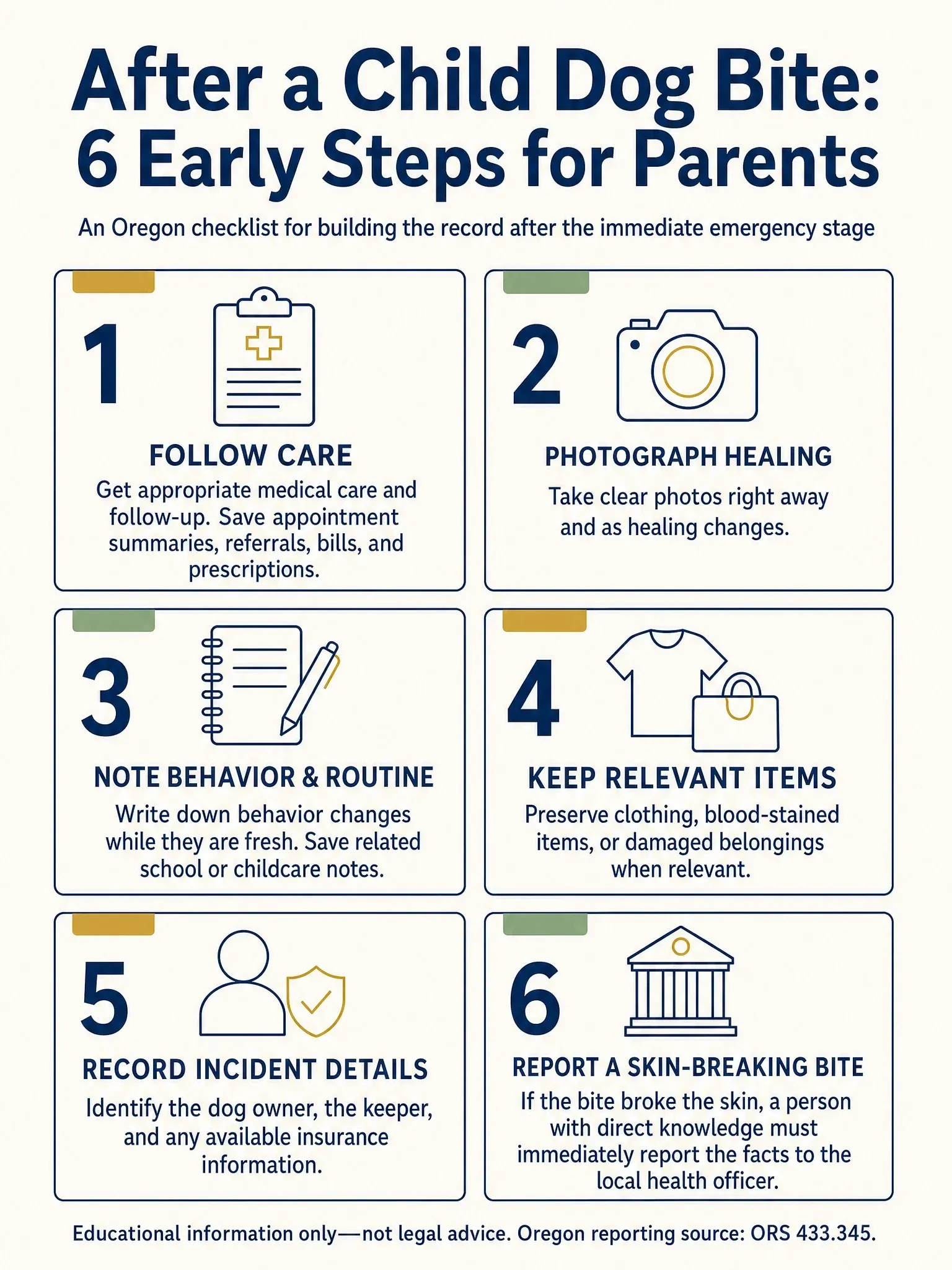
- Get appropriate medical care and follow-up.
- Report the bite if the skin was broken.
- Photograph the injury right away and during healing.
- Keep all bills, prescriptions, and appointment summaries.
- Write down behavior changes while they are fresh.
- Save school or childcare notes tied to the injury.
- Preserve clothing, blood-stained items, or damaged belongings when relevant.
- Identify the dog owner, keeper, and any available insurance information.
9) What Defenses Often Show Up
Even in child cases, the defense may still argue:
- the child provoked the dog,
- the injury is healing well and future concerns are speculative,
- the scar is minor,
- emotional effects are unsupported,
- or someone waited too long to document the progression.
That is one reason careful, calm documentation matters so much. The goal is not to dramatize the injury. The goal is to preserve a fair record while the child’s healing path is still unfolding.
If you need local context, our Portland dog bite lawyer page covers Portland-area claim issues too.
Bottom Line
Pediatric dog-bite cases are often different because they can involve:
- different injury locations,
- more concern about visible scarring,
- a longer follow-up timeline,
- emotional effects that emerge later,
- and parent-managed proof of both the child’s losses and the family’s medical expenses.
In Oregon, that means early record preservation can matter just as much as the initial wound chart.
FAQ
Why are child dog-bite cases often treated differently from adult cases?
Because children are more vulnerable to certain injury patterns, especially to the face and head, and because healing, scarring, and emotional effects may need to be documented over a longer period.
Should parents keep follow-up photos after the first ER visit?
Usually yes. Healing progression, scar development, and color or texture changes may become important later.
Can parent-paid medical bills be part of the case?
Potentially yes. ORS 31.700 addresses how parent-paid medical expenses can be included in a child’s action with proper consent.
Do I still have to report the bite if my child seems okay?
If the bite broke the skin, Oregon law requires any person with direct knowledge to immediately report the facts to the local health officer. See ORS 433.345.
Sources
Client-First Fee Promise
Client First = Bills First, Fees Second
Your unpaid medical bills do not have to make your lawyer's fee bigger. Johnson Law subtracts qualifying medical bills before calculating our fee, helping clients keep more of their settlement.
Applies to qualifying cases. Results vary.