

RIDESHARE ACCIDENT ATTORNEYS Rideshare Accident Lawyers in Oregon Injured in an Uber or Lyft accident? We help you navigate the complex insurance maze and fight for maximum compensation.

Start Here: Your Rights and Options After a Rideshare Accident
Rideshare services like Uber and Lyft offer unparalleled convenience for getting around Portland, Eugene, and communities across Oregon. But when that convenience is shattered by a car accident, injured victims are often thrown into a confusing and stressful situation. Unlike a typical car crash, an accident involving a rideshare vehicle brings a complex web of insurance policies, corporate liability questions, and legal challenges that most people have never encountered.
If you've been injured as a rideshare passenger, another driver, or even a pedestrian hit by an Uber or Lyft driver, you may be facing serious injuries, mounting medical bills, and lost wages. You likely have urgent questions: Whose insurance pays for my damages? What are my rights? How do I hold the at-fault party accountable? The answers are rarely straightforward, and navigating the claims process alone can feel overwhelming.
This guide is designed to provide clear, actionable answers. We will walk you through the entire process, from the critical first steps to take at the accident scene to understanding the intricate layers of rideshare insurance coverage required under Oregon law. We will explain how fault is determined, what your claim may be worth, and why partnering with a knowledgeable attorney can be essential for protecting your rights. Our goal is to empower you with the information you need to navigate this difficult time and pursue the full compensation you deserve for your injuries.
Navigating the Aftermath: Critical First Steps After an Oregon Rideshare Accident
In the chaotic moments immediately following a crash, your adrenaline is high, and it can be difficult to think clearly. However, the steps you take—or fail to take—can have a profound impact on both your physical recovery and your ability to secure fair compensation down the road. Acting deliberately and prioritizing correctly is key.
Ensure Safety and Seek Medical Attention
Your absolute first priority is your health. Before anything else, assess yourself for injuries and move to a safe location away from traffic if you are able. Call 911 immediately, even if you feel your injuries are minor. Adrenaline can easily mask serious conditions like internal bleeding or concussions that require urgent medical attention. Paramedics can provide immediate care, and their official report creates a vital record of your injuries from the moment of the accident.
Even if you believe you are unhurt, seeking a professional medical evaluation is essential. The shock and adrenaline that flood your system during a collision can effectively numb your body to pain, masking potentially serious conditions. Injuries like whiplash, concussions, soft tissue damage, or even internal bleeding often have delayed symptoms that may not appear for hours or days. By visiting an urgent care clinic, an emergency room, or your primary care physician as soon as possible, you prioritize your long-term well-being and create an official, time-stamped medical record that establishes a clear link between the accident and your injuries.
Report the Accident to Law Enforcement
Just as an official medical record validates your injuries, an official police report validates the facts of the accident itself. Always call 911 or the non-emergency police line to have an officer dispatched to the scene. Do not let another driver, including your rideshare driver, convince you to handle the crash "privately" or "without insurance," especially if you feel any pain whatsoever.
When law enforcement arrives, they will conduct an independent investigation and create a formal report. This document is a powerful piece of objective evidence that insurance companies find difficult to dispute. The report will typically contain the exact date, time, and location of the collision; the names, contact details, and insurance information for all involved drivers; statements from drivers, passengers, and any independent witnesses; a description of vehicle damage, weather conditions, and road hazards; a diagram illustrating the positions of the vehicles; and the officer's narrative and, in some cases, a preliminary determination of fault or a traffic citation issued to the at-fault driver.
Document Everything at the Scene
While you wait for law enforcement to arrive, you have a valuable window of opportunity to gather your own evidence. If you are physically able, use your smartphone to thoroughly document the scene. This evidence, captured in the immediate aftermath, is often the most compelling and can be crucial in proving who was at fault.
Start by taking extensive photographs and videos. Capture the scene from multiple angles and distances. Your photos should include:
- Vehicle Damage: Close-up shots of the damage to all vehicles involved, as well as wider shots showing the cars' final resting positions relative to each other and the road.
- License Plates: Clear photos of the license plates of every vehicle.
- The Broader Scene: Document the entire intersection or stretch of road. Capture traffic signals, stop signs, skid marks, debris from the crash, and any relevant weather or road conditions.
- Visible Injuries: Photograph any cuts, bruises, or other visible injuries you or your passengers have sustained.
Next, exchange essential information with the other driver(s). Be polite but thorough. Collect their full name, address, phone number, driver's license number, and insurance information—including the company name and policy number. Also identify and speak with any witnesses. Independent bystanders who saw the accident have no stake in the outcome, and their testimony can be incredibly persuasive.
Report the Incident Within the Rideshare App
In addition to gathering physical evidence, you must take one more crucial step that is unique to rideshare accidents: officially reporting the crash through the company's mobile app. This action creates an immediate and undeniable digital record of the incident within the rideshare company's own system, which is essential for triggering their claims process and accessing their commercial insurance policy.
After ensuring you are safe, open the Uber or Lyft app on your phone. Navigate to your trip history and select the specific ride during which the accident occurred. Within the trip details, you will find a "Help" or "Safety" section. Select the option that allows you to report a safety issue or an accident.
When you make this report, be direct and factual. State simply that the vehicle for this trip was involved in an accident. You do not need to provide a detailed narrative at this stage. It is vital that you do not apologize, accept any blame, speculate on who was at fault, or downplay your potential injuries by saying things like "I feel fine." Insurance adjusters for the rideshare company will review this initial report, and any ambiguous statements can be used to undermine your claim later. By reporting the incident through the app, you create a digital timestamp that proves the accident happened during an active trip, officially notifying Uber or Lyft of the event.
Need Help Navigating Your Rideshare Accident Claim?
Don't face the insurance companies alone. Our experienced team can guide you through every step of the process and protect your rights.
Understanding the Complex Web of Rideshare Insurance Coverage in Oregon
After managing the immediate chaos of an accident scene, you will quickly face a crucial question: who is going to pay for your medical bills, lost income, and other damages? With rideshare accidents, the answer is far more complicated than in a standard collision. The key to your claim lies in a multi-layered insurance system that changes based on the driver's activity within the Uber or Lyft app at the precise moment of the crash.
Unlike a typical car wreck involving just personal auto policies, a crash with a rideshare vehicle introduces a tiered structure of coverage dictated by Oregon law. The insurance responsibility shifts depending on what the driver was doing. Was their app off? Were they logged in and waiting for a ride request? Or were they on their way to pick you up or actively driving you to your destination? Each of these scenarios, often called "phases," triggers a different insurance policy with vastly different coverage limits. Determining which phase the driver was in is the most critical step in identifying the correct source of compensation for your injuries.
Phase 1: Driver App is Off (Personal Policy Applies)
The simplest scenario occurs when a driver is using their vehicle for personal matters. If an Uber or Lyft driver is not logged into the company's app—meaning they are not available to accept rides—they are considered an ordinary motorist. In this phase, the driver might be running errands, commuting to another job, or simply driving for pleasure. From an insurance standpoint, Uber and Lyft have no involvement or responsibility.
If you are injured in an accident caused by a rideshare driver who is "offline," your claim is treated exactly like any other car accident claim in Oregon. You would file a claim directly against the at-fault driver's personal auto insurance policy. The driver's status as a part-time rideshare operator is irrelevant, as they were not engaged in any commercial activity at the time of the collision. The compensation for your medical bills, lost wages, and other damages would come from their personal liability coverage, up to their policy limits.
Phase 2: App is On, Awaiting a Ride Request (Limited Rideshare Coverage)
The insurance landscape changes dramatically the moment a driver logs into the Uber or Lyft app and makes themselves available to accept rides. This period, when the driver is online but has not yet accepted a ride request, is commonly known as "Phase 2." It creates a notorious insurance gap because most personal auto policies contain a "commercial use exclusion," allowing them to deny coverage if an accident happens while the driver is engaged in any business activity—even just waiting for a customer.
To close this gap and protect the public, Oregon law requires Transportation Network Companies (TNCs) like Uber and Lyft to provide a layer of contingent liability insurance that applies specifically during this phase. If you are injured by a rideshare driver who was at fault during Phase 2, this coverage is designed to pay for your damages. The state-mandated minimums for this period are:
- $50,000 in bodily injury liability coverage per person
- $100,000 in total bodily injury liability coverage per accident
- $25,000 in property damage liability coverage per accident
This policy is "contingent," meaning it typically only applies after the driver's personal insurance company has formally denied the claim based on their commercial use exclusion. It acts as a crucial safety net for injured third parties, such as other drivers, pedestrians, or cyclists, ensuring they have a source of recovery.
Phase 3: Actively Transporting a Passenger or En Route to Pickup (Full Rideshare Coverage)
This is the phase where the most significant insurance protection kicks in. The moment a rideshare driver accepts a ride request, the limited coverage of Phase 2 ends, and the TNC's full commercial insurance policy is triggered. This robust coverage remains in effect for the entire duration of the trip, from the second the driver is on their way to pick up a passenger until the moment that passenger is dropped off at their destination and the ride is officially ended in the app.
Under Oregon law (ORS 825.014), this "Phase 3" coverage is substantial. Uber and Lyft must provide:
- $1,000,000 in third-party liability coverage. This policy covers bodily injury and property damage to others if the rideshare driver is at fault for the accident. This includes passengers in other vehicles, pedestrians, or cyclists.
- $1,000,000 in Uninsured/Underinsured Motorist (UM/UIM) coverage. This is a critical protection for anyone inside the rideshare vehicle—both the passenger and the driver. If the accident is caused by a hit-and-run driver or a driver who has no insurance or not enough insurance to cover your injuries, this UM/UIM policy steps in to pay for your damages.
If you were a passenger in an Uber or Lyft during a crash, this $1 million policy is your primary path to compensation, regardless of who caused the accident. If your driver was at fault, the liability portion applies. If another driver was at fault, the UM/UIM portion applies. This comprehensive coverage is designed to ensure that victims of serious accidents involving an active rideshare vehicle have access to the financial resources necessary for their recovery.
Who Pays for Your Injuries? Identifying the Liable Insurer
With these three distinct insurance phases in mind, the crucial question becomes: which policy actually pays for your injuries? The answer hinges on a simple but powerful combination of your role in the accident and the rideshare driver's exact status at the moment of the collision.
For injured passengers inside an Uber or Lyft, the path is the most straightforward. Because you were on an active trip, the accident automatically falls under Phase 3. This means you are covered by the rideshare company's $1 million commercial policy. If your driver caused the crash, their liability coverage applies. If another motorist was at fault, the rideshare company's Uninsured/Underinsured Motorist (UM/UIM) coverage is designed to cover your damages.
For anyone injured outside the rideshare vehicle—such as another driver, a pedestrian, or a cyclist—identifying the liable insurer requires pinpointing the driver's phase:
- If the driver's app was off (Phase 1): You file a claim against the driver's personal auto insurance policy.
- If the driver's app was on while awaiting a request (Phase 2): You file a claim against the rideshare company's contingent liability policy, which provides lower limits of coverage.
- If the driver was en route to a pickup or had a passenger (Phase 3): You file a claim against the rideshare company's full $1 million liability policy.
Because insurance companies will seek to minimize their payout, proving the driver's digital status is paramount. Evidence such as your own app screenshots, witness statements, and data requested from the TNC itself is vital. Correctly identifying and filing your claim with the proper insurer from the very beginning is a foundational step toward securing the compensation you deserve.
Confused About Which Insurance Policy Covers Your Injuries?
The multi-layered rideshare insurance system is complex. We'll identify the right coverage and maximize your compensation.
Determining Fault in Uber and Lyft Accidents
While identifying the correct insurance policy is a critical first step, it doesn't automatically guarantee payment. Before any insurer—whether it's a personal policy or Uber's commercial carrier—pays a claim, you must establish who was legally at fault for the crash. In Oregon, this is determined by the legal principle of negligence. Essentially, you must prove that another party acted carelessly or broke a traffic law, and that this failure directly caused your injuries.
In a rideshare accident, the question of fault can be complex. Was it your Uber driver who was distracted by their phone? Was it another motorist who ran a red light? Or, in rare cases, could the rideshare company itself share some of the blame? Pinpointing the negligent party is the foundation of your injury claim and dictates which insurance company is ultimately responsible for your damages.
Proving Rideshare Driver Negligence
In many situations, the fault for a collision lies directly with the person operating the rideshare vehicle. To hold them accountable, you and your attorney must demonstrate that they were negligent—meaning they failed to operate their vehicle with the level of care a reasonably prudent person would use under similar circumstances. This often involves showing that they violated a specific traffic law or engaged in an unsafe driving practice that directly caused the crash.
Proving this breach of duty relies on concrete evidence. A police report that includes a traffic citation for speeding, running a red light, or making an illegal turn is a powerful piece of evidence. Likewise, testimony from independent witnesses who saw the driver tailgating or swerving erratically can be incredibly persuasive. The physical evidence from the scene, such as the location of vehicle damage and the length of skid marks, can also be analyzed by accident reconstruction experts to help establish fault.
Rideshare drivers face unique pressures that often lead to negligence. The most common is distraction related to their job. We can often prove negligence by showing the driver was looking at their phone to accept a new ride, check the GPS navigation, or communicate with a passenger instead of watching the road. Digital evidence, including data logs from the rideshare company itself, can sometimes reveal if the driver was interacting with the app at the critical moment before impact. By combining this evidence, we can build a compelling case that the driver's careless actions were the direct cause of the collision and your resulting injuries.
Can the Rideshare Company (Uber/Lyft) Be Held Liable?
A common and understandable question victims ask is whether they can hold the rideshare corporation—Uber or Lyft itself—directly responsible for the accident. While it seems logical, this is one of the most challenging aspects of rideshare litigation. The primary reason is that these companies have built their business models on classifying their drivers as independent contractors rather than employees. This legal distinction is crucial because, under a doctrine known as vicarious liability, employers are typically responsible for the negligent acts of their employees, but companies are generally not responsible for the negligence of independent contractors.
This classification creates a powerful legal shield for Uber and Lyft, often protecting them from liability for a driver's simple mistake, like running a stop sign. However, this shield is not absolute. A rideshare company can be held directly liable for its own negligence. This means you may have a claim against the corporation if you can prove it failed in its own duties, leading to your harm.
Examples of direct corporate negligence include negligent hiring or screening (if the company allowed a driver onto its platform who it knew, or should have known, had a dangerous driving record, a history of DUIs, or a criminal background that made them unfit to transport the public), negligent retention (if the company received multiple credible complaints about a driver's unsafe behavior but failed to investigate and remove them from the platform), and app-related malfunctions (if a flaw in the company's app, such as a faulty GPS directive that routed a driver the wrong way down a one-way street, directly contributed to the crash). Successfully proving a case of direct negligence against a massive corporation requires an in-depth investigation, access to internal company records, and a sophisticated legal argument.
Liability of Third-Party Drivers
While the rideshare driver and their parent company are often the focus of an investigation, it is just as common for the crash to be caused by the negligence of a completely separate driver. For instance, if you are a passenger in an Uber that is lawfully proceeding through a green light when another vehicle runs the red light and T-bones your car, the driver of that other vehicle is clearly at fault. In these situations, the initial personal injury claim is directed at the at-fault third-party driver and their automobile insurance company.
This is where a critical problem often arises. Oregon's minimum liability insurance requirements are relatively low, and a significant number of drivers are either uninsured or carry only the bare minimum coverage. If your injuries are serious, the at-fault driver's policy may be exhausted quickly, leaving you with substantial unpaid medical bills and other losses.
This scenario is precisely why Oregon's rideshare laws are so valuable for injured passengers. When the at-fault driver is uninsured or their policy is insufficient, the rideshare company's mandatory Uninsured/Underinsured Motorist (UM/UIM) coverage acts as a powerful safety net. For accidents occurring during Phase 3 (an active trip), this provides up to $1 million in coverage that you can access to pay for your damages. This policy effectively steps into the shoes of the at-fault driver, ensuring you have a path to full and fair compensation, even when the person who caused your injuries lacks the resources to provide it.
Let Us Prove Who Was at Fault
Building a strong negligence case requires evidence, expertise, and experience. We know how to hold rideshare drivers and companies accountable.
Common Causes of Rideshare Accidents in Oregon
While any car accident can be caused by a simple mistake, the unique nature of the rideshare industry creates specific risk factors that contribute to a large number of collisions. The business model, which relies on an app-based gig economy and independent contractors, introduces pressures and hazards not found in typical driving situations.
Understanding these common causes is key to investigating your accident and proving negligence:
- Distracted Driving and App Usage – Rideshare drivers must constantly interact with their smartphones to accept rides, navigate routes, and communicate with passengers, creating dangerous moments of inattention.
- Driver Fatigue and Long Hours – As independent contractors paid per trip, many drivers work exhausting hours, often driving late at night or after a full day at another job.
- Unfamiliarity with Local Roads – Unlike experienced taxi drivers, rideshare drivers may not know the area well and rely heavily on GPS, leading to sudden, unsafe maneuvers.
- Inadequate Vehicle Maintenance – Drivers bear the full cost of maintaining their vehicles, which can lead to deferred repairs and dangerous mechanical failures.
Each of these factors represents a form of negligence that can be proven with the right evidence, from app usage logs to vehicle inspection reports.
Understanding the Unique Risks of the Rideshare Business Model
Distracted Driving and App Usage
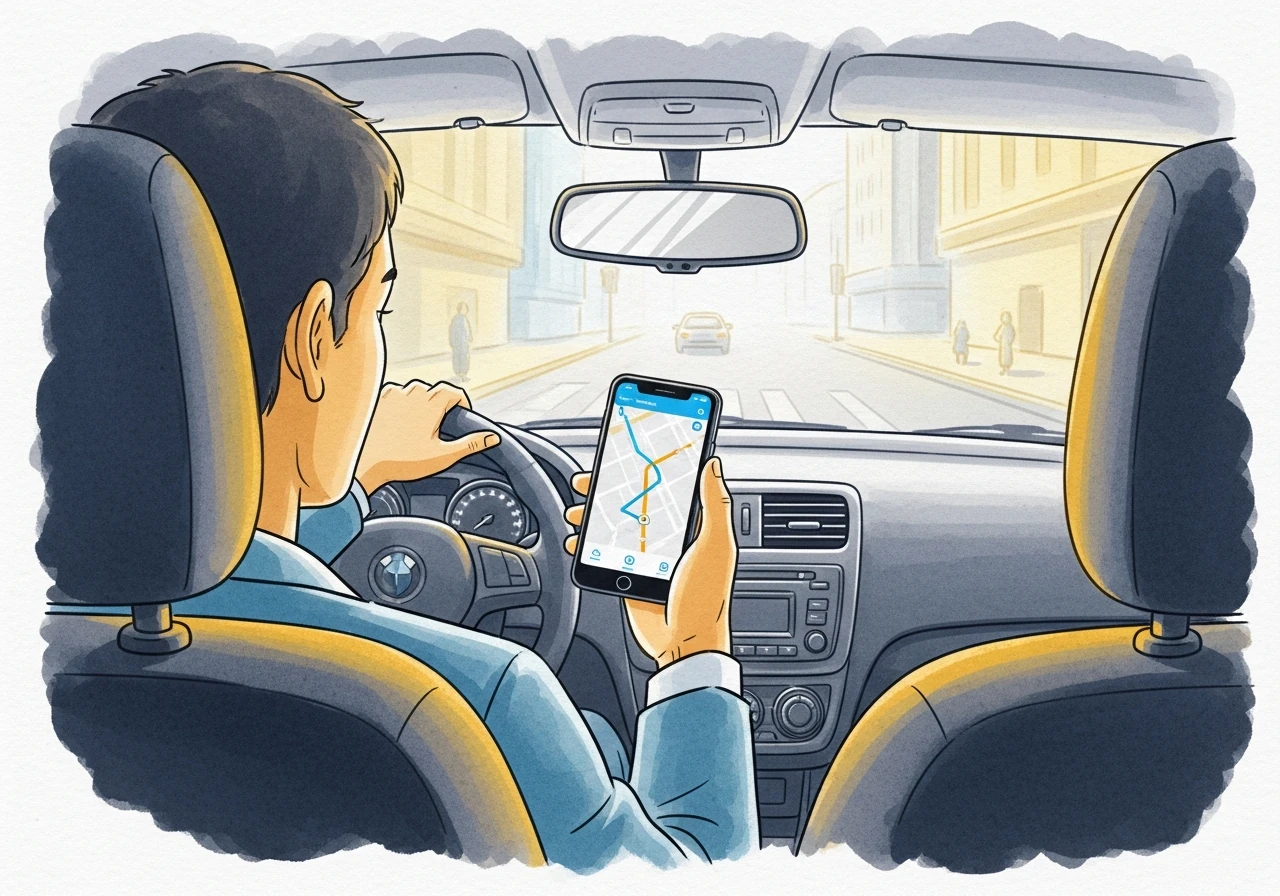
While all drivers face the temptation of a ringing phone or a text message alert, the distraction for a rideshare driver is fundamentally different—it is built directly into their job. Their smartphone is not just a source of temptation; it is their dispatch center, their navigation tool, and their time clock. The Uber and Lyft apps require constant visual, manual, and cognitive engagement that pulls their focus away from the primary task of operating a vehicle safely.
This required distraction manifests in several dangerous ways. A driver may glance down to accept a new ride request that "pings" on their screen, a time-sensitive action that incentivizes them to look away from the road. They may need to manipulate the GPS to find an alternate route in heavy Portland traffic or zoom in to locate a specific pickup address in a confusing apartment complex. Each of these actions, while necessary for their work, represents a critical moment of inattention. A car traveling at just 35 mph covers over 50 feet per second. The few seconds it takes to tap "accept" on a new fare is long enough to miss a child stepping into a crosswalk, a cyclist making a turn, or the brake lights of the car ahead.
Driver Fatigue and Long Hours
The same economic model that encourages app interaction also creates a powerful incentive for drivers to stay on the road for extended periods, pushing them to the brink of exhaustion. As independent contractors paid per trip, their income is directly tied to the hours they put in. Many drivers work for Uber or Lyft as a "second job," meaning they get behind the wheel after already completing a full day's work elsewhere, or they drive late into the night when demand is high. This business structure fosters a culture where driver fatigue is a significant and predictable risk.
Scientific research has repeatedly shown that drowsy driving is just as dangerous as drunk driving. Fatigue severely impairs cognitive function, slows reaction time, dulls judgment, and increases the risk of a driver experiencing a "microsleep"—a momentary lapse of consciousness that can last for several seconds. In that brief time, a car can travel the length of a football field, leading to devastating head-on collisions or lane-departure accidents. In an accident investigation, obtaining the driver's trip logs from one or more platforms can reveal a pattern of dangerously long hours, providing powerful evidence that their fatigue constituted negligence and caused your injuries.
Unfamiliarity with Local Roads
Beyond the dangers of fatigue, another significant risk arises from a driver's lack of local knowledge. Unlike a taxi driver who may have spent years mastering a city's grid, many rideshare drivers are not intimately familiar with the areas they serve. A driver from a suburb might accept a fare that takes them deep into the complex, one-way streets of downtown Portland, or a new resident might be navigating Eugene's bike-heavy corridors for the first time. This lack of familiarity forces an almost total reliance on GPS navigation.
While GPS is a powerful tool, it is not a substitute for situational awareness. A driver who is slavishly following a digital map is often not fully engaged with the dynamic environment around them. Their eyes are drawn to the screen, waiting for the next instruction, rather than scanning for pedestrians, cyclists, or changing traffic conditions. This over-reliance can lead directly to dangerous and unpredictable driving behaviors—a sudden, last-second lane change to avoid missing a GPS-dictated exit; an abrupt stop in a travel lane while the driver tries to pinpoint an address; or an illegal U-turn after the app announces a missed turn. When an accident is caused by a driver making a sudden, unsafe move while trying to follow their GPS, it is a clear example of negligence.
Inadequate Vehicle Maintenance
Finally, the independent contractor model places the full burden of vehicle upkeep squarely on the driver's shoulders. Unlike a commercial fleet where vehicles are regularly serviced by a company, a rideshare driver must pay for every oil change, tire rotation, and brake job out of their own pocket. This financial pressure can lead some to postpone critical repairs or use cheaper, substandard parts to maximize their take-home pay, turning their vehicle into a ticking time bomb.
This form of negligence can be catastrophic. In Oregon's often rainy conditions, tires with worn-out tread cannot properly grip wet pavement, dramatically increasing the risk of hydroplaning and losing control on highways like I-5 or the Sunset Highway. Similarly, faulty brakes with worn pads or low fluid can fail in a critical moment, turning what should have been a safe stop into a serious rear-end or intersection collision. Other common maintenance failures include burned-out headlights or taillights that reduce visibility at night, and worn windshield wipers that can't clear away a sudden downpour, severely obscuring the driver's vision.
While rideshare companies may require an initial vehicle inspection, they do not monitor ongoing maintenance. Under Oregon law, every driver has a non-delegable duty to ensure their vehicle is in safe operating condition. If a mechanical failure is suspected as a cause of your accident, a post-crash inspection by a qualified mechanic can serve as powerful evidence. It can reveal pre-existing defects and prove that the driver's failure to maintain their vehicle was a direct cause of your injuries, establishing a clear case of negligence.
Was Your Accident Caused by Driver Distraction or Fatigue?
These are forms of negligence we can prove. Get a free consultation to learn how we can help you recover full compensation.
Preserving Key Evidence for Your Rideshare Claim
Proving that a rideshare driver was distracted, fatigued, or otherwise negligent requires more than just your word—it requires concrete evidence. While the steps you take at the scene are a critical starting point, preserving the key evidence for your claim is an ongoing process. The digital and paper trail you create in the days and weeks following the crash will form the backbone of your case, providing the proof needed to establish liability and document the full extent of your damages.
Your Digital Trail: Screenshots and Trip Details
Your smartphone is your most powerful evidence-gathering tool, not just at the scene, but long after. The rideshare app itself contains a digital receipt of the event that is crucial to your claim. It is vital that you act quickly to preserve this data, as app interfaces can change and you want to secure this information while it is under your control. As soon as you are able, open the app and take screenshots of everything related to the accident trip.
This digital file should include:
- The Trip Receipt and Route Map: This screen is your single most important piece of evidence. It shows the date, time, cost, and, crucially, the GPS-tracked route of your trip. This definitively proves you were on an active ride (Phase 3) when the crash occurred, directly triggering the rideshare company's $1 million commercial insurance policy and preventing them from arguing the driver was offline.
- The Driver's Profile: Capture a screenshot of the driver's name, photo, vehicle make and model, and license plate number. This confirms the identity of the at-fault driver and their vehicle, preventing any disputes about who was behind the wheel.
- Your In-App Communications: Screenshot any messages you exchanged with the driver. While often mundane, these communications can sometimes contain important details or even admissions, such as a driver apologizing for being late because they were tired.
- The Initial Accident Report: If you reported the crash through the app's help feature, take a screenshot of that report and any confirmation you received. This creates a time-stamped record of your immediate notification to the company.
Think of these screenshots as your indisputable proof. This digital trail creates an undeniable link between your presence in that specific vehicle at that specific time and the company's legal obligations. It is the primary evidence that counters any attempt by an insurer to deny the trip's status and shift liability away from their substantial commercial policy.
Witness Statements and Contact Information
While your digital records provide undeniable proof of your trip's status, the human element of your case can be just as powerful in establishing fault. Independent witnesses—other drivers, pedestrians, or local business employees who saw the accident happen—are one of the most valuable assets in any personal injury claim. Their testimony is incredibly credible because they have no financial interest in the outcome. An insurance adjuster may be skeptical of your version of events, but it is much harder for them to dispute the account of a neutral third party.
The contact information you gathered at the scene is therefore a priceless piece of evidence that must be protected. A witness can corroborate critical details that might otherwise devolve into a "he-said, she-said" argument. They can confirm which driver had the right-of-way, describe the speed of the vehicles, or state whether the rideshare driver appeared distracted or was looking at their phone just before the impact. They might have even heard one of the drivers make a spontaneous admission of fault in the moments after the crash, a detail that can significantly strengthen your claim.
It is essential to safeguard this contact information. Store the names and phone numbers you collected in a secure place and provide them to your attorney immediately. An experienced lawyer will know how to promptly reach out to these individuals to obtain a formal, recorded statement while the details are still fresh in their minds. This formal statement preserves their testimony and can be used as powerful leverage in negotiations with the insurance company, often preventing the need for a lengthy court battle. Without witness testimony, you risk having the insurer deny liability based solely on their own driver's self-serving story.
Medical Records and Injury Documentation
Just as a witness account proves what happened on the road, your medical records provide the official story of what happened to your body. The value of your personal injury claim is directly tied to the severity and cost of your injuries, and this is proven almost exclusively through formal medical documentation. Preserving this evidence is an ongoing process that begins with your first trip to the emergency room and continues until you have fully recovered.
It is essential to maintain a complete and continuous record of all medical care you receive for your accident-related injuries. This goes far beyond the initial hospital bill. You must meticulously track every follow-up visit with your primary doctor, appointments with specialists like orthopedists or neurologists, physical therapy and chiropractic sessions, prescription receipts, and invoices for any necessary medical equipment like crutches or a brace. This creates an unbroken chain of causation, clearly linking the collision to the full extent of your physical harm and the costs required to treat it.
This detailed documentation is your best defense against common insurance company tactics. Without a continuous treatment history, an adjuster may argue that your injuries were pre-existing or that a "gap in treatment" means you must have suffered a new, unrelated injury. They may also claim you "failed to mitigate your damages" by not following your doctor's orders. A complete set of records systematically dismantles these arguments. Furthermore, these documents serve a dual purpose: they provide the specific bills needed to calculate your economic damages (medical expenses) and contain the doctors' notes that serve as critical evidence of your non-economic damages, such as your reported pain levels, physical limitations, and emotional distress.
We'll Handle the Evidence While You Focus on Healing
Our legal team knows exactly what evidence to gather and preserve to build the strongest possible case for your recovery.
Understanding Oregon's Rideshare Laws and Regulations
While preserving evidence is crucial for proving what happened in your accident, understanding the specific laws that govern rideshare companies in Oregon is equally important. These regulations provide the legal backbone for your claim, establishing non-negotiable insurance requirements and safety standards that companies like Uber and Lyft must follow. This legal framework is what gives injured victims a powerful recourse that extends beyond just the driver's personal assets.
The cornerstone of these protections is found in Oregon Revised Statute 825.014, which explicitly dictates the insurance coverage that Transportation Network Companies (TNCs) must carry. This law is the reason for the different insurance "phases." It legally mandates the contingent liability coverage for drivers awaiting a ride ($50,000/$100,000/$25,000) and, most importantly, the $1 million in liability and Uninsured/Underinsured Motorist (UM/UIM) coverage for active trips. These are not merely company policies; they are state-mandated minimums designed to ensure that victims of rideshare accidents have access to significant compensation for their injuries.
State-Mandated Insurance Minimums (ORS 825.014)
At the heart of Oregon's consumer protection framework for rideshare services is Oregon Revised Statute 825.014. This statute was specifically enacted by the Oregon Legislature to solve the dangerous insurance gap that arises when a driver's personal auto policy denies a claim due to commercial activity. The law leaves no room for ambiguity, creating a clear, tiered system of insurance that TNCs are legally required to provide. It is this law that gives your claim its legal teeth.
Under ORS 825.014, the mandated insurance minimums are directly tied to the driver's status:
During the App-On, Waiting Period (Phase 2): When a driver is logged in and available but has not yet accepted a ride, the statute requires the TNC to provide contingent liability coverage of at least $50,000 per person for bodily injury, $100,000 per accident for bodily injury, and $25,000 for property damage. This acts as a critical safety net for pedestrians, cyclists, and other drivers injured by a waiting rideshare driver.
During an Active Trip (Phase 3): The moment a driver accepts a ride request until the passenger is dropped off, the law mandates a much more substantial policy. TNCs must provide at least $1 million in primary third-party liability coverage. Critically, the statute also requires an equal amount—$1 million—in Uninsured/Underinsured Motorist (UM/UIM) coverage for the benefit of anyone inside the rideshare vehicle.
This statute is not just a guideline; it is a powerful legal tool. It ensures that regardless of the driver's personal financial situation or insurance choices, a legitimate source of significant financial recovery exists for those injured in a rideshare crash. It transforms a potential claim against an individual with minimal coverage into a claim backed by a state-mandated, multi-million-dollar commercial policy.
Requirements for Rideshare Drivers in Oregon
Beyond the substantial insurance mandates, Oregon law also holds Transportation Network Companies directly responsible for vetting the individuals they put on the road. These regulations are designed to act as a crucial public safety filter, ensuring that not just anyone can become a rideshare driver. Before a driver is permitted to use the Uber or Lyft platform, the company has a legal duty to conduct a thorough screening process.
This process includes performing both a local and national criminal background check and reviewing the applicant's complete driving history. Oregon law specifies several factors that automatically disqualify a driver, including:
- A recent conviction for driving under the influence of intoxicants (DUII).
- More than three moving violations within the preceding year.
- A conviction for a felony, reckless driving, or certain other serious offenses within a specified look-back period.
These driver requirements are not mere suggestions; they are legal obligations. Their importance to an injured victim cannot be overstated. If an accident is caused by a rideshare driver who should have been disqualified during the screening process, a powerful legal argument can be made for the company's own negligence. This is known as "negligent hiring" or "negligent retention." Proving that Uber or Lyft onboarded a driver with a known history of dangerous driving—or failed to remove them after credible complaints—can open the door to holding the corporation itself directly liable for your injuries. This provides a vital, separate avenue for accountability beyond the driver's actions alone.
Know Your Rights Under Oregon Law
You're protected by state-mandated insurance coverage. We'll make sure you access every dollar you're entitled to receive.
Calculating the Value of Your Oregon Rideshare Accident Claim
Once you understand the legal framework and insurance policies that apply to your case, the next critical question is: what is your claim actually worth? The value of a personal injury claim is not an arbitrary figure; it is a comprehensive calculation of every loss you have suffered as a direct result of the accident. In legal terms, these losses are known as "damages," and they are divided into distinct categories.
Damages are designed to make you "whole" again by providing financial compensation for both your measurable financial costs and the intangible human suffering you have endured. The first category, economic damages, covers all the verifiable, out-of-pocket expenses and financial losses, such as medical bills and lost income. The second, and often more significant, category is non-economic damages, which seek to compensate you for the physical pain, emotional distress, and negative impact the injuries have had on your quality of life. Accurately calculating both types of damages—including those you are likely to face in the future—is essential to ensuring you pursue the full and fair compensation you are entitled to under the law.
Economic Damages: Tangible Financial Losses
Economic damages are the most straightforward component of your claim because they represent the specific, calculable financial losses you have incurred due to the accident. These are the tangible costs that can be proven with bills, receipts, invoices, and pay stubs. The goal is to tally every dollar you have lost or had to spend as a direct result of your injuries.
A thorough calculation of your economic damages must include both past and future losses. Key examples include:
- Medical Expenses: This is often the largest category, encompassing every medical cost from the moment of the crash onward. It includes the ambulance ride, emergency room treatment, hospital stays, surgeries, appointments with specialists, physical therapy, chiropractic care, prescription medications, and any necessary medical devices. Crucially, it also includes the estimated cost of any future medical care your doctors anticipate you will need.
- Lost Wages: This is the income you lost from being unable to work during your recovery. This is calculated using your pay stubs or employment records to show the exact amount of money you would have earned had you not been injured.
- Loss of Future Earning Capacity: If your injuries are permanent and prevent you from returning to your previous job or working at the same capacity, you are entitled to compensation for this diminished future income. This complex calculation often requires input from vocational experts.
- Property Damage: This covers the cost to repair or replace your vehicle and any personal property that was damaged in the collision, such as a laptop, cell phone, or eyeglasses.
- Out-of-Pocket Costs: This includes all other related expenses, such as transportation costs for medical appointments, home modification needs, or the cost of hiring help for household chores you can no longer perform.
Meticulously tracking and documenting these expenses is essential. Every bill and receipt serves as a piece of evidence that substantiates your claim and ensures you are reimbursed for the full financial burden the accident has placed on you.
Non-Economic Damages: Pain, Suffering, and Impact on Life
While economic damages cover your financial ledger, non-economic damages address the profound human cost of the accident. This category of compensation is intended to acknowledge the real, but intangible, ways your injuries have affected your well-being and quality of life. Unlike medical bills, there is no receipt for suffering, but these losses are just as significant and are fully compensable under Oregon law.
Non-economic damages encompass several key areas:
- Pain and Suffering: This includes the physical pain from the initial injury, the discomfort of medical procedures and rehabilitation, and any chronic pain that may persist long after the accident.
- Emotional Distress: The psychological trauma of a crash can be severe. This category covers conditions like anxiety, depression, fear of driving, insomnia, and post-traumatic stress disorder (PTSD) that can haunt victims for months or years.
- Loss of Enjoyment of Life: This refers to your inability to participate in the hobbies, activities, and relationships that brought you joy before the accident. It might mean being unable to hike the trails at Forest Park, play in your local sports league, garden, or simply lift your child without pain.
- Inconvenience and Disruption: This acknowledges the immense hassle and disruption to your daily life, from attending countless doctor's appointments to dealing with the stress of the claims process itself.
Because these damages are subjective, they are often the most contentious part of a claim. Insurance adjusters will try to downplay your pain and minimize the impact on your life. An experienced attorney can help articulate the full extent of your suffering, using medical records, testimony from you and your family, and other evidence to build a compelling case for the true value of these profound personal losses.
The Role of Uninsured/Underinsured Motorist (UM/UIM) Coverage
While calculating your full damages is a critical step, it only answers half the question. The other half is: who will actually pay this amount? This is where Uninsured/Underinsured Motorist (UM/UIM) coverage becomes one of the most important protections available to you, especially as a rideshare passenger. This coverage acts as a vital safety net when the person at fault for the accident cannot cover your losses.
Uninsured Motorist (UM) coverage applies if you are injured by a driver with no auto insurance at all or in a hit-and-run collision where the at-fault driver cannot be identified. Underinsured Motorist (UIM) coverage applies when the at-fault driver has insurance, but their policy limits are too low to cover the full value of your damages. For example, if your claim is worth $150,000 but the driver who hit your Uber only carries Oregon's minimum liability limit of $25,000, their insurance will only pay that amount, leaving you with $125,000 in unpaid damages.
This is precisely why the mandatory rideshare insurance is so powerful. For any accident that occurs during an active trip (Phase 3), Uber and Lyft's $1 million UM/UIM policy steps in to cover that shortfall. In the example above, you could file a UIM claim with the rideshare company's insurer to recover the remaining $125,000. This state-mandated coverage ensures that your ability to be made whole is not dependent on the financial responsibility of a random, negligent driver. It is a critical resource that transforms a potentially devastating financial loss into a recoverable one.
Don't Settle for Less Than Your Claim Is Worth
Insurance companies count on you not knowing the true value of your injuries. We ensure you're compensated for all your losses—past, present, and future.
Why You May Need a Rideshare Accident Attorney
While understanding the components of your claim is empowering, successfully recovering the full compensation you deserve is a different challenge altogether. The path is often blocked by resistant insurance companies, complex legal questions, and procedural traps.
An experienced rideshare accident attorney provides critical support in several key areas:
- Fighting Denied Claims – Insurance companies often dispute liability even in clear-cut cases, requiring skilled legal response to overturn unjust denials.
- Managing Multiple Insurers – A single accident can involve the driver's personal policy, the rideshare company's commercial coverage, and third-party insurers—all pointing fingers at each other.
- Accurate Damage Valuation – Attorneys ensure your claim accounts for future medical needs, lost earning capacity, and non-economic damages that adjusters routinely minimize.
- Leveling the Playing Field – Corporate insurers have teams of lawyers and adjusters working to protect their profits. You deserve equal representation.
An attorney shields you from pressure tactics, handles all communications, and builds a case based on evidence—not insurance company opinions.

How an Attorney Protects Your Rights and Maximizes Your Recovery
When Insurance Companies Dispute Liability or Deny Claims
It is a frustrating and common reality that even in cases where liability seems crystal clear, an insurance company may still dispute fault or deny your claim altogether. Their primary goal is to protect their bottom line, and they will use any available argument to avoid paying. For example, even if you were an innocent passenger, the insurer might try to argue their driver was not at fault and shift the blame to another vehicle. In more complex scenarios, the driver's personal insurer and the rideshare company's insurer may point fingers at each other, each denying responsibility in an attempt to force the other to pay.
You might receive a denial letter that makes a confusing legal argument, misrepresents the facts from the police report, or claims there is insufficient evidence to prove their insured party was negligent. For an unrepresented victim, this formal denial can feel like the end of the road. This is precisely when an attorney becomes indispensable.
A skilled lawyer will immediately analyze the insurer's reasoning, gather the evidence needed to dismantle their arguments—such as witness statements, accident reconstruction data, and the driver's trip logs—and file a formal response demanding they reconsider. They know the legal pressure points and can expose a weak or bad-faith denial for what it is. The simple act of retaining counsel signals to the insurance company that you will not be easily intimidated and are prepared to file a lawsuit, a prospect that often brings them back to the negotiating table with a fair offer.
Navigating Multiple Liable Parties and Policies
A single rideshare collision can instantly create a tangled web of competing interests. It's rarely just you against one insurance company. Instead, you may find yourself dealing with the rideshare driver's personal insurer, the rideshare company's commercial carrier, and the insurance company for a third-party driver who was also involved. Each of these entities has a singular goal: to pay out as little as possible. This often results in a frustrating scenario where each insurer points fingers at the others, leaving you caught in the middle.
For example, the at-fault driver's personal insurance may deny the claim, citing a commercial use exclusion. The rideshare company's insurer might then argue that the driver was in a different "phase" than you believe, or they may try to place partial blame on another driver to reduce their liability. Meanwhile, the third party's insurer will work to prove their driver was not at fault at all. Without a legal advocate, you could spend months trying to get a straight answer while your medical bills pile up.
An experienced attorney cuts through this chaos. They act as your single point of contact, managing all communication and putting each insurance company on formal notice of your claim. They understand the legal hierarchy of insurance policies in Oregon—knowing when to file against a third party's liability policy, when to pivot to the rideshare company's Uninsured/Underinsured Motorist (UM/UIM) coverage, and how to use your own PIP benefits correctly. By strategically managing these multiple fronts, your lawyer ensures that no potential source of recovery is overlooked and prevents insurers from using procedural confusion to delay or deny the compensation you rightfully deserve.
Ensuring All Damages Are Accurately Calculated
Beyond untangling the web of liable parties, one of the most critical roles an attorney plays is ensuring your claim is valued correctly. Injured victims often underestimate the true cost of an accident, focusing only on the immediate bills and lost paychecks they can see. An insurance adjuster is happy to capitalize on this, often presenting a quick settlement offer that seems reasonable at first glance but fails to account for the long-term consequences of a serious injury.
An experienced personal injury attorney prevents you from falling into this trap. They take a comprehensive approach to calculating your damages, looking far beyond the initial hospital bills. They will consult with your doctors to understand the prognosis for your recovery, including the likelihood of future surgeries, the need for ongoing physical therapy, or the development of chronic pain. If your ability to work has been permanently affected, they may work with vocational experts and economists to calculate the full value of your lost future earning capacity over your lifetime.
Furthermore, they know how to build a compelling case for your non-economic damages—the pain, suffering, and loss of enjoyment of life that are often the most significant part of a claim. They help you document the real-world impact of your injuries, translating your personal struggle into a figure that an insurance company or jury can understand. Without this professional valuation, you risk accepting a settlement that covers today's expenses but leaves you financially vulnerable when future medical needs arise or the true, lasting impact of the injury becomes clear. An attorney ensures the number you demand reflects the total cost of the accident—past, present, and future.
Ready to Level the Playing Field?
You don't have to face corporate insurance giants alone. Our experienced attorneys fight for your rights and maximize your recovery.
Protecting Your Rights: Common Insurance Company Tactics
Even when you and your attorney have meticulously calculated the full value of your claim, the fight is often just beginning. Insurance companies, including the massive carriers for Uber and Lyft, are businesses driven by profit, not compassion. Their adjusters are highly trained negotiators who employ a playbook of proven tactics designed to protect their bottom line by paying you as little as possible. Being aware of these common strategies is your first line of defense in protecting your right to fair compensation.
One of the most common approaches is to pressure you into accepting a quick, lowball settlement offer. An adjuster may seem friendly and concerned, offering you a check just days after the accident. This is a strategic move designed to close your claim before you understand the full extent of your injuries or the need for future medical treatment. Another key tactic is the request for a recorded statement. While it may seem like a simple request for your side of the story, adjusters are skilled at asking leading questions that can be used to dispute the severity of your injuries or even shift blame for the accident onto you. Finally, you can expect the insurer to scrutinize your medical history and treatment, looking for any excuse to argue that your injuries were pre-existing or that the care you received was unnecessary.
Pressuring for a Quick, Lowball Settlement
Shortly after your accident, you will likely receive a call from a seemingly helpful adjuster representing the rideshare company's insurer. They will express sympathy for your situation and offer to send you a check immediately to help with your "inconvenience" and initial expenses. This offer might feel like a lifeline, especially when you are in pain, out of work, and worried about mounting bills. However, this is a calculated strategy. The adjuster's goal is to get you to accept a small sum of money and sign a release form, permanently closing your claim before you have any idea what it is truly worth.
Insurance companies know that many serious injuries—such as herniated discs, traumatic brain injuries, or severe soft tissue damage—have delayed symptoms that may not become fully apparent for weeks or even months. They are betting that your initial pain is the worst it will get. By offering you a few thousand dollars today, they are attempting to buy their way out of a potentially much larger claim down the road that could involve surgery, extensive rehabilitation, and significant lost wages.
Once you sign that release, you forfeit all rights to seek further compensation. If you later discover you need a spinal fusion or will be unable to return to your job, you will have no legal recourse. It is a binding contract. Resisting the temptation of "fast cash" and refusing to even discuss a settlement until you have completed all necessary medical treatment is one of the most critical steps in protecting your rights.
Requesting a Recorded Statement to Use Against You
Another common tactic, often presented as a simple procedural step, is the adjuster's request for a recorded statement. The adjuster will explain that they just need to get your version of events on tape to move your claim forward. It sounds reasonable, cooperative, and harmless. In reality, it is one of the most dangerous traps an injury victim can fall into. The adjuster is not recording your statement to help you; they are recording it to find evidence they can use against you.
During the statement, the adjuster, who is a trained professional in claim minimization, will ask carefully crafted questions. A simple, polite "I'm fine, thanks" in response to "How are you doing today?" can be used later to argue that your injuries weren't severe. They will ask for a detailed, minute-by-minute account of the collision, hoping you state a minor detail that differs from the police report. They will then use this inconsistency, no matter how insignificant, to attack your credibility and suggest you are an unreliable narrator. They may ask leading questions like, "So you didn't see the other car until right before impact?" to bait you into a statement that implies you were not paying attention.
Under Oregon's comparative fault rules, any statement that can be twisted into a partial admission of fault can be used to reduce the value of your claim. You are under no obligation to provide a recorded statement to the at-fault party's insurance company. The safest and most effective response is to politely decline and state that your attorney will be in contact. This prevents you from inadvertently giving the insurer the ammunition they need to devalue or deny your legitimate claim.
Disputing the Severity of Your Injuries
Even if the insurance company cannot find a way to deny fault, their efforts to minimize your claim will simply shift to a new target: the nature and extent of your injuries. One of the most common and cynical tactics is to systematically dispute the severity of your physical harm. The adjuster will comb through your medical records not to understand your condition, but to find ammunition to devalue it.
This often begins with a search for any pre-existing conditions. If you had a minor back issue five years ago, the insurer will argue that your current herniated disc is not a result of the crash, but simply an aggravation of an old problem, thereby reducing their responsibility. They will also scrutinize your treatment timeline. If you waited a week to see a doctor because you hoped the pain would subside, or if you missed a physical therapy appointment, they will use this "gap in treatment" to argue that your injury must not have been that serious.
Furthermore, the insurer will often question the necessity of the care you received. They may hire their own doctor for an "Independent Medical Examination" (IME) to produce a report stating that your treatment was excessive or that you should have recovered much sooner. A particularly deceptive tactic is to point to minimal vehicle damage and argue that a low-speed impact could not have possibly caused a significant injury like whiplash or a concussion. This argument ignores a mountain of biomechanical evidence showing that serious injuries can occur even in "fender-benders." The goal of all these strategies is the same: to create doubt and justification for reducing the value of your claim, particularly the compensation for your pain, suffering, and future medical needs.
Don't Fall for Insurance Company Tricks
Protect yourself from lowball offers, recorded statements, and claim denials. We know their tactics and how to counter them.
While understanding your rights and options is vital, it is absolutely critical to know that your right to seek compensation is not unlimited. The law imposes a strict and unforgiving deadline for taking legal action. This deadline is known as the statute of limitations, and failing to meet it will permanently bar you from filing a claim, regardless of how clear the evidence of negligence may be.
The Two-Year Rule in Oregon
In Oregon, the statute of limitations for most personal injury claims, including rideshare accidents, is two years from the date of the crash. This law does not set a deadline for settling your claim; it sets a hard deadline for filing a lawsuit in civil court. If you have not reached a fair settlement agreement with the insurance company by the two-year anniversary of your accident, you must formally initiate a lawsuit to preserve your legal rights.
The consequence for missing this deadline is absolute and unforgiving. If you attempt to file a lawsuit even one day after the two-year period has expired, the court will almost certainly dismiss your case on procedural grounds, regardless of how strong your evidence is or how severe your injuries are. Once that happens, you permanently lose your right to recover any compensation, and the insurance company will have no legal or financial reason to continue negotiations.
Exceptions and Nuances
While the general two-year deadline is the bedrock of Oregon injury law, critical exceptions can dramatically alter your filing timeline. If your rideshare vehicle was struck by a government-owned vehicle, you may be subject to the Oregon Tort Claims Act, which requires you to file a formal "tort claim notice" with the correct government agency within just 180 days of the accident. Certain circumstances can also extend the deadline, such as cases involving minors. Because the consequences of getting this wrong are irreversible, consulting with an attorney immediately is essential to get a definitive analysis of your filing deadline.
Time Is Running Out—Contact Us Before It's Too Late
Oregon's two-year statute of limitations is strict and unforgiving. Don't risk losing your right to compensation. Call us today for a free consultation.
Rideshare Accident FAQs
Quick answers to common questions about Uber and Lyft accidents
What if I was a passenger in an Uber/Lyft that was hit by another car?
Your primary claim is against the at-fault third-party driver's insurance policy. However, if that driver is uninsured or their policy limits are too low to cover your damages, the rideshare company's mandatory $1 million Uninsured/Underinsured Motorist (UM/UIM) policy is designed to step in. This powerful safety net ensures you have a path to full recovery even when the negligent driver cannot pay.
Can I sue Uber or Lyft directly for my accident?
Suing the corporation for a driver's simple mistake is very difficult because drivers are classified as independent contractors, which shields the company from liability for their actions. However, a direct lawsuit against Uber or Lyft may be possible if the company itself was negligent. This could include negligent hiring (onboarding a driver with a dangerous driving record) or negligent retention (failing to remove a driver after multiple credible safety complaints).
What if the rideshare driver's insurance denies my claim?
This is an expected step in many cases. If the at-fault rideshare driver's personal auto insurance denies your claim due to a "commercial use exclusion," your next step is to file a claim against the rideshare company's commercial insurance. The applicable policy—either the lower-limit contingent policy (Phase 2) or the full $1 million policy (Phase 3)—will depend on the driver's status in the app at the moment of the crash.
Do I have to use my own health insurance to pay medical bills initially?
In Oregon, Personal Injury Protection (PIP) coverage is the primary source for initial medical bills, regardless of fault. As a passenger, you may be covered by the rideshare driver's PIP or your own auto policy's PIP. You should also use your personal health insurance to ensure bills are paid promptly and you avoid collections. An attorney can later coordinate reimbursement between the various insurers to ensure PIP benefits are maximized and your health insurer is paid back from the final settlement.
What if I was a pedestrian or cyclist hit by a rideshare vehicle?
You are absolutely protected under Oregon's TNC insurance laws. The coverage you can access depends on the driver's status at the time of the collision. If the at-fault driver was logged into the app and waiting for a ride request (Phase 2), the rideshare company's contingent liability policy applies. If they were actively on a trip or en route to a pickup (Phase 3), you can file a claim against their full $1 million commercial liability policy for your injuries.
Client Reviews
What Our Clients Say
Real experiences from clients who trusted us during their recovery
Get Help with Your Rideshare Accident Claim
The journey from the moment of impact to a final resolution can feel long and arduous. It is a path marked by physical pain, emotional stress, and complex legal and financial challenges. However, understanding the process is the first step toward taking control. This guide has provided you with a detailed roadmap, illuminating each critical stage—from the essential actions at the scene and the three-phase insurance system to navigating corporate liability questions and understanding the true value of your case.
With this knowledge, you are no longer a passive victim of circumstances. You are an informed individual equipped to protect your rights and advocate for the full compensation you need to rebuild your life. Your primary focus must remain on your physical and emotional recovery. Allow yourself the time and space to heal, and do not hesitate to lean on medical professionals and legal advocates for support.
By taking deliberate, informed steps, you can move forward not with uncertainty, but with the confidence that you are on the right path toward recovery and justice.
To take the first step, please call our office directly or fill out our secure contact form. A member of our team will be ready to listen and help you schedule a time to talk.
Keep your rideshare claim moving
Continue to the most useful service pages, guides, and trust pages for this topic.
Related service pages
- Car accidents
Compare ordinary collision claims with rideshare insurance issues.
- Personal injury
Review the broader negligence and damages framework.
- Vancouver rideshare lawyer
See a city-specific rideshare accident page.
- Case results
Review outcomes in injury and vehicle-crash claims.
Insurance and evidence support
- Insurance claims guide
Understand policy layers and insurer tactics.
- Post-accident checklist
Preserve app data, screenshots, and crash evidence quickly.
- Client reviews
Read feedback from former Johnson Law clients.
- Free consultation
Discuss your Uber or Lyft accident claim with Johnson Law.