Airbag Didn't Deploy in a Serious Portland Crash: When Non-Deployment Becomes Product Liability
Educational disclaimer: This article provides general educational information about Oregon product-liability and evidence-preservation issues. It is not legal advice. Every crash, injury, vehicle, and insurance situation is fact-specific. If you have urgent or worsening symptoms, seek medical care promptly. For legal guidance, consult an Oregon attorney about your specific facts.
When an airbag does not deploy in a serious Portland crash, the first reaction is usually disbelief: How could the crash be bad enough to injure me, but not bad enough to trigger the airbag?
That question can matter legally, but the answer is technical. An airbag failed to deploy lawsuit in Oregon usually turns on whether the crash forces should have triggered the airbag system for that specific vehicle, and whether a defect, repair problem, counterfeit replacement part, or module failure kept the system from working.
The most important evidence can disappear quickly. The vehicle may be repaired, totaled, salvaged, started, moved, scanned, or reset before anyone downloads the Event Data Recorder (EDR) or inspects the Supplemental Restraint System (SRS). If you suspect an airbag should have deployed, the vehicle itself may be one of the most important sources of evidence.
Quick Answer: Is Non-Deployment Automatically a Defect?
No. An airbag that did not deploy is not automatically defective.
Airbags are designed to deploy based on crash forces, not simply because a crash looked severe or caused injury. A person can be seriously hurt in a crash that does not meet the deployment threshold for a particular frontal, side, curtain, or knee airbag.
An Oregon airbag non-deployment claim becomes stronger when the evidence shows three things:
- The crash forces and direction should have triggered the relevant airbag system.
- The airbag system did not deploy because of a defect, faulty repair, nonfunctional replacement component, wiring issue, sensor problem, or control-module failure.
- The non-deployment caused or worsened injuries beyond what the crash would have caused with a functioning system.
That is why preserving the vehicle, the SRS module, and EDR data matters before repairs begin.
Evidence-Preservation Steps to Consider If Your Airbag Did Not Deploy
If the crash just happened, these general preservation steps may help before the car is repaired, released, sold, salvaged, or reset:
| Step | What to do | Why it matters |
|---|---|---|
| 1 | Tell the insurer, tow yard, and body shop in writing not to repair, dismantle, reset, scan, sell, or destroy the vehicle | Preserves the vehicle, airbag module, sensors, wiring, fault codes, and EDR data |
| 2 | Do not drive or start the vehicle if it can be avoided | Some non-deployment event data can be overwritten after later events or system activity |
| 3 | Photograph the exterior, interior, dashboard lights, steering wheel, seat belts, airbag covers, sensors, and wiring if visible | Creates a record before the vehicle condition changes |
| 4 | Save tow records, repair estimates, recall notices, prior repair invoices, and insurance total-loss paperwork | Helps identify custody, repair history, and potential SRS work |
| 5 | Run the VIN through NHTSA’s recall lookup | Open airbag or SRS recalls may affect the investigation |
| 6 | Ask about an EDR download and SRS inspection before repairs | The data and module evidence may be the core proof in a non-deployment case |
Related guide: How to preserve evidence after an accident to avoid spoliation issues
If the concern is not only whether an airbag deployed but whether the belt unlatched, jammed, or failed to restrain the occupant, see our related guide to seatbelt failure injuries and restraint-system evidence.
Why Some Airbags Do Not Deploy Even in Bad Crashes
Airbags are not triggered by injury severity, vehicle repair cost, or how frightening the crash felt. They are triggered by crash forces measured over milliseconds.
For frontal airbags, NHTSA materials generally describe deployment in moderate-to-severe frontal or near-frontal crashes roughly equivalent to hitting a solid barrier at about 10 to 15 mph, or hitting a similar-sized parked vehicle at about 20 to 30 mph. Those numbers are only general guidance. Manufacturers calibrate deployment thresholds by vehicle, occupant position, belt use, crash direction, crash pulse, sensor inputs, and federal performance standards.
Non-deployment can be normal in situations such as:
- A low-delta-V impact where the vehicle changed speed less than expected.
- A glancing or oblique impact that spread out the crash energy.
- A rear-end crash where frontal airbags were not designed to deploy.
- A side impact that did not reach the threshold for the relevant side or curtain airbag.
- A crash where the seat belt system provided the designed restraint in a lower-severity frontal impact.
The key point is simple: a serious injury does not prove an airbag defect by itself. The evidence has to show that the airbag system should have deployed under the vehicle’s own design and calibration.
When an Airbag Non-Deployment May Become Product Liability
In Oregon, product-liability claims are governed by ORS 30.900 through ORS 30.920. A product-liability claim generally asks whether a product was defective and unreasonably dangerous, and whether that defect caused harm.
For an airbag that did not deploy, the claim may involve one or more defect theories.
Design Defect
A design-defect theory argues that the airbag system was designed in a way that made it unreasonably dangerous. In a non-deployment case, that could include allegations that:
- Deployment thresholds were calibrated too high for real-world crash conditions.
- Sensor placement missed foreseeable crash configurations.
- Software logic filtered out a legitimate deployment signal.
- The system design failed to account for a known crash mode in that vehicle platform.
Manufacturing Defect
A manufacturing-defect theory argues that something about the specific vehicle or component differed from the intended design. Examples may include:
- A defective SRS control module.
- A faulty crash sensor or inflator assembly.
- Shorted, severed, or disconnected wiring.
- A component that failed even though the overall system design was sound.
Repair, Replacement, or Counterfeit-Airbag Problems
Some airbag failures trace back to prior work, not original manufacturing. A previous crash, body repair, electrical repair, aftermarket installation, or used-part replacement may damage or disable the SRS system.
Oregon also has a specific statute, ORS 815.077, that addresses nonfunctional or counterfeit airbags and supplemental restraint system components. Enacted through Senate Bill 256 in 2023, it makes certain knowing sales, transfers, manufacturing, or installations of nonfunctional or counterfeit airbag components unlawful. That statute is different from a traditional design-defect case, but it may matter if the failure involves a fake, missing, incompatible, or nonfunctional replacement part.
Related guide: An overview of Oregon personal injury and product-liability law
The Evidence That Usually Decides the Case
Airbag non-deployment cases are evidence cases. The most persuasive evidence usually comes from the vehicle, not from assumptions about how the crash looked.
1. Event Data Recorder Data
Many late-model vehicles have an Event Data Recorder, often called the vehicle’s “black box.” Federal EDR rules in 49 CFR Part 563 standardize the crash data that must be recorded when a vehicle is equipped with an EDR. That data can include vehicle speed, brake application, throttle position, longitudinal delta-V, seatbelt status, and frontal-airbag deployment status.
For non-deployment cases, 49 CFR Section 563.9(c)(2) is important because it addresses recording certain non-deployment events when the event meets the EDR trigger threshold. In practical terms, a crash that did not fire the airbag may still leave recoverable data if it was severe enough to trigger EDR recording.
EDR data can help answer questions such as:
- How fast was the vehicle moving before impact?
- Did the driver brake before the crash?
- What was the longitudinal delta-V?
- Was the seat belt latched?
- Did the module record a deployment or non-deployment event?
- Were there earlier events in the buffer?
Access to EDR data can also raise ownership, consent, and court-order issues. In Oregon, EDR data is generally owned by the vehicle owner and may not be retrieved or used without written owner consent unless a statutory exception or court order applies. See ORS 105.928, ORS 105.932, and ORS 105.938.
2. SRS Control Module and Fault Codes
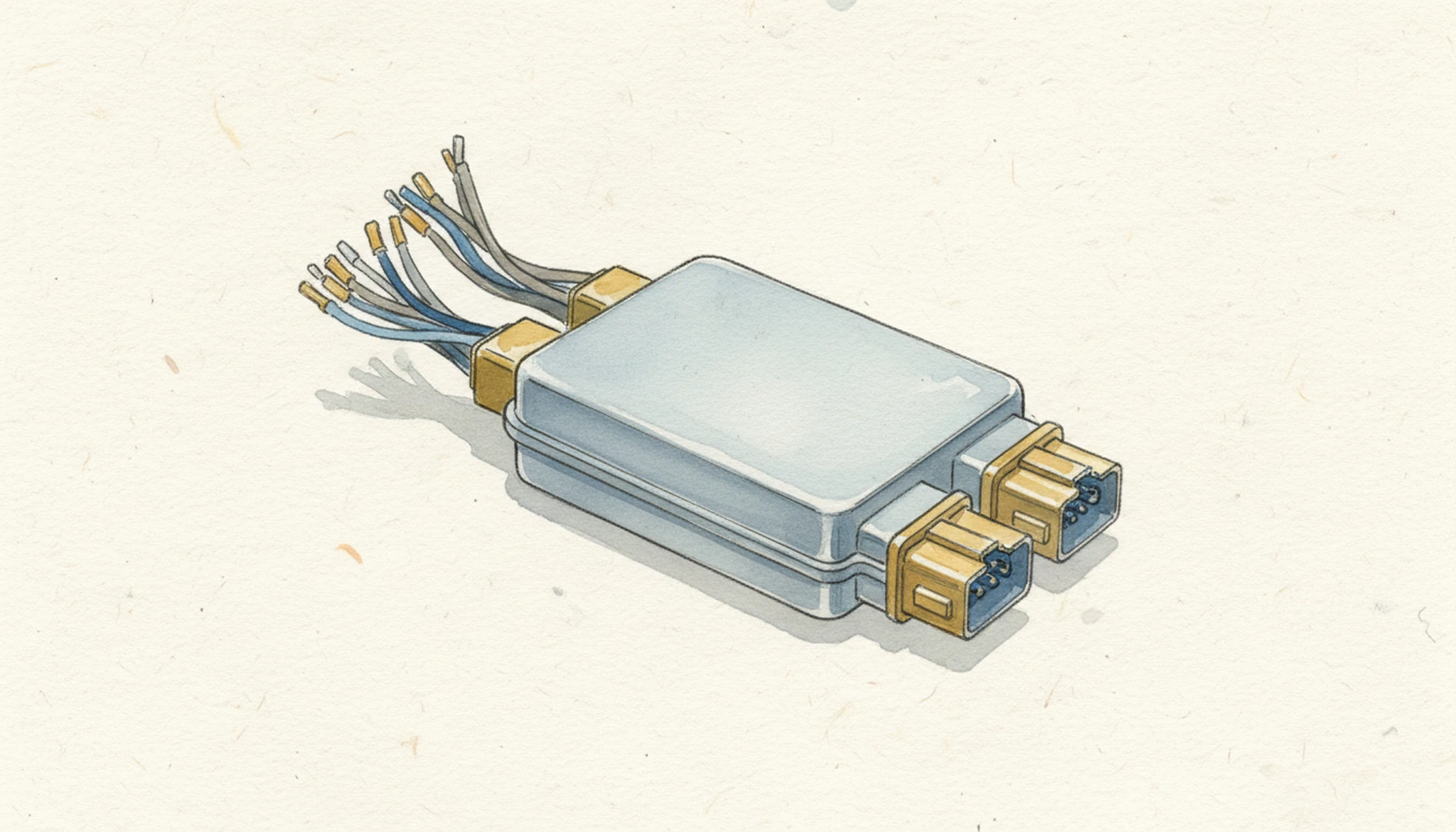
The SRS control module is central to the investigation. It receives crash-sensor inputs, processes the crash pulse, stores certain diagnostic information, and controls deployment commands.
An inspection may look for:
- Stored diagnostic trouble codes.
- Evidence of prior deployment or reset.
- Module replacement history.
- Incompatible or non-OEM replacement components.
- Damaged wiring, connectors, or sensors.
- Signs that the SRS warning light was active before the crash.
If a body shop resets codes, replaces components, repairs wiring, or scans the system before a forensic inspection, important context can be lost.
3. Crash Reconstruction
Crash reconstruction connects the vehicle damage, scene evidence, EDR data, and crash geometry. The central question is whether the crash forces at the vehicle structure reached the deployment threshold for the relevant airbag system.
That analysis may include:
- Crush measurements.
- Impact angle and overlap.
- Roadway evidence, debris, and gouge marks.
- Occupant position and belt use.
- Delta-V and crash pulse analysis.
- Comparison to manufacturer deployment criteria.
Without this comparison, a non-deployment claim can become speculation.
Common Mistakes That Can Hurt an Airbag Failure Claim
The most damaging mistakes usually happen before anyone realizes the vehicle is evidence.
Avoid these if you suspect airbag non-deployment was a defect:
- Letting the insurer move the vehicle to salvage without a preservation demand.
- Authorizing repairs before the SRS system is inspected.
- Allowing a body shop to reset warning lights or clear diagnostic codes.
- Driving the vehicle after a non-deployment crash when storage is possible.
- Throwing away the seat belt, child seat, airbag covers, or damaged interior components.
- Relying only on photos instead of preserving the physical vehicle.
- Assuming the absence of deployment proves the manufacturer did something wrong.
A written preservation notice should identify the entire vehicle, EDR, SRS module, sensors, wiring, inflators, seat belts, and related diagnostic data as evidence.
Who May Be Responsible?
The responsible party depends on what caused the non-deployment. Potential defendants may include:
- The vehicle manufacturer, if the system design or vehicle-level integration was defective.
- The airbag or component supplier, if a sensor, module, inflator, or other component was defective.
- A body shop or repair provider, if prior repairs damaged or disabled the SRS system.
- A seller or installer of replacement parts, if a counterfeit, missing, incompatible, or nonfunctional part was installed.
- The driver who caused the crash, for the underlying collision, even if that driver did not cause the airbag defect.
Some cases involve both a crash-negligence claim and a product-liability claim. For example, another driver may have caused the collision, while a defective airbag system may have made the injuries worse.
Oregon Deadlines and Fault Rules
Product-Liability Limitation Period
Oregon’s product-liability statute of limitations is generally two years from when the plaintiff discovers, or reasonably should have discovered, the injury and its causal connection to the product. That discovery-rule issue can be fact-specific in airbag cases because a person may know they were injured immediately, but may not know the non-deployment was potentially defective until later inspection or expert review.
Statute of Repose
Oregon also has a product-liability statute of repose. Under ORS 30.905(2), a product-liability civil action generally must be commenced before the later of 10 years after the product was first purchased for use or consumption, or the expiration of any statute of repose in the state where the product was manufactured or imported.
The Oregon Supreme Court’s decision in Miller v. Ford Motor Co., 363 Or. 105 (2018), is important for older vehicles because Oregon’s “look-away” provision may point to the manufacturing state’s repose law. If that state has no applicable product-liability statute of repose, Oregon’s 10-year repose may not bar the claim.
Wrongful Death Claims
If a non-deployment case involves wrongful death, ORS 30.905 has separate timing rules. Those cases require prompt review because multiple deadlines may apply.
Comparative Fault
Oregon follows modified comparative fault under ORS 31.600. A claimant can recover if their fault is not greater than the combined fault of the other parties, but damages are reduced by the claimant’s percentage of fault. If the claimant is more than 50 percent at fault, recovery is barred.
In an airbag non-deployment case, comparative-fault arguments may focus on seatbelt use, occupant position, prior known SRS problems, vehicle modifications, or whether the claimant continued using a vehicle with an active airbag warning light.
Federal Airbag Rules and Preemption
Federal Motor Vehicle Safety Standard No. 208, codified at 49 CFR Section 571.208, sets performance requirements for occupant crash protection. It does not publish one universal deployment number for all vehicles and all crash types.
Federal law can affect airbag lawsuits, but the preemption issue is narrower than many people assume. In Geier v. American Honda Motor Co., the U.S. Supreme Court held that a state tort claim based on a manufacturer’s failure to install airbags was preempted because the federal standard intentionally allowed manufacturers to choose among passive-restraint options at that time.
An airbag non-deployment claim is different. It usually argues that an installed airbag system failed to function as designed, or that the vehicle contained a defective SRS component. Williamson v. Mazda Motor of America, Inc. later narrowed the reach of Geier and confirmed that compliance with a federal standard does not automatically eliminate every state tort claim.
The practical takeaway: federal standards matter, but they do not automatically end an Oregon claim involving an installed airbag system that allegedly failed to work.
Airbag Recall Checks: Useful, but Not the Whole Case
Always check the VIN for open recalls. A recall can point investigators toward known airbag, SRS, module, sensor, or inflator problems.
The Takata airbag recall is the largest auto safety recall in U.S. history. As of April 2025, CARFAX reported that about 5.7 million vehicles still had unrepaired Takata airbags, and NHTSA continues to track deaths and injuries linked to defective Takata inflators.
But a Takata recall does not automatically prove a non-deployment claim. Many Takata issues involve dangerous inflator rupture during deployment rather than failure to deploy. Recall history is a lead, not the final answer.
How Lawyers and Experts Usually Evaluate These Claims
A serious airbag non-deployment review usually follows a sequence:
- Identify the vehicle, trim, model year, VIN, and airbag systems installed.
- Preserve the full vehicle and all SRS components.
- Download EDR data with appropriate authorization.
- Inspect the SRS module, sensors, inflators, seat belts, warning lights, and wiring.
- Collect repair history, recall history, prior crash records, and body-shop invoices.
- Reconstruct the crash forces and impact direction.
- Compare the crash forces with deployment criteria for the specific vehicle.
- Determine whether non-deployment caused or worsened injury.
- Identify all potentially responsible parties.
This is why early preservation matters. If the vehicle is gone, repaired, or reset, the analysis may become much harder.
Frequently Asked Questions
If my airbag did not deploy, does that automatically mean it was defective?
No. Airbags deploy based on crash force, direction, sensor input, seatbelt status, and vehicle-specific calibration. A qualified reconstruction or automotive-forensics analysis is usually needed to determine whether the system should have deployed.
What evidence matters most in an Oregon airbag failed-to-deploy claim?
The most important evidence is usually the vehicle itself, the EDR data, the SRS control module, crash-sensor and wiring condition, fault codes, repair history, recall history, and crash reconstruction evidence.
Can EDR data be overwritten?
Yes, some non-deployment event data can be overwritten or compromised depending on the vehicle, later events, module activity, and repair steps. Deployment events are treated differently under federal EDR rules. The safest course is to preserve the vehicle and arrange a proper download before repairs or resets.
How long do I have to bring an Oregon product-liability claim?
Oregon product-liability claims generally have a two-year discovery-based limitation period under ORS 30.905(1), plus a statute of repose under ORS 30.905(2). Older vehicles and manufacturing-state issues can make the repose analysis more complicated.
Can I still bring a claim if another driver caused the crash?
Potentially, yes. Another driver may be responsible for causing the crash, while a defective airbag system may be responsible for making the injuries worse. Those are different theories and may involve different defendants.
What if the car has already been totaled or sent to salvage?
Act quickly. A written preservation demand may be needed to stop sale, dismantling, repair, scanning, or destruction. If the vehicle is already gone, photos, estimates, tow records, insurer records, repair invoices, and any prior diagnostic data may still help, but the case can be harder.
Who can be sued for airbag non-deployment?
Depending on the facts, potentially responsible parties may include the vehicle manufacturer, airbag supplier, component manufacturer, repair shop, replacement-parts seller or installer, and the driver who caused the crash.
This article is for general educational information only and does not constitute legal advice. Airbag non-deployment, product-liability, and crash-reconstruction issues are highly fact-specific. If you were injured in an Oregon crash where an airbag may have failed to deploy, consult an Oregon attorney about your specific facts.
Sources and Further Reading
- NHTSA, “Occupant Crash Protection” (FMVSS 208 informational page), https://crashstats.nhtsa.dot.gov/Api/Public/Publication/809442
- 49 CFR Part 563, “Event Data Recorders,” https://www.ecfr.gov/current/title-49/subtitle-B/chapter-V/part-563
- 49 CFR Section 571.208, “Standard No. 208: Occupant Crash Protection,” https://www.ecfr.gov/current/title-49/subtitle-B/chapter-V/part-571/subpart-B/group-571.208
- Oregon Revised Statutes 30.905 (Statute of limitations and repose for product-liability actions), https://www.oregonlaws.org/statutes/ors_30.905
- Oregon Revised Statutes 30.920 (When seller or lessor of product is liable), https://www.oregonlegislature.gov/bills_laws/ors/ors030.html
- Oregon Revised Statutes 31.600 (Comparative fault), https://www.oregonlegislature.gov/bills_laws/ors/ors031.html
- Oregon Revised Statutes 105.928, 105.932, and 105.938 (Event Data Recorder ownership, retrieval, and court-order provisions), https://www.oregonlegislature.gov/bills_laws/ors/ors105.html
- Oregon Legislature, SB 256 (2023) - ORS 815.077 (Nonfunctional airbags), https://olis.oregonlegislature.gov/liz/2023R1/Downloads/MeasureDocument/SB0256/Enrolled
- Geier v. American Honda Motor Co., 529 U.S. 861 (2000), https://www.law.cornell.edu/supremecourt/text/529/861
- Williamson v. Mazda Motor of America, Inc., 562 U.S. 323 (2011), https://www.law.cornell.edu/supct/html/98-1811.ZD.html
- CARFAX, “Nearly 750,000 Takata Airbags Replaced in 12 Months,” April 2025, https://www2.prnewswire.com/news-releases/carfax-nearly-750-000-takata-airbags-replaced-in-12-months-5-7-million-vehicles-still-at-risk-302436518.html
- NHTSA, Takata Air Bag Recall Spotlight, https://www.nhtsa.gov/recall-spotlight/takata-air-bags
- Russell v. Ford Motor Co., 281 Or. 587 (1978)
- Miller v. Ford Motor Co., 363 Or. 105 (2018)
Client-First Fee Promise
Client First = Bills First, Fees Second
Your unpaid medical bills do not have to make your lawyer's fee bigger. Johnson Law subtracts qualifying medical bills before calculating our fee, helping clients keep more of their settlement.
Applies to qualifying cases. Results vary.