Bite With No Skin Break: Can You Still Claim Nerve or Soft Tissue Injury?
Bite With No Skin Break: Can You Still Claim Nerve or Soft Tissue Injury?
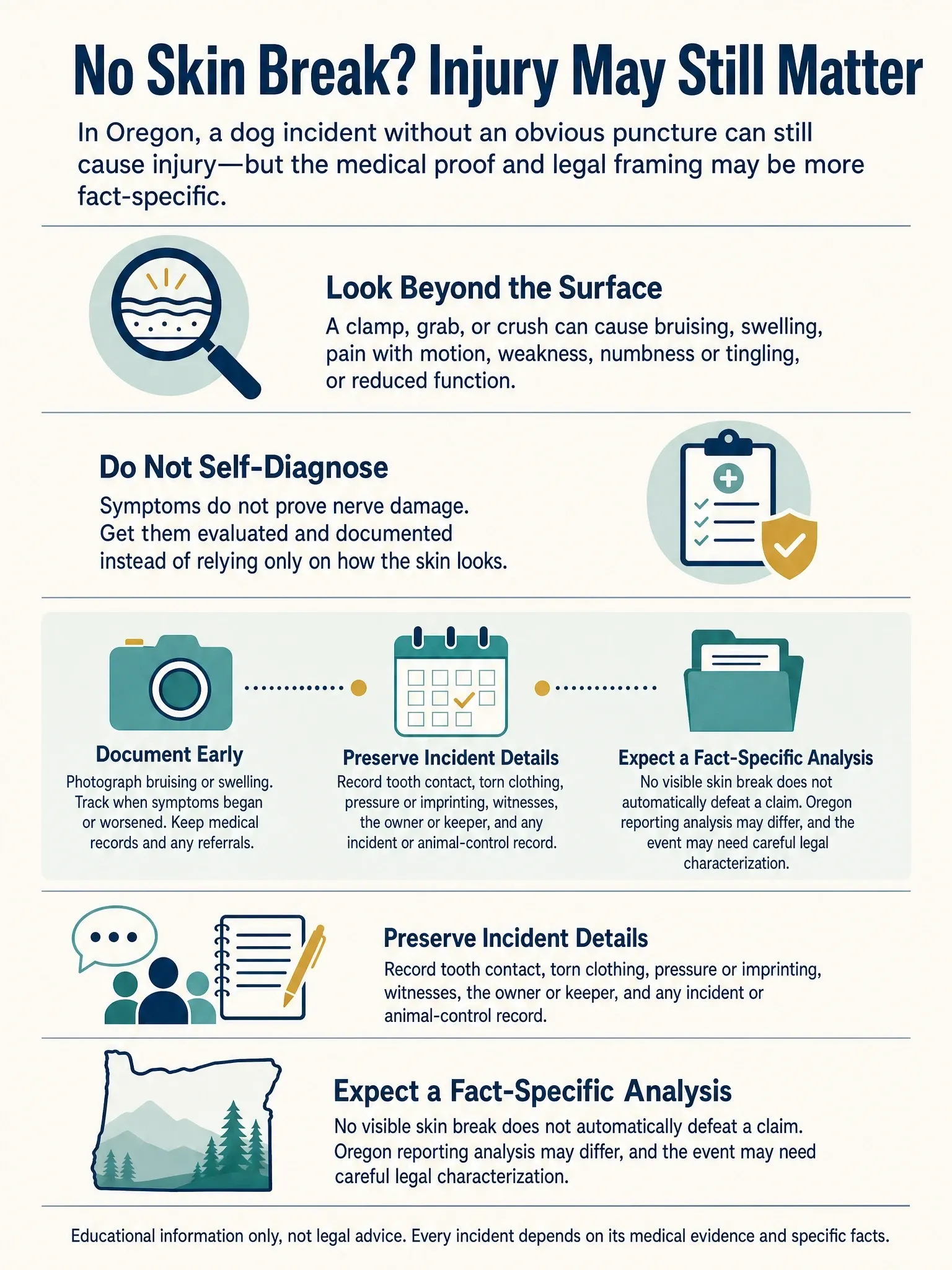
Educational information only, not legal advice. A dog incident can create real injury even when the surface looks minor, but the medical and legal proof often becomes more fact-specific when there is no obvious puncture.
Quick Answer
Sometimes, yes. A dog incident can still cause a real injury even if the skin does not obviously break.
But these cases are usually harder than a classic puncture-wound dog-bite claim because you may have to prove two separate things very clearly:
- that a real physical injury happened, and
- how that injury should be legally characterized.
In other words, “no blood” does not always mean “no case,” but it often means more proof work.
For the broader Oregon dog-bite liability framework, start with our main dog-bite article. For the wider claim overview, see our dog bites practice-area page.
1) Why Surface Appearance Can Be Misleading
Medical literature on bite wounds warns that an injury can look limited on the surface while deeper tissue is affected underneath.
That is especially true when a dog clamps, grabs, or crushes tissue without leaving a dramatic visible puncture.
The deeper injury can involve:
- bruising,
- crush injury,
- tissue devitalization,
- tendon irritation,
- nerve symptoms,
- or reduced hand or finger function.
So if your arm, hand, calf, or thigh hurts far more than the skin suggests, that is not automatically inconsistent with how bite trauma works.
2) What “No Skin Break” Usually Changes Medically
The Oregon Health Authority’s rabies and animal-bite guidance requires reporting when a bite breaks the skin. When the skin is intact, the public-health analysis focuses more on whether there was saliva exposure to broken skin or mucous membranes and on the rest of the exposure facts.
That means a no-skin-break event can raise a different public-health analysis than a classic puncture bite.
It can also change how people respond emotionally. They often think:
- “Maybe it was not really a bite.”
- “Maybe I do not need records.”
- “Maybe I should wait and see.”
That delay is one of the biggest practical problems in these claims.
3) What Kinds of Injury Can Still Matter
Even when the skin is intact or only minimally marked, the incident may still leave a meaningful record of injury.
Examples include:
- swelling,
- a hematoma or deep bruise,
- hand weakness,
- numbness or tingling,
- reduced grip strength,
- pain with motion,
- limited range of motion,
- or a fall-related injury while avoiding or pulling away from the dog.
Published upper-extremity dog-bite literature also shows that nerve, tendon, and vascular injuries can occur in some cases, especially when the physical exam shows neurovascular abnormalities.
That does not mean every painful bruise involves nerve damage. It does mean that symptoms should be documented and examined instead of brushed aside because the skin “looks okay.”
4) Why Legal Proof Gets Harder
These claims often become harder because the defense may argue one or more of the following:
- there was no true bite,
- there was no meaningful injury,
- the symptoms are delayed or unrelated,
- the event caused only temporary soreness,
- or there is no objective proof of deeper damage.
That is why prompt medical documentation matters so much.
When a clinician documents:
- bruising pattern,
- tenderness,
- weakness,
- numbness,
- range-of-motion limits,
- or referral-worthy symptoms,
the claim is usually easier to assess than when the record begins weeks later.
5) How Oregon Law Fits Into This
ORS 31.360 is important in qualifying Oregon claims for economic damages arising from injury caused by dog.
But when there is no visible skin break, one issue may be how the event is legally framed.
Depending on the facts, people may disagree about whether the incident is best described as:
- a bite,
- a crush injury,
- a grab or clamp,
- or another negligent dog-control event.
That does not necessarily defeat the claim. It does mean the legal theory may need more careful analysis. In some cases, negligence and dangerous-propensity issues may matter more than a simple “dog bite statute” shorthand.
6) Reporting Rules Can Look Different Too
If the skin was broken, Oregon reporting rules are straightforward: see ORS 433.345.
If the skin was not broken, the public-health and exposure analysis can look different. That is one reason it helps to describe the incident precisely instead of using broad labels.
Useful details include:
- whether teeth made contact,
- whether clothing was torn,
- whether there was pressure, bruising, or imprinting,
- whether there was saliva exposure to any open skin,
- and whether symptoms worsened in the hours after the event.
7) What Evidence Usually Matters Most
These cases often depend heavily on detailed medical and incident documentation.
Try to preserve:
- early photos of bruising or swelling,
- a timeline of numbness, tingling, weakness, or worsening pain,
- urgent care or ER records,
- orthopedic, hand, or neurology referrals if any,
- witness statements,
- the identity of the dog’s owner or keeper,
- and any incident or animal-control record.
If the injury is in the hand or forearm, documenting grip weakness, loss of sensation, or reduced dexterity early can be especially important.
8) What People Should Not Do
Avoid two common mistakes.
Do not assume intact skin means no injury
If the symptoms are real, get evaluated.
Do not overstate the medical issue
You do not need to self-diagnose a nerve injury. It is enough to preserve the symptoms and get appropriate medical documentation.
9) A Practical Oregon View
The practical question is usually not, “Can I win a claim with zero visible puncture?”
The practical question is:
Can I show a real dog-caused injury with clear medical proof and a legally coherent theory?
Sometimes the answer is yes. Sometimes the no-skin-break issue makes the claim too weak or too disputed. But undocumented symptoms are usually harder to assess later.
If you need local context, our Portland dog bite lawyer page covers Portland-area claim issues as well.
Bottom Line
A dog incident can still cause bruising, soft-tissue damage, or even nerve-related symptoms without an obvious puncture wound.
In Oregon, those cases are often more technical because:
- medical proof matters more,
- reporting analysis may differ,
- and the legal theory may need more careful framing.
So the right reaction is usually not to ignore the injury. It is to document it carefully and evaluate the facts honestly.
FAQ
Can a dog injury bruise or pinch a nerve without breaking the skin?
Potentially, yes. Bite and clamp injuries can create deeper soft-tissue trauma even when the surface looks limited.
Do I still need medical care if there was no puncture?
If you have swelling, weakness, numbness, worsening pain, or reduced motion, it may make sense to seek prompt medical evaluation.
Does Oregon’s animal-bite reporting rule still apply if the skin was not broken?
The analysis can be different when there is no skin break. If the skin was broken, see ORS 433.345.
Does no skin break automatically mean there is no legal claim?
No. But it often makes the proof more disputed and more dependent on medical documentation and the exact facts.
Sources
Client-First Fee Promise
Client First = Bills First, Fees Second
Your unpaid medical bills do not have to make your lawyer's fee bigger. Johnson Law subtracts qualifying medical bills before calculating our fee, helping clients keep more of their settlement.
Applies to qualifying cases. Results vary.