What If My Car Had Old Damage Before an Oregon Crash?
What If My Car Had Old Damage Before an Oregon Crash?
If your car already had dents, scratches, prior repairs, or unrepaired damage before a crash, that does not automatically defeat your Oregon claim. But it can make the property-damage part of the claim harder to prove.
The key question is usually not whether the car was perfect before the crash. The question is what changed because of this collision. Old vehicle damage can create disputes about repair scope, vehicle value, causation, betterment or depreciation, and credibility. Good documentation can make those disputes easier to evaluate and respond to.
This article focuses on Oregon and Portland-area crash claims involving pre-existing vehicle damage. It is educational information only, not legal advice for any specific claim.
Short Answer: Old Damage Does Not Automatically Ruin the Claim
An insurer may ask whether a dent, broken light, bumper scrape, alignment issue, or prior repair was already there before the crash. That is a fair claim question. It does not mean the insurer can simply ignore new crash damage.
In practical terms, old damage may affect:
- What repairs are reasonably tied to this crash
- What the vehicle was worth before the crash
- Whether the repair estimate includes betterment, depreciation, or unrelated damage
- Whether the records tell a consistent story
If the dispute later becomes a legal claim, evidence matters. Oregon jury-instruction law describes contradictory civil evidence in terms of a preponderance of the evidence. For most drivers, the useful takeaway is simpler: save the records that help show the car’s before-and-after condition.
Why Old Damage Matters to an Insurer
Old damage often matters because it affects the insurer’s view of what the crash actually caused. That can show up in several ways.
Repair scope: what damage was actually caused by this crash?
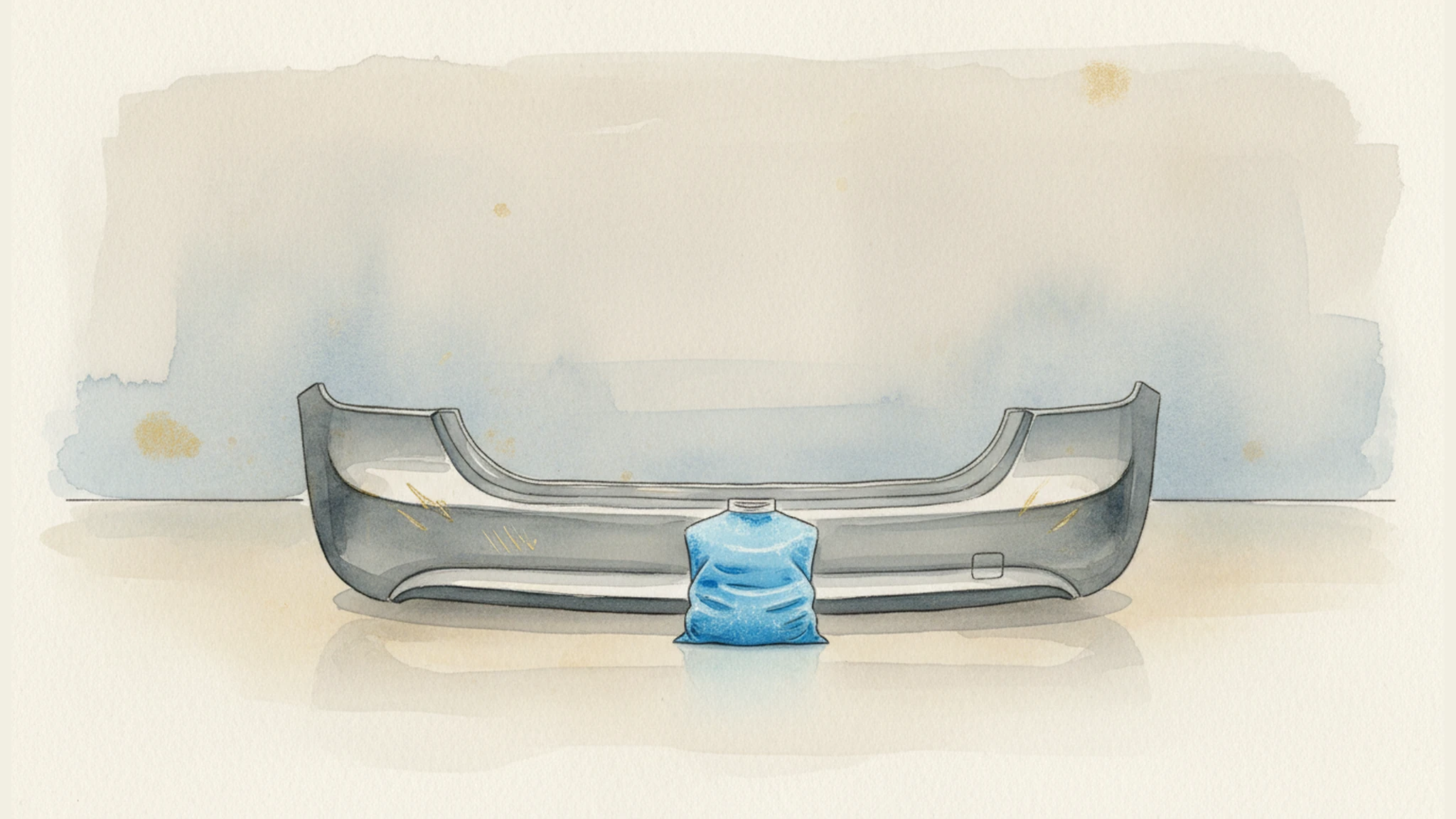
If the rear bumper already had a scratch but the crash cracked the bumper cover and damaged the reinforcement underneath, the insurer may try to separate the old cosmetic damage from the new structural or repair-related damage. If a fender was previously repaired, the adjuster may ask whether new paint or panel alignment problems came from the crash or the prior repair.
That does not make the claim invalid. It means evidence distinguishing old from new damage may become important.
Vehicle value: how prior condition can affect what the car was worth
Pre-crash condition can affect vehicle value. Oregon’s required Vehicle Total Loss Notice identifies factors such as body, paint, tires, glass, interior, mechanical condition, and prior unrelated damage as things that may affect pre-loss value. Oregon DFR’s totaled-vehicle guidance also explains that the owner is generally owed what the vehicle could have sold for before the accident.
This does not turn every old-damage dispute into a total-loss claim. It simply explains why prior unrelated damage can matter when the insurer is valuing the vehicle or evaluating the reasonableness of repairs. For the broader framework, see why total-loss and injury claims follow separate tracks.
Credibility: why inconsistent records can create avoidable disputes
Old damage can also become a credibility issue. For example, a post-crash photo that shows multiple damaged panels may not explain which dents were old and which happened in the crash. If repair records, photos, and the driver’s description do not line up, the insurer may question more than the vehicle-damage claim.
The goal is not to hide old damage. The goal is to document it accurately and separate it from what the crash newly caused. If the insurer is using vehicle damage to challenge your broader injury claim, Johnson Law’s related guide explains what to do when the insurance company says you are exaggerating.
Old Damage vs. New Damage: What Evidence Helps Separate Them
When a car had pre-existing damage, the most helpful evidence usually shows the vehicle before the crash, immediately after the crash, and during inspection or repair.
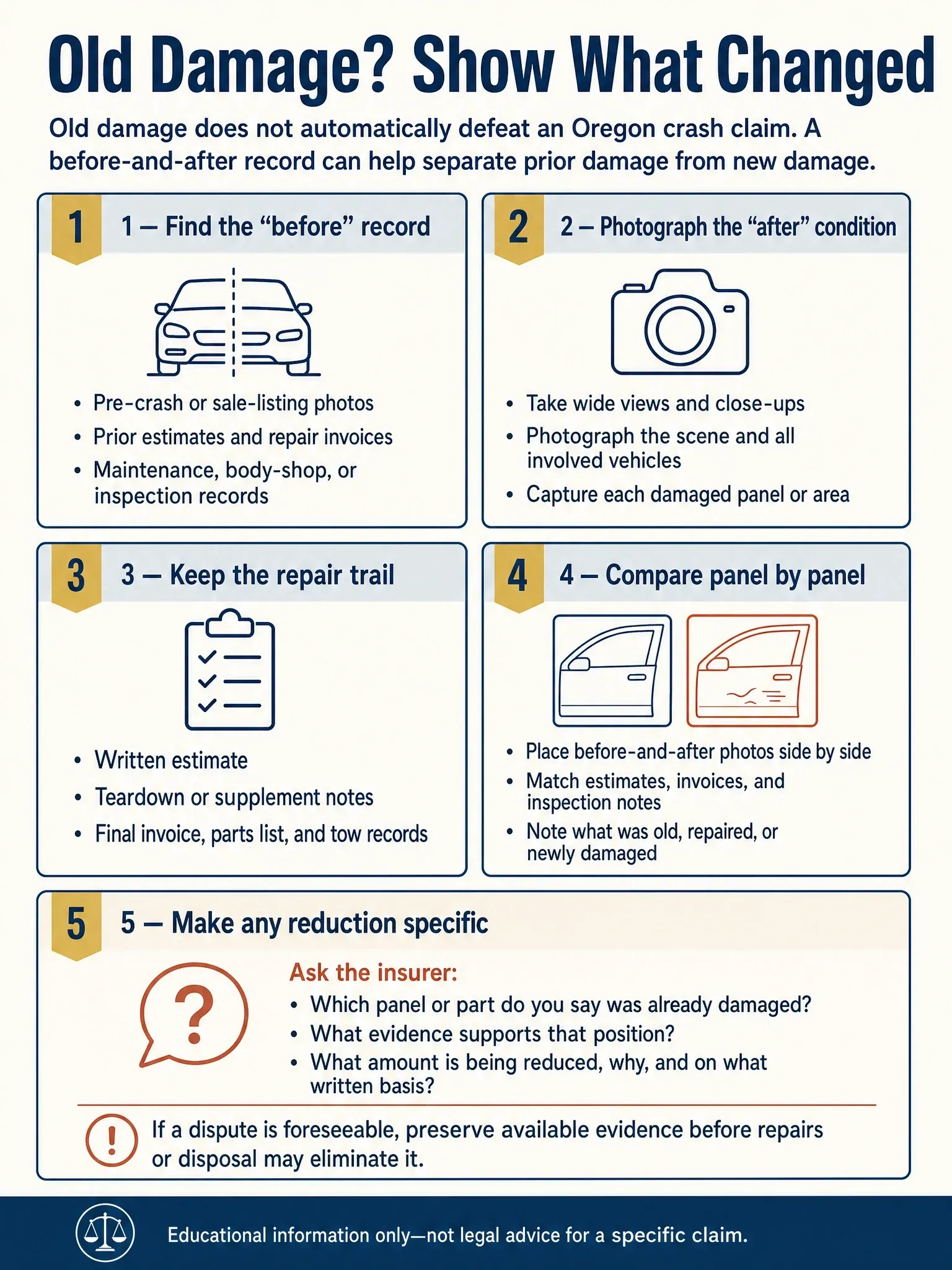
Pre-crash evidence to look for
You may already have useful proof even if you did not take formal “before” photos. Look for:
- Prior repair invoices
- Prior repair estimates
- Maintenance or body-shop records
- Photos from a vehicle sale listing
- Inspection photos
- Driveway, parking-lot, or street-parking photos that show the same side of the car
- Photos from trips, errands, or work sites where the vehicle appears in the background
- Any documents showing prior damage was repaired before the new crash
Portland drivers often deal with old bumper scrapes, street-parking dents, cracked plastic trim, or prior parking-lot damage. Those details are not legal rules, but they are practical examples of why before-and-after documentation matters.
Post-crash evidence to create quickly
Oregon DFR advises drivers after an accident to take pictures of the accident scene and damage to all vehicles involved. When old damage is part of the picture, take both close-up and wide photos. Close-ups show the damage details; wide photos show where the damage sits on the vehicle. Johnson Law’s photo checklist covers photos people often forget after a crash.
Useful post-crash records may include:
- Scene photos
- Photos of all vehicles involved
- Close-ups and wide shots of each damaged area
- Tow records
- Written repair estimates
- Teardown or supplemental repair notes
- Invoices showing work performed and parts supplied
- A short timeline of what damage already existed and what appeared after the crash
If you submit an Oregon online collision report, DMV has advised users to download or print the report for their records because it may not be viewable after submission. Keep a copy with your crash file.
Witness and driver information
Oregon DFR also advises drivers to collect the other driver’s name, address, phone number, vehicle license number, driver license number, insurance company name, insurer phone number, and witness names and phone numbers. Witness information can matter if the insurer disputes how the impact occurred or whether a certain area of damage fits the crash.
Repair Estimates and Shop Records Can Clarify the Dispute
Repair records are often central in an old-damage dispute. They can help identify what the shop saw, what repairs were recommended, and what work was actually performed.
Ask for a written estimate before repairs when appropriate
Oregon repair-shop law provides that, upon a customer’s request, a motor vehicle body and frame repair shop must make a written estimate of parts and labor before starting repair work and may not charge beyond the estimate without the customer’s consent.
A written estimate can help frame the dispute, especially if it identifies crash-related repairs separately from prior or unrelated issues. But an estimate is still evidence, not conclusive proof. An insurer may ask for photographs, inspection, prior records, or supplemental review.
Keep invoices that describe work and parts
Oregon law also requires work done by a motor vehicle body and frame repair shop to be recorded on an invoice describing service work and parts supplied. One copy goes to the customer, and one is retained by the shop.
Keep the invoice, estimate, photos, and any supplement together. If the insurer later argues that part of the damage was pre-existing, those records may help show what the shop actually repaired and why.
Understand that estimates may change after inspection or teardown
Some vehicle damage is not fully visible at the first inspection. A supplement after teardown does not automatically mean the shop or driver is exaggerating; it may mean additional damage was found. At the same time, supplements can become disputed if the insurer thinks they include unrelated repairs.
That is why photos, notes, and part-by-part documentation matter.
You Generally Do Not Have to Use the Insurer’s Preferred Repair Shop
Oregon law prohibits an insurer from requiring a person to use a particular motor vehicle repair shop. Oregon DFR also tells consumers that they do not have to use the repair shop the insurance company recommends.
There is an important practical caution: DFR warns that if you choose a more expensive shop, the insurer may not be willing to pay the whole amount. Choosing your own shop may help you feel more comfortable with the inspection, but it does not guarantee the insurer will accept every charge.
If the old-versus-new damage issue is significant, ask the shop to document what it sees clearly. Avoid vague descriptions like “rear damage” when a more specific note could separate old scratches from new impact damage.
Betterment, Depreciation, and Prior-Damage Reductions Should Be Specific
Sometimes an insurer reduces a vehicle-damage claim because of betterment, depreciation, wear, or prior unrelated damage. A reduction is not automatically improper, but it should not be a mystery.
Oregon insurance regulations provide that when claimed automobile damage is reduced because of betterment or depreciation, the information used as the basis for the reduction must be in the insurer’s claim file, and the deductions must be itemized, specified as to dollar amount, and appropriate for the amount of betterment or depreciation. That rule appears within Oregon’s automobile total-loss settlement regulations, so it should be used carefully and within its context. Still, it supports a practical point: if a reduction is being made, ask for the specific basis.
Useful questions include:
- What specific damage are you saying was pre-existing?
- What photos, records, or inspection notes support that conclusion?
- What dollar amount are you subtracting?
- Is the reduction for betterment, depreciation, prior unrelated damage, or something else?
- Can you provide the written estimate, evaluation, or claim-file basis for that reduction?
You do not need to argue every point immediately. First, find out exactly what the insurer is relying on.
Oregon Reporting and Insurance Notice Still Matter
Old vehicle damage does not erase ordinary post-crash responsibilities. Reporting and notice can still matter.
DMV collision reports
Oregon DMV requires drivers involved in a collision to submit an Oregon Traffic Collision and Insurance Report within 72 hours when certain thresholds are met, including injury or death, damage to the driver’s vehicle over $2,500, damage to any vehicle over $2,500 and any vehicle is towed, or damage to non-vehicle property over $2,500.
DMV also states that a driver still needs to file a required DMV collision report even if law enforcement files a police report. If you cannot file within 72 hours, DMV says to submit the report as soon as possible.
Insurance notice
Oregon DFR advises drivers to contact their insurance company as soon as possible because most policies require prompt notification of a claim. Policy language varies, so avoid assuming that another driver’s insurer, a police report, or a body-shop estimate satisfies your own policy duties.
Investigation timing
DFR states that an insurance company has up to 45 days to investigate an accident to determine who is responsible for what share of damages. That does not mean every claim must resolve in 45 days, and it does not eliminate other deadlines that may apply based on the facts, policy, defendant, or claim type.
Property Damage Is Separate From Injury Evidence
Old dents and scratches usually affect vehicle-damage questions first. They do not automatically decide whether someone was injured.
Oregon’s minimum motor vehicle liability schedule separately identifies bodily injury/death coverage and property damage coverage. Oregon PIP benefits are also injury-related benefits. PIP may include items such as medical expenses, income continuation, and essential-services benefits, subject to statutory limits and policy terms. It is not vehicle-repair coverage.
Vehicle damage can still become part of an injury dispute. An insurer may argue that the damage pattern or repair cost does not match the injuries being claimed. But injury causation depends on medical and factual evidence, not simply whether the car had old cosmetic damage. For more on that distinction, see Johnson Law’s resources on responding to the low impact = no injury argument and why the property-damage claim and injury claim follow separate tracks.
What to Do if the Insurer Says the Damage Was Pre-Existing
If the insurer says some or all of the damage was already there, try to slow the dispute down and make it specific.
Ask what specific damage they are calling old
Do not respond only to a broad statement like “this is prior damage.” Ask which panel, part, scratch, dent, alignment issue, or mechanical issue they mean.
Compare records panel by panel
Put the pre-crash photos, post-crash photos, estimate, invoice, and inspection notes side by side. If the dispute involves the front bumper, focus on the front bumper. If it involves the left rear quarter panel, focus there.
This kind of panel-by-panel comparison is often more useful than a general argument that the whole car was damaged in the crash.
Provide missing records if they help
If a prior repair invoice shows that old damage was fixed before the new crash, provide it. If a pre-crash photo shows the panel was undamaged a week before the collision, save and share a copy. If a sale listing photo shows an old dent in a different area, that may help separate unrelated damage from the new loss.
Keep copies of everything you send.
Preserve the evidence while the dispute is active
If a dispute is foreseeable, preserve photos, estimates, invoices, inspection records, and other available documentation. Before discarding damaged parts or authorizing repairs that may eliminate important evidence, consider whether the items may need to be inspected or documented.
Oregon law recognizes that willfully suppressed evidence may be presumed adverse in some circumstances, and Oregon courts have treated lost physical crash evidence as potentially serious in fact-specific litigation. For most readers, the practical lesson is straightforward: save the proof before repairs, disposal, or file cleanup make it unavailable.
Consider whether the dispute is really about property damage, injury, or both
Sometimes the old-damage argument is limited to repair cost. Other times, it becomes part of a broader credibility or injury dispute. If the insurer is using vehicle damage to suggest that you are exaggerating, consider getting individualized guidance before assuming the property-damage dispute controls the injury claim.
When It May Be Worth Getting Legal Guidance
Many old-damage disputes are handled through documentation, estimates, and follow-up with the adjuster. Legal guidance may be worth considering when:
- The property-damage dispute is affecting the injury claim
- The insurer is using old vehicle damage to argue that you are exaggerating
- The repair dispute overlaps with a larger injury settlement
- The claim involves total loss, diminished value, or a disputed first-party physical-damage appraisal process
- The insurer’s reduction is vague or unsupported, and the dollar amount matters
- A deadline, notice rule, government defendant, or policy term may affect the claim
Oregon has a statute addressing certain disputes between an insurer and insured concerning physical-damage coverage when the policy contains an independent-appraisal provision. That kind of appraisal issue is generally a first-party policy matter and should not be assumed to apply to every third-party claim. For more on that separate topic, see Johnson Law’s guide to Oregon appraisal-clause disputes.
If you are trying to decide whether a vehicle-damage dispute changes the value or complexity of your broader claim, Johnson Law’s case-fit hub discusses whether a claim is too small for a personal injury lawyer.
Documents to Gather
When old damage is part of a crash claim, a simple folder can make the dispute easier to evaluate. Consider gathering:
- pre-crash photos or sale-listing photos;
- prior repair estimates, invoices, and maintenance records;
- post-crash scene, tow-yard, and shop photos;
- the written repair estimate and any supplement;
- the final repair invoice and parts list;
- the DMV collision report and insurance correspondence; and
- a short timeline separating old damage, repaired damage, and new crash damage.
FAQ
Can an insurer deny my Oregon crash claim because my car already had damage?
Old damage does not automatically defeat a claim. It can, however, create disputes about what damage was new, what repairs are reasonably related to the crash, and what the vehicle was worth before the crash.
What proof helps show damage was new after the crash?
Helpful proof may include pre-crash photos, prior repair invoices, prior estimates, post-crash photos, written repair estimates, repair invoices, inspection notes, witness information, and a timeline explaining what was already damaged and what changed after the crash.
Do I have to use the insurance company’s repair shop in Oregon?
Generally, no. Oregon law prohibits an insurer from requiring a person to use a particular motor vehicle repair shop. Oregon DFR also says consumers do not have to use the insurer-recommended shop, but warns that choosing a more expensive shop may lead to a dispute about whether the insurer will pay the full amount.
Does PIP pay to repair old or new vehicle damage?
No. Oregon PIP is injury-related coverage. It may include benefits such as medical expenses, income continuation, and essential-services benefits, subject to statute and policy terms. PIP is not coverage for repairing vehicle damage.
If the insurer says part of the repair is betterment or depreciation, what should I ask for?
Ask what specific part of the claim is being reduced, the dollar amount of the reduction, whether the reduction is for betterment, depreciation, prior unrelated damage, or another reason, and what documentation supports it. Keep in mind that the Oregon regulation addressing itemized betterment/depreciation deductions appears in the automobile total-loss settlement rules, so the exact legal analysis can depend on the claim context.
Does old vehicle damage mean my injuries are not valid?
Not by itself. Property damage and injury causation are separate issues. An insurer may try to use vehicle damage in an injury argument, but injury claims depend on medical records, symptoms, mechanism of injury, and other factual evidence.
Sources and Further Reading
- Oregon DMV: Collision Reporting and Responsibilities
- Oregon Division of Financial Regulation: What to do if you are in an accident
- Oregon Division of Financial Regulation: Repair shops
- Oregon Revised Statutes: ORS 746.280, ORS 746.292, ORS 806.070, ORS 742.520, ORS 742.524, ORS 742.466, and ORS 40.135
- Oregon DFR: Vehicle Total Loss Notice
- Oregon Secretary of State: OAR 836-080-0240
- Oregon Court of Appeals: Boden v. Ford Motor Co.
Client-First Fee Promise
Client First = Bills First, Fees Second
Your unpaid medical bills do not have to make your lawyer's fee bigger. Johnson Law subtracts qualifying medical bills before calculating our fee, helping clients keep more of their settlement.
Applies to qualifying cases. Results vary.