
Case Costs vs. Attorney Fees: The Two-Line Item That Confuses Everyone

Case Costs vs. Attorney Fees: The Two-Line Item That Confuses Everyone
Attorney fees and case costs are two different categories. In simple terms, attorney fees pay for legal work. Case costs pay for expenses needed to investigate, prepare, file, or prove the claim.
That distinction matters in an Oregon personal injury case because fees and costs may appear in different places: a written fee agreement, a litigation budget, a settlement statement, or a post-judgment request for costs. Those documents are related, but they are not the same thing.
This article is educational information only and is not legal advice. The written fee agreement and the facts of the case control how fees and costs are handled in a specific matter.
In related guides, Johnson Law explains Oregon contingency-fee agreements, court costs and litigation expense risk, and how a settlement breakdown from gross recovery to final check can include several different line items.
The Short Answer: Fees Pay for Legal Work; Costs Pay for Case Expenses
Oregon court rules draw a useful line between the two categories. Under ORCP 68, “attorney fees” refers to the reasonable value of legal services related to prosecuting or defending an action. The same rule defines “costs and disbursements” as reasonable and necessary expenses other than legal services.
That court-rule language is not a complete description of every private fee agreement. But it gives a helpful framework:
- Attorney fees compensate the lawyer for legal services.
- Case costs reimburse or pay expenses other than the lawyer’s legal work.
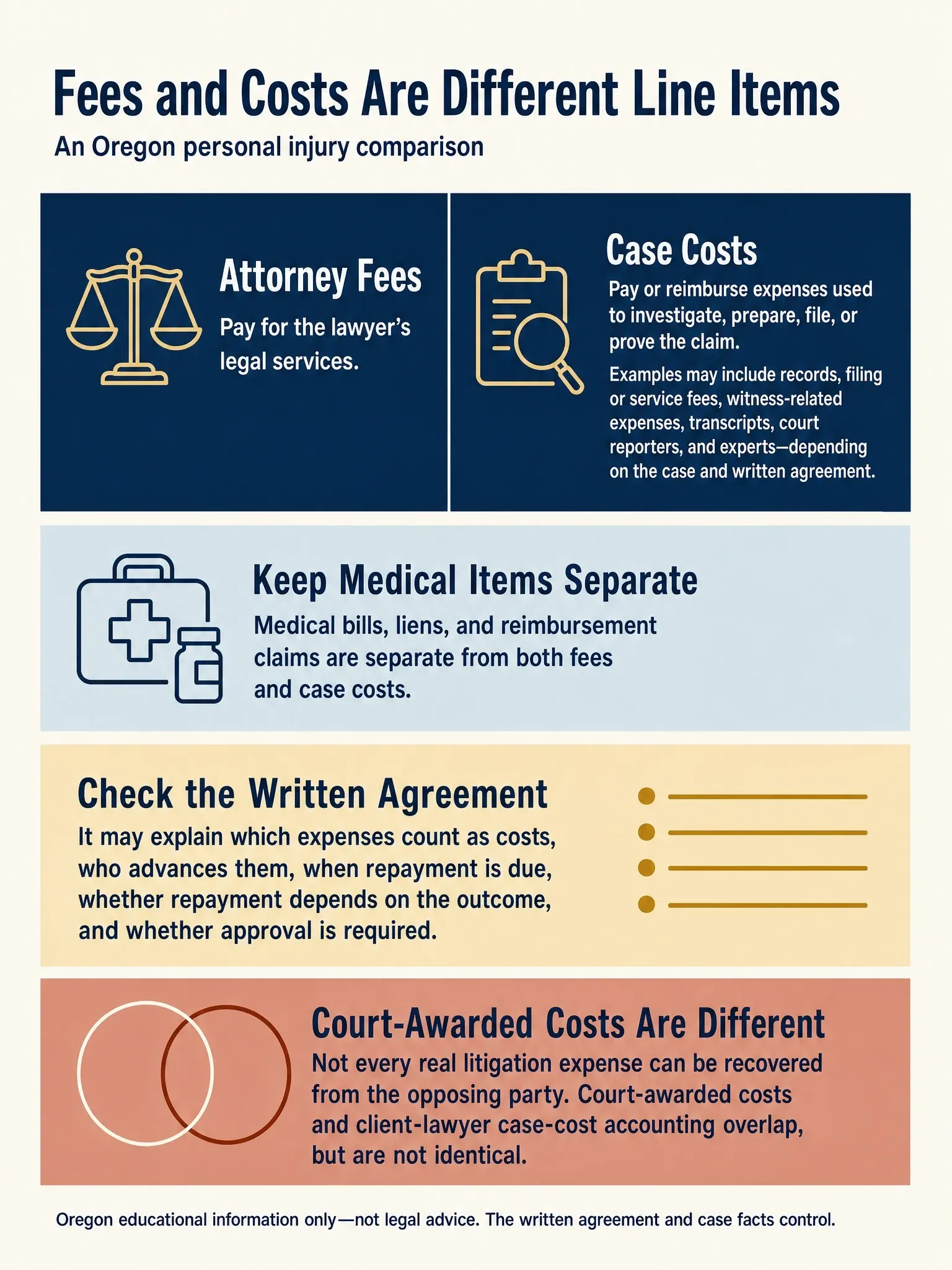
In a personal injury claim, case costs might arise before a lawsuit is filed, during litigation, or after judgment. Some costs are small. Others, especially costs involving depositions, court reporters, medical records, transcripts, or retained experts, can become significant depending on the case.
Why the Difference Matters in a Personal Injury Claim
The fee-versus-cost distinction affects how an injured person reads important documents. A fee agreement may explain the lawyer’s fee, who advances case expenses, when costs must be repaid, and whether certain expenses require client approval. A settlement statement may list attorney fees, case costs, medical bills, liens, reimbursements, and the client’s final net recovery as separate items.
Those categories should not be collapsed into one bucket. In general:
- Attorney fees are payment for legal services.
- Case costs are claim or litigation expenses.
- Medical bills, liens, and reimbursement claims are separate from both attorney fees and case costs.
- Court-awarded fees or costs against another party are a separate legal concept from the accounting between a client and lawyer.
When those categories are mixed together, it becomes harder to understand where the money is going and what the written agreement actually says.
Do Not Confuse Case Costs with Medical Bills or Liens
Medical bills are not attorney fees. They also are not the same thing as litigation expenses such as filing fees or transcript charges.
For example, a hospital bill, a health-insurance reimbursement claim, or another medical lien issue may affect the final settlement accounting. But those items should be treated as a separate category from the lawyer’s fee and from expenses incurred to prepare or litigate the case.
That separation is especially important when reviewing a closing statement. A person may see several deductions or payments listed near each other, but the legal reason for each item can be different.
Common Examples of Case Costs in Oregon Injury Cases
Case costs vary by claim, by stage of the case, and by the written fee agreement. Common examples can include records, reports, filing fees, service fees, witness fees, court reporter charges, transcript costs, and expert-related expenses.
The examples below are not promises that a particular cost will or will not be charged in any specific case. They are categories a claimant may want to understand before signing a fee agreement or approving major litigation expenses.
Records, Reports, and Copies
Personal injury claims often require medical records, billing records, provider reports, and other documentation. Those materials may be needed to evaluate injuries, prove treatment, calculate damages, or respond to an insurer’s questions.
Oregon law allows health care providers or state health plans that receive authorization to disclose protected health information to charge certain copying fees. As of May 2026, ORS 192.563 includes charges such as up to $30 for copying 10 or fewer pages, 50 cents per page for pages 11 through 50, and 25 cents per additional page, plus specified postage and summary or explanation costs.
Those amounts are date-sensitive and may not answer every provider-specific or electronic-record question. The practical point is simpler: getting the records needed to evaluate and prove a claim can create case expenses before anyone ever files a lawsuit.
Filing, Service, Witness, and Transcript Costs
If a case moves into court, additional costs may arise.
Oregon circuit court filing fees for tort and contract cases are tied to the amount claimed. ORS 21.160 lists tiers, including $170 for $10,000 or less, $283 for more than $10,000 and less than $50,000, $594 for $50,000 or more and less than $1 million, $884 for $1 million or more and less than $10 million, and $1,178 for $10 million or more. The Oregon Judicial Department cautions that fee schedules are updated periodically and that the applicable schedule should be checked when a document is filed.
Other court-related costs can include service fees, statutory witness fees, mileage, or transcript charges. Oregon witness fee law generally entitles a civil witness to $30 for each day’s attendance and mileage reimbursement at 25 cents per mile, subject to limits and different rules when a public body is involved. Oregon transcript-fee law also sets rules for transcriber charges, including a statutory per-page limit subject to Judicial Department adjustments.
These examples show why case costs are not the same as attorney fees. The lawyer’s work and the out-of-pocket expenses needed to move the case forward are different line items.
Depositions, Court Reporters, and Experts
Depositions, court reporters, and experts are often a source of confusion because they may be real case expenses even when they are not automatically recoverable from the other side.
ORCP 68 specifically says deposition expenses are not allowed as costs even if the depositions are used at trial, unless a rule or statute provides otherwise. That does not mean deposition-related expenses do not exist. It means the rules for later shifting or taxing those expenses against another party are limited.
Expert-related costs require the same careful treatment. A statutory witness fee is not the same thing as a retained expert’s professional charge for review, consultation, report preparation, deposition time, or testimony. Whether and how expert expenses are approved, advanced, reimbursed, or sought from another party depends on the case, the rules that apply, and the written agreement.
Court-Awarded Costs Are Not the Same as Your Lawyer’s Case-Cost Accounting
A major source of confusion is the phrase “costs and disbursements.” It can refer to taxable costs under court rules, but a lawyer and client may also discuss “case costs” more broadly when accounting for expenses incurred during the claim.
Those concepts overlap, but they are not identical.
Under ORCP 68, costs and disbursements are generally allowed to the prevailing party unless a rule, statute, or court direction says otherwise. But that does not mean “the loser pays everything.” Oregon rules limit which items can be taxed, and some real litigation expenses may not be recoverable from the opposing party.
The client-lawyer accounting question is different. A fee agreement may address who advances costs, when repayment is due, whether repayment depends on the outcome, and whether the client must approve certain expenses before they are incurred. Those are agreement-specific issues and should be reviewed in the written agreement.
When Costs May Be Requested After Judgment
ORCP 68 also includes a post-judgment process for requesting attorney fees or costs and disbursements from another party. In general, a party seeking fees or costs under that rule must file and serve a signed, detailed statement no later than 14 days after entry of judgment.
That deadline and process matter in litigation, but they are not the same as the private fee-agreement question of how a client and lawyer track case expenses during the life of the claim.
What Oregon Requires for Covered Contingent Fee Agreements
Many Oregon personal injury cases use a contingent fee agreement, but the written agreement still matters. Oregon has specific requirements for covered plaintiff contingent fee agreements in bodily injury, death, property damage, emotional injury, and related civil actions.
Under ORS 20.340, a covered plaintiff contingent fee agreement must be written in plain and simple language reasonably believed to be understandable by the plaintiff. The attorney must explain the terms and conditions of the agreement before it is signed, in compliance with a plain-language model explanation prepared by the Oregon State Bar. The agreement also must include a provision allowing the plaintiff to rescind the agreement within 24 hours after signing by written notice to the attorney.
For covered agreements entered on or after September 26, 1987, ORS 20.340 says the agreement is voidable if it does not comply with the statutory requirements. “Voidable” is not the same as saying every noncompliant agreement is automatically void in every circumstance, but it is an important Oregon protection.
Fee Reasonableness and Expense Reasonableness
Oregon’s professional conduct rules also address fees and expenses. Oregon RPC 1.5(a) prohibits a lawyer from entering into an agreement for, charging, or collecting an illegal or clearly excessive fee or a clearly excessive amount for expenses. RPC 1.5(b) includes whether a fee is fixed or contingent among the factors considered when assessing whether a fee is clearly excessive.
This article does not attempt to state a normal fee percentage or create a fee-reasonableness test. The safer takeaway is that both fees and expenses should be addressed clearly, and the written agreement should be understandable before the client signs.
Oregon State Bar guidance also describes Oregon RPC 1.8(e) as allowing lawyers to advance litigation costs and expenses and to make repayment of those costs and expenses contingent on the outcome of the case. That does not mean every lawyer handles costs the same way, or that every cost is waived in every case. The written agreement controls the case-specific terms.
Questions to Ask Before You Sign or Settle
If you are reviewing a fee agreement or settlement statement, ask direct questions about categories. Practical questions include:
- Which expenses count as case costs under the written agreement?
- Will the lawyer advance costs, and if so, when must they be repaid?
- What happens to case costs if there is no recovery?
- Are costs deducted before or after the contingency fee is calculated?
- Are medical bills, liens, and reimbursement claims handled separately from attorney fees and case costs?
- Will the client be asked to approve larger expenses before they are incurred?
- Are deposition, court reporter, transcript, or expert expenses treated differently from routine record-copying costs?
- If a judgment is entered, which costs may be requested from the opposing party and which expenses may remain the client-lawyer accounting responsibility?
Those questions are not a substitute for legal advice. They are a way to make sure the conversation is specific enough to be useful.
Bottom Line for Oregon Injury Claimants
The simplest distinction is still the most useful one: attorney fees pay for legal services, while case costs pay for expenses other than legal services.
In an Oregon personal injury case, that distinction can affect how you read a fee agreement, how you understand a settlement statement, and how you evaluate the cost of litigation decisions. It also helps separate private fee-agreement accounting from court-awarded costs after judgment.
Before signing a contingent fee agreement or approving major litigation expenses, ask for a plain explanation of how fees, costs, medical bills, liens, and reimbursements are handled. Oregon law requires covered plaintiff contingent fee agreements to use plain and simple language and to include specific protections, but the written agreement remains the starting point for the case-specific answer.
FAQ
Are case costs the same as attorney fees in Oregon personal injury cases?
No. Attorney fees generally pay for legal services. Case costs are expenses other than legal services, such as records, filing fees, transcripts, court reporter charges, or witness-related expenses, depending on the case and written agreement.
Does the insurance company automatically pay my attorney fees?
No. Fee-shifting depends on a statute, rule, contract, or other legal basis. An injured person should not assume that an insurer or defendant will automatically pay the claimant’s attorney fees.
Are deposition costs recoverable from the other side in Oregon?
Not automatically. ORCP 68 says deposition expenses are not allowed as costs even if depositions are used at trial, unless another rule or statute provides otherwise. They may still be real case expenses even when they are not taxable against the opposing party.
Can an Oregon lawyer advance case costs in a personal injury case?
Oregon State Bar guidance describes Oregon RPC 1.8(e) as allowing lawyers to advance litigation costs and expenses and to make repayment contingent on the outcome. The written fee agreement controls the client’s case-specific terms.
What should I look for in a contingent fee agreement?
Look for plain-language terms explaining the attorney fee, which expenses count as case costs, who advances those costs, when costs are repaid, whether repayment depends on recovery, whether larger expenses require approval, and how medical bills or liens are handled separately. For covered Oregon plaintiff contingent fee agreements, also look for the 24-hour rescission provision required by ORS 20.340.
Are medical bills part of case costs?
Medical bills, liens, and reimbursement claims should be treated as a separate category from attorney fees and litigation expenses. They may appear on the same settlement statement, but they are not the same line item.
For medical bills and repayment claims, see the separate guide to medical bills, liens, and subrogation in Oregon injury settlements.
Sources
- ORCP 68 A(1) and A(2): definitions of attorney fees and costs/disbursements, examples of taxable costs, and the deposition-expense limitation.
- ORCP 68 B and C(4)(a): prevailing-party costs/disbursements framework and the general 14-day post-judgment detailed-statement process.
- ORS 20.340: Oregon requirements for covered plaintiff contingent fee agreements, including plain/simple language, attorney explanation, 24-hour rescission, and voidable-if-noncompliant language.
- Oregon RPC 1.5: prohibition on illegal or clearly excessive fees and clearly excessive expenses; contingent-fee factor in fee reasonableness analysis.
- Oregon State Bar guidance on Oregon RPC 1.8(e): discussion of advancing litigation costs and outcome-contingent repayment.
- ORS 192.563: Oregon health care provider and state health plan copying-charge rules.
- ORS 21.160 and Oregon Judicial Department fee schedules page: Oregon tort/contract filing-fee examples and current-schedule caveat.
- ORS 21.345: Oregon transcript-fee rules.
- ORS 44.415: Oregon civil witness attendance and mileage fee rules.
Disclaimer: This article provides general educational information about Oregon personal injury fee and cost categories. It is not legal advice and does not create an attorney-client relationship. Fee and cost obligations depend on the written agreement, the facts of the case, and the law that applies at the time.
Client-First Fee Promise
Client First = Bills First, Fees Second
Your unpaid medical bills do not have to make your lawyer's fee bigger. Johnson Law subtracts qualifying medical bills before calculating our fee, helping clients keep more of their settlement.
Applies to qualifying cases. Results vary.