
The Athlete’s Burden: How One Word Could Weigh Down Your Oregon Injury Claim

The Athlete’s Burden: How One Word Could Weigh Down Your Oregon Injury Claim
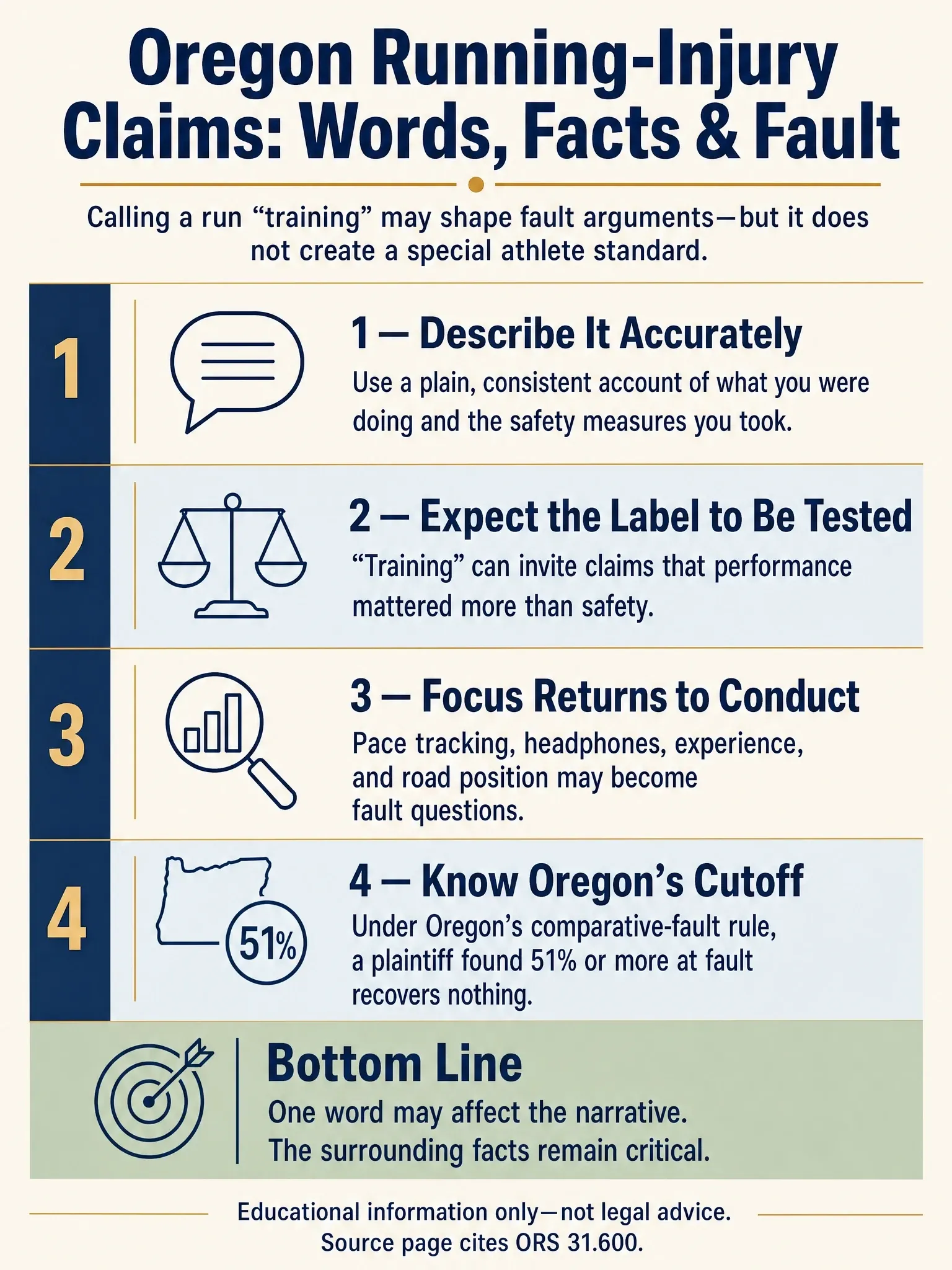
When you’re hurt while running, one simple word can shift the legal landscape beneath your feet. Calling your outing “training” instead of “running” or “jogging” might feel trivial, but in an Oregon personal injury claim it can carry outsized implications. Oregon uses a modified comparative negligence rule: if a plaintiff is found 51% or more at fault, they recover nothing. ORS 31.600 sets the statutory framework, and this plain-English explainer clarifies how comparative negligence works in practice.
Insurance companies understand the math. Shifting fault from 45% to 51% saves them from paying a dime. That is why language matters. This article explains “The Athlete’s Burden” across four vectors—standard of care, assumption of risk, jury perception, and deposition traps—and ends with practical guidance for runners on how to describe what they were doing.
1) The “Reasonable Person” vs. “Expert” Standard
Ordinary pedestrians and recreational joggers are held to the reasonable person standard: the care a prudent person would use in the same circumstances. That standard already accounts for context (time of day, surface, traffic, etc.), and it doesn’t officially change just because someone is fit or experienced. However, words matter. If you say “I was training,” you may be perceived as a person with special skill—someone expected to act as a reasonable person with that expertise would. While Oregon courts apply their own precedents, a Wisconsin Supreme Court decision articulates the general principle that the “circumstances” defining ordinary care include relevant special knowledge or skill the actor brings to bear, consistent with the Restatement’s superior-knowledge principle. Court opinion PDF.
Defense lawyers often exploit this perception. “You weren’t just running—you were training for a marathon,” they’ll say. “So why didn’t you anticipate the hazard?” Oregon law does not create a formal “expert athlete” negligence standard, but jurors are human. Presenting yourself as highly trained can invite harsher scrutiny than an average pedestrian would receive.
Why it matters: Saying “training run” can imply you were prioritizing performance over safety—checking a GPS watch, hugging the asphalt for speed, or running intervals. Those details may be irrelevant to who had the right-of-way, but they can inflate your share of fault in a close case.
A Helpful Oregon Analogy: Bagley v. Mt. Bachelor
In Bagley v. Mt. Bachelor (2014), the Oregon Supreme Court recognized that skiers accept inherent risks of the sport, but they do not assume the risk of a ski area’s negligence. Bagley held that operators still owe a duty of care for unreasonable hazards. That logic applies here: even a trained athlete does not forfeit the protections owed to any pedestrian. But if you describe your run as “training,” the defense will try to muddy that duty.
2) Assumption of Risk (Implied Secondary)
Oregon has abolished implied assumption of risk as a separate defense. ORS 31.620 folds any careless behavior into comparative fault instead. However, some sports—like skiing—have statutes that expressly recognize inherent risks. That is why the language of “training” is dangerous: it can make your run sound like a sporting event with assumed dangers.
The legal dividing line is important. If you aren’t engaged in a formal sporting event, you have not consented to negligent drivers or unsafe road conditions. Courts consistently distinguish between ordinary recreation and organized sport when assessing assumed risk, and the same reasoning applies to runners. For more on cyclist protections, see our Oregon bicycle accident resource.
Bottom line: Calling it “training” can invite a jury to treat your run like a voluntary sport with elevated danger, even though Oregon law does not support that leap. “I was out for a run” frames the activity as recreation or transportation with an expectation of safety—exactly what the law presumes.
3) The Psycholinguistics of Jury Perception
Words shape how jurors perceive vulnerability and blame. Compare:
- “I was out for a run to get some air.”
- “I was training for a sub-3 marathon.”
The first sounds relatable, cautious, and ordinary. The second evokes intensity, competition, and a higher risk tolerance. Studies of jury perception (and trial strategy) show that subtle framing affects sympathy and fault apportionment. For context on what jurors are instructed to do, see the Ninth Circuit model civil jury instructions. Oregon courts also provide jury FAQs, and the NCSC jury bias report summarizes research on how bias can influence deliberations.
In Oregon, this shift can be case-dispositive. If a jury sees you as a careful pedestrian, they might assign 40% fault and allow recovery. If they see you as a performance-focused athlete who took risks, they might push you to 51%—and you get nothing under ORS 31.600.
4) Strategic “Gotcha” Questions in Depositions
If you say you were “training,” expect a line of questioning designed to turn that into negligence. Defense attorneys ask questions that plant a seed even if you answer carefully. Common traps include:
- “Were you monitoring your split times or pace at the moment of impact?”
- “Were you trying to hit a specific pace or distance?”
- “Were you wearing headphones or listening to music?”
- “You’re an experienced runner, right? So how did this happen?”
- “Were you running in the roadway or bike lane to avoid slower pedestrians?”
Each question frames the narrative around distraction, speed, or assumed risk. Even if you answer “no,” the jurors have now heard the suggestion. This is why word choice at the outset matters.
Actionable Advice: Choose “Recreation” Over “Sport”
If you’re hurt while running or walking, the language you use can protect your claim. Use these guidelines:
- Keep it ordinary. Say “I was out for a run” or “jogging for exercise,” not “training” or “racing.”
- Avoid loaded terms in official records. Police reports and medical intake forms often quote your exact words. “Training for a marathon” can become Exhibit A later.
- Emphasize safety, not performance. If you mention details, focus on safety measures (e.g., “I was on the shoulder because the sidewalk was closed”), not pace goals.
- Be consistent with social media. Assume anything you post could be used in litigation. “Got hit while jogging” is safer than “hit during marathon training.”
- Let your attorney frame your athletic background. Running can be a positive story, but it should be presented as healthy recreation—not risk-taking.
Oregon law protects pedestrians and runners. You are entitled to reasonable care from drivers and property owners. Don’t let a single word distort that duty or push your fault percentage over the 51% line.
Key Takeaways
- Oregon uses a 51% comparative fault cutoff that bars recovery at 51% or more. ORS 31.600
- Saying “training” can invite jurors to treat you as an expert athlete who should have avoided the hazard.
- Implied assumption of risk is abolished in Oregon, but defense counsel still tries to inject the concept. ORS 31.620
- Strategic wording protects your claim and keeps focus on the defendant’s negligence.
Related Resources
Client-First Fee Promise
Client First = Bills First, Fees Second
Your unpaid medical bills do not have to make your lawyer's fee bigger. Johnson Law subtracts qualifying medical bills before calculating our fee, helping clients keep more of their settlement.
Applies to qualifying cases. Results vary.