Sudden Stop Defense in Rear-End Crashes: When It Works and When It’s Just Noise
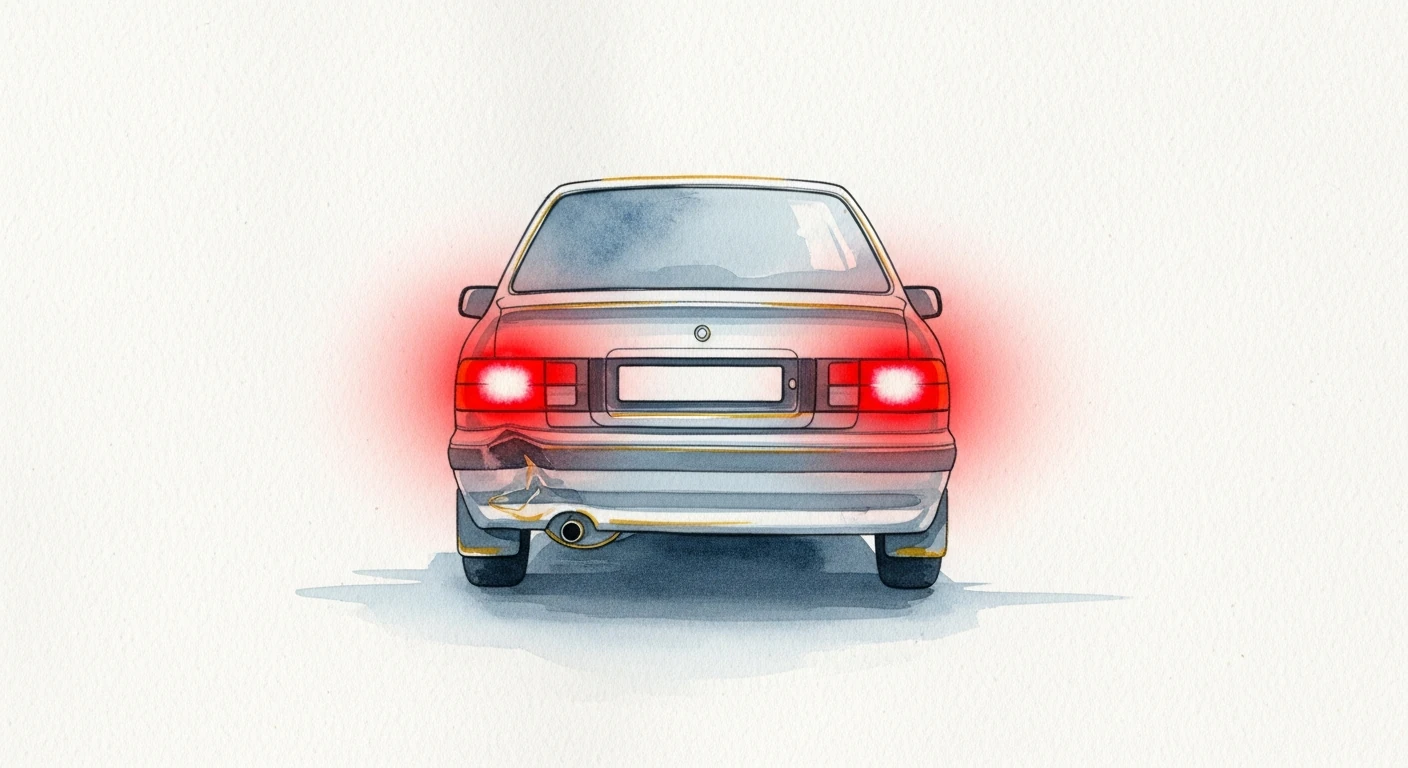
Sudden Stop Defense in Rear-End Crashes: When It Works and When It’s Just Noise
Rear-end crashes seem simple until they are not. Most people assume the rear driver is always responsible. That is a strong starting point in many claims—but it is not absolute in every Oregon case.
One of the most disputed exceptions is the sudden stop defense. The basic idea: the lead driver stopped abruptly and without a reasonable safety justification, leaving the trailing driver no realistic way to avoid impact even with reasonable attention.
Sometimes this defense is legitimate. Sometimes it is a label used to deflect blame from clear tailgating or inattention. The difference almost always comes down to evidence quality and Oregon comparative-fault rules.
Important: This guide is general educational information, not legal advice for your specific facts.
Why the sudden stop defense matters in Oregon
Oregon uses modified comparative fault under ORS Chapter 31. Fault can be apportioned among multiple drivers, and recovery is adjusted based on assigned percentages.
That makes sudden-stop arguments high stakes:
- They can reduce a trailing driver’s assigned fault.
- They can reduce (or potentially bar) the lead driver’s recovery.
- They can change settlement leverage during negotiations.
In short, this is not a minor technicality. It can materially change who pays for medical expenses, wage loss, vehicle damage, and non-economic harms.
Rear-end fault starts with a presumption—not an automatic verdict
In everyday claims handling, rear-end collisions often begin with an inference that the trailing driver:
- followed too closely,
- failed to keep proper lookout, or
- drove too fast for traffic conditions.
That inference is powerful, but rebuttable. A trailing driver can challenge it by showing the lead driver created an unreasonable and unforeseeable hazard through unjustified hard braking or unsafe stopping behavior.
This distinction is critical. A viable defense is not simply “the stop was abrupt.” It is “the stop was abrupt and unreasonable under the circumstances.”
What Oregon law looks at in sudden-stop disputes
Reasonableness under real driving conditions
Fact-finders evaluate what a reasonably careful driver would have done in the same environment:
- freeway flow versus urban stop-and-go,
- daylight versus reduced visibility,
- dry pavement versus rain or ice,
- hazard present versus no apparent hazard.
Signaling and deceleration obligations
Oregon law addresses signaling before stopping or suddenly decreasing speed when feasible. See ORS 811.385 and related provisions in ORS Chapter 811.
If a lead driver had time to provide warning but did not, that can support a negligence argument.
Unsafe or prohibited stopping locations
Stopping in a travel lane or other unsafe location can become central to liability analysis. See ORS 811.395 within the same statutory chapter.
The trailing driver’s duty does not disappear
Even where the lead driver’s behavior is questionable, the rear driver still has duties tied to safe speed and spacing for actual conditions under Oregon road rules in ORS Chapter 811.
That is why many sudden-stop cases end as shared-fault outcomes rather than all-or-nothing results.
When the defense can actually work
The argument becomes stronger when evidence shows the lead stop was both abrupt and unjustified.
Common facts that help:
- no visible hazard ahead of the lead vehicle,
- stop occurred in a through-lane where a full halt was unexpected,
- little or no warning before aggressive deceleration,
- lead-driver statements suggesting distraction, anger, or panic,
- independent witness confirmation that there was no safety reason to stop.
Typical scenarios that may support the defense
- Brake-check behavior: retaliatory hard braking in response to perceived tailgating.
- Missed-turn panic stop: abrupt stop after passing an exit or turn.
- Non-hazard stop: unnecessary stopping in active traffic to check directions, a phone, or roadside activity.
These cases are fundamentally about foreseeability: could a reasonably attentive trailing driver have anticipated this maneuver in time to avoid contact?
When the defense is mostly “noise”
The defense often fails when the stop was abrupt but still foreseeable in normal driving.
Examples:
- braking for stopped traffic,
- braking for a pedestrian in a crosswalk,
- reacting to debris, an animal, or a sudden lane intrusion,
- compression at intersections or merges.
In those circumstances, insurers often argue the rear driver should still have maintained enough distance and attention to react.
The argument also weakens quickly when trailing-driver negligence is clear:
- phone distraction,
- tight following distance,
- failure to adjust speed for weather/night congestion,
- impairment.
When those facts exist, “they stopped suddenly” usually has limited value.
Evidence is usually the deciding factor
Sudden-stop cases are evidence-driven. Narrative alone rarely carries the day.
High-value evidence categories
-
Video evidence
Dashcam, business cameras, or nearby vehicle footage can resolve sequence disputes quickly. -
Scene and vehicle documentation
Debris pattern, skid marks, lane layout, and crush profiles often reveal timing and force dynamics. -
Electronic records
Device-use timing, telematics, and event-data sources can support or contradict driver accounts. -
Neutral witness accounts
Independent witnesses can break deadlocks in “he said/she said” conflicts. -
Reconstruction analysis
Useful when reaction windows, deceleration rates, and stopping distance are contested.
Why speed matters in preserving proof
The most useful evidence can vanish quickly:
- vehicles are repaired, moved, or salvaged,
- video retention windows expire,
- witnesses become difficult to locate,
- recollections degrade.
For that reason, fast documentation is often as important as legal theory.
How comparative fault changes claim outcomes
Under Oregon’s comparative-fault structure, outcomes usually track percentages, not slogans.
Possible result patterns:
- Lead driver mostly at fault: trailing driver may still recover part of losses.
- Shared-fault split: each side’s recovery may be reduced proportionally.
- Trailing driver mostly at fault: sudden-stop theory may have little practical effect.
This is why disciplined evidence organization often outperforms broad fault assertions in settlement discussions.
Practical steps after a rear-end crash with a sudden-stop dispute
If you are safe and able to act:
- Call 911 and prioritize scene safety.
- Photograph vehicle positions, lane context, road ahead, and all impact zones.
- Identify possible camera sources nearby.
- Collect witness names and contact information.
- Exchange insurance/driver information carefully.
- Obtain medical evaluation promptly, even for “minor” symptoms.
- Keep one centralized claim file for records and communications.
For Oregon reporting obligations, review Oregon DMV Accident Reporting Requirements.
Injury records still influence liability disputes
Even when fault is contested, injury documentation strengthens causation and damages analysis.
For neutral medical background:
Early and consistent care can reduce later insurer arguments that symptoms are delayed, exaggerated, or unrelated.
Common misconceptions that create claim problems
“Rear driver is always 100% liable.”
Not always. It is a strong presumption, not an irrebuttable rule.
“Any hard braking creates a winning defense.”
No. The issue is negligent, unjustified stopping—not merely abrupt stopping.
“Calling it a brake check proves fault.”
Not by itself. Objective corroboration is what moves liability analysis.
“Police narrative always ends the civil dispute.”
Police reports are important, but civil liability can shift with additional evidence and expert analysis.
Public sources for deeper review
- Oregon Legislature, ORS Chapter 811 (Rules of the Road)
- Oregon Legislature, ORS Chapter 31 (Civil Liability / Comparative Fault)
- Oregon Legislature, ORS Chapter 12 (Limitations Periods)
- Oregon DMV, Accident Reporting Requirements
- ODOT, Transportation Safety
- NHTSA, Distracted Driving
- IIHS, Advanced Driver Assistance
Bottom line
In Oregon rear-end litigation and claims handling, the sudden stop defense can be either a serious allocation-of-fault argument or little more than noise. The practical difference is evidence: Was the lead stop truly unjustified, and did the trailing driver still act reasonably for the conditions?
If you are in this situation, treat the case as an evidence-and-timeline problem from day one. Preserve proof early, document injuries consistently, and evaluate fault through Oregon comparative-fault principles—not assumptions.
Related Resources
Client-First Fee Promise
Client First = Bills First, Fees Second
Your unpaid medical bills do not have to make your lawyer's fee bigger. Johnson Law subtracts qualifying medical bills before calculating our fee, helping clients keep more of their settlement.
Applies to qualifying cases. Results vary.