Chain-Reaction Rear-End Crashes on I-5: How Oregon Fault Rules Work for the Middle Car
Chain-Reaction Rear-End Crashes on I-5: How Oregon Fault Rules Work for the Middle Car
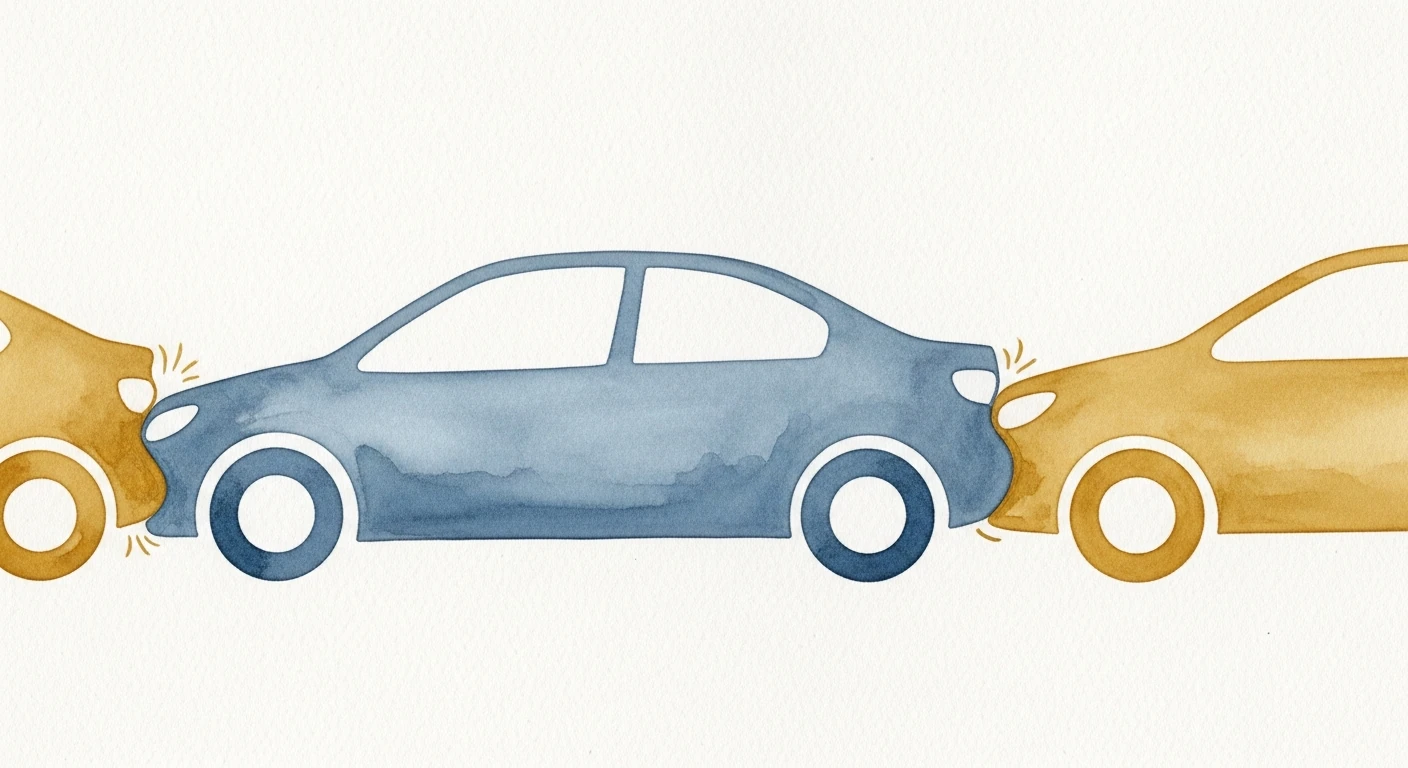
On I-5, traffic can shift from moving to stopped in seconds. One driver brakes hard, the line compresses, and then—impact from behind. If your vehicle gets shoved forward into the car ahead, you are suddenly in one of the most disputed crash scenarios in Oregon: the middle-car “sandwich” collision.
Most people assume fault is obvious. In reality, multi-vehicle rear-end crashes are often fought case-by-case because insurance companies focus on one central question: Did the middle car hit first, or get pushed first?
That distinction controls who pays for:
- Vehicle damage (front and rear)
- Emergency treatment and follow-up care
- Lost wages and reduced earning capacity
- Pain, daily limitations, and long-term recovery costs
This guide explains how these cases are analyzed under Oregon law, what evidence actually helps, and what to do right away if you are the middle driver.
Important: This article is general educational information, not legal advice for your specific case.
Why chain-reaction crashes feel simple—but are legally complex
In a two-car rear-end crash, liability often starts with a straightforward inference: the trailing driver likely failed to stop in time. In a three-car crash, the sequence becomes harder to prove because multiple impacts can happen in less than a second.
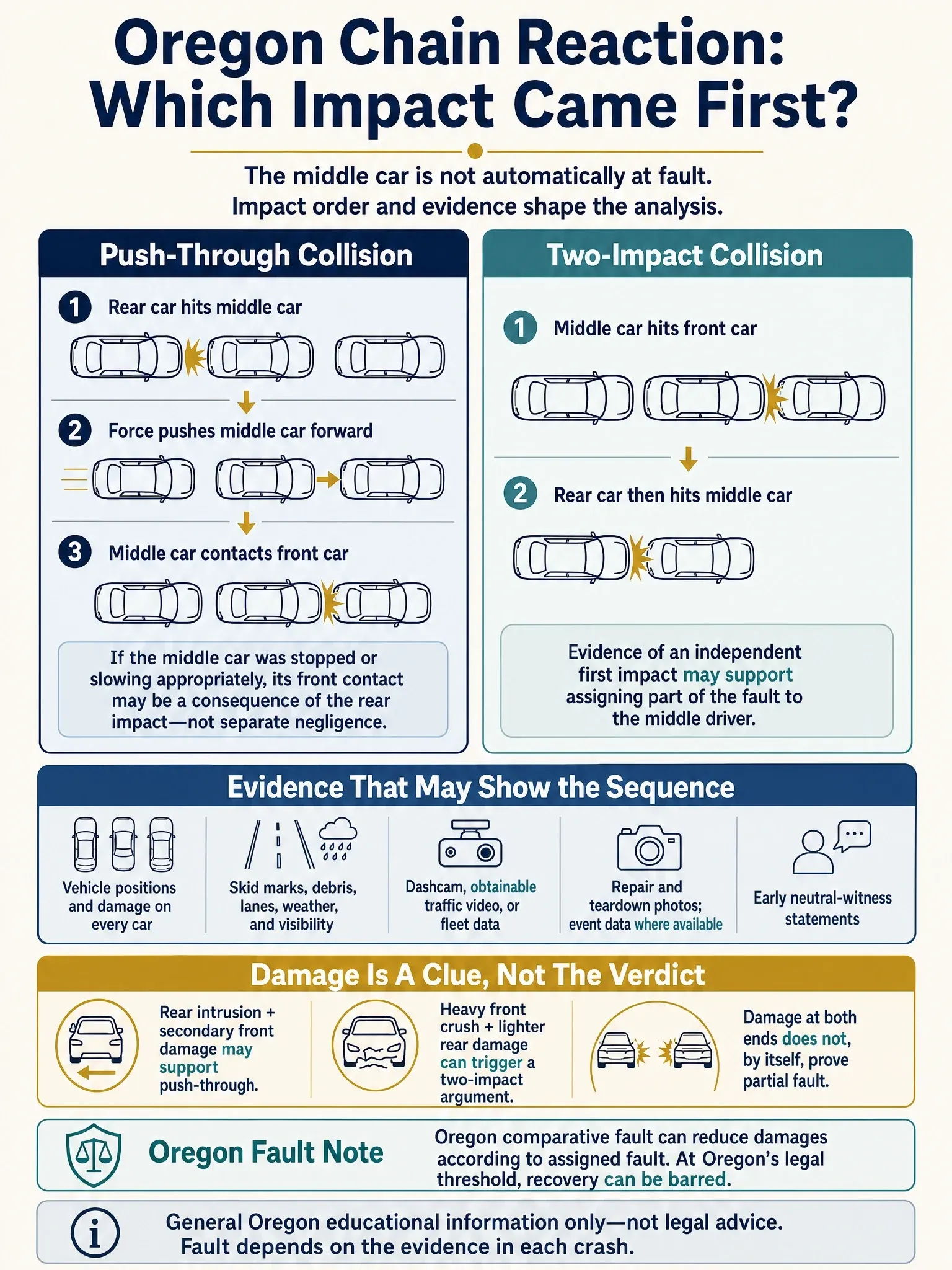
Insurance adjusters typically break these events into one of two models:
-
Push-through collision
Rear driver hits middle vehicle, and that force pushes middle into front vehicle. -
Two-impact collision
Middle vehicle hits front first, then rear vehicle strikes middle.
Those two models can produce very different fault allocations under Oregon’s comparative fault rules.
Oregon rules that usually decide these claims
1) Reasonable speed for actual conditions
Oregon’s “basic speed rule” requires drivers to travel at a speed that is reasonable for existing conditions—not just the posted limit. In dense stop-and-go traffic, safe speed can be far below the sign. See ORS chapter 811 (Rules of the Road).
2) Following distance matters
Rear-end chains often involve allegations of following too closely. Insurers will evaluate spacing, reaction time, and braking opportunities for each driver.
3) Comparative fault can reduce recovery
Oregon uses modified comparative fault under ORS chapter 31. If a claimant is assigned a percentage of fault, damages can be reduced proportionally. If fault allocation crosses Oregon’s legal threshold, recovery can be barred.
For middle-car claims, this is exactly why crash sequence evidence is so important.
The middle car is not automatically at fault
A common myth is that the middle car must share blame because it struck the front vehicle. That is not how negligence analysis works.
If you were stationary (or slowing appropriately) and then violently propelled forward by rear impact energy, your contact with the front vehicle may be a consequence of the rear driver’s negligence—not separate negligence by you.
In other cases, the middle driver may still carry part of fault if evidence shows an independent first impact before being struck from behind. This is why the timeline of impacts is the entire case.
What evidence is most persuasive in push-through disputes
In practice, liability is usually decided by evidence quality, not by who argues louder.
Scene documentation
If physically safe, gather:
- Wide photos of all vehicle positions
- Close photos of damage patterns on every vehicle
- Skid marks, debris fields, and lane context
- Weather, visibility, congestion, and lighting conditions
Damage pattern analysis
Middle-car claims often turn on front-vs-rear crush characteristics:
- Severe rear intrusion with secondary front damage may support push-through
- Heavy front crush with lighter rear damage can trigger two-impact arguments
Repair estimates, teardown photos, and event data (where available) can clarify sequence.
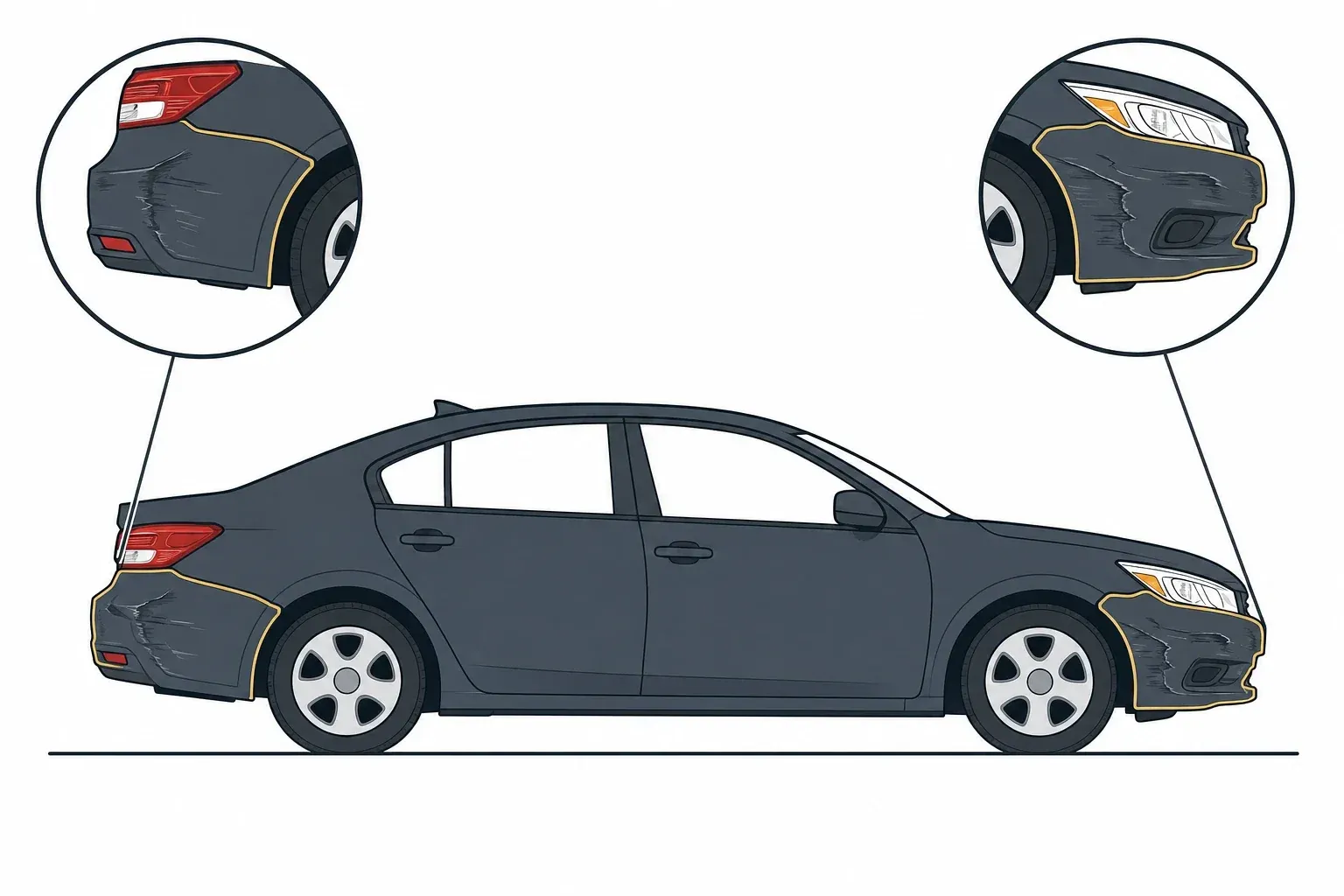
Document both front and rear damage on the middle vehicle. Damage locations alone do not establish impact order or fault.
Electronic and independent evidence
- Dashcam footage (yours or nearby drivers)
- Commercial fleet telematics
- Traffic camera captures (if obtainable)
- Neutral witness statements taken early
Medical timeline consistency
Prompt care and consistent records help connect injury mechanics to crash mechanics. For neck injury background, see MedlinePlus: Neck Injuries and Disorders.
Why insurers target ambiguity in multi-car rear-end claims
In a three-car crash, each insurer has a financial incentive to narrow its own driver’s responsibility. Common tactics include:
- Framing the crash as two separate incidents
- Isolating only one impact for payment
- Using early statements to suggest uncertainty
- Arguing injury complaints are delayed or unrelated
This is especially common when adjusters believe the middle driver lacks organized documentation.
A practical post-crash checklist for I-5 chain reactions
1) Prioritize immediate safety
Move to a safe area if possible, activate hazards, and call 911. Secondary impacts on high-speed corridors are a real risk.
2) Request official reporting and exchange information
Get officer details, report number, insurance data, and contact information for all drivers.
3) File required Oregon crash paperwork when applicable
Oregon has reporting requirements that may apply even when police respond. Confirm requirements with Oregon DMV Accident Reporting.
4) Seek medical evaluation quickly
Adrenaline masks symptoms. Early evaluation creates a clear baseline and treatment record.
5) Start a single claim file
Maintain one organized folder with:
- Photos and video
- Police report and witness contacts
- Medical records and bills
- Mileage, prescriptions, and out-of-pocket costs
- Employer wage-loss verification
- All insurer communications
Understanding compensation categories in Oregon crash claims
When liability is established, damages may include:
Economic losses
- Past and future medical expenses
- Lost income and diminished earning ability
- Vehicle/property loss and related costs
Non-economic losses
- Physical pain
- Sleep disruption and functional limits
- Emotional strain from injury and recovery
In chain-reaction cases, valuation can be complicated because adjusters may try to assign each body region (neck, back, shoulder, head) to different impacts. Strong records help prevent artificial claim splitting.
Deadlines and timing pressure
In Oregon, filing deadlines depend on claim type and party involved. Missing deadlines can end an otherwise valid claim. Review general limitation statutes in ORS chapter 12.
Also note practical timing issues:
- Some evidence disappears quickly (tow-yard photos, digital footage retention)
- Witness memory degrades fast
- Delayed treatment can create causation disputes
Early investigation usually improves claim clarity.
How road safety data supports defensive spacing in stop-and-go traffic
Rear-end crashes remain one of the most common collision types nationally. Public safety sources consistently emphasize attention, speed management, and spacing.
Useful references:
Practical takeaway for Oregon commuters: leave a larger buffer than feels necessary, watch several vehicles ahead, and plan for abrupt compression near merges, lane drops, and bottlenecks.
Frequently asked questions about Oregon middle-car rear-end claims
If my car has damage on both ends, does that prove I was partly at fault?
No. Dual-end damage only proves dual-end impact. Fault depends on when each impact occurred and whether your conduct was reasonable before rear impact.
Can two different drivers share responsibility for one chain reaction?
Yes. Oregon comparative fault allows responsibility to be allocated among multiple parties based on evidence.
Should I give recorded statements to every insurer right away?
Be careful. In multi-car crashes, wording and timing matter. Provide accurate basic facts, avoid guessing, and keep records of every contact.
What if symptoms show up two days later?
That is common. Seek evaluation promptly and report symptom onset accurately to your provider.
Does a police report always settle liability?
Not always. Reports are influential but not final in civil claims. Additional evidence can shift conclusions.
Is it worth preserving minor evidence like prescription receipts and mileage?
Yes. Small documented expenses often become meaningful in aggregate and improve claim credibility.
Bottom line
In Oregon chain-reaction rear-end crashes, the middle driver is not automatically responsible. The outcome usually turns on evidence that reconstructs impact order, driver behavior before impact, and medical causation after impact.
If you were pushed forward on I-5, treat the case like a documentation project from day one: secure scene proof, protect your medical timeline, and keep communications organized. In disputed multi-vehicle claims, that discipline can determine whether liability is placed accurately—or shifted unfairly.
Related resources
Public sources used for this guide
- Oregon Legislature, ORS chapter 811 (Rules of the Road)
- Oregon Legislature, ORS chapter 31 (Civil Liability / Comparative Fault)
- Oregon Legislature, ORS chapter 12 (Limitations)
- Oregon DMV, Accident Reporting Requirements
- ODOT, Transportation Safety
- NHTSA, Distracted Driving
- IIHS, Advanced Driver Assistance
- MedlinePlus, Neck Injuries and Disorders
Client-First Fee Promise
Client First = Bills First, Fees Second
Your unpaid medical bills do not have to make your lawyer's fee bigger. Johnson Law subtracts qualifying medical bills before calculating our fee, helping clients keep more of their settlement.
Applies to qualifying cases. Results vary.