Strava, Garmin, and GPS Evidence in Oregon Injury Litigation

Strava, Garmin, and GPS Evidence in Oregon Injury Litigation
A Strava activity, Garmin file, GPS route, pace chart, or wearable record can become evidence after a runner, cyclist, or pedestrian is injured. These records may help establish where someone traveled, when an activity began, how the device recorded movement, or what happened immediately after a collision. They can also be misunderstood when a screenshot or isolated data point is treated as a precise reconstruction of the event.
The important litigation questions are not simply whether wearable data exists. They are what the device actually recorded, whether the original data was preserved, how it can be obtained, and what context is needed before drawing a conclusion.
This article focuses on digital fitness evidence. For the separate question of how words such as “training” can affect claim framing, read The Athlete’s Burden: How One Word Could Weigh Down Your Oregon Injury Claim.
What Fitness Platforms and Wearables May Record
The available information depends on the device, app, account settings, sensors, and synchronization history. Potentially relevant material may include:
- Route data: GPS points showing a recorded path, subject to device accuracy and signal conditions.
- Time data: activity start and end times, elapsed time, moving time, pauses, laps, and splits.
- Pace or speed: calculated from recorded time and distance rather than a direct statement of what the person was doing at every instant.
- Elevation and cadence: values recorded or calculated by the device or platform.
- Heart-rate data: sensor readings that may show exertion but do not, by themselves, establish attention, judgment, or fault.
- Activity and account metadata: device type, upload or synchronization details, edits, privacy settings, titles, descriptions, comments, and associated photographs.
- Original activity files: formats such as FIT, GPX, or TCX may contain more useful detail than a screenshot of an activity summary.
Different systems can hold different versions of the same activity. A watch may create the original file, a paired phone may synchronize it, and Strava or Garmin Connect may display a processed version. Identifying that chain matters when the displayed map or pace differs from the source file.
Why a Screenshot Is Not the Whole Record
A screenshot can preserve what an app displayed at one moment, but it may omit the device source, timestamps, pause settings, editing history, privacy cropping, and the underlying sequence of GPS points. It can also be compressed, cropped, or detached from account metadata.
When wearable evidence may matter, preserve the native or exported data in addition to screenshots. The Strava account-download process and Garmin’s account-data management page provide user-facing ways to request or export account information. The exact contents of an export can vary, so the export should be documented rather than assumed to contain every device-level record.
Preserve the Evidence Without Altering It
Deleting an activity, changing its title, trimming the route, editing the activity type, resetting the watch, or replacing a phone can complicate later efforts to understand the record. A person should not guess at what must be produced or make changes to “clean up” an account after a claim is anticipated.
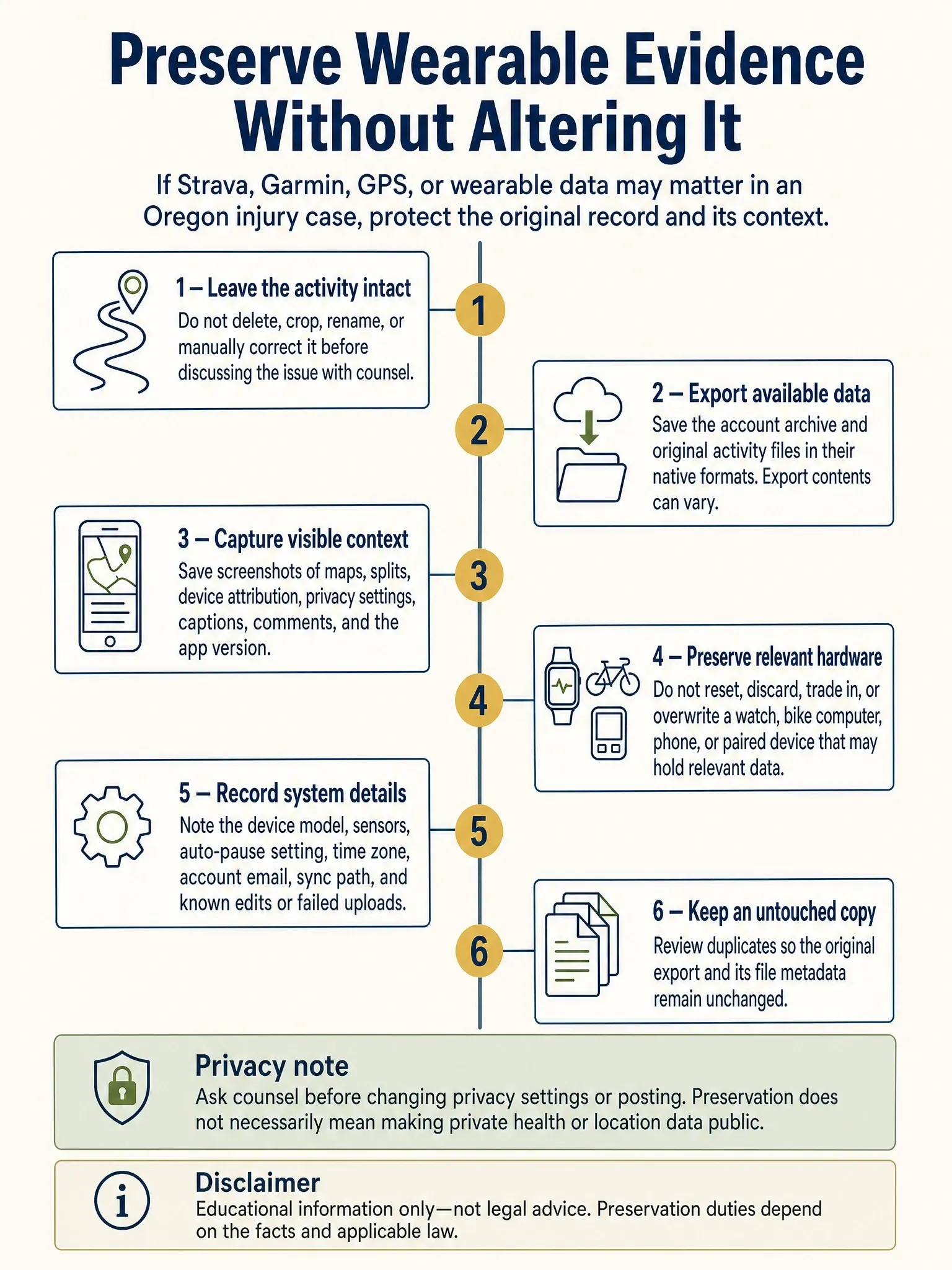
A practical preservation plan may include:
- Leave the original activity intact. Do not delete, crop, rename, or manually correct it without first discussing the issue with counsel.
- Export available account data. Save the downloaded archive and original activity files in their native formats.
- Capture the visible context. Screenshots can document maps, splits, device attribution, privacy settings, captions, comments, and the app version being viewed.
- Preserve the hardware. Avoid resetting, discarding, trading in, or overwriting the watch, bike computer, phone, or other paired device if its data may be relevant.
- Record the system details. Note the device model, sensor connections, auto-pause setting, time zone, account email, synchronization path, and any known edits or failed uploads.
- Keep an untouched copy. Work from a duplicate when reviewing files so the original export and its file metadata remain unchanged.
- Ask counsel before changing privacy settings or posting. Preserving evidence does not necessarily mean making private health or location data public.
A preservation request can put another person or organization on notice of potentially relevant data, but it is not the same as a court order and does not itself compel pre-suit production.
How Wearable and App Records May Be Requested in Oregon Litigation
Once an Oregon civil action is pending, ORCP 43 permits appropriately scoped requests for relevant, nonprivileged documents and electronically stored information in a party’s possession, custody, or control. Depending on the dispute, that could include an account export, original activity file, device inspection, or records sufficient to identify how an activity was recorded and edited.
If relevant records are held by a nonparty, ORCP 55 may provide a subpoena procedure. A subpoena does not guarantee that a platform retains the requested data or that every category is legally obtainable. Providers may object, identify technical limits, or be restricted by federal privacy law. Requests may also be narrowed or protected to avoid exposing unrelated location, health, or social information.
Good requests usually identify:
- The account, device, and activity at issue.
- A focused date and time range around the incident.
- The native file or export format requested.
- Associated metadata, including time zone, device source, edits, and synchronization information.
- Whether a read-only inspection or neutral forensic protocol is proposed.
- How unrelated routes, communications, and health data will be redacted or protected.
Broad demands for an athlete’s entire history can create relevance and privacy disputes. A targeted request tied to the incident, claimed injuries, or a specific factual issue is easier to evaluate and less likely to sweep in years of unrelated information.
Contextualizing GPS, Pace, and Route Data
Wearable data is not self-explanatory. Before using it to reconstruct an injury event, consider the following limits.
GPS Points Are Measurements, Not a Survey
Satellite visibility, buildings, tree cover, device placement, sampling intervals, and software processing can affect a recorded route. A line on an app map should not automatically be treated as proof that a runner occupied an exact spot within a lane, shoulder, sidewalk, or crosswalk.
Compare the source file with scene photographs, roadway measurements, maps, camera footage, and witness accounts. If the precise path matters, the device’s accuracy and processing method may require technical analysis.
Average Pace Is Not Instantaneous Conduct
An average pace or split combines movement across time and distance. Auto-pause, manual pauses, signal drift, smoothing, and the platform’s distinction between moving time and elapsed time can change the displayed number. A fast mile does not establish the person’s speed at the instant of impact, and a post-crash pause may not appear the way a reader expects.
A Route Name or Segment Does Not Prove Intent
An activity title, planned workout, or appearance on a Strava segment can provide context, but it does not necessarily show that the person was racing, looking at a screen, or trying for a segment result when the incident occurred. Examine whether the segment was automatically matched, whether the device gave live prompts, and what the person could actually see or hear.
Heart Rate Does Not Establish Awareness
Heart-rate data may help describe exertion or a physical response, but it does not directly reveal where someone was looking, what they perceived, or whether their conduct was reasonable. Sensor fit, cadence interference, device type, and missing samples can also affect the record.
Timestamps Need a Common Clock
The activity, 911 call, traffic camera, police report, vehicle data, and witness messages may use different clocks or time zones. A sound reconstruction documents each source and any clock offset rather than rounding everything to the same minute.
How the Evidence Can Cut Both Ways
Depending on the facts, digital fitness data may support or undermine a position. It might:
- Corroborate a route, crossing point, direction of travel, or approximate timing.
- Show that an activity stopped or changed near the reported collision location.
- Help test whether a route was familiar or whether a detour was caused by a closure or obstruction.
- Provide a before-and-after activity history relevant to a claimed physical limitation, subject to medical context and privacy limits.
- Be cited in a comparative-fault argument about pace, location, headphones, device interaction, or route choice.
Oregon’s comparative-fault statute, ORS 31.600, makes the plaintiff’s own conduct potentially important. But the existence of fitness data does not create a special athlete standard, and it does not erase another person’s duty to use reasonable care. Oregon also abolished implied assumption of risk as a separate doctrine through ORS 31.620. As Bagley v. Mt. Bachelor illustrates in the recreational-sports context, risk and negligence require a fact-specific legal analysis rather than a label.
Questions to Ask Before Relying on Wearable Evidence
- Which device created the original record?
- Was the activity edited, cropped, manually entered, or reclassified?
- Did the device use auto-pause, a foot pod, a speed sensor, or a paired phone?
- Does the display show moving time, elapsed time, or a calculated pace?
- Was the route privacy-masked or processed after upload?
- Are the timestamps stored in local time or Coordinated Universal Time?
- What unrelated health, location, or social data should be protected?
- What other evidence can corroborate or challenge the wearable record?
Key Takeaways
- Preserve original activity files, account exports, devices, settings, and visible app context.
- Treat screenshots as useful documentation, not a substitute for native data and metadata.
- Use focused Oregon discovery requests that identify the activity, time window, format, and needed metadata.
- Do not assume a GPS line is exact, an average pace is instantaneous speed, or a segment proves racing intent.
- Align wearable timestamps with independent evidence before drawing conclusions.
- Keep the terminology issue separate; the consumer guide explains how “training” language may affect claim framing.
Sources and Related Resources
- Oregon comparative fault statute, ORS 31.600
- Oregon implied-assumption-of-risk statute, ORS 31.620
- Bagley v. Mt. Bachelor
- Cornell Legal Information Institute: comparative negligence
- Oregon Rules of Civil Procedure, including ORCP 43 and ORCP 55
- Strava: exporting account data
- Garmin: account data management
- Preserving evidence after an accident
- Pedestrian injury claims
- Oregon recording laws for evidence
- Schedule a consultation
This article provides general educational information, not legal advice. The discoverability, preservation duties, privacy protections, and admissibility of digital fitness data depend on the facts and applicable law.
Client-First Fee Promise
Client First = Bills First, Fees Second
Your unpaid medical bills do not have to make your lawyer's fee bigger. Johnson Law subtracts qualifying medical bills before calculating our fee, helping clients keep more of their settlement.
Applies to qualifying cases. Results vary.