Civil vs. Criminal Standards in Court: A Plain-Language Guide

Civil vs. Criminal Standards in Court: A Plain-Language Guide
People hear “civil case” and “criminal case” all the time, but the difference is more than just a label. These two systems have different goals, different rules, and different standards of proof. Those differences affect everything from what evidence is needed to what outcomes are possible.
This guide breaks it down in everyday language—no legal jargon required.
The short version
- Civil cases are usually about money or orders (like paying damages or stopping harmful behavior).
- Criminal cases are about public safety and can lead to jail, probation, or fines.
- Civil standard of proof: preponderance of the evidence (more likely than not).
- Criminal standard of proof: beyond a reasonable doubt (a much higher bar).
What is a civil case?
A civil case is a dispute between people, businesses, or organizations. The goal is usually to make someone whole after a loss or to resolve a conflict.
Typical civil cases include:
- Car crash injury claims
- Slip-and-fall injuries
- Contract disputes
- Property damage
- Medical bills and reimbursement disputes
If the person bringing the case wins, the court can order money damages or issue court orders (like requiring someone to fix a problem or stop doing something).
What is a criminal case?
A criminal case is brought by the government (the state or federal prosecutors). The goal is to address conduct that violates criminal law and threatens public safety.
Typical criminal cases include:
- Assault or domestic violence
- DUII or reckless driving
- Theft or fraud
- Drug-related offenses
If the defendant is convicted, the court can impose penalties, such as jail or prison time, probation, fines, or restrictions on freedom.
The key difference: the burden of proof
The burden of proof is how convincing the evidence must be to win the case.
Civil standard: “Preponderance of the evidence”
This means more likely than not—just over 50%. If the judge or jury believes the claim is slightly more likely true than not, the civil case can succeed.
Plain example: If the evidence tips the scale even a little, the plaintiff can win.
Criminal standard: “Beyond a reasonable doubt”
This is a much higher standard because the stakes include loss of freedom. The prosecution must prove the case so clearly that there is no reasonable doubt about guilt.
Plain example: If a reasonable person would still have serious questions, the defendant cannot be convicted.
Side-by-side comparison
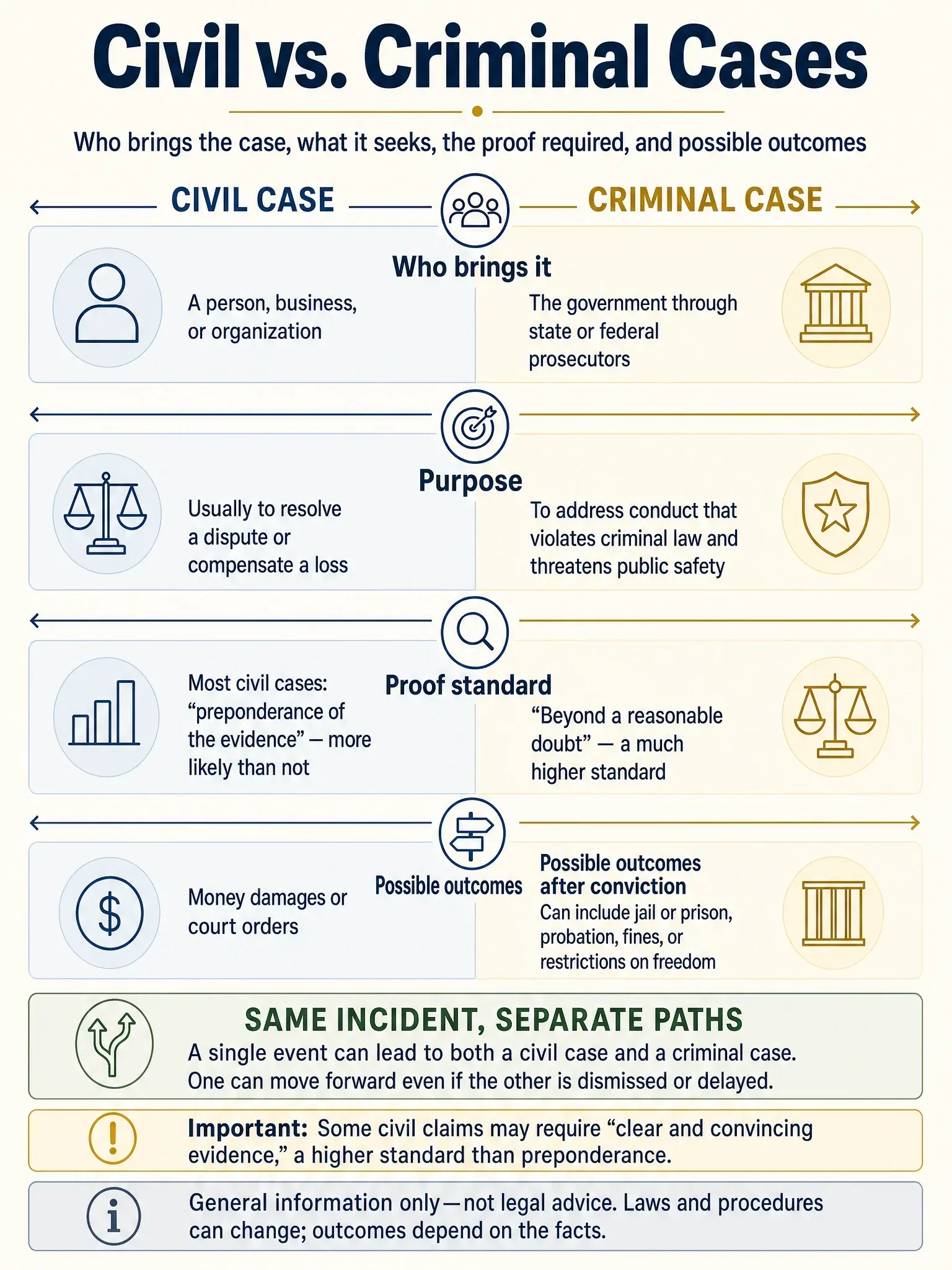
| Feature | Civil Case | Criminal Case |
|---|---|---|
| Who files | A private person or business | The government (state or federal) |
| Purpose | Resolve disputes, compensate losses | Punish and deter illegal conduct |
| Burden of proof | Preponderance of the evidence | Beyond a reasonable doubt |
| Possible outcomes | Money damages, court orders | Jail/prison, probation, fines |
| Who represents the case | Private attorney | Prosecutor |
| If you lose | You may owe money or be ordered to act | You may lose your freedom |
Can the same incident lead to both cases?
Yes. A single event can lead to both a criminal case and a civil case, and they are separate.
Example:
- A driver causes a serious crash while intoxicated.
- The state files a criminal DUII case.
- The injured person files a civil injury claim for medical bills, lost income, and pain.
The criminal case is about punishment and public safety. The civil case is about compensation and restoring what was lost. One case can move forward even if the other case is dismissed or delayed.
Why the standards matter in real life
Because the civil standard is lower, a person can be found not guilty in a criminal case but still responsible in a civil case.
Plain example: A jury might decide there isn’t enough proof to convict in a criminal trial, but the same facts can still support a civil verdict if the evidence tips the scale in favor of the injured person.
This is also why civil claims can succeed even when prosecutors decline to file criminal charges. The evidence standard is different, and the goals are different.
Frequently asked questions
Do you need to “press charges” to file a civil case?
No. A civil case is your own legal claim. It does not depend on a prosecutor, and you can usually file a civil claim even if no criminal case exists.
If the defendant is convicted, does that automatically win the civil case?
Not automatically, but a criminal conviction can be strong evidence in a civil case. Your civil case still needs its own proof and damages.
Can a civil case happen while a criminal case is pending?
Yes. Sometimes civil cases wait for the criminal case to finish, but they don’t have to. Courts can proceed separately depending on the circumstances.
Is the civil burden of proof always “50% plus a little”?
Most civil cases use “preponderance of the evidence,” but some civil claims (like certain fraud claims) may require clear and convincing evidence, which is higher than preponderance but still lower than criminal proof.
Key takeaways
- Civil cases resolve disputes and compensate losses.
- Criminal cases protect public safety and can result in jail or fines.
- Civil proof is lower (“more likely than not”).
- Criminal proof is higher (“beyond a reasonable doubt”).
- The same incident can lead to both, and each follows its own path.
Talk with a lawyer about your situation
If you need advice about a specific civil or criminal case, contact an attorney who handles that type of matter. Every case is different, and the best next step depends on your facts and goals.
This article provides general information and is not legal advice. Laws and procedures can change, and outcomes depend on the specific facts of each case.