Cauda Equina Syndrome: The Herniated Disc Emergency That Often Gets Missed
Cauda Equina Syndrome: The Herniated Disc Emergency That Often Gets Missed
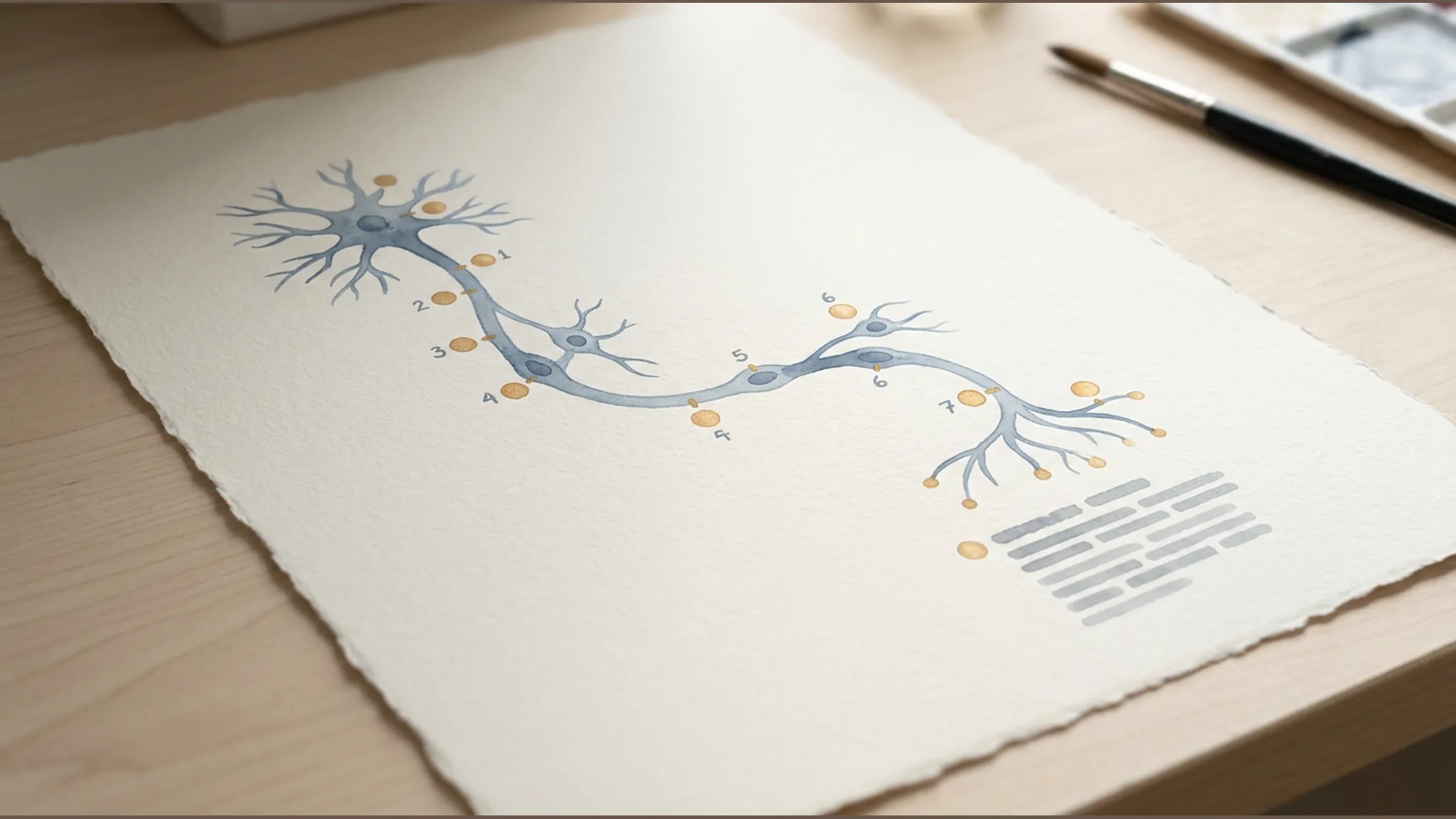
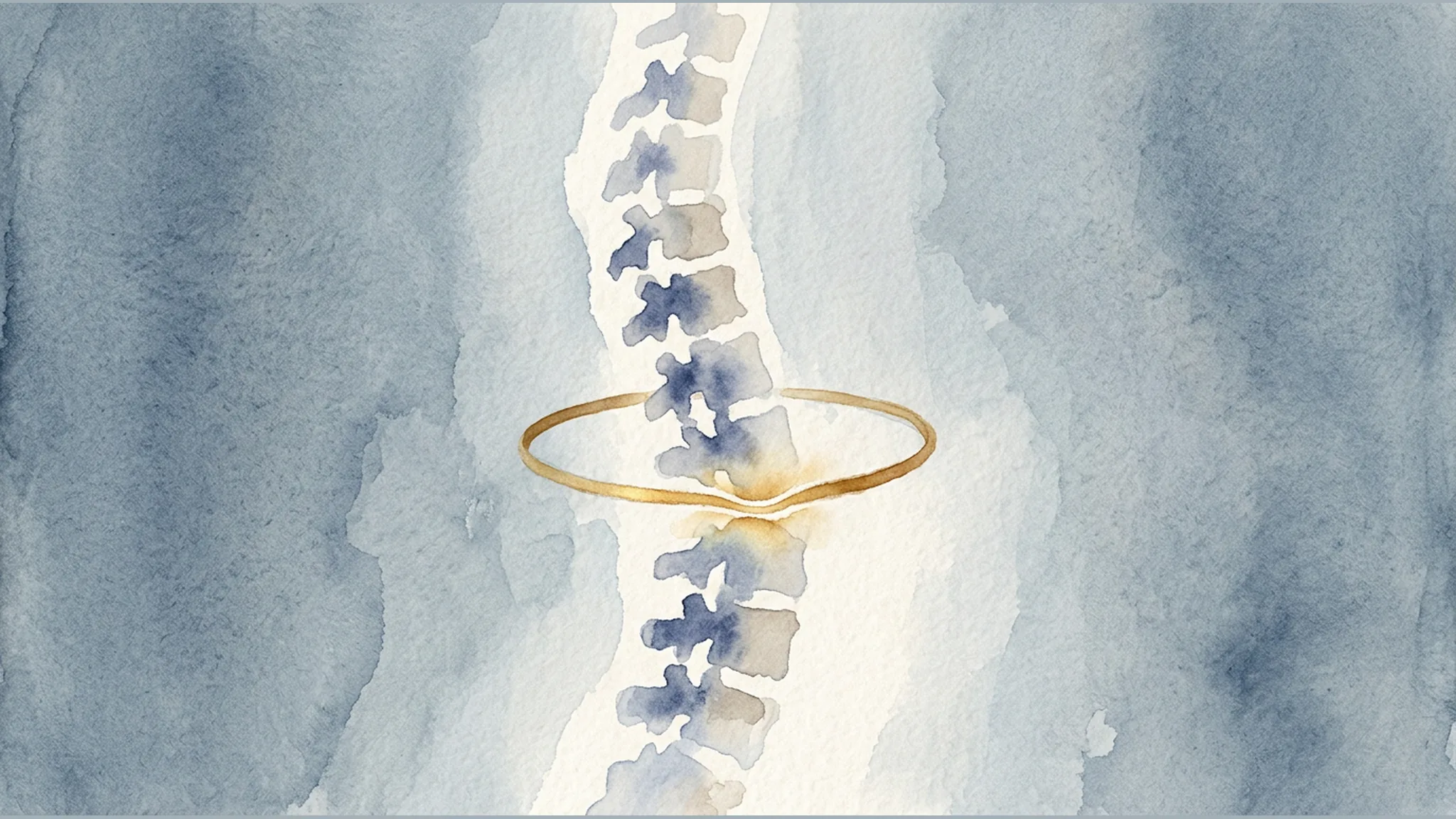
Cauda equina syndrome is not ordinary back pain. It is a rare but serious condition involving compression and dysfunction of the nerve roots at the lower end of the spinal canal. Those nerves help control sensation and movement in the legs, bladder, anus, and perineal or “saddle” area.
Because those functions can be permanently affected, medical sources describe cauda equina syndrome as a neurosurgical emergency. A herniated lumbar disc is identified in medical literature as the most common cause of cauda equina compression, but the condition itself is uncommon. That combination—common back-pain complaints, rare emergency diagnosis—helps explain why cauda equina syndrome can be missed in emergency rooms and clinics.
This article is educational information only, not legal advice, and does not create an attorney-client relationship. Medical and legal questions depend on the specific facts.
For Oregon patients and families, the legal question is not simply whether the outcome was severe. A missed or delayed diagnosis may raise medical-negligence issues only if the facts support duty, breach of the applicable standard of care, causation, and measurable injury—usually with qualified expert testimony.
For related timing and documentation issues, compare this topic with another time-sensitive missed emergency and with when an ER miss may become a malpractice issue.
Why Cauda Equina Syndrome Is Different From Ordinary Back Pain
Most back pain is not cauda equina syndrome. Many people have sciatica, disc problems, or severe pain without this emergency. But cauda equina syndrome is different because the compressed nerve roots can affect bladder, bowel, sexual, sensory, and leg function.
Medical sources describe cauda equina syndrome and conus medullaris syndrome as emergencies because they can involve:
- radiating back or leg pain;
- lower-extremity weakness, numbness, or sensory changes;
- bladder dysfunction;
- bowel dysfunction;
- sexual dysfunction; and
- saddle anesthesia or reduced sensation in the perineal area.
The danger is not just pain. The danger is neurological injury that may become permanent, including problems with leg movement, bladder control, bowel control, sexual function, and sensation.
Cauda equina syndrome affects the lumbosacral nerve roots below the end of the spinal cord; it is not the same anatomical diagnosis as an incomplete spinal cord injury. The symptoms can overlap, but the neurological classifications and medical questions are distinct.
The Symptoms That Should Raise Concern
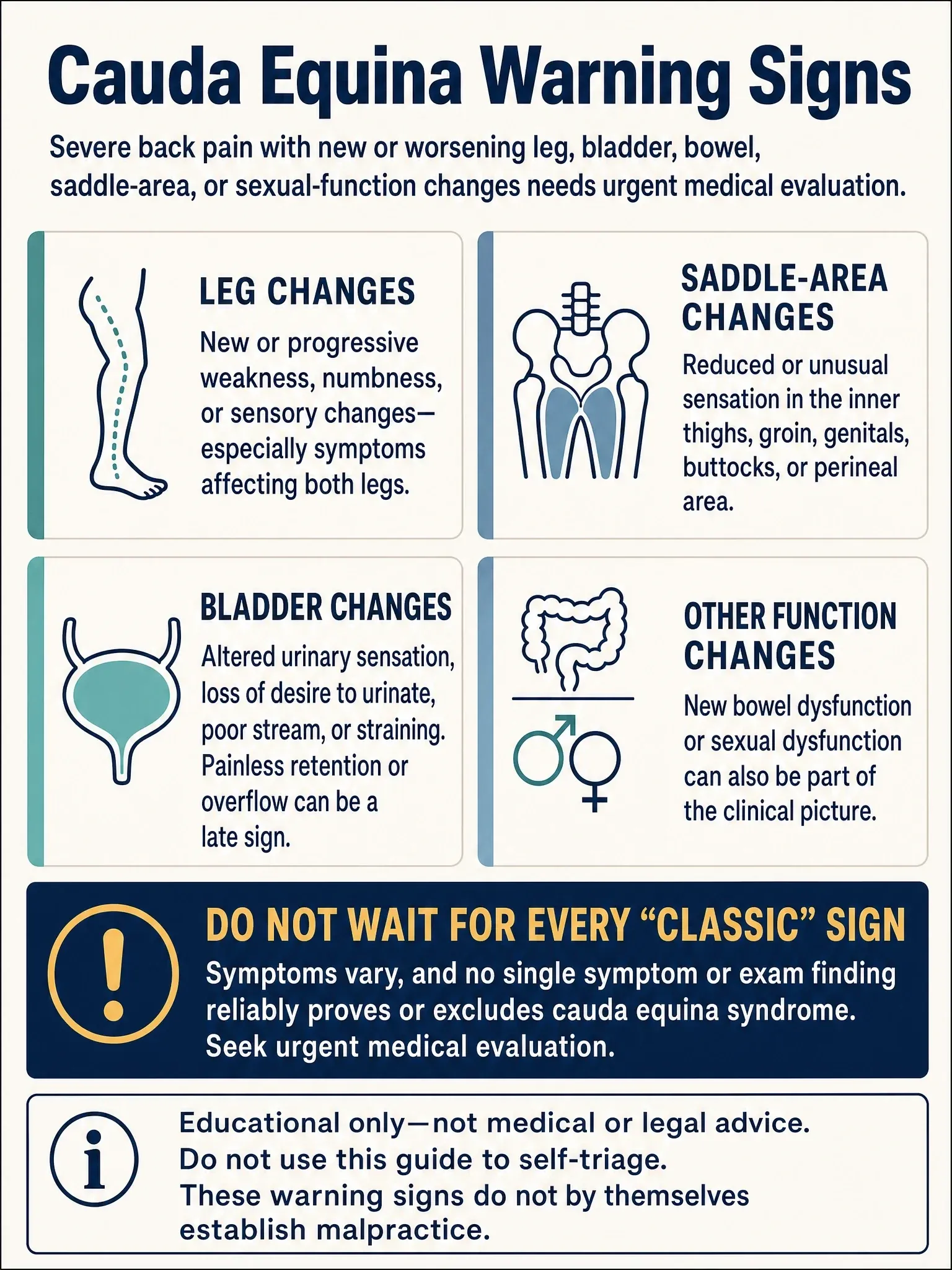
Cauda equina syndrome can be difficult to recognize because symptoms vary. Not every patient has every “classic” sign. Medical literature also cautions that no single symptom or exam finding reliably proves or excludes cauda equina syndrome.
That said, certain symptom patterns should raise concern—especially when they are new, progressive, or combined with severe back pain or a known herniated disc.
Back Pain, Sciatica, and Leg Changes
Back pain and sciatica are common reasons people seek emergency or clinic care. In cauda equina syndrome, pain may be accompanied by neurological changes in the legs, such as weakness, numbness, sensory changes, or progressive deficits.
The WFNS Spine Committee describes bilateral radiculopathy and progressive neurological deficits in the legs as definite red flags. But back and leg pain patterns can vary. The WFNS article also notes that back and leg pain are often present but are not essential to the clinical definition of cauda equina syndrome.
That matters because a patient should not be dismissed simply because the presentation does not match a textbook picture.
Saddle Anesthesia and Perineal Sensory Changes
“Saddle anesthesia” means reduced or abnormal sensation in the areas that would contact a saddle: the inner thighs, groin, genitals, buttocks, or perineal area. Patients may describe numbness when wiping, reduced genital sensation, or an unusual feeling in the groin or rectal area.
Medical sources identify saddle or perineal sensory disturbance as a key cauda equina warning sign. StatPearls states that perineal anesthesia associated with bladder dysfunction is typical of the start of cauda equina syndrome and the point when diagnosis and management become time-critical.
In real cases, timing can be disputed. A chart may not clearly show when the patient first reported saddle numbness, whether the question was asked, or how the symptom changed over time. That is one reason a careful timeline can become important later.
Bladder, Bowel, and Sexual Dysfunction
Bladder symptoms are especially important, but they must be understood carefully. Painless urinary retention can have strong predictive value as a stand-alone symptom, but medical sources also describe it as a late and potentially irreversible sign.
Clinicians should not have to wait for complete urinary retention before considering cauda equina syndrome when other concerning signs are present. Incomplete cauda equina syndrome may involve subtler urinary changes, including altered urinary sensation, loss of desire to void, poor stream, or straining while the patient can still urinate. Cauda equina syndrome with retention involves painless urinary retention and overflow incontinence when the bladder is no longer under normal control.
Bowel dysfunction and sexual dysfunction can also be part of the clinical picture. Like urinary symptoms, they may be uncomfortable for patients to raise unless someone asks directly and documents the answer.
Why CES Can Be Missed in the Emergency Room or Clinic
Cauda equina syndrome can be missed because it sits at the intersection of common and uncommon medicine: back pain is common, but true cauda equina syndrome is rare. The challenge is identifying the patient whose back pain is no longer routine.
Misses can involve many fact patterns, including:
- red-flag symptoms that were not asked about;
- urinary complaints treated as unrelated;
- saddle-area symptoms not documented;
- worsening leg weakness or sensory loss not escalated;
- reliance on an incomplete or falsely reassuring exam; or
- delay in obtaining MRI or specialist consultation when cauda equina syndrome was suspected.
Whether any of those facts amounts to negligence depends on the circumstances and expert analysis. Medical recommendations can help explain why the condition is urgent, but they do not automatically decide the Oregon legal standard of care.
No Single Exam Finding Rules It Out
The WFNS Spine Committee states that no symptom or sign, alone or in combination, can reliably diagnose or exclude cauda equina syndrome. The same article discusses the low sensitivity of clinical examination for excluding cauda equina syndrome and notes that the diagnostic value of digital rectal examination and anal tone has been questioned.
That does not mean a rectal exam is never appropriate or never useful. It means that one exam finding should not be treated as a complete substitute for the broader clinical picture when cauda equina syndrome remains a concern.
Why Timed Symptom Documentation Matters
In delayed cauda equina cases, time often matters. Important questions may include:
- When did severe back pain begin?
- When did leg weakness or numbness appear?
- When did saddle-area symptoms start?
- When did urinary changes begin?
- When were symptoms reported to medical providers?
- When was MRI ordered and completed?
- When was a spine surgeon, neurosurgeon, or orthopedic specialist consulted?
- When did decompression surgery occur, if surgery was performed?
A European Spine Journal review notes that deficient medical records—especially records lacking timed neurological deficits and bladder-function changes—are associated with higher litigation risk in cauda equina cases. From a patient or family perspective, that is not just a legal point. A clear timeline can help doctors and reviewers understand what happened and when.
Urgent MRI, Bladder Scans, and Surgical Consultation
Medical sources identify urgent MRI as central when cauda equina syndrome is suspected. StatPearls describes MRI as the gold-standard evaluation and says early MRI with neurosurgical or orthopedic consultation is imperative. The WFNS Spine Committee recommends urgent MRI in all patients with suspected cauda equina syndrome, citing the limits of clinical examination for excluding the diagnosis.
The practical issue in many cases is not whether back pain existed. It is whether the combination of symptoms should have led to urgent imaging, further evaluation, or specialist involvement.
What a Bladder Scan Can and Cannot Do
A bladder scan can help evaluate urinary retention by estimating post-void residual volume. Medical sources recognize that as a recommended part of evaluating urinary retention in suspected cauda equina syndrome.
But a bladder scan is not the same as an MRI. The WFNS recommendations caution that post-void residual testing should not dictate whether early MRI is obtained when cauda equina syndrome is suspected. A patient may still need urgent imaging and specialist review depending on the full presentation.
This article does not state a specific post-void residual threshold because the reviewed source materials do not establish one for Oregon emergency care or for a legal standard of care.
When Surgery Timing Becomes Central
When MRI confirms cauda equina syndrome or conus medullaris syndrome, medical sources generally emphasize decompression as soon as possible. The WFNS Spine Committee recommends decompression for MRI-proven cauda equina syndrome as soon as possible, with early decompression within 48 hours and preferably within 24 hours once diagnosis is established.
The timing evidence is not perfectly uniform. A European Spine Journal review describes a balance of evidence favoring decompression within 48 hours of cauda equina onset, with some evidence suggesting benefit within 24 hours, especially for incomplete cauda equina syndrome with progression. The same review notes that patients who undergo surgery while still in incomplete cauda equina syndrome generally have a better prognosis than those who have deteriorated to cauda equina syndrome with retention.
Those points are important, but they should not be overstated. Earlier surgery may matter, but it does not guarantee recovery. Outcomes and causation are case-specific.
When a Missed CES Diagnosis May Become an Oregon Medical-Negligence Issue
An Oregon medical-negligence case is not built on the fact of a bad outcome alone. The Oregon State Bar explains that a poor medical outcome does not, by itself, mean a provider was negligent. A malpractice claim generally requires proof of duty or standard of care, breach, causation, and measurable injury or damages. Most medical-malpractice cases require qualified expert testimony to establish standard of care and breach, and often causation and damages as well.
In a delayed cauda equina case, the questions may include:
- What symptoms were present and when?
- What information did each provider have?
- What would an ordinarily careful provider have done in the same or similar circumstances?
- Should MRI or consultation have happened earlier?
- Would earlier diagnosis and decompression likely have changed the outcome?
- What permanent injuries resulted from the delay, if any?
Those are medical and legal questions, not assumptions.
Oregon’s Standard-of-Care Framing
Oregon law provides a statutory duty-of-care framework for physicians. ORS 677.095(1) states that a physician licensed by the Oregon Medical Board must use the degree of care, skill, and diligence used by ordinarily careful physicians in the same or similar circumstances in the physician’s community or a similar community.
That is a case-specific standard. National or international medical recommendations may help explain medical urgency and inform expert review, but they do not automatically become the Oregon legal standard in a particular case.
Duty, On-Call Doctors, and Mead v. Legacy Health Sys.
Oregon has a reported Supreme Court decision involving cauda equina syndrome: Mead v. Legacy Health Sys. In Mead, the patient presented to the emergency room unable to walk because of severe low back pain and leg weakness. A July 1 MRI was later understood to show a herniated disk. A July 5 exam diagnosed a large herniated disk with cauda equina syndrome. Surgery relieved compression, but the delay resulted in substantial nerve damage affecting leg movement and bladder and bowel control.
Mead is useful because it shows that cauda equina delay issues have reached Oregon appellate courts. But it should be kept narrow. The Oregon Supreme Court stated that, in Oregon, a physician-patient relationship is a necessary predicate to stating a medical-malpractice claim against a physician. That can matter when on-call consultants, remote advice, or informal involvement are part of the story.
Mead does not create a universal rule that every cauda equina delay is malpractice or that a specific timeline always creates liability.
Causation and Damages in Delayed CES Cases
Even if a provider should have acted sooner, an Oregon claim still requires proof that the breach caused harm. In cauda equina cases, causation may focus on whether earlier MRI, consultation, or decompression would likely have prevented or reduced permanent injury.
Damages may involve serious long-term effects, including bladder dysfunction, bowel dysfunction, sexual dysfunction, sensory loss, mobility problems, pain, and future medical or care needs. But the existence and cause of those harms must be evaluated from the records, timeline, imaging, expert opinions, and the patient’s course before and after surgery.
Oregon Deadlines and Why Prompt Legal Review Matters
Oregon medical-negligence deadlines can be fact-sensitive. ORS 12.110(4) generally requires actions for injuries arising from medical, surgical, or dental treatment, omission, or operation to be filed within two years from when the injury is discovered or should have been discovered with reasonable care, and no later than five years from the treatment, omission, or operation, subject to statutory language involving fraud, deceit, or misleading representation.
ORS 12.115 contains a 10-year repose provision for negligent injury to person or property, but it does not extend shorter limitation periods such as ORS 12.110.
This is not deadline advice for any specific case. The date a claim accrues, the applicable defendant, and possible additional notice rules or exceptions can depend on facts not covered here. Prompt legal review is important if a family is concerned about a missed cauda equina diagnosis.
What Patients and Families Can Do After a Suspected Miss
Once the emergency has occurred, patients and families often feel overwhelmed. The most useful first steps are usually practical and evidence-focused.
Preserve a Timeline
Write down the sequence of events as soon as possible. Include dates and approximate times for:
- first severe back pain or sciatica;
- new leg weakness, numbness, or sensory changes;
- saddle-area or genital numbness;
- urinary changes, retention, incontinence, poor stream, or straining;
- bowel or sexual-function changes;
- calls to clinics, nurse lines, or specialists;
- emergency-room or urgent-care visits;
- MRI orders and MRI completion;
- specialist consultation;
- surgery; and
- symptoms after surgery.
Also note who was present and what they remember. Witness observations can matter, especially when records do not fully capture what the patient reported.
Request and Review Medical Records, But Do Not Treat Them as the Whole Story
Medical records are important, but they may not answer every question. Records can show what was charted, when imaging was ordered, what exams were documented, and when consultations occurred. They may also reveal gaps, unclear timing, or missing symptom details.
At the same time, medical records are not always the whole story. Family recollections, discharge instructions, phone logs, portal messages, imaging timestamps, and witness observations may help fill in the timeline.
Seek Medical Care for Current Symptoms
If you or a family member is currently experiencing severe back pain with new or worsening bladder, bowel, saddle-area, sexual-function, leg weakness, or numbness symptoms, do not use a legal article to self-triage. Seek urgent medical evaluation.
How Johnson Law Evaluates Potential Missed Cauda Equina Cases
Johnson Law reviews potential missed cauda equina cases by looking carefully at the medical timeline, red-flag symptoms, records, imaging, provider decisions, consultation timing, surgery timing, and resulting injuries. These cases often require expert review because the core questions involve both medical judgment and Oregon negligence law.
A careful review may ask whether warning signs should have led to urgent MRI or specialist consultation, whether a delay changed the outcome, and what long-term harms resulted. The answer is always case-specific. A serious injury does not automatically mean malpractice, and no lawyer can responsibly promise an outcome from the fact of a delayed diagnosis alone.
FAQ
What is cauda equina syndrome?
Cauda equina syndrome involves compression and dysfunction of the cauda equina nerve roots. These nerves affect the legs, bladder, bowel, anus, and perineal or saddle area. Medical sources describe cauda equina syndrome as a neurosurgical emergency because delay can lead to serious neurological harm.
Is urinary retention required for cauda equina syndrome?
No. Urinary retention can be a late sign. Incomplete cauda equina syndrome may involve subtler urinary changes, such as altered urinary sensation, loss of desire to void, poor stream, or straining while the patient can still urinate. Clinicians should not necessarily wait for complete retention before acting when other concerning signs are present.
Should suspected cauda equina syndrome get an MRI?
Medical sources identify urgent MRI as the gold-standard evaluation when cauda equina syndrome is suspected. The WFNS Spine Committee recommends urgent MRI in all patients with suspected cauda equina syndrome, while also recognizing that clinical examination alone has limits.
Does delayed cauda equina surgery always mean malpractice in Oregon?
No. A delayed diagnosis or bad outcome is not automatically malpractice. Oregon claims require proof of duty, breach of the applicable standard of care, causation, and injury, usually with qualified expert testimony.
How fast should cauda equina surgery happen?
Medical sources generally recommend decompression as soon as possible once cauda equina syndrome is established by MRI, often discussing surgery within 48 hours and preferably within 24 hours. The evidence on exact timing is not perfectly uniform, and earlier surgery does not guarantee recovery. Timing, causation, and prognosis are case-specific.
What deadline applies to an Oregon medical-malpractice claim?
ORS 12.110(4) includes a two-year discovery-based period and a five-year outer period for injuries arising from medical treatment, omission, or operation, subject to statutory caveats. Deadline questions depend on specific facts and should be reviewed promptly with a qualified Oregon attorney.
Because symptom timing and witness observations can matter, also see why medical records are not the whole story.
Sources
This article relies on the source materials and outline. Key sources identified there include:
- NCBI Bookshelf / StatPearls, “Cauda Equina and Conus Medullaris Syndromes,” for medical background, symptom ranges, urinary-retention cautions, and MRI evaluation.
- Vaishya et al., “Cauda equina, conus medullaris and syndromes mimicking sciatic pain: WFNS spine committee recommendations,” for suspected-CES MRI recommendations, clinical-exam limitations, bladder-scan cautions, and decompression-timing recommendations.
- Gardner, Gardner & Morley, “Cauda equina syndrome: a review of the current clinical and medico-legal position,” for red flags, incomplete CES versus CES-retention, timing uncertainty, ER response concepts, and documentation concerns.
- Mead v. Legacy Health Sys., 352 Or. 267, 283 P.3d 904 (2012), for an Oregon cauda-equina medical-malpractice case and physician-patient relationship framing.
- ORS 677.095, for Oregon physician standard-of-care language.
- ORS 12.110(4) and ORS 12.115, for Oregon limitation and repose language relevant to medical-treatment injury claims.
- Oregon State Bar, “Medical Malpractice,” for public legal-education framing that poor outcomes alone do not establish negligence and that expert testimony is commonly required.
Client-First Fee Promise
Client First = Bills First, Fees Second
Your unpaid medical bills do not have to make your lawyer's fee bigger. Johnson Law subtracts qualifying medical bills before calculating our fee, helping clients keep more of their settlement.
Applies to qualifying cases. Results vary.