Claim File Notes: Can You Get the Adjuster’s Internal Notes and Strategy?
Claim File Notes: Can You Get the Adjuster’s Internal Notes and Strategy?
After an Oregon crash, the insurance adjuster may sound like they are just making phone calls and collecting documents. Behind the scenes, the insurer is also building a claim file. That file may include dates, communications, estimates, medical-document references, liability notes, coverage issues, settlement authority, and internal impressions.
The practical question is understandable: can you get the adjuster’s claim-file notes? Sometimes parts of a claim file may become important later, especially if a claim turns into litigation or a coverage dispute. But it is not safe to assume every internal note, reserve number, legal strategy memo, or adjuster thought is automatically available on request.
This article is educational information only, not legal advice. Claim-file access, discovery, privileges, and policy duties are fact-specific.
Quick Answer: The Claim File Matters, But Access Depends on Context
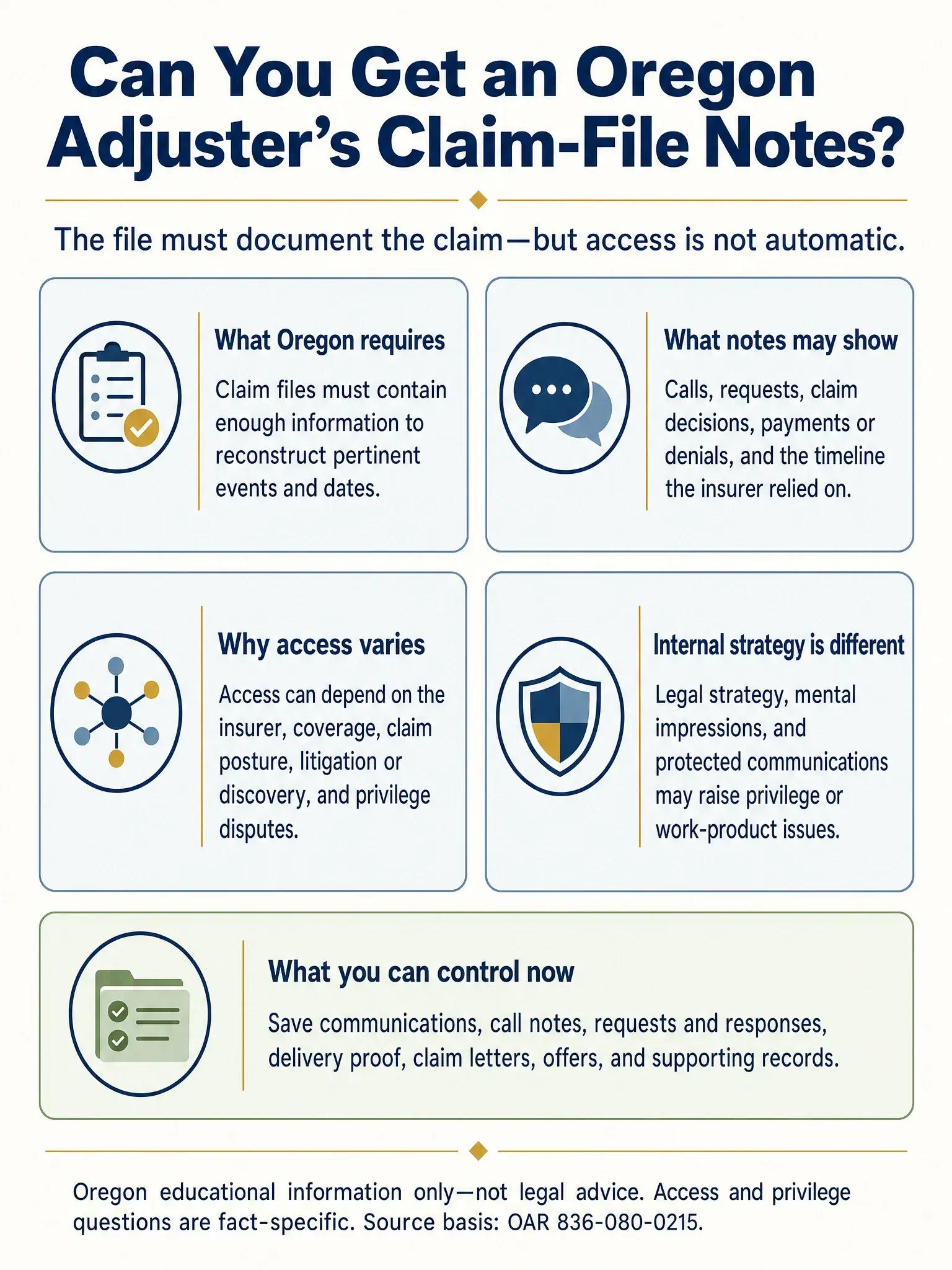
Oregon insurance rules require an insurer’s claim files to contain enough information that pertinent events and dates can be reconstructed. That rule helps explain why adjusters document calls, letters, requests, deadlines, claim decisions, and payment or denial activity.
But a rule requiring insurers to keep claim files is not the same as a rule giving every claimant immediate access to every internal note. Access may depend on whether you are dealing with your own insurer, another driver’s insurer, a PIP or UM/UIM claim, a lawsuit, a discovery request, a regulatory complaint, or a privilege dispute.
If the insurer is also pressing for a recorded statement or using a friendly adjuster script, remember that your answers can become part of the same claim history.
What May Be in an Insurance Claim File
Every claim file is different, but common categories include:
- claim numbers, insured names, policy references, and coverage notes;
- dates of calls, emails, letters, and document requests;
- police reports, photos, repair estimates, and witness information;
- medical bills, treatment records, wage-loss materials, and PIP documents;
- liability analysis, comparative-fault notes, and causation questions;
- payment logs, denial letters, settlement offers, and release drafts;
- supervisor reviews or diary entries about next steps.
Oregon’s claim-file rule is important because it requires enough detail to reconstruct pertinent events and dates. If the insurer later says you missed a request, failed to respond, delayed treatment, or changed your story, the claim file may contain the timeline the insurer is relying on.
Why Adjuster Notes Can Become Important
Claim-file notes may matter when there is a dispute about:
- what the adjuster asked for and when;
- whether the insurer acknowledged the claim on time;
- whether communications were answered;
- whether the investigation was prompt and reasonable;
- whether the insurer had enough information to accept, deny, or continue investigating;
- why a settlement offer was made or changed; or
- whether a denial letter identified the policy provision, facts, or law relied on.
For example, Oregon rules include timing standards for claim acknowledgment or payment after notice, appropriate replies to claim communications that reasonably call for a response, and prompt investigation unless the investigation cannot reasonably be completed within the stated time. Claim-file notes may show how the insurer tracked those steps.
What You Usually Can Control: Your Own Claim Record
Even if you cannot immediately see the insurer’s internal notes, you can build your own record. Save:
- every letter, email, text, portal message, and voicemail;
- claim numbers and adjuster contact information;
- dates of calls and summaries of what was discussed;
- document requests and what you sent in response;
- proof of delivery or upload confirmations;
- denial letters, reservation-of-rights letters, and settlement offers;
- medical bills, wage records, photos, repair documents, and receipts.
The related post on what to save after adjuster calls gives a broader checklist. Your record can help test whether the insurer’s timeline is accurate if the claim later becomes disputed.
Why “Internal Strategy” Is Different From Basic Claim Documents
There is a difference between documents that show what happened and internal materials that may reflect legal strategy, mental impressions, or protected communications. A claimant may be able to request certain documents, may receive some materials during litigation discovery, or may obtain information through court-supervised processes. But internal strategy notes can raise privilege and work-product issues.
That is why broad statements like “you can always get the claim file” or “the insurer never has to disclose anything” are both too simple. The answer depends on the claim posture, the type of document, the reason it was created, and whether a lawsuit or coverage dispute is underway.
Red Flags in the Claim Timeline
Consider getting claim-specific guidance if the insurer:
- keeps saying records are missing but will not identify what is missing;
- changes adjusters repeatedly without explaining next steps;
- delays investigation without written explanation;
- denies the claim without identifying the policy language or factual basis;
- pressures you to accept a quick settlement offer before the record is complete; or
- relies on your earlier statement to challenge later medical or wage records.
Those issues may connect to the broader signs that a crash is more than a simple insurance claim.
Sources
Client-First Fee Promise
Client First = Bills First, Fees Second
Your unpaid medical bills do not have to make your lawyer's fee bigger. Johnson Law subtracts qualifying medical bills before calculating our fee, helping clients keep more of their settlement.
Applies to qualifying cases. Results vary.