The Quick Cash Settlement Offer After an Oregon Crash: Why It Can Be Risky and How to Evaluate It
The Quick Cash Settlement Offer After an Oregon Crash: Why It Can Be Risky and How to Evaluate It
A quick settlement offer after a crash is not automatically unfair, unlawful, or too low. Sometimes an offer may be reasonable for the facts that are known.
The risk is timing. A fast check can arrive before you know what the release covers, how your injuries are developing, whether fault is disputed, how PIP benefits fit in, or whether the vehicle-value number is accurate. Before you sign or cash anything, slow down long enough to answer one question: what rights are you giving up in exchange for this money?
This Oregon-focused guide explains how to evaluate an early or low settlement offer after a car accident. It is educational information only, not legal advice for any specific case.
A Fast Settlement Check Can Feel Helpful — But It May Come Too Soon
After a crash, quick cash can feel practical. Bills may be arriving. Your car may be in the shop or declared a total loss. An adjuster may sound helpful and may present the offer as a simple way to “wrap things up.”
But settlement offers are often tied to finality. If the offer requires a release, you may be agreeing that certain claims against certain parties are over. That can be risky when important parts of the claim are still uncertain, including:
- whether your medical condition has stabilized;
- whether additional treatment, work restrictions, or out-of-pocket costs will appear later;
- whether the insurer is assigning you some percentage of fault;
- whether the offer includes bodily injury, property damage, total-loss value, or something else;
- whether PIP benefits are being handled separately; and
- whether any real legal deadline is being confused with artificial urgency.
The point is not that every early offer is a trap. The point is that a fast offer deserves careful review before it becomes a final agreement.
If the decision has moved beyond evaluating one offer and into whether to keep negotiating or consider filing suit, see Johnson Law’s guide to settlement versus lawsuit decision points. If the insurer later describes its number as final, use a separate framework for how to evaluate a claimed final offer.
What a Settlement Offer May Actually Be Asking You to Give Up
Not every settlement offer covers the same thing. One of the first steps is to separate bodily-injury claims from vehicle damage, total-loss disputes, and PIP benefits.
Bodily-Injury Releases
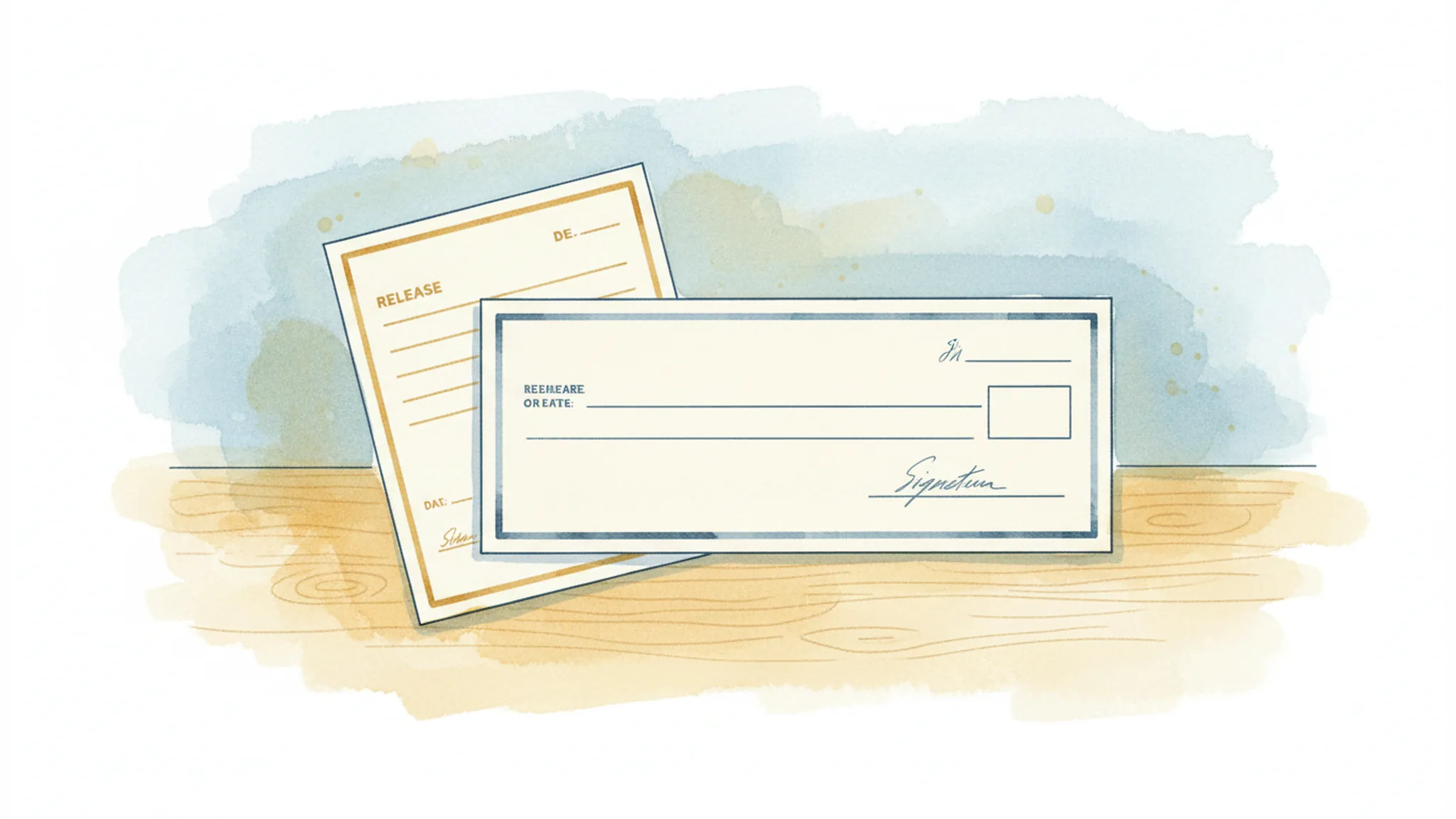
A bodily-injury settlement may ask you to sign a release. A release is a contract. Depending on the language, it may end the identified claims against the identified parties.
Oregon law recognizes that this can be a serious step. For certain in-person bodily-injury releases obtained by a motor vehicle liability insurer representative from a person eligible for PIP benefits, ORS 742.548 requires conspicuous language explaining that the document is a binding contract, that it concludes the identified claims, and that no further claims can be made against the listed parties after signing.
That does not mean every release has the same form, every release is covered by that statute, or every signed release can be undone. It means you should read the release itself, identify exactly who and what it releases, and avoid relying on a verbal summary of what the document supposedly means.
Property Damage and Total-Loss Offers
Vehicle damage is separate from bodily-injury value. A total-loss offer may raise questions about the vehicle’s valuation, comparable vehicles, options, mileage, condition, and whether the settlement check contains “full and final” language.
Oregon law requires an insurer that declares a vehicle a total loss and offers a cash settlement to provide valuation or appraisal reports relied on, along with a written statement about the total loss, valuation, insurer duties, and contacting the Oregon Division of Financial Regulation. Oregon law also says that when the parties cannot agree on total-loss value, the insurer must pay the undisputed amount, and accepting that undisputed amount does not waive the right to pursue additional amounts.
The Oregon Division of Financial Regulation advises consumers who remain in a dispute over a total-loss offer not to cash a check that says something like “full and final settlement.” DFR also recommends reviewing the insurer’s valuation reports, correcting vehicle details, checking whether comparable vehicles are local and comparable, documenting contrary values, and sending that documentation to the insurer for review.
PIP Benefits Are Related, But Not the Same as Your Injury Claim
Oregon auto policies covering private passenger vehicles issued for delivery in Oregon generally must provide personal injury protection, often called PIP, for insured people, certain household family members and children, passengers, and pedestrians struck by the insured vehicle.
PIP can pay certain benefits regardless of who caused the crash. Oregon PIP medical benefits generally include reasonable and necessary medical, hospital, dental, surgical, ambulance, and prosthetic expenses incurred within two years after injury, up to $15,000 in the aggregate.
But PIP is not the same thing as the full value of a bodily-injury claim against an at-fault driver. A quick settlement offer may involve PIP-related language, liability-release language, or both. Oregon also has a specific disclosure rule for certain bodily-injury releases obtained within 60 calendar days after an accident from a PIP-eligible person: the release must state that PIP insurer recovery rights for medical-benefit payments are not impaired, subject to liability limits.
If the paperwork mixes bodily injury, PIP, and property damage in a way that is hard to follow, that is a reason to pause and get clarity before signing.
Also ask whether any health insurance reimbursement claim, provider lien, Medicare or Medicaid interest, workers’ compensation issue, PIP reimbursement issue, or attorney-fee term could affect the net amount you actually keep. Those issues are fact-specific and are not the same as the headline settlement number. For fee-agreement background, see our guide to questions to ask about Oregon contingency fees before signing.
Why Early Offers Are Often Hard to Evaluate
An offer can look attractive in isolation and still be difficult to evaluate fairly. The number only makes sense if you know what it is being compared against.
Your Medical Picture May Still Be Incomplete
Early in a claim, you may not know the full medical picture. Symptoms can change. Treatment may continue. Work restrictions, follow-up appointments, or out-of-pocket expenses may not be fully documented yet.
That does not mean you should make medical decisions for claim-value reasons. Medical care decisions belong between you and your providers. From a claim-evaluation standpoint, however, it is risky to treat an early snapshot as the whole story if the facts are still developing.
For settlement-timing context, Johnson Law also explains why maximum medical improvement can matter before settling, while avoiding any rule that every claim must wait for that milestone.
For a broader documentation perspective, see why medical records are not the whole story in many Oregon injury claims.
Fault May Still Be Under Investigation
Fault matters because Oregon uses comparative fault. Under ORS 31.600, a claimant’s damages may be reduced in proportion to the claimant’s percentage of fault, and recovery depends on whether the claimant’s fault is not greater than the combined fault of the specified others.
That means a settlement offer may be based not only on claimed damages, but also on the insurer’s view of responsibility. Oregon DFR explains that insurers have up to 45 days to investigate an accident to determine who is responsible for what share of damages. Oregon administrative rules also require insurers to complete claim investigations within 45 days after receiving notice of a claim unless the investigation cannot reasonably be completed within that time.
If an offer arrives before witness information, photos, crash reports, recorded answers, or other liability evidence have been reviewed, the fault assumption behind the offer may be unclear. For a closer look at formal claim interviews, see our guide to recorded statements after an Oregon crash.
The Offer May Follow Earlier Adjuster Conversations
An early offer often follows early claim communications. What you said in an adjuster call, how you described your injuries, and whether you agreed with a version of the crash can influence how the insurer evaluates the claim.
Oregon rules also limit certain pressure tactics. For example, an insurer may not tell a third-party claimant that rights may be impaired if a form or release is not completed within a given time unless the statement is for notifying the claimant of a relevant statute of limitations.
Real deadlines matter. Artificial pressure is different. If the urgency is coming from the adjuster’s preferred timeline rather than an actual legal deadline, slow down and ask what deadline applies and why. For the earlier-call version of this problem, see how a friendly adjuster call can backfire.
Oregon Rules That Matter When an Insurer Makes an Offer
Oregon insurance rules do not tell you the exact value of your claim. They do, however, provide guardrails for how insurers handle claims.
Claim Investigation and Communication Timelines
Oregon administrative rules require an insurer to complete its claim investigation within 45 days after receiving notice of a claim unless the investigation cannot reasonably be completed within that time.
For first-party claims, Oregon rules separately require the insurer to advise the claimant of claim acceptance or denial within 30 days after receiving properly executed proofs of loss. If the insurer needs more time, it must provide notice within that 30-day period and continue written updates every 45 days while the investigation remains incomplete. Written denials must reference the policy provision, condition, or exclusion the insurer relies on.
These rules do not mean every slow investigation or low offer automatically violates the law. They do mean you can ask practical questions: Has the insurer completed a reasonable investigation? What information is still missing? Is the offer based on documented facts or assumptions?
Unfair Claim Settlement Practices
ORS 746.230 identifies several unfair claim settlement practices. Examples include misrepresenting facts or policy provisions, failing to promptly acknowledge claim communications, refusing to pay claims without a reasonable investigation, and failing to attempt in good faith to promptly and equitably settle claims where liability has become reasonably clear.
The statute also identifies as an unfair practice compelling claimants to initiate litigation to recover amounts due by offering substantially less than amounts ultimately recovered.
Those rules are important context for low or rushed offers. But an article cannot decide whether a specific offer is unlawful without the claim file, the policy language, the evidence, the damages, and the communications. Treat these rules as warning lights, not automatic conclusions.
Oregon’s Narrow Rescission Rule for Certain In-Person Releases
If you already signed, act quickly to find out whether any rescission right applies. ORS 742.548 provides a limited five-business-day rescission right for certain in-person bodily-injury releases obtained from PIP-eligible people by motor vehicle liability insurer representatives. The statute requires written notice to the insurer no later than five business days after execution and prompt performance of other required rescission acts.
This is narrow. It is not a universal cooling-off period for every settlement, every release, every phone or electronic transaction, or every type of claim. If you think it may apply, the deadline is short and fact-specific.
A Practical Checklist Before You Accept, Reject, or Counter
Before responding to a quick settlement offer, work through the basics. You do not need a perfect legal theory to ask clear questions.
1. Identify Exactly What the Offer Covers
Ask whether the offer covers:
- bodily injury;
- property damage;
- total-loss vehicle value;
- rental or loss-of-use issues;
- PIP benefits;
- uninsured or underinsured motorist benefits;
- all claims against one person or company; or
- all claims against multiple parties.
Do not assume that “settlement” means only one category. A property-damage payment should not be confused with a bodily-injury release, and PIP benefits should not be treated as the full measure of an injury claim.
2. Read the Release Language Before You Sign or Cash Anything
Look for language such as “full and final settlement,” “release of all claims,” names of released parties, dates, claim numbers, and whether the release covers known and unknown claims.
For total-loss disputes, Oregon DFR specifically warns consumers not to cash a check that says something like “full and final settlement” if they remain in dispute over the offer. More broadly, if you do not understand whether cashing a check or signing a document ends a claim, pause before taking that step.
3. Compare the Offer to Current Documentation
An offer is easier to evaluate when you can compare it to records. Depending on the claim, relevant documentation may include:
- medical bills and records already available;
- photos of injuries, vehicles, and the scene;
- repair estimates;
- total-loss valuation reports;
- local comparable vehicle information;
- wage-loss information, if applicable;
- receipts for out-of-pocket expenses;
- written claim communications;
- adjuster notes, emails, or letters; and
- the proposed release itself.
For vehicle valuation disputes, Oregon DFR recommends reviewing the insurer’s valuation reports, correcting errors in the vehicle details, making sure comparable vehicles are local and comparable, documenting contrary values, and sending copies to the company for review.
For documentation steps after claim communications, see what to save after the adjuster calls.
4. Ask Whether Fault, Treatment, or Vehicle Value Is Still Unsettled
An early offer may be difficult to evaluate if:
- the insurer has not finished investigating fault;
- the insurer says you were partly responsible;
- your treatment is ongoing;
- future medical costs are unclear;
- work limitations are not yet documented;
- your vehicle was declared a total loss and you disagree with the valuation; or
- the offer does not explain how the number was calculated.
Uncertainty does not always mean you should reject an offer. It does mean the offer may need more support before you can make an informed decision.
5. Check Deadlines Without Letting Artificial Urgency Control the Decision
Some deadlines are real. Oregon’s general limitation period for personal-injury claims not arising on contract and not otherwise specifically enumerated is two years. Claims involving public bodies can require Oregon Tort Claims Act notice much sooner: generally within 180 days for non-death claims and within one year for wrongful-death claims. Oregon wrongful-death actions have separate timing rules.
Those are only examples. Deadlines can depend on the parties, claim type, disability or tolling issues, death, public-body involvement, and filing or service rules.
The key is to separate real legal deadlines from pressure to sign a form by an adjuster’s chosen date. If someone says you will lose rights unless you sign quickly, ask what specific deadline applies and where it comes from.
When a Quick Offer Is a Sign the Claim Is Not Simple
A quick settlement offer may be a signal that the claim needs closer attention, especially when it appears alongside other complications, such as:
- a release request before treatment is complete;
- disputed fault or allegations that you were partly responsible;
- injuries that are changing or not fully documented;
- a crash involving a public body or government employee;
- a total-loss valuation dispute;
- a check or letter using “full and final settlement” language;
- pressure to sign before you understand PIP, property damage, and bodily injury separately; or
- an offer that does not explain the assumptions behind the number.
For more warning signs, see signs your Oregon crash may be more than a simple insurance claim.
What If the Insurer Will Not Pay More or Denies the Claim?
This article focuses on evaluating an offer before you accept it. If the insurer refuses to move, disputes liability, or denies the claim, the next steps may be different.
At that point, the issue may shift from “Should I accept this offer?” to “What evidence, policy language, deadlines, and procedures control the dispute?” Oregon’s unfair claim settlement practices statute and claim-handling rules may still matter, but a denial or refusal-to-pay situation deserves its own analysis.
For the denial stage, see what happens if the insurance company denies your claim.
Bottom Line: Slow Down Before You Trade Certainty for Finality
A fast settlement offer can provide certainty. Certainty has value. But finality also has a cost.
Before accepting, rejecting, or countering, make sure you understand what the offer covers, what claims the release would end, whether medical treatment or fault investigation is still developing, how PIP and property damage fit in, and whether any real legal deadline applies.
If the paperwork is unclear, the offer feels rushed, or the claim involves injuries, disputed fault, a public body, a total-loss dispute, or a broad release, consider getting case-specific guidance before you sign. This article is educational information about Oregon issues and is not legal advice.
FAQ
Is a quick settlement offer after an Oregon crash always a lowball offer?
No. A quick offer is not automatically a lowball offer or an unlawful offer. It may be reasonable depending on liability, damages, policy limits, documentation, and what the release covers. The problem is that early offers often arrive before the full claim is clear, so they deserve careful review.
Can I change my mind after signing a car accident settlement release in Oregon?
Only in narrow circumstances. ORS 742.548 provides a limited five-business-day rescission right for certain in-person bodily-injury releases obtained by motor vehicle liability insurer representatives from PIP-eligible people. It is not a universal cooling-off period for every release or settlement.
Should I cash a settlement check if I disagree with the amount?
Be careful. Oregon DFR warns consumers in total-loss disputes not to cash a check that says something like “full and final settlement” if they still dispute the offer. Review the check, letter, and release language before cashing or signing anything that may end a claim.
How long does an Oregon insurer have to investigate a claim?
Oregon rules generally require an insurer to complete a claim investigation within 45 days after receiving notice of the claim unless the investigation cannot reasonably be completed within that time. First-party acceptance or denial timing has separate proof-of-loss rules and continuing update requirements.
Does PIP mean I do not need a bodily-injury settlement?
No. PIP may cover certain benefits, including qualifying medical expenses, but it does not determine the full value of a bodily-injury claim. PIP, property damage, total-loss value, and bodily-injury settlement value should be evaluated separately.
What if the offer is low because the insurer says I was partly at fault?
Oregon comparative fault can reduce damages based on the claimant’s percentage of fault, and recovery depends on the fault allocation. If an offer is based on alleged partial fault, ask what evidence supports that allocation and whether the investigation is complete.
Sources and Source Notes
- ORS 746.230 — Oregon unfair claim settlement practices, including reasonable investigation, good-faith settlement where liability is reasonably clear, and substantially low offers that compel litigation.
- OAR 836-080-0230 — Oregon prompt claim investigation rule, including the 45-day investigation standard unless the investigation cannot reasonably be completed in that time.
- OAR 836-080-0235 — Oregon standards for prompt and fair settlements, including first-party acceptance/denial timing, continuing updates, written denial requirements, and limits on certain third-party pressure statements.
- ORS 742.548 — required disclosure language and narrow rescission rule for certain in-person bodily-injury releases involving PIP-eligible people.
- ORS 742.546 — required disclosure in certain bodily-injury releases related to PIP insurer recovery rights.
- ORS 742.520 and ORS 742.524 — Oregon PIP availability and basic medical-benefit parameters.
- ORS 31.600 — Oregon comparative fault rule.
- ORS 12.110 — Oregon general two-year personal-injury limitation period for claims not arising on contract and not otherwise specifically enumerated.
- ORS 30.275 — Oregon Tort Claims Act notice timing for claims against public bodies and their officers, employees, or agents.
- ORS 30.020 — Oregon wrongful-death timing rules.
- ORS 742.554 and ORS 742.558 — Oregon total-loss valuation report, written statement, and undisputed-payment rules.
- Oregon Division of Financial Regulation, “What to do if you are in an accident” — consumer guidance on notifying insurers, investigation timing, and Oregon DMV crash-report thresholds.
- Oregon Division of Financial Regulation, “Totaled vehicle” — consumer guidance on reviewing total-loss valuations and avoiding “full and final settlement” checks when value remains disputed.
Disclaimer: This article provides general educational information about Oregon insurance and injury-claim issues. It is not legal advice and does not create an attorney-client relationship. Claim deadlines, release language, insurance coverage, and settlement value depend on the specific facts and documents involved.
Client-First Fee Promise
Client First = Bills First, Fees Second
Your unpaid medical bills do not have to make your lawyer's fee bigger. Johnson Law subtracts qualifying medical bills before calculating our fee, helping clients keep more of their settlement.
Applies to qualifying cases. Results vary.