Recorded Statement After a Crash: What the Insurance Adjuster May Be Looking For
Recorded Statement After a Crash: What the Insurance Adjuster May Be Looking For
If an insurance adjuster asks for a recorded statement after an Oregon crash, pause before treating it like a casual phone call. The request may be part of the insurer’s claim investigation, and the answers can become part of the claim record.
That does not mean every request is improper. Oregon insurers have duties to investigate claims and communicate with claimants. It also does not mean every Oregon crash claimant has the same obligation to give a recorded statement. The answer can depend on whether the request comes from your own insurer or another driver’s insurer, what your policy says, and where the claim stands.
This article is educational information only, not legal advice. Recorded-statement decisions are fact-specific, especially when fault, injuries, coverage, or settlement pressure is disputed.
Quick Answer: A Recorded Statement Can Matter, But the Rules Depend on Context
A recorded statement is a formal question-and-answer session, usually by phone, that the adjuster records and adds to the claim file. It is different from an ordinary update call or an early adjuster conversation, although the two can feel similar when they happen soon after a crash.
In Oregon, there is no simple blanket rule that every injured person must give a recorded statement whenever an adjuster asks. There also is no safe blanket rule that a person can always ignore or refuse the request without consequences.
The context matters:
- Your own insurer may have policy conditions that require prompt notice, cooperation, forms, proof of loss, or other claim-related information.
- The other driver’s insurer may investigate the accident facts and its insured’s legal responsibility, but that does not automatically mean an injured third-party claimant has the same duties owed to their own insurer.
- The claim posture matters. A property-damage claim, PIP claim, disputed injury claim, or liability claim against another driver may involve different questions and different risks.
A careful general approach is not to guess about your obligations. Identify who is asking, why they want the statement, whether it will be recorded, and whether you need claim-specific guidance before answering.
Why Insurers Ask for Recorded Statements
The phrase “recorded statement” can sound adversarial. A more accurate starting point is this: insurers investigate claims. Oregon law requires insurers to adopt reasonable standards for prompt claim investigation, prohibits refusing to pay claims without a reasonable investigation based on all available information, and requires good-faith settlement efforts when liability has become reasonably clear.
A recorded statement may be one way an insurer gathers information. It can also create a fixed record of what the claimant said at a particular time.
Oregon Insurers Have Investigation Duties
Oregon’s claim-handling rules define an insurance “investigation” broadly as activities directly or indirectly related to determining liabilities under insurance-policy coverages. Oregon consumer guidance likewise explains that insurers may investigate accident facts and determine who is responsible for what share of damages.
That investigation can include questions about how the crash happened, what injuries or losses are being claimed, what coverage may apply, and whether later records match earlier statements.
The important point is balance. An insurer may have a legitimate reason to ask questions, but a recorded statement is still a formal claim event. It should not be treated like a harmless chat.
The Adjuster Is Building a Claim Record
Oregon rules require insurer claim files to contain enough detail that pertinent events and dates can be reconstructed. A recorded statement can become part of that timeline.
That means the adjuster may be trying to clarify:
- when and where the crash happened;
- who was involved;
- what each driver, cyclist, pedestrian, or witness reportedly did;
- what injuries or property damage were reported;
- what treatment, missed work, or expenses are being claimed;
- what coverage or benefits may apply; and
- whether the statement is consistent with other records.
Those are claim-investigation topics. The risk for an injured person is that an incomplete, rushed, or speculative answer can later be treated as part of the claim history.
First-Party vs. Third-Party Requests: Who Is Asking Matters
Before giving a recorded statement, it helps to separate two very different situations.
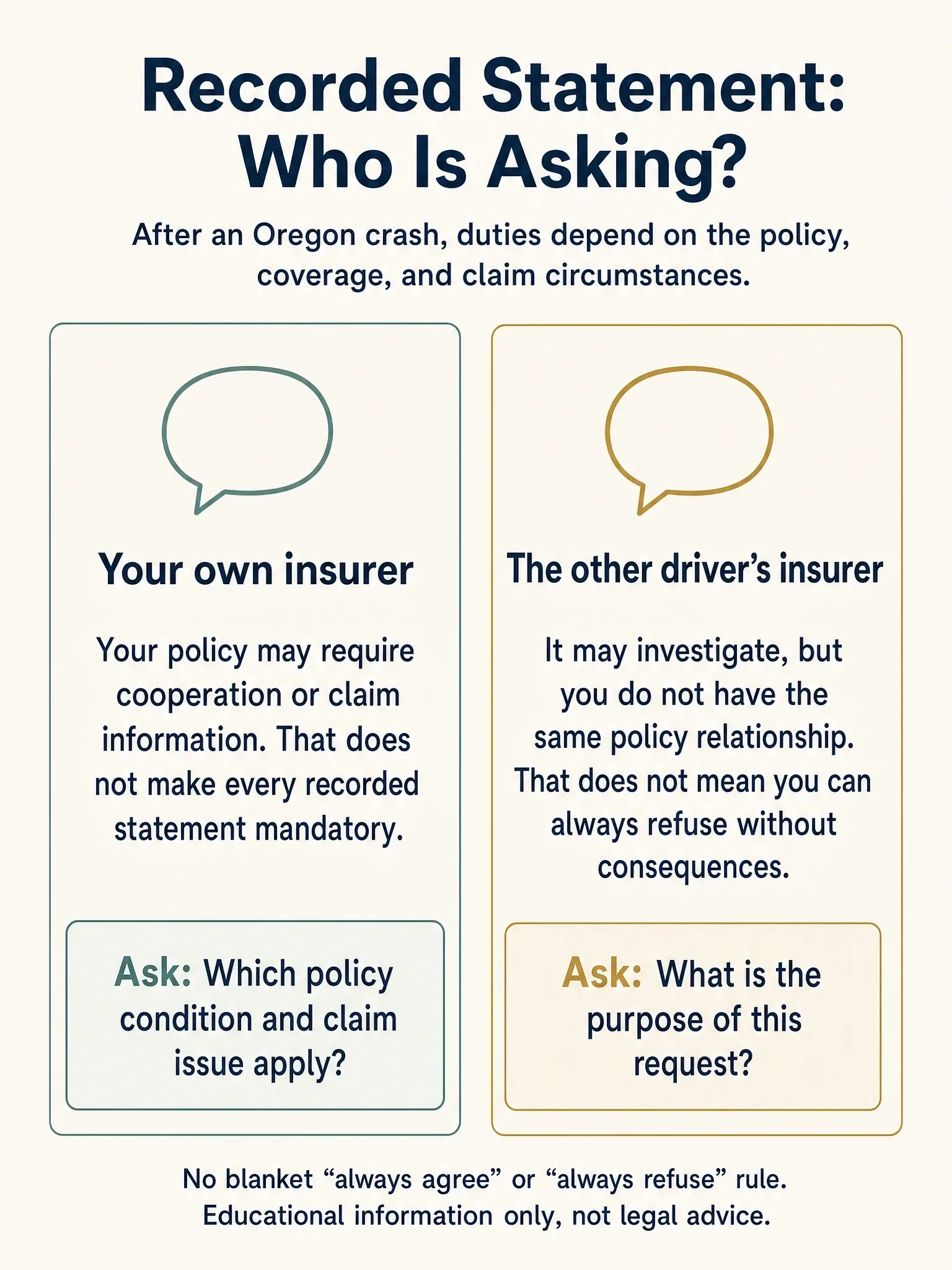
Your Own Insurer
Your own insurer is often called the first-party insurer. Oregon’s Division of Financial Regulation says most policies require prompt notification of a claim after an accident. Oregon rules also require insurers, after receiving notice from a first-party claimant, to provide necessary claim forms, instructions, and reasonable assistance so the claimant can comply with policy conditions and reasonable insurer requirements.
That does not tell you exactly what your policy requires in your specific situation. Some duties may come from policy language, such as cooperation or proof-of-loss requirements. Without reviewing the policy and the claim facts, it is not safe to say exactly what must be provided, when, or in what format.
If your own insurer asks for a recorded statement, take the request seriously. Ask what coverage or claim issue the statement relates to, whether there are policy deadlines, and whether the insurer will identify the specific policy condition it is relying on.
The Other Driver’s Insurer
The other driver’s insurer is usually handling a third-party claim. Oregon claim-handling rules define a third-party claimant as someone asserting a claim against a person insured under an insurance policy.
The other driver’s insurer may investigate the accident facts and determine the legal obligation of the person it insures. But that is not the same as saying you have the same policy duties to that insurer that you may have to your own company.
If the other insurer asks for a recorded statement, it is reasonable to clarify the purpose of the request. For example: Is the adjuster investigating liability? Property damage? Injury causation? Coverage? Settlement value? A careful answer starts with knowing why the statement is being requested.
What the Adjuster May Be Trying to Clarify
An adjuster’s questions often fall into predictable categories. The categories below are not proof of improper motive; they are the types of issues insurers commonly investigate when evaluating a crash claim.
Fault and Comparative Negligence
Oregon uses a comparative negligence framework. In general terms, a claimant’s contributory negligence does not bar recovery for injury to person or property if the claimant’s fault was not greater than the combined fault of specified others, but damages are reduced in proportion to the claimant’s percentage of fault.
Because fault percentages can affect claim value, a recorded statement may focus on facts such as speed, signals, lane position, lookout, following distance, right of way, visibility, and what each person did immediately before impact.
If you do not know an answer, guessing can create problems. “I do not know” or “I do not remember” may be more accurate than filling in details because the adjuster expects a response.
Timeline and Accident Details
Adjusters may ask for a minute-by-minute timeline: where you were coming from, where you were going, what you saw, what you heard, when you first noticed the other vehicle, and what happened after the crash.
They may also ask about weather, traffic, lighting, road conditions, witnesses, police response, photographs, and vehicle damage. Those questions can help the insurer reconstruct the event and compare your statement with the police report, repair records, photographs, and other claim materials.
Injuries, Symptoms, Treatment, and Daily Impact
Recorded statements often include questions about injuries, symptoms, treatment, missed work, and daily limitations. The risk is not that you should avoid truthful answers. The risk is that early answers may be incomplete.
For example, a person may accurately say they are waiting for an appointment, still trying to understand what hurts, or unsure how symptoms will affect work and daily activities. A short statement like “I’m fine” may not reflect the actual injury picture if the person is trying to be polite or end the call quickly.
For broader documentation guidance, the related article on why medical records are not the whole story can help explain why day-to-day effects and non-medical records may matter.
Prior Conditions, Gaps, and Consistency
An adjuster may ask about prior injuries, prior claims, earlier symptoms, treatment gaps, work history, or activities after the crash. These questions may relate to causation, damages, or consistency with later records.
This is another area where precision matters. If a question is broad, unclear, or assumes facts that are not accurate, it is better to clarify than to agree with a summary that does not match your memory.
Coverage and Available Benefits
Some recorded-statement questions may relate to coverage. Oregon personal injury protection law requires Oregon private-passenger motor vehicle liability policies to provide PIP benefits to specified categories of people, including the insured, resident family members, passengers occupying the insured vehicle, and pedestrians struck by the insured vehicle. PIP benefits include payments for expenses, loss of income, and loss of essential services as provided by Oregon law.
This article does not address PIP dollar limits, wage-loss percentages, or every coverage condition. Those details require separate review of current law, policy language, and the facts of the claim.
Common Recorded-Statement Risk Areas
Recorded statements become risky when the questions move faster than the person’s memory, records, or medical understanding. The goal is not to memorize a script. The goal is to be accurate and avoid speculation.
Guessing When You Do Not Know
Guesses can sound like facts on a transcript. If you are unsure about speed, distance, timing, traffic signals, impact angle, or what another person did, say so. It is usually better to be clear about uncertainty than to provide a confident estimate you cannot support.
Giving Precise Estimates Too Early
Adjusters may ask for exact times, speeds, distances, pain levels, or recovery expectations. Sometimes an estimate is all you have. If so, label it as an estimate. Do not let a rough impression become a precise answer unless you are actually confident in the number.
Saying “I’m Fine” or Minimizing Injuries
Many people downplay pain or limitations in ordinary conversation. In a recorded statement, casual minimizing language can be misunderstood. If you are still being evaluated, still monitoring symptoms, or do not yet know the full effect of the crash, it is more accurate to say that than to summarize your condition too broadly. If the issue is an earlier “I’m fine” statement followed by later symptoms, see the related guide on feeling fine at the scene but hurting later.
Agreeing With the Adjuster’s Summary Without Checking It
At the end of a statement, an adjuster may summarize what they believe you said. Listen carefully. If the summary is incomplete or inaccurate, clarify it. You do not need to adopt wording that does not match your memory.
Oregon Claim-Handling Timelines and Why Timing Matters
Recorded-statement requests often come quickly because insurers have claim-handling timelines.
Oregon rules require an insurer to acknowledge claim notification or pay the claim no later than 30 days after receiving notice of the claim. Insurers also must make an appropriate reply within 30 days to other pertinent claim communications from a claimant that reasonably indicate a response is expected.
Oregon’s prompt-investigation rule requires an insurer to complete its claim investigation within 45 days after receiving notification of claim unless the investigation cannot reasonably be completed within that time. Oregon DFR consumer guidance similarly notes that an insurance company has up to 45 days to investigate an accident to determine who is responsible for what share of damages.
These timelines explain why adjusters may contact people soon after a crash. They do not guarantee payment, settlement, or a particular outcome. They also do not eliminate the need to be careful before creating a recorded claim statement.
What to Do Before or After a Recorded Statement Request
The following steps are practical, general suggestions. They are not a substitute for legal advice about your specific claim.
Identify Who Is Asking and Why
Write down the adjuster’s name, company, phone number, claim number, the insured person’s name, and the coverage or claim issue being discussed. Ask whether the adjuster represents your insurer, another driver’s insurer, or a different coverage provider.
Then ask what topic the recorded statement is meant to address. Liability? Property damage? PIP benefits? Medical treatment? Wage loss? Coverage? Settlement evaluation?
Ask Whether the Statement Will Be Recorded and How It Will Be Used
Before the questions begin, confirm whether the call is being recorded. Ask whether you can receive a copy or transcript, whether the statement is limited to a particular claim issue, and whether the adjuster expects any documents to be reviewed first.
If the request feels broader than expected, or if the adjuster is asking about disputed fault, significant injuries, prior medical history, or a release, consider getting claim-specific guidance before proceeding.
Keep a Claim Communication Log
Save the date and time of the request, who called, what they asked for, whether a deadline was mentioned, and what you provided. Keep copies of letters, emails, texts, forms, claim numbers, and follow-up messages.
For a more detailed preservation checklist, see the related guidance on what to save after an adjuster call.
Consider Legal Guidance Before a High-Stakes Statement
Some recorded-statement requests are routine. Others are not. Consider getting advice before giving a statement if there is a dispute about fault, uncertainty about injuries, pressure to settle quickly, a request for broad medical history, a question about policy duties, or a disagreement over coverage or damages.
That does not mean a lawyer is needed for every insurance call. It means the risk increases when a recorded answer may shape liability, comparative fault, causation, benefits, or settlement value.
Be Careful Recording Calls Yourself in Oregon
Do not assume Oregon recording law can be reduced to a simple “one-party consent” rule in every setting.
Oregon law treats different communications differently. ORS 165.540 addresses telecommunications, radio communications, and in-person “conversations” with different wording and exceptions. Violating the communication-recording prohibitions can be a Class A misdemeanor.
Because the rules depend on the type of communication and the circumstances, get specific advice before recording an adjuster call or an in-person conversation yourself. This article is not a recording-law instruction guide.
How a Recorded Statement Can Connect to Later Settlement or Denial Issues
A recorded statement can matter later because it may influence how the insurer evaluates liability, comparative fault, injury causation, damages, coverage, and consistency.
Oregon law requires insurers to attempt, in good faith, to promptly and equitably settle claims in which liability has become reasonably clear. But whether liability is reasonably clear may depend on the facts the insurer gathers. A recorded statement can become one piece of that record.
The same is true for later settlement discussions. If an insurer makes an early settlement offer after a crash, earlier recorded answers may affect how the insurer views fault, injuries, damages, and release negotiations.
If the insurer later disputes the claim because of facts, coverage, liability, or damages, the issue may move beyond a routine recorded-statement question. At that point, it can help to understand what happens if the insurer denies your claim, while keeping in mind that denial-response strategy is a separate topic.
When the Claim Feels More Complicated Than a Routine Insurance Call
A recorded statement request deserves extra caution when:
- fault is disputed;
- the adjuster suggests you may be partly responsible;
- your injuries, treatment, or work loss are still uncertain;
- the insurer asks broad questions about prior medical history;
- the request comes with pressure to sign a release or accept quick payment;
- your own policy duties are unclear;
- coverage is disputed; or
- the insurer’s version of events does not match your understanding.
Oregon DFR can help consumers with insurance complaints and regulatory issues, and it can check whether a company or agent is licensed. But DFR says it cannot act as your attorney or decide who is at fault or how much should be paid after a car accident.
If the recorded-statement request feels like one of the signs an Oregon crash claim is getting complicated, it may be worth getting individualized guidance before creating a formal claim record.
FAQ
Do I have to give a recorded statement to the other driver’s insurance company in Oregon?
There is no simple blanket Oregon rule that says every injured third-party claimant must give a recorded statement to the other driver’s insurer. The other insurer may investigate the accident facts and its insured’s legal responsibility, but your obligations can depend on the claim posture and circumstances. Consider getting case-specific advice before refusing or agreeing.
Can my own insurance company ask for a recorded statement after a crash?
Yes, your own insurer may ask for information as part of its claim investigation, and most policies require prompt notice of a claim. Exact duties may depend on your policy language, the coverage involved, and the facts. Ask the insurer to identify what claim or policy condition the statement relates to.
What questions will an insurance adjuster ask in a recorded statement?
Common topics include accident facts, timeline, fault issues, injuries, treatment, property damage, lost income, prior conditions, coverage, and whether your statement is consistent with other records. The exact questions depend on the claim.
Can a recorded statement affect my Oregon injury claim?
It may. A recorded statement can become part of the claim file and may affect disputes over liability, comparative fault, injury causation, damages, coverage, and settlement evaluation. That is why accuracy and avoiding speculation matter.
Is Oregon a one-party consent state for recording adjuster calls?
Do not rely on that simplified label. Oregon law treats different types of communications differently, including telecommunications and in-person conversations, and violations can carry criminal consequences. Get specific advice before recording a call or conversation yourself.
What should I save after an adjuster asks for a recorded statement?
Save the adjuster’s name, company, phone number, claim number, date and time of the request, what was requested, any stated deadline, and copies of related emails, letters, texts, forms, or follow-up messages. Keep a claim communication log so the sequence of events can be reconstructed later.
Sources and Source Notes
This article is based on Oregon-focused source materials for recorded-statement and insurance-claim issues. Key source notes include:
- ORS 746.230 — Oregon unfair claim settlement practices, including prompt communications, reasonable investigation, no misrepresentation of facts or policy provisions, no refusal to pay without reasonable investigation based on all available information, and good-faith settlement efforts when liability has become reasonably clear.
- OAR 836-080-0210 — Oregon claim-handling definitions, including “claimant,” “third party claimant,” and “investigation.”
- OAR 836-080-0215 — Oregon claim-file documentation rule requiring enough detail to reconstruct pertinent events and dates.
- OAR 836-080-0225 — Oregon claim communication rules, including 30-day acknowledgment/reply concepts and first-party claim forms, instructions, and reasonable assistance.
- OAR 836-080-0230 — Oregon prompt-investigation rule requiring completion within 45 days unless the investigation cannot reasonably be completed within that time.
- OAR 836-080-0235 — Oregon settlement-communication rules for prompt and fair settlements, including notices involving statutes of limitation or policy time limits.
- Oregon Division of Financial Regulation accident guidance — consumer guidance that most policies require prompt notice to one’s own insurer and that insurers may investigate responsibility and share of damages.
- Oregon Division of Financial Regulation totaled-vehicle and auto-insurance FAQ guidance — source notes that another driver’s insurer may investigate accident facts and determine the legal obligation of its insured.
- ORS 31.600 — Oregon comparative negligence framework and proportional reduction of damages.
- ORS 742.520 — Oregon PIP coverage categories and general benefit types, without adding unverified dollar limits or percentages.
- ORS 165.540 — Oregon communication-recording distinctions and Class A misdemeanor classification for violations of the recording prohibitions.
- Oregon Division of Financial Regulation complaint guidance — DFR can assist with regulatory issues and complaints but cannot act as a consumer’s attorney or decide fault or damages after a crash.
Update note: Oregon statutes, administrative rules, and agency guidance can change, so current sources should be checked before relying on this article for a specific claim decision.
Client-First Fee Promise
Client First = Bills First, Fees Second
Your unpaid medical bills do not have to make your lawyer's fee bigger. Johnson Law subtracts qualifying medical bills before calculating our fee, helping clients keep more of their settlement.
Applies to qualifying cases. Results vary.