
Contingency Fees in Oregon: What Percent Is “Normal” and What Changes It?

Contingency Fees in Oregon: What Percent Is “Normal” and What Changes It?
Educational information only, not legal advice. Fee agreements, case costs, medical bills, liens, and insurance reimbursement issues depend on the written agreement and the facts of the case. Reading this article or contacting Johnson Law through the website does not by itself create an attorney-client relationship.
The short answer is that Oregon does not appear to publish one official “normal” contingency-fee percentage for personal injury cases. The specific percentage, what it applies to, and whether it changes during the case should be spelled out in the written fee agreement.
That does not mean percentages are random. Oregon lawyers are subject to professional-conduct rules that prohibit illegal or clearly excessive fees, and Oregon law gives plaintiffs certain protections in covered percentage-based contingency agreements. But if you are trying to compare lawyers, the most useful question usually is not just “What percent do you charge?” It is: “How is the fee calculated, what can change it, and what else comes out of the recovery?”
Quick answer: Oregon does not publish one “normal” personal injury contingency percentage
Public education sources often describe contingency fees in broad percentage ranges. For example, American Bar Association public guidance describes contingent fees as often set at one-third to 40 percent of the recovery, while Cornell’s Legal Information Institute describes personal injury contingency fees more broadly as often between 20% and 50% of the recovery.
Those ranges are background information. They are not an Oregon fee schedule, not a quote for your case, and not Johnson Law’s fee for any particular matter. Oregon’s professional-conduct rule focuses on whether a fee is illegal or clearly excessive under the circumstances. The rule lists reasonableness factors such as the time and labor required, the novelty and difficulty of the work, the customary local fee for similar services, the amount involved and results obtained, time limits, the lawyer’s experience and ability, and whether the fee is fixed or contingent.
So if two Oregon contingency-fee agreements use different percentages, the difference may reflect different case risks, scope of work, cost responsibilities, litigation stages, or agreement terms. It still is worth asking the lawyer to explain the calculation in plain language and to show how costs, medical bills, and other deductions may affect the final disbursement.
Key takeaways before you sign
- Oregon does not publish one official “normal” contingency-fee percentage for every personal injury case.
- The written fee agreement should explain the percentage, what recovery it applies to, whether it can change, and how costs are handled.
- Attorney fees, case costs, medical bills, liens, insurance reimbursement claims, and the client’s net recovery are related but separate issues.
- Broad national percentage ranges are background only. The written agreement controls the actual terms.
What a contingency fee means in a personal injury case
A contingency fee usually means the lawyer’s attorney fee is owed only if there is a recovery, as defined by the written fee agreement. In a personal injury case, that recovery may come through a settlement, award, or judgment. Instead of billing hourly as the case moves forward, the lawyer receives a percentage of the recovery if the case succeeds, according to the written agreement.
For eligible personal injury matters, Johnson Law uses a contingency fee structure. Clients do not pay attorney fees unless there is a recovery, subject to the written fee agreement. Attorney fees are separate from case costs, medical bills, liens, insurance reimbursement issues, and other disbursement items, which the written agreement and settlement statement should address.
That last phrase matters: subject to the written fee agreement. A contingency-fee arrangement should not be treated as a vague handshake or a slogan. The agreement should explain the percentage, what recovery the percentage applies to, what costs are separate, and what happens if there is no recovery.
Why contingency percentages can vary
Case risk, complexity, and likely scope of work
Some injury claims can be investigated and resolved before a lawsuit is filed. Others require filing suit, written discovery, depositions, expert review, motion practice, trial preparation, trial, or appeal. A case may also involve disputed liability, complex injuries, multiple insurers, difficult medical-causation issues, or unusually high cost exposure.
Oregon’s fee-reasonableness factors recognize that time, labor, difficulty, customary local fees, amount involved, results obtained, and contingent risk can matter. That does not answer whether a specific percentage is reasonable in a specific case. It does explain why a fee agreement may be structured differently depending on the work and risk the lawyer expects to take on.
Litigation escalators and stage-based percentages
Some contingency-fee agreements use one percentage if the case resolves before litigation and a higher percentage if the case moves into later stages. These are sometimes called litigation escalators or stage-based percentages.
An escalator might be tied to filing a lawsuit, beginning discovery, preparing for trial, trying the case, or handling an appeal. The reason is usually that each stage can add work, risk, case costs, and delay.
But not every Oregon lawyer uses the same structure, and litigation does not automatically mean the same fee increase in every agreement. Before signing, ask:
- What exact percentage applies now?
- Does the percentage change if suit is filed?
- Does it change again for trial, arbitration, appeal, or other milestones?
- Is the trigger clearly defined in the agreement?
Special contexts may have separate rules
This article is focused on Oregon personal injury matters. Other contexts can have different rules. Oregon professional-conduct rules prohibit certain contingent fees in domestic-relations matters and criminal-defense representation. Workers’ compensation third-party recoveries also have a specific Oregon administrative rule addressing attorney fees, which should not be mistaken for a general cap on all Oregon personal injury cases.
If your case involves workers’ compensation, a minor’s claim, Medicare or Medicaid, ERISA health plans, a government defendant, medical malpractice, or another specialized issue, ask for advice specific to that situation.
Oregon written-agreement protections to understand before signing
Plain and simple written agreement
Oregon’s contingent-fee statute, ORS 20.340, applies to certain plaintiff contingency agreements in civil actions involving bodily injury, death, property damage, emotional injury or distress, and related loss claims when the attorney receives a percentage of a settlement or judgment.
For covered agreements, Oregon law requires the agreement to be written in plain and simple language that the lawyer reasonably believes the plaintiff can understand. In practical terms, you should not feel pressured to sign a fee agreement you cannot explain back in your own words.
Oregon State Bar-affiliated public guidance also recommends that written fee agreements explain the scope of work, billing practices, deposits, fees, costs, and other expenses the client may need to pay during the case.
Explanation before signing
For covered ORS 20.340 agreements, the attorney must explain the agreement’s terms and conditions in plain and simple language a reasonable time before the agreement is signed, consistent with the Oregon State Bar model explanation referenced in the statute.
That means it is appropriate to slow down and ask questions such as:
- “What does this percentage apply to?”
- “What costs are separate from the attorney fee?”
- “What happens if the case goes into litigation?”
- “Can you walk me through a sample disbursement using simple numbers?”
24-hour rescission provision for covered agreements
ORS 20.340 also requires covered contingency-fee agreements to contain a provision allowing the plaintiff to rescind the agreement within 24 hours after signing by giving written notice to the attorney.
This is an Oregon-specific protection for covered plaintiff percentage-fee agreements. It should not be overstated as a cancellation right for every attorney fee agreement in every kind of case. The statute also says covered agreements entered on or after September 26, 1987, that do not comply with subsection (1) are voidable; that is not the same thing as saying every noncompliant agreement is automatically void without legal review.
Attorney fees are different from case costs
One of the biggest sources of confusion is the difference between attorney fees and case costs.
The attorney fee is the lawyer’s compensation for legal work under the contingency-fee agreement. Case costs are expenses incurred to pursue the claim. Depending on the case, costs may include items such as:
- court filing fees;
- service-of-process fees;
- medical-record charges;
- deposition-related expenses;
- expert-witness or expert-review fees;
- investigation expenses; and
- trial exhibit or litigation-support expenses.
Oregon court filing fees are set by statewide fee schedules and can change over time. The key point is that case costs should be addressed separately from the attorney-fee percentage. Do not assume they are included unless the written agreement says so.
Why gross-vs-net calculation order matters
The order of calculations can change the client’s net recovery. A fee agreement should explain whether the attorney-fee percentage is calculated from the gross recovery or after certain deductions, such as costs or medical bills.
Here is a simplified hypothetical example using round numbers:
- Gross recovery: $100,000
- Case costs: $5,000
- Example attorney-fee percentage: one-third
If the fee is calculated on the gross recovery, the attorney fee would be calculated from $100,000, and then costs would also be addressed according to the agreement. If the fee is calculated after certain costs are deducted, the percentage may be applied to a different number. The same nominal percentage can produce a different net result depending on the agreement’s calculation order.
The numbers are only placeholders to illustrate calculation order. They are not Johnson Law’s fee quote, not a statement of what is customary in Oregon, and not an estimate of what any client would receive. A real settlement distribution may also involve liens, reimbursements, unpaid medical balances, negotiated reductions, case costs, and other agreement-specific terms.
Medical bills, liens, and PIP are separate from the lawyer’s fee
Medical bills and liens are another separate category. They can affect what a client receives at the end of a case, but they are not the same as the attorney-fee percentage or case costs.
Oregon medical-lien statutes allow certain hospitals and medical providers to claim liens against sums obtained by judgment, award, settlement, or compromise for qualifying injury treatment, subject to statutory limits and perfection requirements. Oregon statutes discussing medical-services liens refer to hospitals, physicians, physician associates, and nurse practitioners in specific contexts.
Because lien and reimbursement issues can be technical, the practical takeaway is to ask early how unpaid medical bills, provider liens, health-insurance reimbursement claims, and other payback issues will be handled. For a deeper overview, see Johnson Law’s guide to how medical bills, liens, and subrogation can change your Oregon injury settlement and the related explainer on what medical providers may claim from a settlement.
If hospital billing, provider balances, or lien notices are hard to follow, this guide to why hospital bill and lien paperwork gets confusing may also help separate the paperwork issues from the attorney-fee question.
PIP in Oregon motor vehicle cases
In covered Oregon motor vehicle cases, personal injury protection benefits may pay certain medical expenses, lost income, or essential-services losses under the policy and Oregon law. Oregon’s statutory minimum PIP medical-benefit description includes reasonable and necessary medical expenses incurred within two years after injury, capped at $15,000 in the aggregate for those expenses, though some policies may provide more favorable benefits.
PIP does not solve every medical-bill issue, and it does not answer the attorney-fee question. It is one part of the payment picture in covered crash cases. If your case involves a car crash, you may also want to read about which coverage may pay first after an Oregon crash.
How Johnson Law describes its fee calculation
For eligible personal injury matters, Johnson Law, P.C. calculates its attorney fee after outstanding medical bills are paid, according to the written fee agreement.
That statement is about attorney-fee calculation. It does not eliminate the need to understand case costs, medical bills, liens, insurance reimbursement issues, or the specific terms of the written fee agreement. It also does not mean every medical bill, lien, reimbursement claim, or disputed balance will necessarily be paid in full or eliminated. During a consultation, the important next step is to ask how the agreement would treat attorney fees, costs, and medical bills in your specific circumstances.
Save the documents that show the calculation
If you are comparing fee agreements or reviewing a settlement distribution, preserve the paperwork that shows the calculation. That may include:
- the signed fee agreement and any amendments;
- written explanations of stage-based percentages or cost responsibilities;
- case-cost ledgers or expense summaries;
- medical bills, lien notices, and reimbursement letters;
- PIP, health-insurance, Medicare, Medicaid, or workers’ compensation correspondence; and
- the final settlement-distribution statement.
Keeping those documents together can make it easier to understand the path from gross recovery to final disbursement and to ask focused questions if something is unclear.
Questions to ask before signing an Oregon contingency-fee agreement
Before signing, consider asking these questions and making sure the answers are reflected in the written agreement:
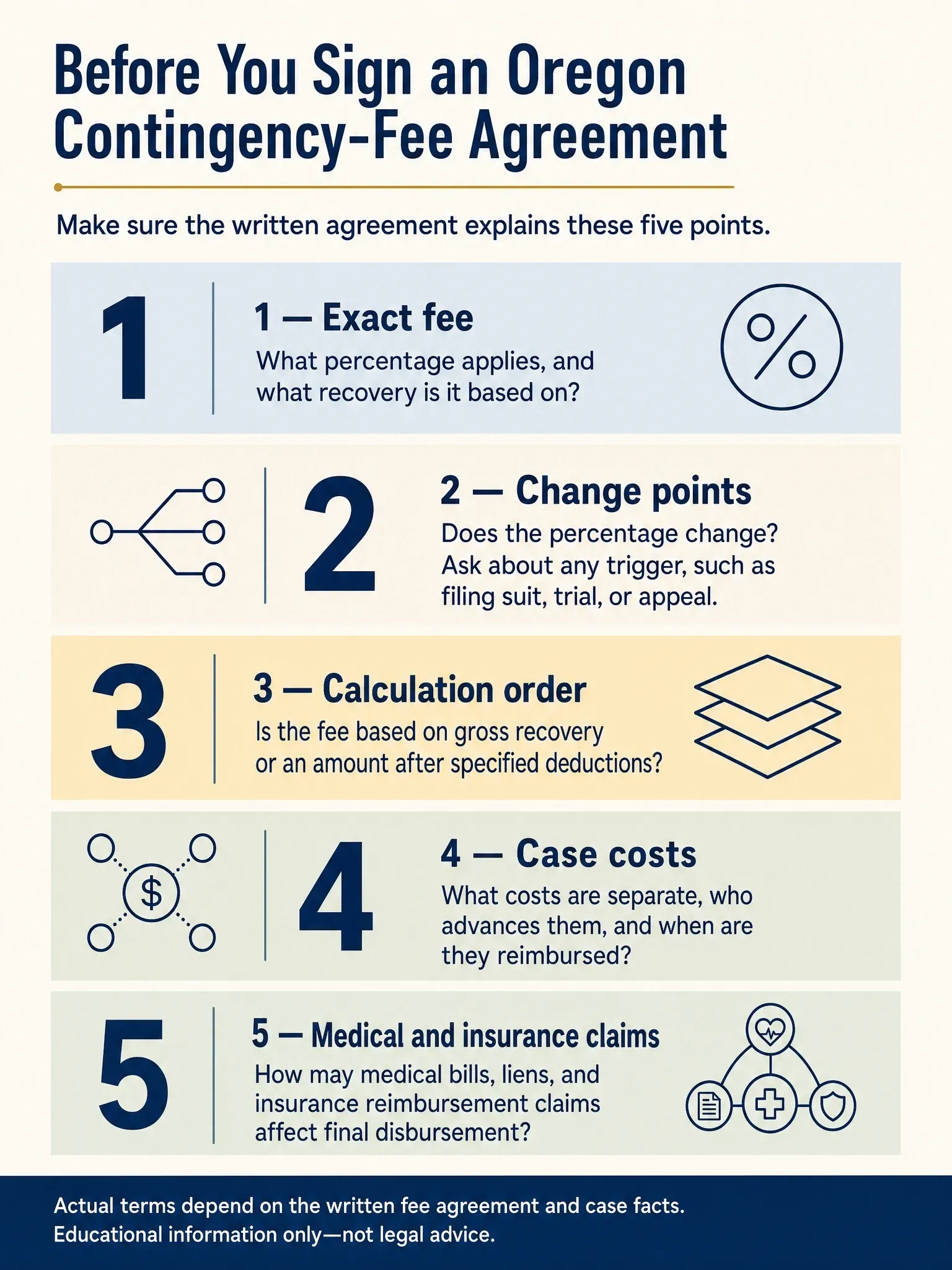
- What exact percentage applies? Ask for the percentage in writing, not just a verbal summary.
- Does the percentage change later? Ask whether the fee changes after filing suit, discovery, trial preparation, trial, appeal, or another milestone.
- What does the percentage apply to? Ask whether the fee is calculated from the gross recovery or after certain deductions.
- What case costs might arise? Ask about filing fees, depositions, records, expert witnesses, investigation expenses, and trial costs.
- Who advances case costs, and when are they reimbursed? Ask what happens if there is no recovery. For a broader Oregon cost-risk overview, see Johnson Law’s article on what can happen with court costs and litigation expenses if a case is lost.
- How are medical bills and liens handled? Ask how unpaid provider balances, liens, PIP, health insurance, and reimbursement claims may affect settlement distribution.
- What work is included? Ask who will work on the case and what is included in the scope of representation.
- Can the lawyer explain the agreement in plain English? If a term is unclear, ask for an example before signing.
- Do I have a rescission right under ORS 20.340? For covered plaintiff contingency agreements, ask how the 24-hour written rescission provision works.
- Will I receive a settlement-distribution statement? Ask how the final disbursement will show the recovery, attorney fee, costs, medical bills, liens, and client net amount.
Understanding these points can also help you evaluate settlement pressure. Medical debt and unpaid bills can make a quick offer feel tempting, but it is worth understanding the deductions before deciding. Johnson Law has a separate guide on how medical debt can affect settlement decisions and another on how to evaluate a quick cash settlement offer.
What if you believe a fee was calculated incorrectly?
If you believe a lawyer’s fee was calculated incorrectly, start by reviewing the written fee agreement and the settlement-distribution documents. Many questions come down to calculation order: gross recovery, attorney-fee percentage, case costs, medical bills, liens, reimbursements, and final client disbursement.
Oregon State Bar public guidance explains that some fee issues may involve professional-conduct concerns, but many fee disputes are handled through the Oregon State Bar Fee Dispute Resolution Program. The program is a voluntary mediation or arbitration process for qualifying fee disputes, and all parties must agree to participate.
This is a consumer-resource point, not a suggestion that any particular lawyer has done anything wrong. If the issue involves a current case, deadlines, liens, or settlement funds, consider getting case-specific advice before taking action.
Bottom line
There is no single Oregon personal injury contingency-fee percentage that can safely be called “normal” for every case. Broad national ranges can give background, but the written fee agreement controls the specific terms.
Before signing, focus on the details that affect the final disbursement: the percentage, whether it changes during litigation, whether the fee is calculated before or after certain deductions, what case costs are separate, and how medical bills, liens, PIP, health insurance, or reimbursement claims may be handled.
A clear contingency-fee agreement should help you understand not only the lawyer’s percentage, but also the path from gross recovery to client net recovery.
FAQ
Is there a normal contingency-fee percentage in Oregon personal injury cases?
Oregon does not appear to set one official “normal” personal injury contingency-fee percentage. Public education sources describe broad percentage ranges, but those are not Oregon law, not a fee schedule, and not a quote for a specific case. The written agreement and Oregon fee-reasonableness rules matter.
Can a contingency fee increase if my case goes to litigation?
Some agreements use stage-based percentages that increase after filing suit, discovery, trial preparation, trial, or appeal. Others may not. The agreement should identify any escalation points clearly before you sign.
Are case costs included in the contingency fee?
Not necessarily. Attorney fees are different from filing fees, deposition costs, expert fees, medical-record charges, and other case expenses. The written agreement should explain what costs may arise, who advances them, when they are reimbursed, and what happens if there is no recovery.
Are medical bills paid out of my settlement before or after attorney fees?
It depends on the written agreement, the type of bills or liens, insurance issues, and the facts of the case. For eligible personal injury matters, Johnson Law, P.C. calculates its attorney fee after outstanding medical bills are paid, according to the written fee agreement. Ask how the agreement treats disputed bills, liens, reimbursement claims, case costs, and any balances that may remain.
What does Oregon law require in a personal injury contingency-fee agreement?
For covered plaintiff contingency agreements under ORS 20.340, Oregon law requires plain and simple language, an explanation of terms and conditions before signing, and a provision allowing the plaintiff to rescind the agreement within 24 hours after signing by written notice to the attorney.
What should I ask a lawyer before signing a contingency-fee agreement?
Ask about the percentage, whether it changes at litigation milestones, what recovery the percentage applies to, what case costs are separate, who advances costs, what happens if there is no recovery, and how medical bills, liens, PIP, health insurance, or reimbursement claims may affect the final disbursement.
Sources
- Oregon State Bar, Oregon Rules of Professional Conduct, Rule 1.5
- Oregon Legislature, ORS chapter 20, including ORS 20.340
- Oregon Law Help / Oregon State Bar, Guide to Hiring a Lawyer in Oregon
- American Bar Association, Fees and Expenses
- Cornell Legal Information Institute, Contingency fee
- Oregon Judicial Department, Fees
- Oregon Legislature, ORS chapter 87 medical-services lien provisions
- Oregon Legislature, ORS chapter 742 PIP provisions
- Oregon State Bar, Fee Dispute Resolution Program
Client-First Fee Promise
Client First = Bills First, Fees Second
Your unpaid medical bills do not have to make your lawyer's fee bigger. Johnson Law subtracts qualifying medical bills before calculating our fee, helping clients keep more of their settlement.
Applies to qualifying cases. Results vary.