Settlement vs. Lawsuit: The Decision Points That Actually Matter (Not Internet Myths)

Settlement vs. Lawsuit: The Decision Points That Actually Matter (Not Internet Myths)
When an Oregon personal injury claim is stuck, the real question is usually not “Is settlement better than a lawsuit?” or “Will suing make the insurance company pay more?” Those are internet myths dressed up as strategy.
The better question is: What problem are you trying to solve, and which path actually addresses it?
Settlement and litigation are tools. A settlement may resolve uncertainty, avoid further procedure, and bring the claim to a negotiated close. A lawsuit may become necessary to meet a legal deadline, use formal discovery, respond to denied liability, or put disputed facts into a court process. Neither path guarantees a better result, and neither path is automatically safer.
Mediation can be one step between informal negotiation and trial, but only when the claim is developed enough for a meaningful settlement conversation. For that narrower decision, see Johnson Law’s guide to when mediation is worth trying before trial.
This article is Oregon-specific and focuses on personal injury claims. It is educational information only, not legal advice. Deadlines, insurance duties, release language, and litigation strategy can change depending on the claim type, the parties involved, and the facts.
Start With the Real Question: What Problem Are You Trying to Solve?
Before deciding whether to keep negotiating, accept a settlement, or file suit, identify the specific problem blocking the claim. Common decision points include:
- a statute of limitations or other deadline is approaching;
- the insurer denies liability or argues you share fault;
- medical treatment, injury causation, or future care is disputed;
- available insurance limits may be lower than the harm;
- key evidence is unavailable through informal claim handling;
- social media, surveillance, or other digital evidence may create risk;
- the proposed release may give up more than you understand; or
- the costs, time, and obligations of litigation may outweigh the likely benefit.
That analysis is different from common online slogans about “never settle” or “always sue.” A personal injury settlement vs lawsuit decision should be based on facts, proof, deadlines, insurance, and the injured person’s goals—not pressure from an adjuster or broad internet advice.
Common internet myths to avoid
Several myths can lead people to make rushed decisions:
- Myth: Filing suit automatically increases settlement value. Filing a lawsuit creates formal procedures and discovery tools. It does not guarantee a higher offer or better outcome.
- Myth: Any insurance or medical payment proves fault. Oregon law treats some payments carefully. For example, an advance payment for personal injury or death is not an admission of liability under ORS 31.560, and offers to pay medical expenses are not admissible to prove liability under ORS 40.195. Advance payments can also raise separate limitation-notice issues under ORS 12.155, so payment should not be treated as either proof of fault or a reliable deadline extension.
- Myth: Surveillance or one social media post always destroys a claim. Evidence can matter, but relevance, admissibility, authentication, privilege, objections, and court limits still matter.
- Myth: Oregon’s injury deadline is always a simple two-year rule. Oregon has a general two-year personal injury limitations period, but special claims and service rules can change the analysis.
Decision Point 1: Is a Deadline Driving the Choice?
Oregon’s general limitations period for many personal injury actions is two years under ORS 12.110. That general rule is important, but it should not be treated as universal.
Different or shorter rules may apply in claims involving public bodies or public employees, wrongful death, medical negligence, minors or incapacity, contractual insurance deadlines, or other special circumstances. If any deadline may be close, the settlement-versus-lawsuit decision becomes more urgent even if negotiations are still active.
The key point: ongoing negotiation does not automatically extend a legal deadline. A claim can feel “open” with an insurance company while a court deadline is still approaching.
Filing is not the same as service
Oregon deadline analysis must distinguish between:
- making an insurance claim;
- negotiating with an adjuster;
- filing a complaint in court;
- serving the defendant with summons and complaint; and
- satisfying the statute of limitations rules for each defendant.
Under ORS 12.020, an action is generally deemed commenced as to each defendant when the complaint is filed and the summons is served. If service occurs before 60 days after filing, commencement can relate back to the date the complaint was filed. That means filing alone should not be casually treated as enough in every situation.
The Oregon Judicial Department explains that filing a case starts the legal process, usually with a complaint or petition in circuit court. But after filing, service rules matter. ORCP 7 requires summons to be served in a manner reasonably calculated to notify the defendant and give a reasonable opportunity to appear and defend. In many cases served by methods other than publication, a defendant generally must appear and defend within 30 days after service.
This is one reason deadline-driven cases should not wait until the last moment. Service problems, wrong-party issues, and timing questions can become significant.
Separate DMV reports from lawsuit deadlines
After an Oregon motor vehicle crash, the Oregon DMV may require a Traffic Collision and Insurance Report within 72 hours when injury, death, towing, or listed damage thresholds are involved.
That reporting duty is separate from a personal injury lawsuit deadline. A DMV report does not, by itself, prove civil liability or preserve a personal injury claim in court.
Decision Point 2: Is Liability Denied or Shared?
If the insurer accepts responsibility and the medical picture is clear, settlement discussions may focus mostly on valuation and documentation. If liability is denied or fault is shared, the decision changes.
Oregon uses a comparative-fault framework. Under ORS 31.600, a claimant’s recovery is affected by the percentage of fault attributed to the claimant. The statute allows recovery only if the claimant’s fault is not greater than the combined fault of specified others, and any damages allowed are reduced by the claimant’s percentage of fault.
In practical terms, fault disputes can affect both settlement negotiations and litigation risk. An insurer may argue that the injured person caused or contributed to the incident. The injured person may need witness information, photos, video, measurements, records, or other evidence to respond. Sometimes that evidence can be gathered informally. Sometimes formal discovery becomes part of the analysis.
For a deeper discussion of shared-fault issues, see Johnson Law’s guide to Oregon comparative fault rules.
Multiple parties can complicate the decision
Cases involving multiple drivers, property owners, contractors, employers, or other potentially responsible parties require extra care.
Oregon’s comparative-fault statute allows the trier of fact to compare the claimant’s fault with the fault of defendants, certain third-party defendants, and persons who settled with the claimant, subject to statutory limits. Oregon law also provides that liability of defendants is generally several only—not joint—in actions subject to the comparative-fault statutes. See ORS 31.600 and ORS 31.610.
That does not mean suing more parties is always helpful. It means a settlement with one party, a claim against another, or a decision not to pursue someone may affect allocation and collection questions. Multi-party cases are a strong reason to get individualized advice before signing a release or letting a deadline pass.
Decision Point 3: Are Insurance Limits Lower Than the Harm?
A serious injury claim can still run into an insurance-limit problem.
Oregon’s financial-responsibility statute lists minimum motor vehicle liability limits of $25,000 for bodily injury or death to one person, $50,000 for bodily injury or death to two or more people in one accident, and $20,000 for property damage. See ORS 806.070. The Oregon DMV also lists minimum required auto insurance amounts, including bodily injury/property damage liability, $15,000 per person in personal injury protection benefits, and uninsured motorist coverage of $25,000 per person and $50,000 per crash on its insurance requirements page.
Those are minimums, not a statement of what coverage exists in a specific case. Some policies have higher limits. Some cases involve multiple policies or coverage disputes. Some cases involve uninsured or underinsured motorist issues. And insurance limits are not necessarily presented to a jury in the same way they matter during settlement negotiations; Oregon evidence law generally excludes evidence that a person was or was not insured against liability to prove negligent or wrongful conduct, while allowing insurance evidence for certain other purposes. See ORS 40.205.
Low limits may affect whether a settlement is realistic, whether other coverage should be explored, and whether litigation costs make sense. For more detail, see Johnson Law’s article on whether policy limits are the practical ceiling.
PIP is related, but not the same as the liability claim
Oregon personal injury protection, or PIP, often causes confusion in auto cases.
PIP is first-party coverage. Oregon law requires PIP benefits in covered private passenger motor vehicle liability policies, and the potential existence of a tort claim does not relieve the insurer from the duty to pay PIP benefits. See ORS 742.520.
Oregon PIP medical benefits include reasonable and necessary medical, hospital, dental, surgical, ambulance, and prosthetic services incurred within two years after injury, up to the statutory minimum aggregate medical-expense coverage of $15,000 unless the policy provides more favorable benefits. See ORS 742.524.
That does not make PIP the same as a liability settlement with the at-fault party. PIP may help with certain bills while the liability claim is unresolved, but PIP payment does not automatically prove fault, causation, or the full value of the liability claim. For more, read about how Oregon PIP benefits fit separately from the liability claim.
Decision Point 4: Is the Injury, Treatment, or Causation Disputed?
Many personal injury claims stall because the insurer disputes medical issues rather than the incident itself. Common disputes include whether treatment was reasonable, whether symptoms were caused by the incident, whether care was necessary, whether a prior condition explains the symptoms, or whether the records support ongoing limitations.
Oregon PIP law includes rules about covered medical expenses and denial timing, and annotations to ORS 742.524 note that the statutory presumption of reasonableness and necessity is rebuttable. That matters because even when medical bills are paid or not immediately denied in one context, another insurer or party may still dispute injury causation or damages in the liability claim.
If causation or treatment is the central dispute, the settlement-vs-lawsuit analysis may turn on the strength of medical records, provider opinions, timing of symptoms, prior medical history, and the likely cost and burden of litigating those issues.
Medical exams require careful wording
The phrase “independent medical exam” is often used loosely, but the legal context matters.
In some insurance contexts, a policy or statute may require cooperation with an insurer-requested examination. For example, Oregon’s uninsured motorist statute includes provisions requiring insureds making UM claims to provide written proof of claim and, upon reasonable request and at the insurer’s expense, submit to physical examinations by listed medical professionals selected by the insurer. See ORS 742.504.
That is different from a court-ordered examination after a lawsuit is filed. Under ORCP 44, when a party’s physical or mental condition is in controversy, the court may order an examination only on motion for good cause shown and notice to the person examined and all parties. The order must specify the time, place, manner, conditions, scope, and examiner.
The practical takeaway is not that medical exams are always avoidable or always harmful. It is that exam requests, objections, scope, and consequences are fact-specific and should be handled carefully.
Decision Point 5: Do You Need Formal Discovery to Prove the Case?
Informal claim handling has limits. An adjuster may ask you for records, statements, forms, or releases while providing only limited information in return. A lawsuit changes that structure.
Oregon discovery rules allow parties to use tools such as depositions, production of documents or things, entry on property for inspection, physical and mental examinations, and requests for admission. See ORCP 36. Discovery generally reaches nonprivileged matters relevant to a claim or defense, including witness information and the existence, custody, condition, and location of documents or tangible things.
ORCP 43 allows requests for designated documents, electronically stored information, images, sound recordings, and other data compilations within the scope of discovery. If electronically stored information is requested, the rule includes provisions about the form in which it is produced.
This is one of the real differences between settlement negotiations and litigation. Filing suit may allow structured evidence gathering that informal negotiation does not provide. But that does not mean litigation guarantees a better settlement. Discovery also creates obligations, deadlines, and risk for both sides.
For readers looking ahead to litigation obligations, Johnson Law also explains what a deposition can involve in an Oregon injury case.
Examples of evidence that may matter
Depending on the claim, relevant evidence may include:
- photographs or video;
- witness names and contact information;
- repair, inspection, employment, or incident records;
- medical records and billing records;
- text messages or emails;
- nonprivileged claim-related records and adjuster communications;
- electronic data, images, sound recordings, or other data compilations; and
- information about other potentially responsible parties.
Before a claim becomes a lawsuit, it is still wise to preserve claim-related communications and records. Johnson Law has separate resources on recorded-statement risks and claim records to save after adjuster calls.
Decision Point 6: Could Surveillance, Social Media, or Digital Evidence Change the Risk?
Surveillance and social media are often discussed in extreme terms. One side says private posts do not matter. The other says one photo will ruin the case. Neither framing is reliable.
Under Oregon evidence law, relevant evidence is evidence that has any tendency to make a consequential fact more or less probable. Relevant evidence is generally admissible unless another authority provides otherwise. See ORS 40.150 and ORS 40.155.
But relevance is not the end of the analysis. A court may exclude relevant evidence if its probative value is substantially outweighed by unfair prejudice, confusion, misleading the jury, undue delay, or needless cumulative evidence. See ORS 40.160.
In practical terms, surveillance, posts, photos, location data, messages, or videos may matter if they relate to claimed injuries, activities, causation, credibility, or damages. But they are not automatically discoverable, automatically admissible, or automatically decisive. Privilege, authentication, discovery objections, and court limits may all matter.
Do not delete, hide, alter, or manipulate evidence because you are worried about how it looks. If you have concerns about social media, surveillance, texts, or digital evidence, get legal guidance before taking action.
Avoid both extremes
The safer approach is consistency and caution:
- Do not assume “private” settings make claim-related content irrelevant.
- Do not assume a normal life activity means an injury claim is false.
- Do not exaggerate symptoms online, in records, or in conversations.
- Do not destroy or edit evidence in response to a claim dispute.
The issue is not whether digital evidence exists. The issue is what it actually shows, whether it is relevant, and how Oregon evidence and discovery rules apply.
Decision Point 7: What Would Settlement Actually Release?
A settlement is not just a number. It usually includes a release—a contract that may end identified claims. The release language can matter as much as the dollar amount.
Before accepting a settlement, a claimant should understand:
- which parties are being released;
- which claims are being released;
- whether unknown, future, or disputed injuries are addressed;
- how PIP, UM, UIM, health insurance, liens, or reimbursement claims are handled;
- whether confidentiality or non-disparagement language is included; and
- whether the release affects claims against other potentially responsible parties.
Oregon has specific motor-vehicle/PIP-related release protections, but they are narrow. For example, when a motor vehicle liability insurer obtains a bodily-injury release within 60 calendar days after an accident from a person eligible for Oregon PIP benefits, ORS 742.546 requires disclosure preserving certain PIP-reimbursement rights subject to policy limits. And if a motor vehicle liability insurer representative obtains a bodily-injury release in person from a PIP-eligible person, ORS 742.548 requires a clear and conspicuous notice that the document is a binding contract concluding identified claims and allows rescission only if statutory requirements are met.
Those rules should not be generalized to every personal injury release. Not every release can be undone. This is why early offers and release language deserve careful review, especially before injuries and treatment needs are clear. For more on early offers, see Johnson Law’s guide on how to evaluate a quick settlement offer before signing a release.
Settlement communications are not automatically “secret” in every sense
Oregon evidence law also treats settlement communications carefully. Under ORS 40.190, compromise offers and statements made in compromise negotiations are generally not admissible to prove liability, invalidity of a claim, or claim amount.
But that rule has limits. Evidence does not become undiscoverable just because it was presented during negotiations, and the rule allows some uses for other purposes. Settlement communications should be handled thoughtfully, not casually treated as either fully public or fully protected in every situation.
Decision Point 8: What Costs, Procedures, and Court Deadlines Come With Filing?
Filing a lawsuit starts a formal court process. That process can provide tools, but it also brings costs, deadlines, and obligations.
The Oregon Judicial Department explains that a case-starting document, usually a complaint or petition, is filed to begin a circuit court case, and most cases require a filing fee. Attorneys generally must file most circuit court documents through Oregon’s approved electronic filing system. The court system’s 2026 circuit court fee schedule lists first-appearance tort/contract filing fees by amount claimed, with different fee amounts depending on the size of the claim. Fee schedules are date-sensitive and should be checked as of the time of filing.
After filing and service, the case may involve pleadings, discovery, motions, medical examinations, depositions, settlement discussions, trial preparation, and court deadlines. Some cases resolve after filing. Some do not. Some cases justify the added burden. Others may not.
The important point is balance: litigation may provide access to evidence and a structured process, but it is not quick, risk-free, or certain.
A lawsuit changes the pace and obligations
Once a defendant is served, formal response deadlines begin. Discovery may require both sides to produce information, answer questions, appear for depositions, respond to motions, and follow court orders. The injured person may also face closer scrutiny of medical history, work history, activities, and claimed limitations.
If an insurer is delaying, denying, or repeatedly changing its position, that pattern may be part of the decision to reassess negotiation strategy. Johnson Law discusses insurance delay patterns that pressure settlement decisions and what a denied insurance claim may mean in separate articles.
A Practical Settlement-vs-Lawsuit Checklist for Oregon Injury Claims
Use this checklist as a discussion guide, not a substitute for legal advice:
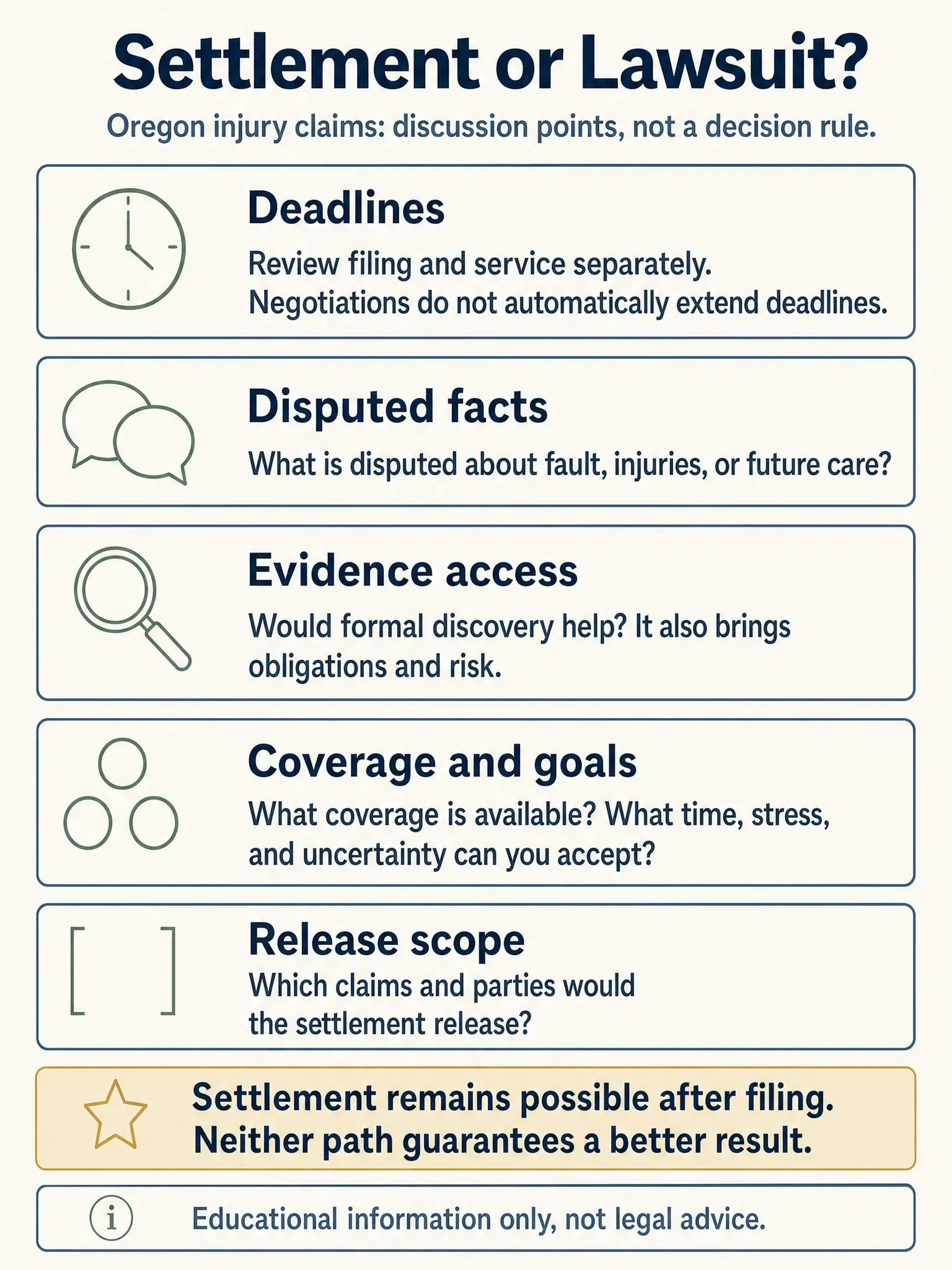
- Deadlines: Is a statute of limitations, government-claim notice rule, insurance deadline, or other time limit approaching?
- Filing and service: If filing may be needed, has service timing under Oregon commencement rules been considered?
- Liability: Is the insurer denying fault or arguing comparative fault?
- Multiple parties: Are there several potentially responsible people or entities, or has one party already settled?
- Insurance limits: Are available limits low compared with the injuries, medical bills, lost income, or future needs?
- PIP/UM/UIM: Are first-party benefits or uninsured/underinsured motorist issues separate from the liability claim?
- Medical disputes: Is the insurer disputing injury causation, treatment necessity, prior conditions, or future care?
- Evidence access: Is key evidence unavailable without formal discovery?
- Digital evidence: Could surveillance, social media, texts, photos, or other data affect disputed issues?
- Exams: Is there a policy-based exam request, or could a court-ordered examination become an issue after filing?
- Release language: Does the proposed settlement release only the intended claims and parties?
- Costs and burden: Are filing fees, litigation expenses, discovery obligations, time, and stress justified by the issues in dispute?
- Goals: Does the injured person value speed, privacy, certainty, formal fact-finding, or preserving claims against other parties?
When to get legal advice before deciding
It is especially important to speak with an Oregon personal injury lawyer before deciding whether to settle or file suit when:
- a deadline may be near;
- the defendant may be a public body or public employee;
- liability is denied;
- comparative fault is alleged;
- injuries are serious or still developing;
- policy limits appear low;
- PIP, UM, or UIM coverage may be involved;
- multiple parties may share responsibility;
- an insurer requests an examination or broad records release;
- social media or surveillance is being raised; or
- a settlement release has been offered.
Legal advice cannot promise a particular result. It can help identify the deadlines, evidence problems, insurance issues, and release consequences that make the decision more informed.
For a broader view of how a claim may progress, see Johnson Law’s overview of how the personal injury process typically unfolds.
Bottom Line: A Sound Decision Is Fact-Specific, Not Myth-Based
The right settlement-vs-lawsuit decision in an Oregon personal injury claim depends on deadlines, service rules, proof, liability disputes, insurance limits, PIP and UM/UIM issues, medical evidence, discovery needs, release language, costs, and personal goals.
Settlement is not weakness. Litigation is not magic. A sound decision is one that addresses the real problem in the claim while accounting for Oregon law, the available evidence, and the risks of each path.
This article is general educational information for Oregon personal injury readers. It is not legal advice and does not create an attorney-client relationship. For advice about a specific claim, deadlines, release, or lawsuit decision, consult a qualified Oregon attorney.
FAQ
Is it better to settle or file a lawsuit for an Oregon personal injury claim?
It depends. Settlement and litigation serve different purposes. The decision may turn on deadlines, liability proof, comparative fault, medical disputes, insurance limits, access to evidence, release terms, costs, and the injured person’s goals. Neither settlement nor a lawsuit is categorically better in every case.
Does filing a lawsuit automatically increase settlement value?
No. Filing a lawsuit creates formal procedures and discovery tools, but it does not guarantee a higher offer, a settlement, or a better result. In some cases, filing may be necessary to meet deadlines or obtain evidence. In others, the costs and risks may not make sense.
Is Oregon’s personal injury deadline always two years?
No. Oregon has a general two-year limitations period for many personal injury claims under ORS 12.110, but special claims and parties can involve different rules. Public-body claims, wrongful death, medical negligence, minors or incapacity, contractual insurance deadlines, and other circumstances may require separate analysis.
Is filing the complaint enough to meet the Oregon deadline?
Not necessarily. Oregon commencement rules require attention to both filing and service. Under ORS 12.020, an action is generally commenced as to each defendant when the complaint is filed and summons is served, with relation-back if service occurs within the statutory window. Service timing should be reviewed before relying on filing alone.
Can an insurance company use my social media or surveillance against me?
Potentially, if the evidence is relevant and otherwise discoverable or admissible. But social media and surveillance are not automatically admissible, automatically discoverable, or automatically decisive. Relevance, privilege, authentication, objections, and court limits may all matter. Do not delete or alter evidence without legal guidance.
Can I undo a personal injury settlement release in Oregon?
Only in limited circumstances. Oregon has specific motor-vehicle/PIP-related release rules, including certain disclosure and rescission provisions, but those rules do not apply to every release. A settlement release is a serious contract and should be reviewed carefully before signing.
Sources
- ORS Chapter 12, including ORS 12.110, ORS 12.020, and ORS 12.155, for Oregon limitations, commencement, and advance-payment notice rules.
- ORS Chapter 31, including ORS 31.600, ORS 31.610, and ORS 31.560, for comparative fault, several-only liability, and advance payments.
- Oregon Rules of Civil Procedure, including ORCP 7, 36, 43, and 44, for service, discovery, production, and court-ordered examinations.
- ORS Chapter 40, including Oregon Evidence Code provisions on relevance, exclusion, compromise negotiations, medical payments, and insurance evidence.
- ORS Chapter 742, including Oregon PIP, UM, and motor-vehicle/PIP release provisions.
- ORS Chapter 806 and the Oregon DMV’s insurance requirements for Oregon minimum auto insurance requirements.
- Oregon Judicial Department resources on filing a case and the 2026 circuit court fee schedule.
- Oregon DMV guidance on collision reporting responsibilities.
Client-First Fee Promise
Client First = Bills First, Fees Second
Your unpaid medical bills do not have to make your lawyer's fee bigger. Johnson Law subtracts qualifying medical bills before calculating our fee, helping clients keep more of their settlement.
Applies to qualifying cases. Results vary.