Concussion vs. Mild TBI After a Car Crash: Why a Normal CT Does Not End the Case
Concussion vs. Mild TBI After a Car Crash: Why a Normal CT Does Not End the Case
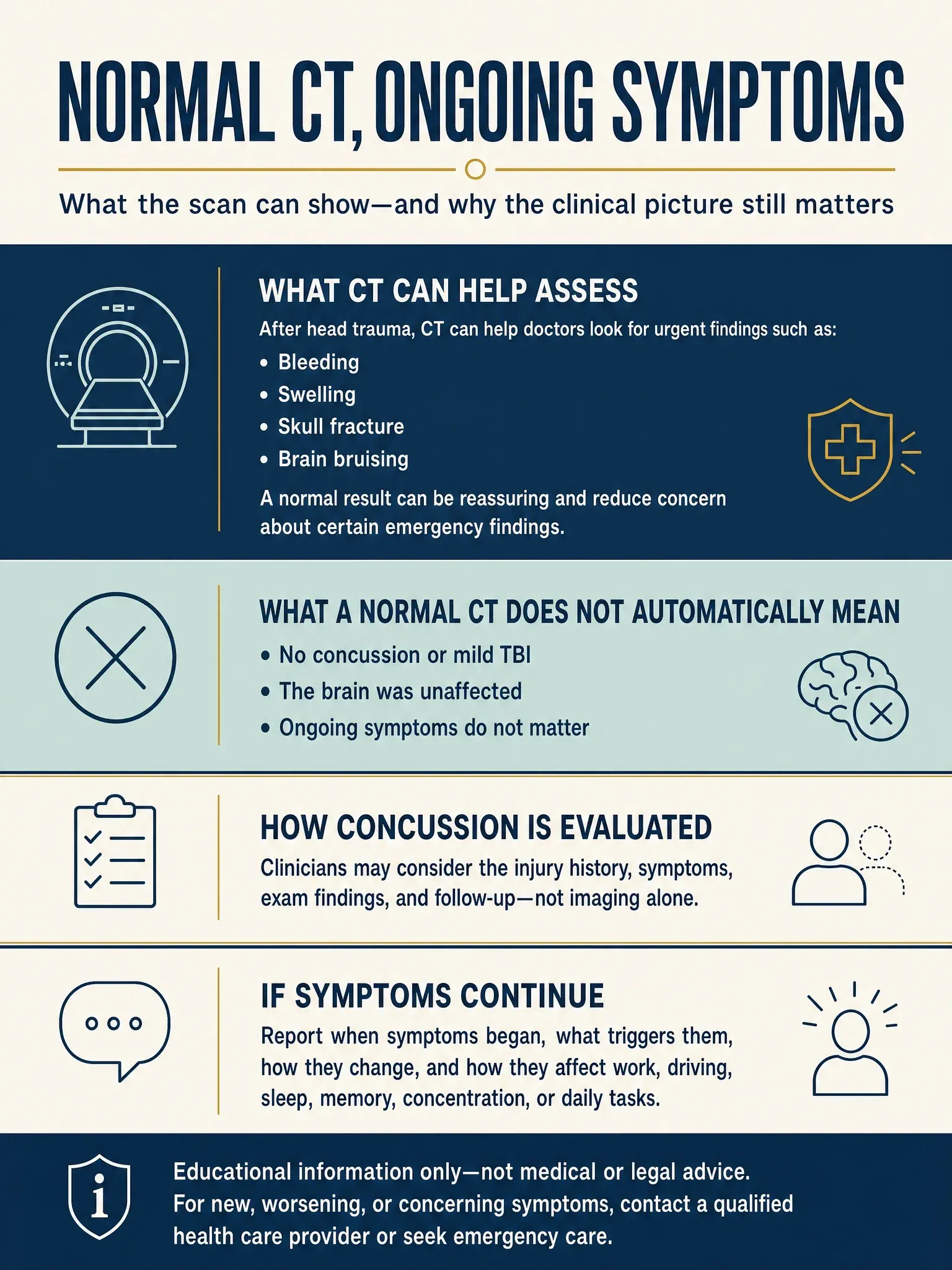
If the emergency room told you your head CT was normal after a car crash, that is often good news. A CT scan can help doctors look for urgent problems such as bleeding, swelling, skull fracture, or brain bruising.
But a normal CT does not necessarily answer every question about concussion or mild traumatic brain injury. Concussion symptoms can involve headaches, dizziness, thinking and memory problems, sleep changes, mood changes, and difficulty with daily activities. Some symptoms are obvious right away. Others may show up hours or days later, or may not be fully recognized until the person tries to return to work, driving, screens, or normal routines.
For an Oregon injury claim, the CT report is one part of the record. The broader picture may include medical follow-up, symptom history, exam findings, work restrictions, functional limitations, consistent documentation, insurance benefits, and Oregon legal deadlines.
This article is educational information only. It is not medical or legal advice and does not create an attorney-client relationship. If you have new, worsening, or concerning symptoms after a head injury, contact a qualified health care provider or seek emergency care.
For help with the broader claim context, see Johnson Law’s page on concussion and mild TBI claims and the related discussion of normal imaging and injury proof.
A Normal CT Is Reassuring, But It May Not Answer Every Brain-Injury Question
A normal CT can be medically important. After head trauma, CT imaging may help identify acute conditions that need urgent attention, including skull fracture, brain bruising, bleeding, or swelling. When a doctor orders a CT after a crash, the goal is often to evaluate those immediate risks.
That is different from saying a CT scan is the only way to evaluate a concussion. Federal and medical guidance recognizes that mild traumatic brain injury is often assessed through clinical information, including the injury history, symptoms, exam findings, and follow-up. The CDC’s adult emergency-department checklist also advises clinicians not to routinely image every mild TBI, and to use clinical decision rules when deciding whether CT or MRI is needed.
In plain English: a normal CT can reduce concern about certain emergency findings, but it does not automatically prove that the brain was unaffected or that ongoing symptoms do not matter.
The reverse is also true. Persistent symptoms alone do not prove legal responsibility, medical causation, or the value of a claim. Those issues depend on the facts, medical support, insurance coverage, Oregon law, and the evidence connecting the crash to the injury and losses.
Concussion vs. Mild TBI: The Terms Often Overlap
Medical records after a crash may use several terms: “concussion,” “mild TBI,” “head injury,” “closed head injury,” or symptom-based descriptions such as headache, dizziness, confusion, or memory problems.
The National Institute of Neurological Disorders and Stroke describes a concussion as a type of mild traumatic brain injury. A concussion may result from a blow to the head or from rapid movement of the brain within the skull, including violent shaking.
That matters in car-crash cases because not every suspected concussion begins with a clear direct head strike. Some crash mechanisms involve rapid acceleration or deceleration. Whether that mechanism caused a concussion in a particular person is a medical question, not something an article can diagnose.
You Do Not Always Need a Direct Head Strike
If you did hit your head on a window, steering wheel, headrest, airbag, or another surface, that detail should be reported accurately to medical providers. If you do not remember a direct impact but developed symptoms after a forceful crash, that is also worth discussing with a provider.
The key is accuracy. Do not guess, exaggerate, or try to force your story to match a term you saw online. Tell your providers what happened, what you remember, what others observed, and how your symptoms have changed.
What CT Scans Are Usually Looking For After Head Trauma
CT imaging is fast and can be very useful in the acute setting. NINDS states that CT can show skull fracture, brain bruising, bleeding, or swelling. Medical guidelines also recognize CT as an appropriate tool in certain mild head-trauma scenarios when imaging is indicated by clinical decision rules.
That role is important. A normal CT may reassure doctors that certain dangerous findings are not present. It may also help guide whether a person can be discharged with instructions, monitored, or treated further.
But concussion and mild TBI symptoms may occur even when conventional imaging does not show a clear structural injury. The Ontario Neurotrauma Foundation guideline states that CT and conventional MRI usually fail to detect structural brain abnormalities in mild TBI and that structural imaging has not produced a consistent diagnostic pattern for concussion or mild TBI. That guidance is medical, not Oregon law, but it helps explain why a normal scan should not be treated as the whole story.
Why Doctors May Order—or Not Order—a CT
Not everyone with a suspected concussion receives imaging. CDC and American College of Radiology guidance support using clinical decision rules rather than imaging every mild TBI patient automatically. The ACR rates CT head without IV contrast as usually appropriate in certain mild acute head-trauma scenarios when clinical decision rules indicate imaging, and rates initial imaging as usually not appropriate when imaging is not indicated by a clinical decision rule.
That does not create a legal proof rule. It simply means the presence or absence of a CT scan should be understood in context. A person may have a concussion evaluation without imaging, and a person who had imaging may still need follow-up if symptoms continue.
Why Concussion Symptoms Can Still Matter When Imaging Is Normal
The CDC describes mild TBI and concussion symptoms as variable from person to person. Symptoms can affect physical function, thinking and memory, social or emotional status, and sleep.
Those symptom categories matter because concussion effects are not limited to what appears on an imaging report. A person may struggle with concentration, memory, headaches, dizziness, fatigue, irritability, sleep disruption, or daily tasks even when the CT report does not show bleeding or fracture.
Symptoms to Track After a Crash
After a suspected concussion or mild TBI, useful documentation may include symptoms in several areas:
- Physical symptoms: headaches, dizziness, balance problems, nausea, sensitivity to light or noise, or fatigue.
- Thinking and memory symptoms: brain fog, trouble concentrating, slowed thinking, forgetfulness, or difficulty following conversations.
- Social or emotional symptoms: irritability, anxiety, mood changes, or feeling unlike yourself.
- Sleep symptoms: sleeping more than usual, sleeping less than usual, trouble falling asleep, or disrupted sleep.
These examples do not mean every symptom is caused by the crash. Pain, sleep disruption, migraine, anxiety, depression, vestibular problems, neck injuries, medication effects, and unrelated conditions may overlap with concussion symptoms. That is why medical evaluation and careful follow-up are important.
Where anxiety, mood, or sleep concerns are central, a separate guide discusses distinguishing post-crash emotional injury from overlapping concussion symptoms without treating PTSD and mild TBI as interchangeable diagnoses.
Delayed Symptoms and Delayed Recognition
Some concussion symptoms may appear immediately. Others may appear hours or days later. CDC guidance also notes that diagnosing mild TBI can be challenging because symptoms can resemble other conditions, and symptom onset or recognition may occur days or weeks after the injury.
Delayed recognition is common enough that it should not be ignored. Someone may feel “shaken up” at the scene, focus first on neck or back pain, or assume they are simply tired. Then they return to work, screens, driving, school responsibilities, or household tasks and realize that concentration, memory, light sensitivity, dizziness, or fatigue are affecting daily life.
Most people with mild TBI or concussion feel better within a couple of weeks, according to the CDC. But symptoms can change during recovery, and some people need additional evaluation. If symptoms are ongoing, worsening, or interfering with function, the record should show what is happening and what medical advice was sought.
When Persistent Symptoms May Need Follow-Up or Specialist Evaluation
NINDS states that people with mild TBI should follow up with a health care provider, discuss new or ongoing symptoms, and pay attention to new symptoms even if they seem unrelated. CDC guidance also discusses referral to a concussion specialist if symptoms worsen, have not gone away after 2 to 4 weeks, or the person has multiple concussions or risk factors for prolonged recovery.
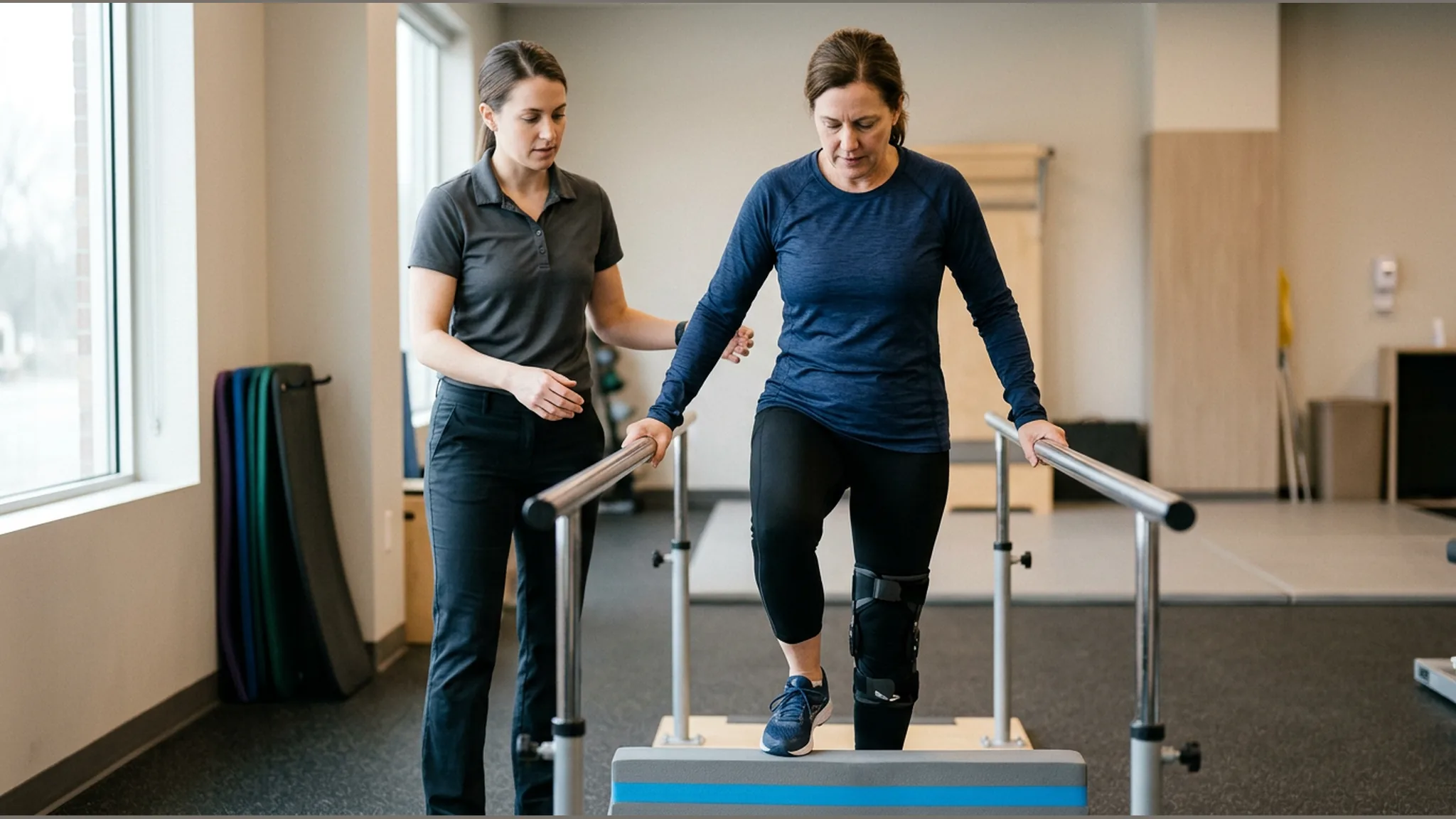
That does not mean every person needs the same specialist, test, or timeline. Treatment decisions belong to qualified health care providers. From a claim-documentation perspective, the important point is that ongoing symptoms should be communicated, evaluated, and recorded rather than left vague.
Work, Driving, Screen Time, and Daily Activities
Concussion symptoms often become most visible when a person tries to resume normal activities. CDC return-to-activity guidance says return-to-work planning should be based on careful evaluation of symptoms and neurocognitive status, and that repeated evaluation of both symptoms and cognitive status is recommended to guide management.
For an Oregon crash claim, that can make functional documentation important. Examples may include:
- missed work or reduced hours;
- difficulty performing job tasks that require focus, memory, reading, screen use, driving, or multitasking;
- medical work restrictions or return-to-work instructions;
- problems managing household responsibilities;
- changes noticed by family members, coworkers, or supervisors; and
- patterns showing whether symptoms improve, worsen, or fluctuate with activity.
The goal is not to manufacture evidence. The goal is to keep accurate, consistent records that help medical providers understand recovery and help insurers, lawyers, or a court understand how the injury affected real life. When the main issue is sustained job performance rather than missed work alone, a separate guide explains documenting reduced productivity after a concussion.
Neuropsychological Testing Is Not Usually an Immediate Shortcut
Some people hear “mild TBI” and assume they need neuropsychological testing, MRI, diffusion tensor imaging, functional MRI, PET/SPECT, or another advanced scan to prove the injury. The supported guidance is more cautious.
NINDS notes that MRI is more sensitive than CT and can detect more subtle brain changes that CT may miss. But that does not mean MRI is always necessary or that MRI will prove every concussion.
The ACR evidence summaries state that advanced neuroimaging techniques such as DTI, fMRI, MR spectroscopy, perfusion imaging, PET/SPECT, and magnetoencephalography remain under investigation and that evidence is insufficient for routine individual-patient clinical use in mild TBI.
Neuropsychological testing also has timing and purpose limits. The VA/DoD post-acute mild TBI guideline recommends against comprehensive neuropsychological or cognitive testing during the first 30 days after mild TBI. It suggests referral for structured cognitive or neuropsychological assessment when cognitive symptoms do not resolve within 30 to 90 days and are refractory to treatment for associated symptoms. The Ontario guideline similarly supports considering specialized cognitive assessment when cognitive symptoms continue to interfere with daily functioning beyond 4 weeks.
In other words, testing may be useful in selected cases, especially where cognitive symptoms persist and affect function. But it should not be presented as an automatic, immediate, or required proof tool.
How Oregon Injury Claims Look Beyond the CT Report
An Oregon injury claim does not turn on one phrase in one radiology report. The claim may involve liability, comparative fault, medical causation, insurance coverage, damages, and deadlines.
If a concussion or mild TBI is medically supported and connected to the crash, Oregon damages may include both financial losses and nonfinancial harms. ORS 31.705 defines economic damages to include objectively verifiable monetary losses, such as reasonable charges necessarily incurred for medical and rehabilitative services, loss of income, and past and future impairment of earning capacity. The same statute defines noneconomic damages to include subjective, nonmonetary losses such as pain, mental suffering, emotional distress, inconvenience, and interference with normal and usual activities apart from gainful employment.
Those categories do not guarantee compensation. They identify types of losses that may matter when supported by evidence.
Economic Damages May Include Medical Care and Income Loss
Concussion-related economic damages may involve emergency care, follow-up visits, rehabilitation, therapy, specialist evaluation, medication, or other reasonable and necessary medical services when supported by the facts. They may also involve lost income or reduced earning capacity if symptoms and medical restrictions affect work.
For example, a person whose job requires driving, screen use, concentration, memory, or quick decision-making may need careful documentation if symptoms interfere with those tasks. Medical records, employer records, wage records, and provider restrictions can all matter.
Noneconomic Damages May Include Daily-Life Disruption
Concussion symptoms can disrupt more than work. Oregon’s noneconomic-damages definition includes pain, mental suffering, emotional distress, inconvenience, and interference with normal and usual activities.
For a mild TBI claim, that may make day-to-day evidence important: trouble reading to a child, avoiding social settings because of noise sensitivity, needing help with household tasks, missing hobbies, or struggling with sleep and mood. These details should be truthful, specific, and consistent with medical records and other evidence.
Oregon PIP Benefits May Help With Early Medical Bills and Wage Loss
Oregon personal injury protection benefits may be important after a motor-vehicle crash, especially when someone needs follow-up care before the liability claim is resolved.
Oregon law generally requires motor vehicle policies issued for delivery in Oregon that cover private passenger motor vehicles to provide PIP benefits to specified insureds, household members, passengers, and pedestrians struck by the insured motor vehicle. Applicability is policy- and fact-specific, and motorcycles or other situations may differ.
Under ORS 742.524, Oregon PIP benefits include payment for reasonable and necessary medical, hospital, dental, surgical, ambulance, and prosthetic services incurred within two years after injury, subject to the statutory aggregate limit. The required statutory aggregate medical-expense limit is $15,000, although a policy may provide more favorable benefits.
Oregon PIP may also include wage-loss benefits if the injured person is usually engaged in a remunerative occupation and disability continues for at least 14 days. The statute provides 70 percent of income loss, subject to a monthly cap and maximum payment period.
For a person with concussion symptoms, PIP may help with early medical bills or documented wage loss. Whether benefits are available depends on the policy, the facts, and the required proof.
Practical Documentation Steps After a Normal CT and Ongoing Symptoms
If your CT was normal but symptoms continue, practical documentation can help both your medical care and any later claim evaluation.
Follow Up and Report New or Ongoing Symptoms
Tell health care providers about new, ongoing, or changing symptoms. Be specific about timing, frequency, triggers, and functional effects. If symptoms started later, explain when you first noticed them and what activity made them obvious.
Because CDC guidance notes that mild TBI problems may be overlooked by the injured person, family members, or health care providers, it can help to write down symptoms before appointments. If a family member has noticed changes in sleep, mood, memory, balance, or daily function, that observation may also be worth sharing with medical providers.
Track Function, Not Just Pain Scores
A symptom journal does not need to be complicated. It can record:
- headaches, dizziness, nausea, light sensitivity, or fatigue;
- memory and concentration problems;
- sleep changes;
- missed work, shortened shifts, or tasks you could not complete;
- driving tolerance, screen tolerance, reading tolerance, or noise sensitivity;
- household tasks or activities you avoided or needed help with; and
- what improves or worsens symptoms.
Function matters because concussion claims often involve the gap between “the scan was normal” and “my daily life is not normal yet.”
Avoid Gaps When Possible—and Explain Them When They Happen
Insurers often scrutinize delays in treatment or gaps in care. A delay does not automatically defeat a claim, especially when symptoms were delayed or not recognized right away. But unexplained gaps can make causation and damages harder to understand.
If you miss appointments, delay follow-up, or stop treatment, keep accurate notes about why. Common reasons may include symptom improvement, scheduling problems, insurance issues, work conflicts, transportation problems, or not realizing the symptoms could be concussion-related. Do not create an explanation after the fact that is not true. Accurate context is better than a polished story.
Safety Box: Symptoms That Should Prompt Emergency Medical Care
Some symptoms after a head injury require urgent medical attention. The CDC lists adult danger signs that should prompt emergency care, including:
- a headache that gets worse and does not go away;
- weakness, numbness, or decreased coordination;
- repeated vomiting;
- slurred speech or unusual behavior;
- one pupil larger than the other;
- confusion, restlessness, or agitation;
- loss of consciousness; or
- being very drowsy or unable to wake up.
This safety information is not a substitute for emergency medical advice. If you are unsure whether symptoms are urgent, contact a medical professional or emergency services.
Oregon Legal Deadlines and Fault Issues Still Matter
Even when the medical issue is concussion-focused, the legal claim still has deadlines and fault rules.
ORS 12.110 generally requires an action “for any injury to the person or rights of another, not arising on contract” to be commenced within two years unless another specifically enumerated rule applies. That is a general rule, not advice for every case. Minors, public bodies, wrongful death, insurance claims, and other circumstances may involve different or additional deadlines and notice requirements.
Oregon also follows a comparative fault statute. ORS 31.600 provides that contributory negligence does not bar recovery if the claimant’s fault was not greater than the combined fault of specified other persons, but damages are reduced by the claimant’s percentage of fault.
Comparative fault affects the legal claim. It does not answer the medical question of whether a crash caused or worsened concussion symptoms. Both fault and medical causation need evidence.
Bottom Line: The CT Report Is One Piece of the Evidence
A normal CT after a car crash can be reassuring and medically meaningful. It may help rule out urgent findings such as bleeding, swelling, fracture, or bruising. But it does not automatically end the medical or legal analysis of concussion or mild TBI symptoms.
If symptoms continue, the more useful question is not simply, “Was the CT normal?” It is:
- What symptoms were reported, and when?
- What did medical providers diagnose or rule out?
- How did symptoms affect work, driving, sleep, memory, concentration, and daily life?
- Was follow-up care recommended and completed?
- Are treatment records, work records, and witness observations consistent?
- What Oregon insurance benefits, deadlines, and fault issues apply?
Oregon crash claimants with persistent symptoms should prioritize appropriate medical care and careful documentation. Legal guidance may also help with PIP benefits, deadlines, evidence preservation, and claim strategy. No article can determine whether a particular claim is valid or what it may be worth.
FAQ
Can I have a concussion if my CT scan was normal?
Yes, a normal CT does not automatically rule out concussion or mild TBI. CT is often used to look for urgent findings such as bleeding, swelling, skull fracture, or bruising. Concussion diagnosis and causation require medical evaluation and case-specific evidence.
What does a CT scan show after a head injury?
NINDS states that CT imaging can show skull fracture, brain bruising, bleeding, or swelling. In mild head-trauma settings, CT is often used to assess urgent risks when clinical decision rules indicate imaging.
Do I need an MRI or advanced brain scan to prove a mild TBI claim?
Not necessarily. MRI may detect subtler changes than CT in some contexts, but it is not always necessary and does not prove every concussion. Advanced imaging techniques such as DTI, fMRI, PET/SPECT, and related tests remain under investigation and are not supported for routine individual-patient clinical use in mild TBI by the ACR evidence summaries.
When should I follow up after a suspected concussion?
Follow up with a health care provider for new, ongoing, worsening, or functionally limiting symptoms. CDC guidance discusses specialist referral when symptoms worsen, have not gone away after 2 to 4 weeks, or when certain risk factors for prolonged recovery are present.
Can Oregon PIP cover concussion follow-up care?
Oregon PIP may cover reasonable and necessary medical services after covered motor-vehicle injuries, and may also provide wage-loss benefits in qualifying circumstances. Availability depends on the policy, vehicle context, facts, and proof.
How long do I have to bring an Oregon car-crash injury claim?
Oregon generally has a two-year limitation period for personal-injury actions under ORS 12.110, but exceptions and special rules may apply. Claims involving minors, public bodies, wrongful death, insurance disputes, or other special circumstances may require different analysis.
A normal CT with persistent concussion symptoms is different from a later hemorrhage; for that separate safety and malpractice issue, see delayed brain bleed after ER discharge.
Sources
Key sources include:
- CDC, “Symptoms of Mild TBI and Concussion”: https://www.cdc.gov/traumatic-brain-injury/signs-symptoms/index.html
- CDC, “Checklist to Assess for and Manage Mild Traumatic Brain Injury (mTBI) and Concussion for Emergency Department Physicians Treating Patients 18 Years and Older”: https://www.cdc.gov/traumatic-brain-injury/media/pdfs/checklist_adult_mTBI-508.pdf
- CDC HEADS UP, “Managing Return to Activities”: https://www.cdc.gov/heads-up/hcp/clinical-guidance/index.html
- National Institute of Neurological Disorders and Stroke, “Traumatic Brain Injury (TBI)”: https://www.ninds.nih.gov/health-information/disorders/traumatic-brain-injury-tbi
- American College of Radiology, “ACR Appropriateness Criteria: Head Trauma”: https://acsearch.acr.org/docs/69481/Narrative/
- American College of Radiology, “Appropriateness Criteria Evidence Table: Head Trauma”: https://acsearch.acr.org/list/GetEvidence?TopicId=139&TopicName=Head+Trauma
- Ontario Neurotrauma Foundation, “Guideline for Concussion/Mild Traumatic Brain Injury & Prolonged Symptoms, Third Edition”: https://concussionsontario.org/sites/default/files/2023-03/Third_Edition.pdf
- VA/DoD, “Management and Rehabilitation of Post-Acute Mild Traumatic Brain Injury Clinical Practice Guideline”: https://www.healthquality.va.gov/guidelines/Rehab/mtbi/
- Oregon Revised Statutes, ORS 12.110: https://www.oregonlegislature.gov/bills_laws/ors/ors012.html
- Oregon Revised Statutes, ORS 31.600 and ORS 31.705: https://www.oregonlegislature.gov/bills_laws/ors/ors031.html
- Oregon Revised Statutes, ORS 742.520 and ORS 742.524: https://www.oregonlegislature.gov/bills_laws/ors/ors742.html
Disclaimer
This article is for general educational information only. It is not medical advice, legal advice, or a promise about any case outcome. Concussion diagnosis, treatment, causation, insurance benefits, deadlines, and claim value depend on individual facts and should be evaluated by qualified medical and legal professionals.
Client-First Fee Promise
Client First = Bills First, Fees Second
Your unpaid medical bills do not have to make your lawyer's fee bigger. Johnson Law subtracts qualifying medical bills before calculating our fee, helping clients keep more of their settlement.
Applies to qualifying cases. Results vary.