ACL Tear on the Jobsite: When It’s Not Just Workers’ Comp
ACL Tear on the Jobsite: When It’s Not Just Workers’ Comp
Educational disclaimer: This article provides general educational information about Oregon workplace injury issues. It is not legal advice and does not create an attorney-client relationship.
Short answer: workers’ comp may start the claim, but it may not end it
If you tore your ACL at work in Oregon, workers’ compensation is often the first system involved. Oregon workers’ compensation generally covers accidental injuries that arise out of and in the course of employment, when the injury requires medical services or causes disability or death and is supported by objective medical evidence.
But “it happened at work” does not always mean “workers’ comp is the only possible claim.” Oregon law also recognizes that an injured worker may have a claim against a legally responsible third person when the injury was caused by that third person’s negligence or wrong and the third person is not protected by the workers’ compensation exclusive-remedy rules.
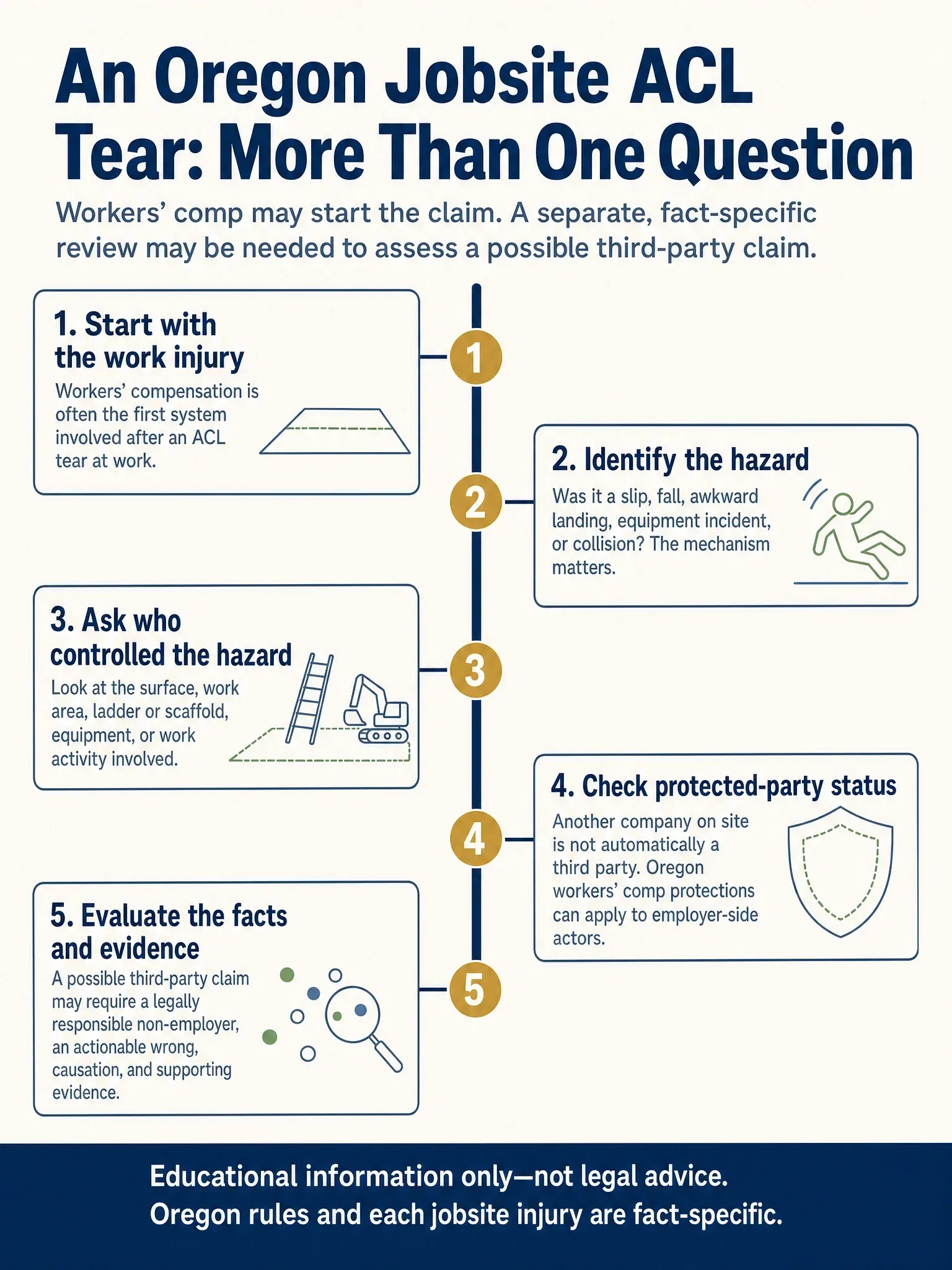
That distinction matters on construction sites and other multi-employer jobsites. An ACL tear caused by a bad landing, unsafe walking surface, defective ladder, equipment failure, or collision may require more than one question:
- Was this a compensable workplace injury?
- Who controlled the hazard that caused the knee injury?
- Was the responsible person or company protected by employer-side immunity?
- Does the evidence support negligence, a product defect, or another actionable wrong?
Oregon workers’ compensation exclusivity is broad. Covered employers generally receive protection from ordinary workplace-injury lawsuits, and Oregon law extends protection to certain employer-side actors, subject to statutory exceptions. For a broader overview, see Johnson Law’s guide to when a workplace injury may involve more than workers’ comp. This article focuses on the ACL-specific screening questions: what caused the knee mechanism, who may have been responsible, and what evidence helps separate a comp-only claim from a possible third-party case.
Why an ACL tear can be more than a “knee sprain”
The anterior cruciate ligament, or ACL, helps stabilize the knee. According to the American Academy of Orthopaedic Surgeons, ACL injuries can occur when sudden forces overwhelm the ligament, including rapid direction changes, sudden stops, awkward landings, or direct collision.
On a jobsite, those same mechanics can show up in practical ways: a worker slips on a slick surface, lands awkwardly from a height, twists while avoiding moving equipment, steps through an unstable surface, or is struck by a vehicle or machinery. The legal claim turns on the facts, but the medical mechanism often matters from the beginning.
Common jobsite mechanisms that can tear an ACL
Jobsite ACL injuries may involve:
- Slips or falls on unsafe walking or working surfaces
- Awkward landings from ladders, scaffolds, platforms, steps, or temporary flooring
- Sudden twisting while carrying materials or avoiding a hazard
- A direct collision with equipment, vehicles, or falling objects
- A ladder or work platform that shifts, collapses, or was improperly provided
- Equipment or safety gear that fails in a way that forces the knee into a dangerous position
Those examples do not prove a third-party claim by themselves. They are starting points for asking what caused the force on the knee and who had responsibility for the condition, equipment, or activity that created the risk.
Why medical documentation matters
ACL injuries vary. AAOS describes a grading scale that ranges from mild ligament damage, to partial tears, to complete tears with knee instability. ACL injuries can also occur with damage to other knee structures, including the meniscus or MCL.
Symptoms may include a pop or a feeling that the knee gave out, pain and swelling within 24 hours, loss of range of motion, tenderness along the joint line, and discomfort walking. MRI is often used to evaluate ligament, cartilage, and other soft-tissue injury, although some ACL tears may be diagnosed clinically.
For both workers’ compensation and any possible third-party claim, medical documentation helps connect the jobsite event to the diagnosed injury. The records may also show restrictions, time off work, instability, associated injuries, surgery or nonoperative treatment, and ongoing limitations. None of that guarantees a particular result, but it helps establish what happened medically.
The Oregon workers’ comp baseline: what it can cover—and what it does not resolve
Oregon workers’ compensation can provide important benefits after an accepted workplace ACL injury. Insurers and self-insured employers are generally required to pay the cost of medical services for compensable claims. Oregon worker guidance also explains that workers may receive time-loss payments when a doctor authorizes time off work or modified or light-duty work that results in lost wages. There are detailed rules, including rules about the first three days missed from work, that depend on the facts and the workers’ compensation system.
Those benefits can be crucial after a serious knee injury. But workers’ compensation does not always answer every responsibility question. It may cover medical care and wage-loss benefits while leaving open whether a non-employer caused the hazard.
Workers’ comp is not the same as a third-party damages claim
A workers’ compensation claim and a third-party personal injury claim are different systems. Workers’ compensation focuses on statutory benefits for a compensable injury. A third-party claim asks whether someone outside the protected employer-side group is legally responsible for causing the injury and resulting harm.
That difference is why the “who caused this?” question still matters. If a property owner, general contractor, subcontractor, rental company, maintenance vendor, equipment seller, or other non-employer played a legally responsible role, workers’ compensation may not be the end of the analysis.
When a jobsite ACL tear may involve a third party
Oregon law allows an injured worker to seek a remedy against a third person when the injury is due to the negligence or wrong of a third person not in the same employ. In practice, however, that sentence does not answer every case.
The harder questions are usually:
- Is the person or company truly a third party for Oregon workers’ compensation purposes?
- Did that person or company owe a duty related to the hazard?
- Did negligence, a product defect, or another wrong cause the ACL injury?
- What defenses or comparative-fault arguments may be raised?
Start with “who controlled the hazard?”
In many ACL cases, the most useful early question is not simply “who was on site?” It is “who controlled the hazard that caused the knee injury?”
For example:
- If the worker slipped on a surface, who owned, created, maintained, inspected, or controlled that surface?
- If the worker landed awkwardly from a ladder or scaffold, who provided it, set it up, inspected it, or controlled that work area?
- If the knee injury followed an equipment incident, who owned, rented, maintained, repaired, or operated the equipment?
- If another company’s employee caused a collision or sudden evasive movement, what was that person’s role and who controlled the work activity?
On multi-contractor jobsites, fault and control can be complicated. A general contractor, subcontractor, property owner, vendor, staffing client, equipment rental company, or maintenance company may be relevant. But the label alone does not prove liability. For more on that issue, see Johnson Law’s article on which company controlled the jobsite hazard.
Common third-party patterns after a jobsite ACL tear
Potential third-party patterns may include:
- An unsafe walking or working surface controlled by someone other than the injured worker’s employer
- An unprotected fall hazard or unstable surface on a construction site
- A defective or improperly provided ladder, scaffold, platform, or temporary step
- A rental-equipment or maintenance failure involving non-employer equipment
- A defective product, tool, machine, or safety component
- Negligent vehicle or machinery operation by someone outside the protected employer-side group
These are examples, not automatic claims. A careful analysis still has to identify the responsible entity, the specific hazard, the applicable safety or product issue, causation, medical proof, and potential defenses.
Why “another company was on site” is not enough
Oregon’s exclusive-remedy statute protects covered employers and also extends protection to specified employer-side actors, including certain insurers, claims administrators, contracted agents, employees, partners, LLC members, officers, and directors, subject to exceptions. The statute also contains rules and exceptions that can matter in multi-employer settings, including common-enterprise and role-capacity issues.
That means a worker should not assume that every other contractor or person on site can be sued. The legal question is fact-intensive: what role did the person or company have, what capacity were they acting in, and does Oregon law treat them as protected or as a legally responsible third party?
Safety rules can help tell the story, but they do not automatically prove the case
Oregon workplace safety law requires employers to provide employment and a place of employment that are safe and healthful and to use reasonably necessary devices, safeguards, practices, methods, operations, and processes to protect employees. Oregon law also addresses unsafe places of employment and requires employers, owners, employees, and other persons to comply with safety and health orders, standards, rules, and regulations made or prescribed by the Department of Consumer and Business Services.
Oregon OSHA’s construction materials include rule families for fall protection, ladders, scaffolding, cranes and derricks, motor vehicles and mechanized equipment, excavations, materials handling, tools, and stairs and ladders. Oregon OSHA also identifies fall protection, ladder use, safety committee meeting documentation, and written hazard communication programs as construction rules that are among the most violated almost every year.
Match the rule to the hazard
In an ACL case, it is usually more useful to match the safety issue to the specific mechanism than to say “the jobsite was unsafe.”
For example, Oregon OSHA fall-protection rules generally require employers to ensure fall-protection systems are provided, installed, and implemented when workers are exposed to a hazard of falling six feet or more to a lower level, subject to exceptions and other applicable standards. Oregon OSHA fall-protection rules also require the employer to determine whether walking and working surfaces have the strength and structural integrity to safely support employees before employees work on those surfaces.
Those rules may matter in a fall, unstable-surface, temporary-flooring, or step-through scenario. A ladder case may involve a different rule family. A vehicle, crane, tool, scaffold, or excavation incident may require a different analysis.
Safety violations are evidence, not a guarantee
A safety violation may help explain what went wrong and who had responsibility for a hazard. But a safety violation does not automatically mean there is a civil lawsuit, and it does not guarantee recovery. The injured worker still must address legal responsibility, protected-party status, causation, damages, deadlines, and defenses.
Equipment, ladders, and product-defect scenarios
Some ACL injuries involve equipment rather than only site control. A ladder shifts, a platform fails, a power tool malfunctions, a machine unexpectedly moves, or rented equipment fails under ordinary use. Those facts may raise negligence questions, product-liability questions, or both.
Oregon product liability law defines a product liability civil action to include claims for personal injury, death, or property damage caused by a product and based on issues such as design, inspection, testing, manufacture, failure to warn, marketing, packaging, or labeling. Oregon law also addresses when a seller or lessor may be liable for a product in a defective condition unreasonably dangerous to the user or consumer, when the product reached the user without substantial change and caused physical harm.
If the ACL tear involved defective equipment or tools, Johnson Law’s related discussion of defective power tools and product-liability claims may be relevant. If the mechanism involved a ladder, see the article on defective or improperly provided ladder falls.
Defect is different from ordinary wear, misuse, or poor maintenance
Equipment failure does not automatically prove product liability. The issue may be:
- A design or manufacturing defect
- A missing or inadequate warning
- A rental or maintenance failure
- Ordinary wear that should have been discovered
- Improper setup or jobsite use
- Misuse or a defense argument about how the equipment was handled
Those categories can point to different defendants and different deadlines. Oregon product-liability timing rules are also specific and can involve discovery-based limitation rules and repose provisions. It is safer to treat equipment cases as deadline-sensitive rather than assuming the same rule applies to every jobsite injury.
Preserve the equipment if possible
When equipment is involved, preservation can matter. If it is safe and practical, identify and preserve the ladder, tool, machine, component, rental tag, serial number, maintenance record, inspection record, or other item involved. Photos and video can help, as can witness names, incident reports, and information about who owned, rented, maintained, or controlled the equipment.
Do not interfere with medical care, workplace safety, or an official investigation. The point is to avoid losing evidence before anyone can evaluate whether the issue was a product defect, maintenance problem, unsafe setup, or something else.
What evidence helps separate a comp-only ACL claim from a third-party case?
The evidence in a jobsite ACL case usually has to answer three broad questions: what happened to the knee, what hazard caused it, and who may be legally responsible for that hazard.
Injury and medical evidence
Helpful medical evidence may include:
- Early medical records describing the work incident and symptoms
- MRI or other imaging when used to assess the ACL and related soft-tissue injury
- Diagnosis of sprain, partial tear, complete tear, meniscus injury, MCL injury, or other associated condition
- Work restrictions, light-duty limitations, or time-loss authorization
- Treatment plan, including physical therapy, surgery, reconstruction, or nonoperative care
- Records showing instability, range-of-motion limits, swelling, pain, or functional restrictions
The goal is not to self-diagnose. It is to make sure the medical record accurately documents the event, symptoms, diagnosis, restrictions, and treatment course.
Jobsite evidence
Useful jobsite evidence may include:
- Photos or video of the surface, ladder, platform, equipment, lighting, weather, debris, or work area
- Incident reports, supervisor reports, safety reports, or near-miss reports
- Witness names and contact information
- Site maps or work-area assignments
- Names of contractors, subcontractors, vendors, property owners, rental companies, or maintenance companies involved
- Equipment identifiers, rental documents, inspection records, and maintenance records
- Safety meeting records, hazard reports, or prior complaints about the condition
This evidence helps identify control and responsibility. It can also show whether the condition existed before the injury, whether it was reported, and whether another company had the power to fix it.
Defense evidence
Oregon comparative fault law can reduce recovery if the injured worker is partly at fault, as long as the worker’s fault is not greater than the combined fault of the defendants and certain others identified by statute. In jobsite ACL cases, defense arguments may include claims that the worker stepped wrong, ignored training, failed to watch footing, misused equipment, or chose an unsafe route.
Those arguments do not automatically defeat a claim. But they make contemporaneous evidence important. Photos, witness accounts, work instructions, safety procedures, and records showing the condition of the site can help evaluate both responsibility and comparative-fault issues.
How workers’ comp liens and third-party recoveries interact
When a compensable workplace injury is caused by a legally responsible third person, Oregon law includes election, lien, reimbursement, settlement, assignment, and distribution rules. This is one reason an injured worker should be careful before assuming a third-party settlement number equals the amount the worker will personally receive.
At a high level:
- Oregon law requires an election about whether to recover damages from the third person.
- The paying agency may have a lien on the third-party cause of action for compensation paid.
- Oregon law sets distribution rules for third-party recoveries, including costs and attorney fees, a worker share, agency reimbursement, and remaining-balance rules.
- A paying agency must join in a compromise of a third-party claim.
- If a worker elects not to bring the third-party action, that election can operate as an assignment of the claim to the paying agency.
These rules are technical and fact-specific. For a deeper discussion, see Johnson Law’s article on how workers’ comp liens can affect third-party settlement proceeds.
Deadlines: why waiting can create problems
Many Oregon personal injury claims are generally subject to a two-year limitation period. But that is not a universal deadline for every possible jobsite ACL case. Product-liability claims have their own timing rules. Claims involving public bodies may involve shorter notice requirements. Repose rules can matter in older design, construction, maintenance, or product scenarios. Workers’ compensation election and assignment rules can also create practical timing risks.
For more general deadline context, see Johnson Law’s guide to Oregon statute-of-limitations issues. The key point here is simple: if a jobsite ACL injury might involve a non-employer third party, waiting can make evidence harder to preserve and deadlines harder to evaluate.
Practical next steps after a jobsite ACL tear in Oregon
After a serious knee injury at work, the immediate priority is medical care and accurate reporting. Once the urgent medical issues are addressed, it can help to think through the third-party screening questions early.
Questions to ask early
Consider documenting or asking:
- Who was your direct employer?
- Where exactly did the knee injury happen?
- What movement caused the ACL mechanism: slip, fall, twist, awkward landing, collision, or equipment failure?
- Who controlled the work area, walking surface, ladder, scaffold, platform, vehicle, or equipment?
- Were other contractors, vendors, property owners, rental companies, or maintenance companies involved?
- Was the condition reported before your injury?
- Were photos, video, incident reports, or safety reports created?
- Are there witnesses who saw the incident or the condition beforehand?
- Is your workers’ compensation claim accepted, denied, or still pending?
- Has anyone asked you to make an election or sign settlement or release documents?
These questions do not replace legal advice. They help organize the facts before memories fade, conditions change, equipment disappears, or deadlines approach.
Talk with an Oregon lawyer before assuming it is comp-only
An ACL tear on the jobsite may be handled entirely through workers’ compensation. In some cases, that is the only practical legal path. In other cases, the facts may point to a third-party claim involving a contractor, property owner, equipment company, vendor, or other non-employer.
Johnson Law can review whether an Oregon jobsite ACL injury may involve more than workers’ comp. The analysis is fact-specific and no result can be guaranteed, but an early review may help evaluate potential responsible parties, evidence to preserve, deadline issues, and how the workers’ compensation and third-party systems may interact.
This article is for educational information only and is not legal advice. Reading it does not create an attorney-client relationship. If you have a workplace ACL injury, talk with a qualified Oregon lawyer about the facts, deadlines, and options in your specific situation.
FAQ
Can I sue my employer for a torn ACL at work in Oregon?
Usually, a covered Oregon employer is protected by workers’ compensation exclusivity for ordinary workplace-injury claims. There are statutory exceptions and special circumstances, but workers generally should not assume they can sue their direct employer. A separate third-party claim may be possible if someone outside the protected employer-side group caused or contributed to the injury.
What is a third-party claim after a workplace ACL tear?
A third-party claim is a claim against a legally responsible person or company other than protected employer-side actors. Depending on the facts, that could involve a property owner, general contractor, subcontractor, equipment company, rental company, maintenance vendor, or another non-employer that caused or contributed to the hazard.
Does an Oregon OSHA violation mean I automatically have a lawsuit?
No. A safety violation may be relevant evidence, but it does not automatically create civil liability or guarantee recovery. The case still depends on legal responsibility, causation, damages, protected-party status, comparative fault, and deadlines.
Can I receive workers’ comp and still bring a third-party claim?
Potentially, yes. Oregon law recognizes third-party claims in some workplace-injury situations, but election, lien, reimbursement, distribution, settlement-approval, and assignment rules can affect the claim and the worker’s net recovery.
How long do I have to bring a third-party claim for a jobsite knee injury in Oregon?
Many Oregon personal injury claims are generally subject to a two-year limitation period, but not every jobsite ACL case follows one simple rule. Product-liability claims, public-body claims, repose issues, death claims, workers’ compensation election procedures, and other circumstances may affect timing. Get case-specific advice as early as possible.
What evidence matters after an ACL tear on a construction site?
Important evidence may include medical records, imaging, diagnosis, work restrictions, photos or video of the hazard, witness information, incident reports, site-control facts, contractor and vendor identities, equipment identifiers, rental or maintenance records, safety reports, and Oregon OSHA rule context where it matches the hazard.
Source notes
- Oregon workers’ compensation definitions, employer exclusivity, medical benefits, third-party election, liens, compromise, assignment, and distribution rules: ORS Chapter 656, including ORS 656.005, 656.018, 656.154, 656.245, 656.578, 656.580, 656.587, 656.591, and 656.593.
- Oregon limitation and repose rules: ORS Chapter 12, including ORS 12.110, ORS 12.115, and ORS 12.135.
- Oregon Tort Claims Act notice and death-claim timing edge cases: ORS Chapter 30, including ORS 30.020 and ORS 30.275.
- Oregon product-liability definitions, liability framework, and timing rules: ORS 30.900, 30.920, and 30.905.
- Oregon comparative fault: ORS 31.600.
- Oregon workplace safety statutes: ORS 654.010, 654.015, and 654.022.
- Oregon OSHA construction and fall-protection materials, including construction topic guidance and Division 3, Subdivision M fall-protection rules.
- Oregon DCBS and Workers’ Compensation Division guidance on workers’ compensation medical care and time-loss benefits.
- American Academy of Orthopaedic Surgeons, OrthoInfo, “Anterior Cruciate Ligament (ACL) Injuries”, for medical background on ACL function, mechanisms, symptoms, grading, associated injuries, MRI, and treatment variability.
Client-First Fee Promise
Client First = Bills First, Fees Second
Your unpaid medical bills do not have to make your lawyer's fee bigger. Johnson Law subtracts qualifying medical bills before calculating our fee, helping clients keep more of their settlement.
Applies to qualifying cases. Results vary.