Can I Sue My Employer After a Workplace Injury in Oregon? The Real Exceptions Explained
Can I Sue My Employer After a Workplace Injury in Oregon? The Real Exceptions Explained
Educational information only, not legal advice. Oregon workplace injury claims are deadline-sensitive and fact-specific. Workers’ compensation, third-party liability, liens, insurance coverage, and employment relationships should be reviewed before assuming one path is the only path.
Quick answer: usually not for ordinary employer negligence, but there are important exceptions
If you were hurt at work in Oregon, the first rule is frustrating but important: workers’ compensation usually replaces an ordinary negligence lawsuit against a complying employer.
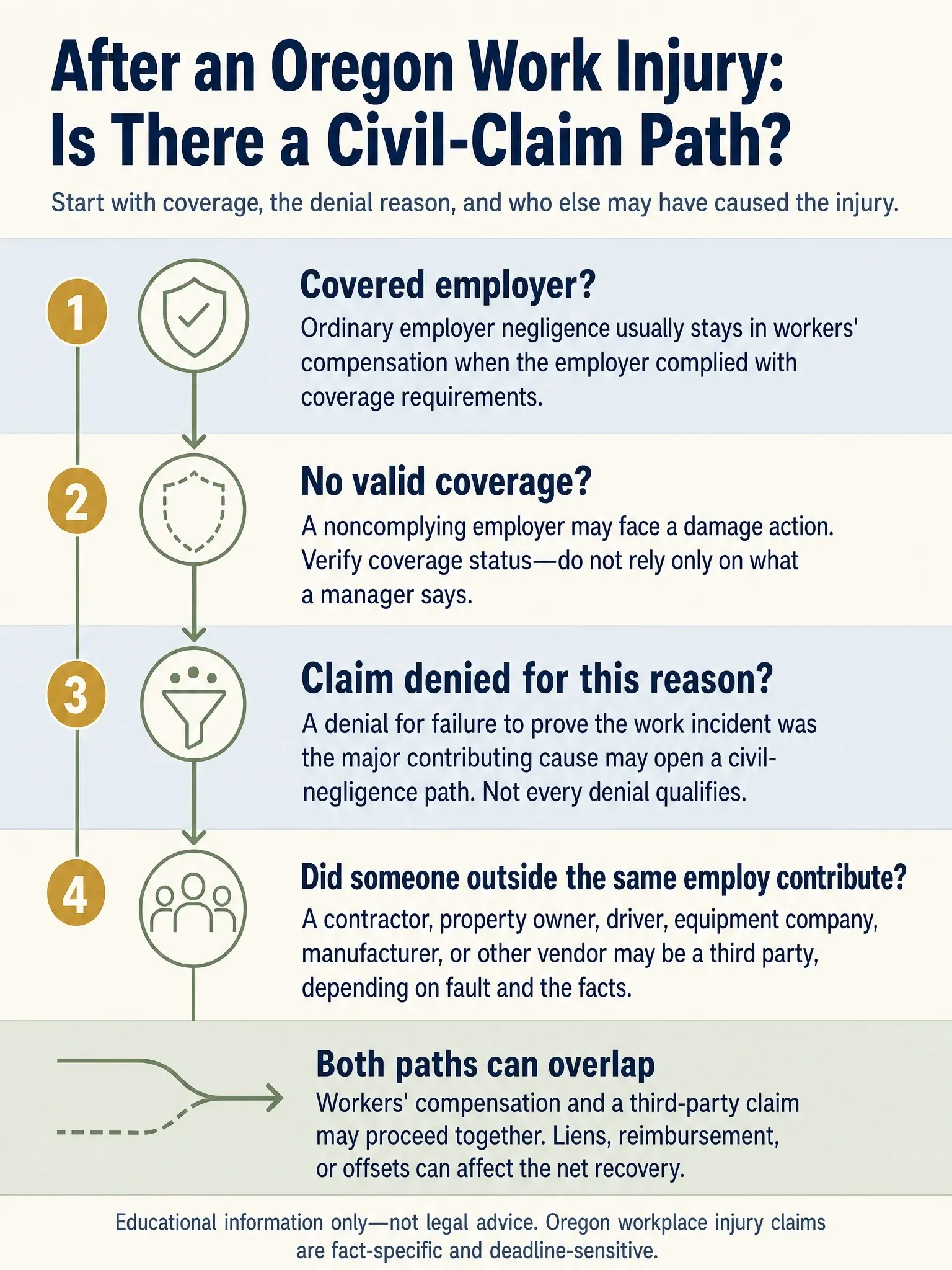
That does not mean every workplace injury is “just workers’ comp.” The real question is more precise:
- Did your employer have valid workers’ compensation coverage?
- Was the claim denied in a way that opens a civil-negligence pathway?
- Did a third party—someone outside your employer—cause or contribute to the injury?
- Did defective equipment, a dangerous property condition, a contractor’s work, or a vehicle crash play a role?
For construction examples, see our guide to scaffolding fall claims and third-party lawsuits. If several companies were working at the site, our post on multi-contractor jobsite fault explains why responsibility can be split. For excavation-specific evidence issues, see our article on trench collapse injury claims in Oregon.
The baseline rule: workers’ comp exclusivity
Oregon’s workers’ compensation system is designed to provide benefits for covered work injuries without making the worker prove ordinary negligence by the employer. In exchange, a complying employer generally receives protection from civil lawsuits for the same injury.
That exclusivity rule is reflected in ORS 656.018. In plain English, if your employer had workers’ compensation coverage and your injury is handled within that system, you normally cannot sue the employer simply because it made a careless safety mistake.
Examples that often stay primarily in workers’ comp include:
- an employee slipping on a wet work floor maintained by the employer;
- a supervisor failing to warn about a routine job hazard;
- a coworker accidentally causing an injury while doing the same employer’s work; or
- a workplace lifting, twisting, or repetitive strain and occupational disease claim in Oregon workers’ compensation.
Those examples can still be serious. Workers’ compensation may involve medical treatment, time-loss benefits, permanent impairment, vocational issues, claim denials, and disputes. But it is different from a civil personal injury lawsuit.
Exception path #1: a noncomplying employer
Oregon requires subject employers to provide workers’ compensation coverage. When an employer fails to comply, the legal picture can change.
ORS 656.020 addresses damage actions by workers against noncomplying employers. A noncomplying-employer situation is not the same as a normal covered workers’ compensation claim. It can raise different remedies, defenses, insurance questions, and collection problems.
Practical signs that coverage status needs investigation include:
- the employer refuses to provide workers’ compensation insurance information;
- the worker is told to use health insurance and not report the injury;
- the business says the worker was an “independent contractor” despite controlling the work like an employee;
- no claim number or insurer appears after the injury is reported; or
- the employer threatens the worker for asking about coverage.
Do not assume coverage does or does not exist based only on what a manager says. Coverage status should be verified through the proper channels.
Exception path #2: a denied workers’ comp claim may open a civil-negligence route
Oregon also has a specific statute, ORS 656.019, addressing civil negligence actions when a workers’ compensation claim is denied because the worker failed to establish that the work incident was the major contributing cause under the compensation standard.
This is a technical pathway. It does not mean every denied workers’ compensation claim turns into a lawsuit. The exact denial reason, timing, medical causation issue, and available negligence evidence all matter.
If your claim was denied, save:
- the denial letter;
- claim acceptance or denial notices;
- medical causation reports;
- incident reports;
- witness information;
- photos or video of the hazard; and
- any correspondence from the insurer or employer.
The wording of the denial can matter. A general “workers’ comp denied me” summary is not enough.
For a closer look at denial-letter concepts, see Johnson Law’s guide to common Oregon workers’ comp denial reasons and deadlines.
The big category: third-party claims
A common way a workplace injury becomes more than workers’ comp is a claim against a third party.
ORS 656.154 recognizes that a worker injured by the negligence or wrong of a person not in the same employ may have a remedy against that person. That can include many non-employer defendants, depending on the facts.
Possible third parties include:
- a subcontractor on a construction site;
- a general contractor that controlled site safety;
- a property owner or manager;
- a delivery driver or other motorist;
- an equipment rental company;
- a manufacturer of a defective tool, ladder, forklift, scaffold, or machine;
- a maintenance company; or
- a security, cleaning, loading, or logistics contractor.
For a narrower premises example, a break-room slip-and-fall involving a landlord, janitorial vendor, or maintenance contractor may require a different analysis than an employer-controlled spill.
For a product-focused example, see our guide to defective power tool injuries on Portland jobsites, which explains how workers’ comp and product-liability investigations can overlap.
This is why an early question after a work injury should not be only “Was I on the clock?” It should also be “Who else controlled the hazard?”
Workers’ comp and a third-party case can overlap
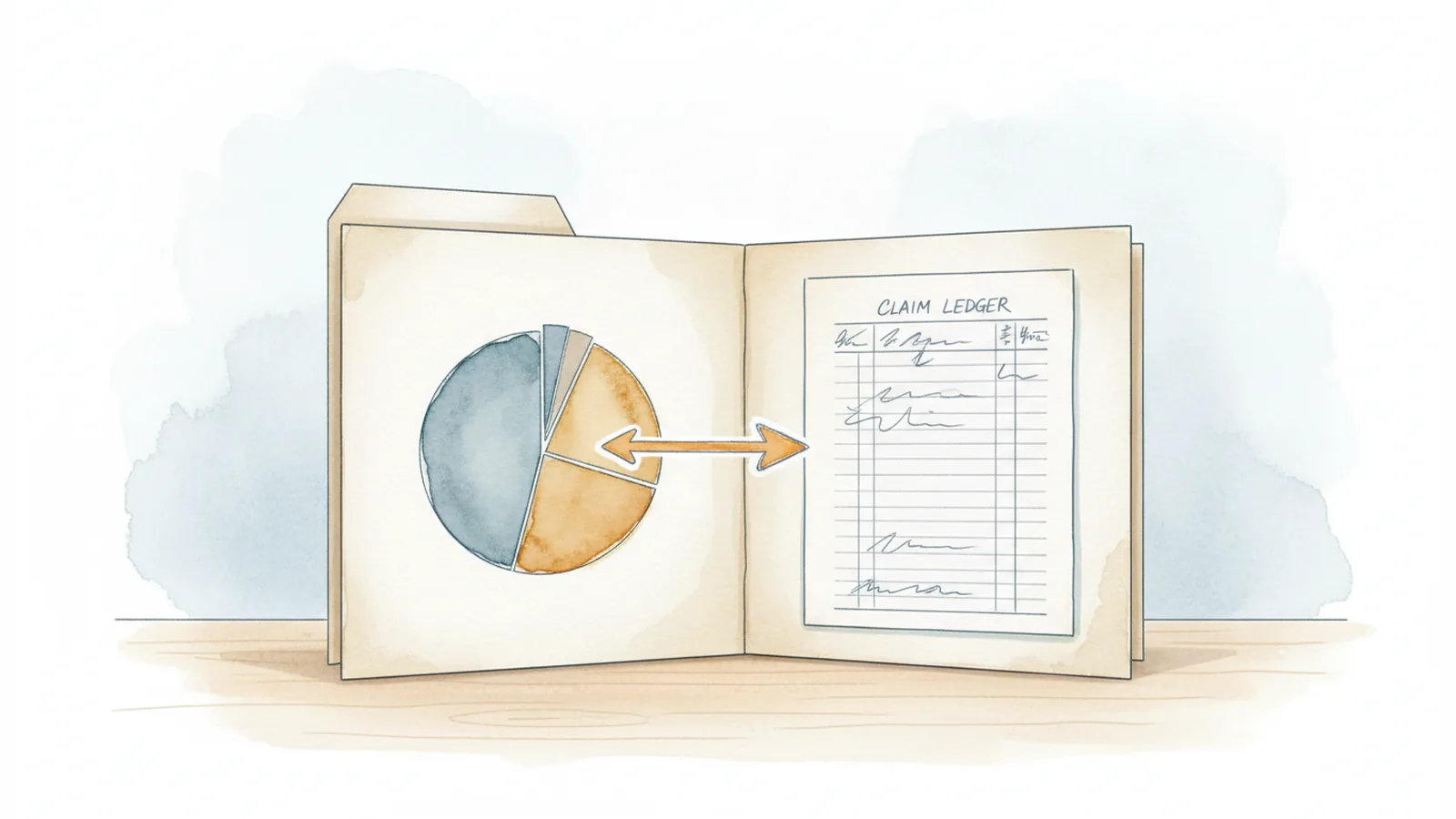
You may have workers’ compensation benefits and a third-party injury claim at the same time. That overlap can help with medical care and wage loss, but it also creates reimbursement and lien issues.
Oregon’s third-person recovery statutes, including ORS 656.576 to 656.596, address issues such as the worker’s election to sue, payment of compensation despite a third-party claim, paying-agency liens, compromise participation, and offsets.
In everyday terms: if workers’ compensation pays benefits and you later recover money from a third party, the workers’ compensation paying agency may claim reimbursement from part of that recovery. That can change the real net settlement. For a closer look at that overlap, see our guide to how Oregon workers’ comp liens and reimbursement can affect a third-party settlement.
For broader background on how liens can affect settlement value, see our guide to medical bills, liens, and subrogation in Oregon injury settlements.
Evidence that helps separate comp-only claims from third-party claims
After a workplace injury, preserve evidence that identifies who controlled what:
- photos of the hazard, equipment, scene, warning signs, and work area;
- names of every company present at the site;
- contracts, work orders, delivery tickets, inspection tags, rental paperwork, and maintenance logs if available;
- witness names and phone numbers;
- incident reports from each company, not just your employer;
- video locations and camera angles;
- damaged tools, ladders, PPE, machine parts, or products; and
- texts, emails, or job instructions showing who directed the work.
Do not let a dangerous product or jobsite condition disappear before it is photographed or preserved. In many work injury cases, the evidence is altered quickly because the job has to keep moving.
FAQ
Can I sue my boss personally after a work injury?
Usually not for ordinary workplace negligence if the injury is covered by Oregon workers’ compensation and the employer complied with coverage requirements. But coverage status, denial grounds, and non-employer fault should be reviewed.
What if another contractor caused my injury?
That may create a third-party claim if the contractor was not in the same employ and its negligence or wrongful conduct contributed to the injury. The details of control, scope of work, and causation matter.
What if workers’ comp says I was not really an employee?
Employee status can be disputed. Save the denial, pay records, schedules, job instructions, texts, tax forms, and proof of who controlled the work. Do not rely only on the label the company used.
Does a third-party case replace workers’ comp?
Not necessarily. The two can overlap. Workers’ compensation may pay benefits while a third-party claim is pursued, but reimbursement and lien rules can affect the final net recovery.
Talk with an Oregon workplace injury attorney before assuming the case is “just comp”
If you were seriously injured at work in Oregon, the early investigation should identify the employer, coverage status, denial issues, all non-employer parties, insurance layers, and evidence that may disappear.
Johnson Law can help evaluate whether your workplace injury is limited to workers’ compensation or may also involve a third-party personal injury claim.
Sources
Client-First Fee Promise
Client First = Bills First, Fees Second
Your unpaid medical bills do not have to make your lawyer's fee bigger. Johnson Law subtracts qualifying medical bills before calculating our fee, helping clients keep more of their settlement.
Applies to qualifying cases. Results vary.