Assault at a Hotel: What a “Foreseeable Risk” Looks Like in Guest Safety Cases
Assault at a Hotel: What a “Foreseeable Risk” Looks Like in Guest Safety Cases
Educational information only, not legal advice. Oregon negligent security claims are fact-specific. If you were injured in an assault at a hotel, talk with an attorney promptly about deadlines, evidence preservation, and the facts of your situation.
Hotels sell more than a room. They control hallways, lobbies, stairwells, elevators, parking areas, key-card systems, staff training, guest complaints, and often surveillance video. When an assault happens on hotel property, those control points can become the center of the case.
That does not mean a hotel is automatically responsible whenever one guest, visitor, trespasser, or unknown third person attacks someone. Oregon law does not make hotels insurers of everyone’s safety. The better question is narrower: before the assault happened, did the hotel know or have reason to know about a security risk, and did it fail to take reasonable steps within its control?
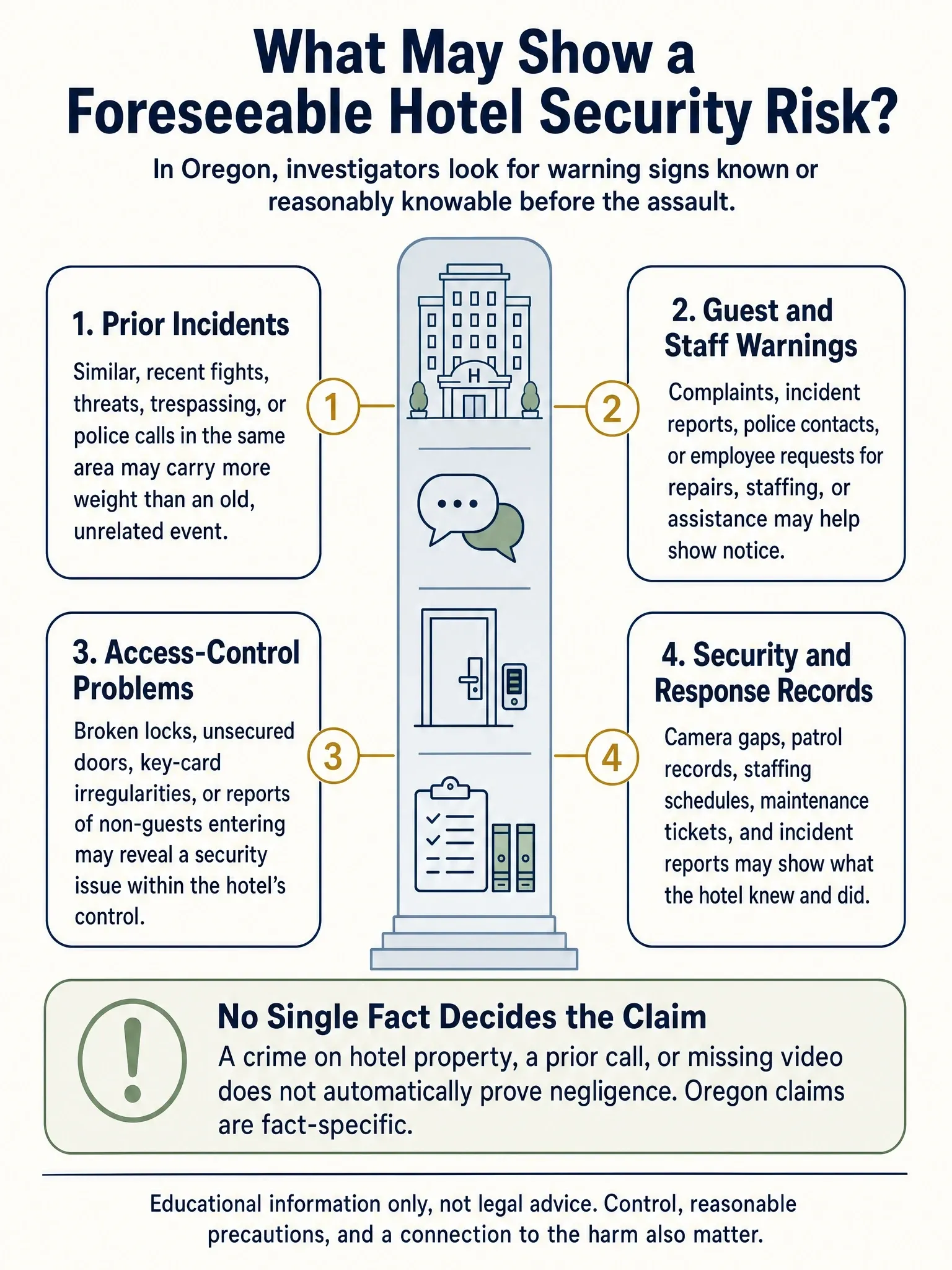
For hotel negligent security cases in Oregon, “foreseeable risk” often comes down to evidence such as prior calls for service, repeated guest complaints, broken locks, room-access control problems, unsecured side doors, missing patrols, and camera gaps.
Quick answer: a hotel assault claim turns on notice, control, and reasonableness
An Oregon hotel assault claim usually needs more than proof that an assault happened on hotel property. The strongest cases tend to show three things:
- Notice: the hotel knew or should have known about a risk before the assault.
- Control: the hotel had some practical ability to reduce that risk through staffing, repairs, access control, warnings, patrols, or other reasonable steps.
- Connection: the security failure helped create, increase, or fail to interrupt the opportunity for the assault.
Examples might include a side entrance that had been reported broken for weeks, repeated police calls for fights in the same hallway or parking area, complaints about non-guests roaming the property, or key-card records showing a room was accessed in a way that should not have happened.
The evidence matters because hotels and insurers often respond with a version of the same defense: “We cannot control crime.” That argument is sometimes legally important, but it is not the whole analysis. For a broader discussion, see our guide to how property owners use the “we can’t control crime” defense.
What “foreseeable risk” means under Oregon law
Oregon negligence law focuses heavily on foreseeability. In general terms, the question is whether the defendant’s conduct unreasonably created a foreseeable risk of the kind of harm that happened.
In guest-safety cases, that does not require proof that the hotel predicted the exact attacker, minute, weapon, or sequence of events. Oregon courts look at whether the general type of harm was reasonably anticipatable under the circumstances. A history of violent incidents, a known access-control problem, or a pattern of ignored warnings can make the analysis very different from a sudden incident with no meaningful warning signs.
Oregon premises-liability law also recognizes that a proprietor’s reasonable-safety duties depend in part on how the premises are used. A hotel is open to guests, visitors, vendors, employees, and sometimes the public. It may have late-night check-ins, bars or restaurants, parking lots, side doors, elevators, shared hallways, and guest-room access systems. Those features do not automatically create liability, but they can shape what reasonable precautions may require when a risk is foreseeable.
The same rule cuts both ways. A hotel is not liable just because a crime occurred. Hindsight is not enough. The question is what was known or reasonably knowable before the assault, and what reasonable steps were available then.
Prior calls for service and incident history
Prior calls for service can be important evidence in a hotel negligent security case. They may show whether the hotel, police, or nearby businesses had already dealt with fights, threats, trespassing, drug activity, robberies, assaults, stalking, or repeated disturbances in the same area.
But prior calls do not all carry the same weight. A useful investigation asks:
- Were the earlier incidents similar to the assault?
- Did they happen in the same lobby, hallway, stairwell, parking lot, bar area, or room corridor?
- How recent were they?
- Did hotel management receive complaints, incident reports, police contacts, or employee warnings?
- Did the hotel change anything afterward?
For example, one unrelated theft years earlier may say little about a later assault. Repeated calls for fights in the same parking area during late-night hours may say much more, especially if management received reports, complaints, or other information tying those incidents to the property. So may records showing that employees had repeatedly asked management for more staffing, door repairs, or police assistance.
In Oregon, some police and public-agency records may be requested under public-records laws, though exemptions, privacy rules, and practical limits can apply. Hotel internal records may require preservation demands, insurance communications, subpoenas, or litigation discovery.
Room access control failures
Hotel assault cases often turn on access: who could enter the property, who could reach guest floors, and who could open a guest room.
Evidence may include:
- key-card audit logs;
- records showing when a room key was created, replaced, or deactivated;
- front-desk identity-verification policies;
- maintenance records for guest-room locks, side doors, stairwells, and elevators;
- complaints about propped doors or non-guests entering the building;
- records of staff letting someone into a room without proper authorization;
- reports of locks, deadbolts, latches, or peepholes that were broken or missing.
Oregon’s innkeeper statutes are mostly about lodging and property issues, not a complete hotel assault code. Still, Oregon law expressly recognizes hotels, innkeepers, transient lodging, and room-lock concepts in the innkeeper context, including statutory references to locks or bolts on sleeping-room doors in a property-liability scheme. In a personal-injury claim, the key issue is usually negligence: did the hotel fail to act reasonably with the access-control risks it knew or should have known about?
Access evidence can also help separate responsible parties. A franchise owner, hotel manager, property owner, security contractor, or maintenance vendor may each control different parts of the system.
Surveillance gaps and missing video
Surveillance video can help answer basic questions: where the attacker came from, how long they were on the property, whether staff saw warning signs, whether doors were propped open, whether patrols occurred, and how quickly anyone responded.
Missing video can be just as important to investigate, even though a gap in footage does not automatically prove negligence. A hotel may have cameras pointed at the lobby but not the hallway. A camera may cover the parking lot entrance but not the stairwell. Video may overwrite automatically after days or weeks. A camera may be decorative, broken, blocked, or not monitored.
After a hotel assault, it is important to ask quickly about:
- camera locations and blind spots;
- retention periods;
- whether video was saved after the incident;
- whether cameras were functioning;
- who had access to the video system;
- whether the hotel received a preservation request before footage was overwritten.
For more on preserving time-sensitive records, see our guide to preserving evidence after an incident.
What reasonable hotel security might look like
There is no single statewide Oregon negligent-security checklist that says every hotel must have a certain number of cameras, guards, locks, patrols, or front-desk employees. Reasonable security depends on the property, the risk, what the hotel knew or should have known, and any applicable local, contractual, brand, industry, or property-specific standards.
Depending on the facts, reasonable steps might include:
- repairing broken locks or access points;
- enforcing key-card and guest-verification policies;
- responding to guest complaints about threats or stalking;
- calling police when staff observe escalating violence;
- documenting and escalating repeated disturbances;
- adjusting staffing during known high-risk times;
- using patrols or a security contractor where prior incidents justify it;
- warning guests about a specific known hazard when a warning would be useful;
- preserving video and incident records after a serious event.
If a third-party security company was involved, the contract, post orders, patrol logs, and incident reports may become central. Our post on security guard failures and shared blame explains how those contractor records can matter.
Hotel cases can overlap with other property-specific negligent security claims. Similar evidence issues arise in parking garage assault claims and convenience store parking lot robbery cases, but hotel claims often add room-access, guest-privacy, front-desk, and key-card issues.
Common hotel and insurer defenses
Hotels and insurers often argue that the criminal attacker is solely responsible. That may be partly true: the attacker’s conduct is central. But Oregon law can still allow a negligence claim when a property owner’s failures unreasonably created or increased a foreseeable risk, or failed to address a foreseeable risk within the owner’s control.
Other defenses may include:
- No prior similar incidents: the hotel may argue it had no reason to expect violence.
- The attack was too sudden: the hotel may claim staff had no time to intervene.
- The guest caused or escalated the incident: comparative fault may be raised depending on the facts.
- The unsafe area was not under hotel control: the hotel may point to a landlord, adjacent business, parking operator, or security contractor.
- Reasonable measures were already in place: the hotel may cite cameras, locks, patrols, or staff response.
These defenses are fact-dependent. The answer often comes from records: prior incident reports, employee emails, maintenance tickets, police calls, key-card logs, camera footage, staffing schedules, security contracts, and documents showing who controlled the area or system involved.
What to preserve after a hotel assault
If you were assaulted at a hotel, preserve evidence as soon as practical:
- Write down the date, time, location, room number, hallway, floor, parking area, or entrance involved.
- Photograph visible injuries, doors, locks, lighting, cameras, signs, and the surrounding area.
- Save booking confirmations, room-key envelopes, receipts, text messages, and emails.
- Identify witnesses, staff names, police report numbers, and ambulance or medical records.
- Ask that video, key-card records, incident reports, maintenance tickets, and complaints be preserved.
- Avoid relying on the hotel’s verbal assurance that “everything is saved.”
The sooner the preservation request is made, the better. Video may overwrite, staff may leave, and access logs may be harder to retrieve later.
Talk with an Oregon injury lawyer before evidence disappears
Hotel negligent security cases are rarely simple. They require a careful look at what happened before the assault, what the hotel controlled, what reasonable security measures were available, and whether the security failure actually contributed to the harm.
If you were injured in an Oregon hotel assault, Johnson Law can help evaluate the evidence and explain your options. The first step is not assuming the hotel is liable or assuming it is off the hook. The first step is preserving the records that show what the hotel knew, what it did, and what it failed to do.
For broader context, see our Oregon personal injury law overview.
Frequently asked questions
Can I sue a hotel after being assaulted in Oregon?
Possibly. A hotel assault claim usually depends on whether the hotel acted unreasonably in the face of a foreseeable risk, whether it controlled the relevant security issue, and whether that failure contributed to your injuries. An assault on hotel property is not enough by itself.
Do prior police calls prove the hotel knew the assault would happen?
Not automatically. Prior calls may help show notice, but their importance depends on similarity, timing, location, and whether the hotel knew or should have known about them.
What if someone got into my room with a key or through a broken door?
That can be important. Key-card audit logs, front-desk procedures, lock maintenance records, and reports about broken access points may show whether the hotel failed to follow reasonable room-access practices.
What if the hotel says there is no video?
Ask what cameras existed, where they pointed, how long video was retained, whether footage was overwritten, and whether anyone requested preservation. Missing video does not automatically prove negligence, but it can raise important evidence questions.
Sources
- ORS chapter 699, Innkeepers and Hotelkeepers
- ORS chapter 31, including comparative fault
- ORS chapter 192, including Oregon public records provisions
- Fazzolari v. Portland School Dist. No. 1J, 303 Or 1 (1987)
- Piazza v. Kellim, 360 Or 58 (2016)
- Fulmer v. Timber Inn Restaurant and Lounge, Inc., 330 Or 413 (2000), discussing premises-safety duties and proprietor-use principles
- Gross v. Wiley, 231 Or 421 (1962)
Client-First Fee Promise
Client First = Bills First, Fees Second
Your unpaid medical bills do not have to make your lawyer's fee bigger. Johnson Law subtracts qualifying medical bills before calculating our fee, helping clients keep more of their settlement.
Applies to qualifying cases. Results vary.