Bar Fight Injury: When the Bar Is Liable for Failing to Intervene or Eject
Bar Fight Injury: When the Bar Is Liable for Failing to Intervene or Eject
Educational information only, not legal advice. Oregon bar-fight and negligent-security claims are fact-specific. If you were injured in a bar, tavern, nightclub, restaurant, or event venue, talk with an attorney promptly about deadlines and evidence preservation.
When someone is hurt in a bar fight, the first responsible person is usually obvious: the person who threw the punch, swung the pool cue, shoved someone into a table, or started the assault.
But that is not always the end of the question.
In Oregon, a bar may face liability when the evidence shows that staff had reason to know a fight or assault was developing and failed to take reasonable steps within their control. That can include failing to intervene, failing to eject an aggressive patron, failing to call security or police, failing to respond to repeated threats, or running the premises with staffing levels that made a known risk worse.
This post focuses on the property-owner and security-duty side of a bar fight claim. If your main question is whether the bar overserved a visibly intoxicated person, see our separate guide to Oregon dram shop liability for overservice.
Quick answer: a bar fight claim depends on notice, time, control, and response
A bar is not automatically liable because a fight happened on its property. Oregon law does not make bars insurers of every customer’s safety.
A negligent-security claim becomes more realistic when the facts support four points:
- The danger was visible or foreseeable. Staff saw threats, pushing, harassment, repeated confrontations, weapons, aggressive behavior, or a patron with a known history of problems.
- There was enough time to act. The fight did not unfold as a completely sudden, one-punch surprise before anyone could reasonably respond.
- The bar had practical control. Staff, management, bouncers, or hired security had some ability to cut off service, separate people, remove a patron, call police, clear the area, or follow an incident procedure.
- The response was unreasonable and mattered. The failure to act helped allow the injury to happen or made the harm worse.
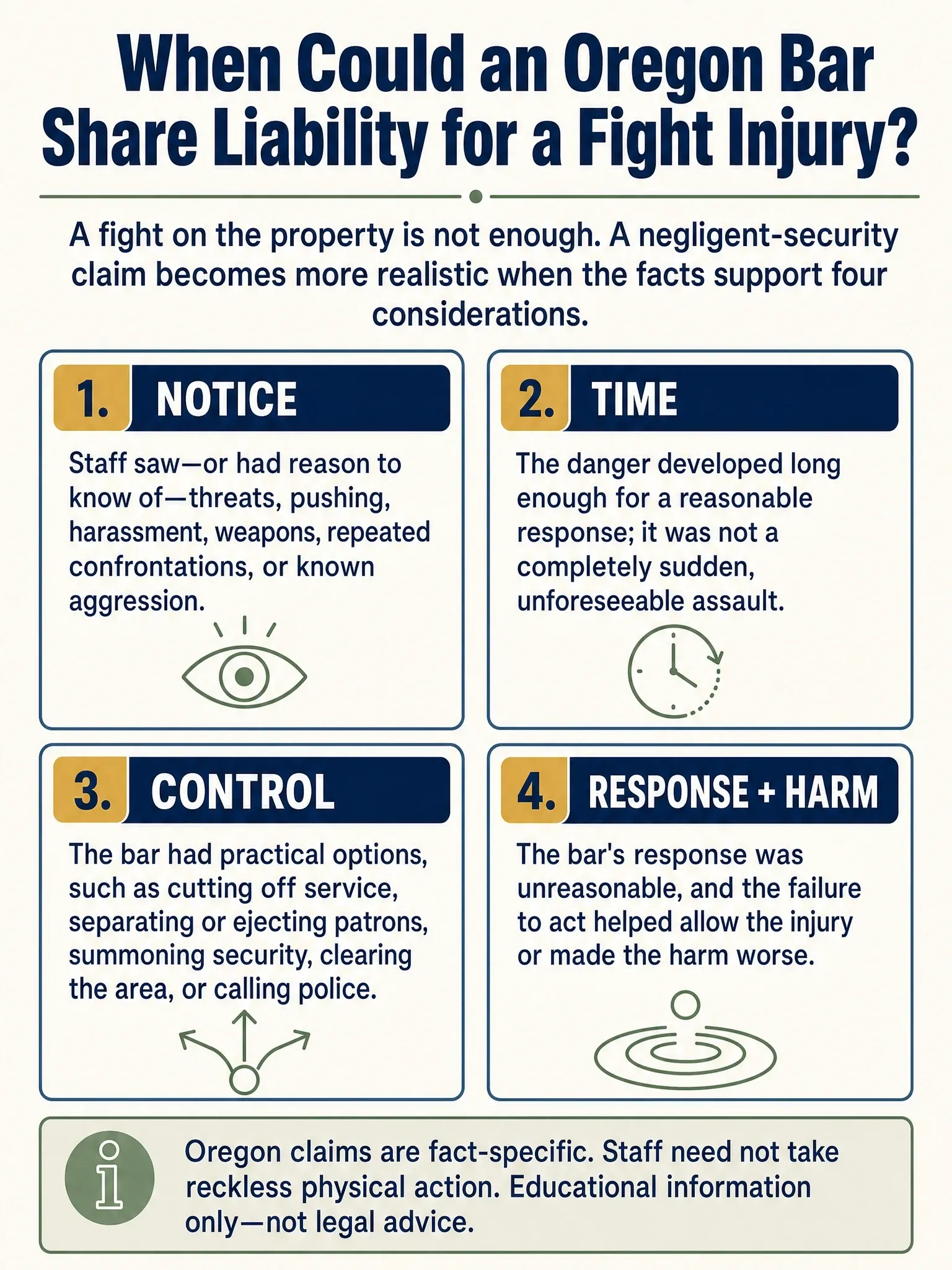
That is why bar-fight cases often turn on minutes, sometimes seconds: what did staff know, when did they know it, and what did they do?
Oregon law: bars are not insurers, but they may have to act on known danger
Oregon premises-liability law generally requires a business to use reasonable care to make its premises reasonably safe for invitees. In cases involving taverns and similar businesses, Oregon courts have recognized that the safety analysis can account for the way the premises are used: alcohol service, crowds, closing-time pressure, security staffing, and the risk of confrontations.
Oregon’s key bar-fight case is Whelchel v. Strangways. There, the Oregon Supreme Court held that a jury could consider whether tavern operators were negligent where evidence showed a fight had gone on for several minutes before the plaintiff was struck with a pool cue, and the bartender allegedly did nothing to stop the fight, eject the participants, or prevent the pool cue from being used as a weapon.
The point is not that a bartender must personally jump into every fight. The point is that a business may need to take reasonable action when staff know, or have reason to know, that dangerous conduct is occurring or about to occur.
That same principle has a limit. In Gross v. Wiley, the Oregon Supreme Court rejected a claim where an altercation was essentially sudden and the evidence did not show that the proprietor should have anticipated the first attack or that more security staff were reasonably required at the specific time and place. Oregon’s general negligence framework also requires facts showing a foreseeable risk, not just a conclusion that the business should have known something bad might happen.
Together, those cases show the line Oregon courts often examine: Was this a sudden, unforeseeable assault, or was there a developing danger the bar had a fair chance to address?
For the broader negligent-security defense framework, see our guide to how property owners use the “we can’t control crime” defense.
What “failure to intervene” can mean in a bar fight case
Intervention does not always mean tackling someone or physically breaking up a fight. In many situations, physically jumping between intoxicated or aggressive patrons could create more danger.
Reasonable intervention may include:
- stopping alcohol service to a problem patron;
- separating patrons before the confrontation becomes physical;
- removing glasses, pool cues, bottles, stools, or other obvious objects that could become weapons when safe to do so;
- summoning a manager, bouncer, or trained security guard;
- calling 911 or non-emergency police before the situation escalates;
- directing uninvolved customers away from the fight area;
- using a clear ejection policy for patrons who threaten, shove, harass, or refuse to leave;
- preserving video and identifying witnesses after the incident.
The right question is not “Did someone heroically break up the fight?” The better question is: What reasonable safety steps were available before the injury, and did the bar ignore them?
If a third-party security company or contract guard was involved, the claim may also require reviewing contracts, post orders, patrol logs, and incident reports. We cover that evidence in more detail in our post on security guard failures and shared responsibility.
Timing evidence: why the fight timeline matters so much
Bar owners and insurers often defend these cases by saying the fight happened too fast for anyone to stop it. Sometimes that defense is true.
But sometimes video, witness statements, and staff records tell a different story.
Important timeline questions include:
- Did the aggressor threaten someone earlier in the night?
- Did staff already warn the patron, cut off service, or tell the patron to calm down?
- Did the same patron start multiple arguments?
- How long did yelling, pushing, or circling continue before the injury?
- Did staff see the confrontation but continue serving or cleaning instead of responding?
- Was a manager or security person nearby?
- Did anyone call police before the injury, after the first blow, or only after the injured person was already down?
- Did a weapon-like object become visible before it was used?
In Whelchel, the alleged several-minute gap between the start of the fight and the injury mattered. In a different case, a single unexpected punch with no warning may be much harder to connect to a bar’s negligence.
This is why early video preservation is critical. A bar’s surveillance system may capture not only the injury but the entire buildup: the first argument, staff observations, earlier warnings, security positioning, and the delay before anyone intervened.
Failure to eject: when a known aggressive patron should have been removed earlier
Many strong bar-fight cases are not just “the bar failed to stop the fight.” They are “the bar let the danger stay too long.”
Evidence that a patron should have been removed earlier may include:
- earlier threats toward the injured person or other customers;
- harassment, stalking, or repeated unwanted contact;
- pushing, chest-bumping, grabbing, or throwing objects;
- prior incidents involving the same patron;
- a patron previously banned or warned by staff;
- security reports from earlier nights;
- staff texts or radio communications about the patron;
- complaints from other customers;
- refusal to leave after being cut off;
- visible possession or attempted use of a bottle, cue, glass, chair, or other object as a weapon.
Prior aggressive patron history can be especially important. If a bar knew a regular customer had repeatedly threatened people, started fights, ignored staff warnings, or returned after being banned, the bar’s “we had no idea” defense may be weaker.
But the evidence has to be specific. A vague claim that “this bar gets rowdy” is less useful than an incident report showing the same patron had been removed twice before for threatening customers.
Staffing levels and security planning can matter
Understaffing is not automatically negligence. A small bar does not necessarily need the same security setup as a packed nightclub, concert venue, or late-night sports bar.
But staffing can become important when the risk was known. A reasonable investigation may ask:
- How many employees were working compared with the crowd size?
- Was it a known high-risk time, such as closing, last call, a rivalry game, a concert night, or a prior-problem night?
- Did management schedule security for similar nights but not this one?
- Were employees trained on refusing service, calling police, ejecting patrons, and documenting incidents?
- Was one bartender expected to serve, monitor the room, de-escalate fights, and control the door alone?
- Did the bar have cameras, panic buttons, radios, or a written incident-response policy?
- Were bouncers or guards present but away from the problem area?
Staffing evidence connects closely to foreseeability. If a venue had no reason to expect trouble and the assault happened instantly, staffing arguments may be weak. If management knew the same crowd, same patron, same event type, or same corner of the bar repeatedly produced fights, staffing decisions may matter.
Overservice is related, but it is not the same claim
Alcohol often appears in bar-fight cases, but not every alcohol fact is a dram shop claim.
Oregon’s dram shop statute, ORS 471.565, has its own proof requirements. In general, it focuses on serving alcohol to a visibly intoxicated person and requires specific evidence about visible intoxication and service, including a clear-and-convincing evidence standard. That is a separate theory from the premises/security question discussed here.
For this post, overservice evidence matters mainly because it can overlap with security facts:
- Did staff recognize the patron was becoming aggressive as intoxication increased?
- Did the bar cut off service but then fail to remove the patron?
- Did staff let a visibly impaired and belligerent person keep drinking or remain in the same area as the threatened person?
- Did alcohol-refusal or responsible-vendor policies exist, and were they followed?
Visible intoxication by itself does not automatically prove that later violence was foreseeable. The question for this post is whether staff had facts showing a developing safety risk, such as threats, aggression, prior incidents, or a failure to respond once the danger became apparent.
If your case turns on visible intoxication and continued alcohol service, read our separate guide to Oregon dram shop law and assault liability. If the key issue is staff ignoring a developing fight, prior threats, ejection failures, or inadequate security response, the negligent-security analysis may be more important.
Incident response after the injury can affect the case
What the bar does after the injury may not prove what it should have done before the injury. But incident response can still matter because it affects evidence.
Important post-incident questions include:
- Did staff call 911 promptly?
- Did they identify the attacker before the person left?
- Did they separate witnesses and get names?
- Did they write an incident report?
- Did they preserve video from all relevant cameras, including the buildup before the fight?
- Did they document who was working and where each employee was positioned?
- Did they keep receipts, tabs, security logs, radio logs, and door records?
- Did they clean or repair the scene before photographs were taken?
Video can overwrite quickly. Staff memories can fade. Incident reports can be written in a way that minimizes the bar’s role. If you were seriously injured, preserving evidence early may be the difference between a documented negligent-security claim and an unsupported accusation.
For a broader checklist, see our guide to preserving evidence after an incident.
Common defenses bars and insurers raise
Bar-fight claims are often defended aggressively. Common defenses include:
- The attacker alone caused the harm. The attacker is usually a central responsible party, but that does not always erase a separate premises-security failure.
- The fight happened too fast. Timing is often the key factual dispute. Video and witnesses may support or undermine this defense.
- There was no prior similar incident. Prior fights help, but notice can also come from same-night threats, staff observations, or known aggressive behavior.
- The injured person participated. Oregon comparative fault may reduce recovery, and may bar recovery if the injured person’s fault is greater than the combined fault of the other responsible parties.
- Alcohol service alone is not enough. This can be true for negligent-security foreseeability. Overservice belongs in a separate dram shop analysis.
- Security was present. Security presence does not automatically defeat a claim if guards ignored post orders, missed patrols, failed to respond, or were stationed away from a known problem area.
- No reasonable action would have changed the outcome. This is a causation defense. The answer may depend on timing, layout, staff location, and whether earlier ejection or police contact would likely have prevented the injury.
The strongest cases answer these defenses with specific evidence rather than general statements that the bar was “unsafe.”
Evidence to preserve after an Oregon bar fight injury
If you were injured in a bar fight, try to preserve evidence quickly:
- names and contact information for witnesses;
- photos of injuries, broken furniture, glass, pool cues, stools, doors, cameras, exits, and the fight location;
- video from the bar, neighboring businesses, parking lot, sidewalk, rideshare pickup area, or nearby traffic cameras;
- receipts, tabs, payment records, and timestamps;
- 911 records and police reports;
- incident reports written by bar staff or security;
- employee schedules and security assignments;
- door logs, ban lists, ID scans, cover-charge records, or wristband records;
- prior incident reports involving the same patron or same area of the bar;
- staff training materials on refusal of service, ejection, de-escalation, and incident response;
- social media posts or messages showing threats, prior conflict, or the fight itself.
Do not assume the bar will save everything voluntarily. A preservation letter may need to request video from a wider time window than the injury moment, because the buildup is often the most important part.
FAQ
Can I sue a bar if another patron punched me in Oregon?
Sometimes. The bar is not automatically liable, but a claim may exist if staff had notice of escalating danger, enough time to act, control over the premises, and reasonable safety options that could have prevented or reduced the harm.
Does a bartender or bouncer have to physically break up a fight?
Not necessarily. Reasonable intervention depends on the situation. It may include calling police, summoning security, cutting off service, separating patrons, clearing the area, or ejecting an aggressive person when safe. The law does not require staff to take reckless physical action.
What if the bar overserved the person who attacked me?
Overservice may matter, but it is a separate theory. Oregon dram shop law has specific requirements involving service to a visibly intoxicated person. For that issue, see our guide to Oregon dram shop liability.
What evidence proves the bar should have ejected someone earlier?
Useful evidence may include prior incident reports, staff warnings, complaints from customers, video of threats or pushing, security logs, a prior ban, refusal-to-leave evidence, or testimony that staff knew the patron had become aggressive before the injury.
What if I was also arguing or drinking?
The defense may raise comparative fault. That does not automatically end the case, but it can reduce damages and may bar recovery if your fault is greater than the combined fault of the other responsible parties. The details matter: who escalated, who used force, whether you tried to leave, what staff saw, and whether the bar had an earlier chance to prevent the confrontation.
Bottom line
An Oregon bar-fight injury claim is strongest when it is built around specifics: the timeline, what staff observed, prior aggressive patron history, staffing decisions, ejection opportunities, and incident response.
The legal question is not simply “Was there a fight?” It is whether the bar failed to use reasonable care when a foreseeable danger was developing on premises it controlled.
If you were seriously injured in a bar fight, act quickly to preserve video, witness information, incident reports, and staffing records before they disappear.
Sources
- Whelchel v. Strangways, 275 Or. 297, 550 P.2d 1228 (1976).
- Gross v. Wiley, 231 Or. 421, 373 P.2d 421 (1962).
- Fulmer v. Timber Inn Restaurant and Lounge, Inc., 330 Or. 413 (2000).
- Moore v. Willis, 307 Or. 254, 767 P.2d 62 (1988).
- ORS 471.565, liability for providing or serving alcoholic beverages to intoxicated person.
- ORS 471.412, allowing visibly intoxicated person to consume alcoholic beverages.
- OAR 845-006-0345, prohibited conduct and good-faith effort to remove alcohol.
- OAR 845-009-0135, Oregon Responsible Vendor Program training standards.
- ORS 31.600, Oregon comparative fault.
Client-First Fee Promise
Client First = Bills First, Fees Second
Your unpaid medical bills do not have to make your lawyer's fee bigger. Johnson Law subtracts qualifying medical bills before calculating our fee, helping clients keep more of their settlement.
Applies to qualifying cases. Results vary.