Jobsite Injury With Multiple Contractors: How Fault Gets Split (and Why That Matters to You)
Jobsite Injury With Multiple Contractors: How Fault Gets Split (and Why That Matters to You)
Educational information only, not legal advice. Oregon jobsite injury claims can involve workers’ compensation, third-party liability, contracts, insurance tenders, liens, and comparative fault. The responsible parties depend on the specific facts and documents.
Quick answer: fault may be split, and that can change the whole case
On a busy Oregon jobsite, the company that signs your paycheck may not be the only company that matters.
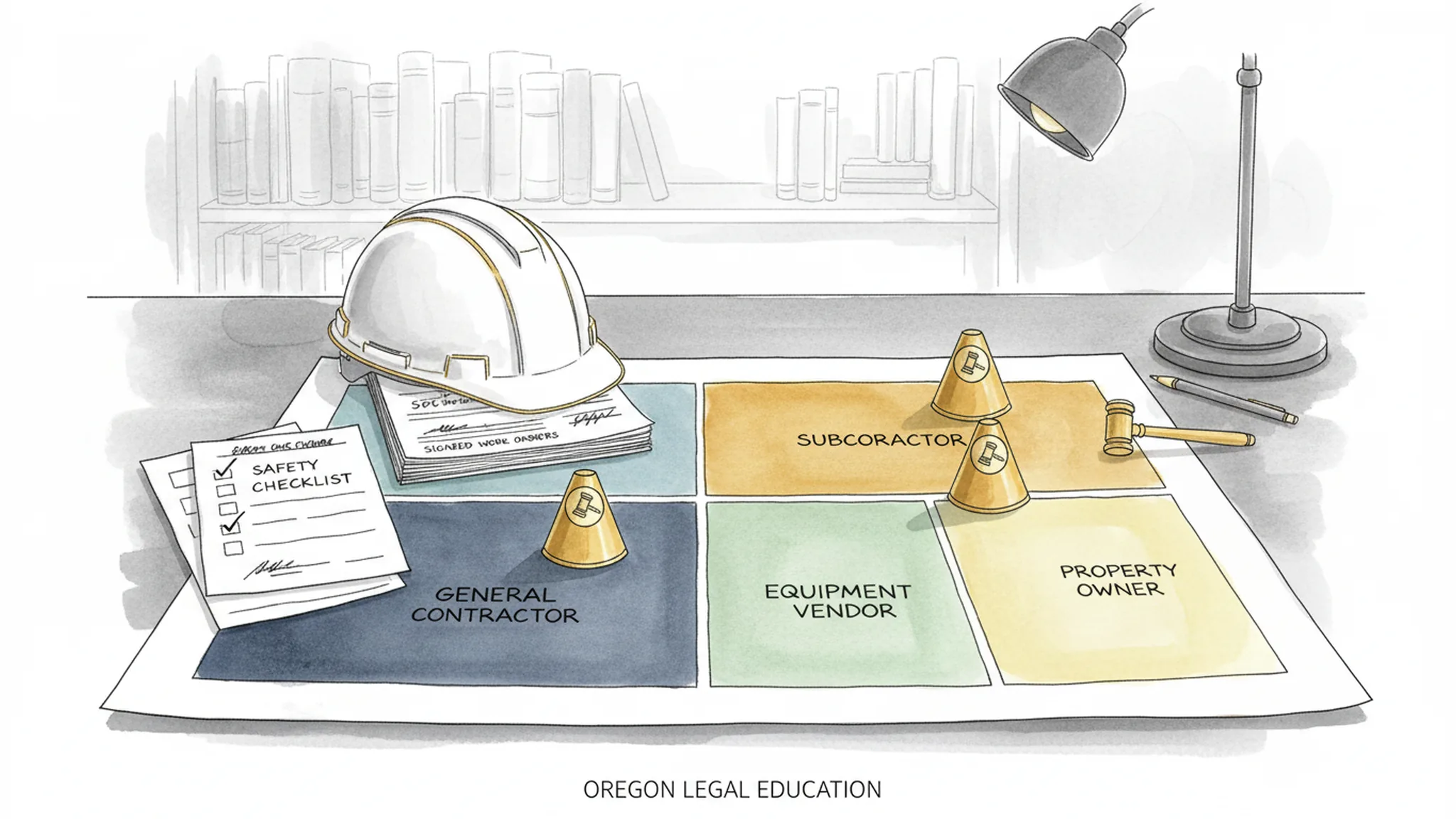
A serious injury can involve:
- your employer;
- a general contractor;
- one or more subcontractors;
- a property owner or manager;
- an equipment rental company;
- a maintenance or inspection vendor;
- a manufacturer or product seller; and
- other workers, drivers, or trades that created the hazard.
Workers’ compensation may still be the first benefit system. But if a non-employer caused or contributed to the injury, a third-party claim may also exist. For the broad rule, see Can I sue my employer after a workplace injury in Oregon?. For a scaffold-specific example, see construction scaffolding fall claims.
Why multi-contractor jobsites are different
In a simple work injury, the main questions may be employment, medical causation, and workers’ compensation benefits. On a multi-contractor jobsite, the investigation must also map control.
Control can mean many things:
- who controlled the work area;
- who directed sequencing;
- who owned or supplied equipment;
- who had authority to stop unsafe work;
- who inspected the hazard;
- who created the hazard;
- who had notice of the hazard; and
- who promised to handle safety in a contract or site plan.
The written contract matters, but it is not the only evidence. Actual jobsite practice may show that a different company controlled the real-world hazard.
If the injury involved a saw, grinder, nail gun, battery, guard, blade, or other tool component, the control analysis may also overlap with defective power tool and product-liability claims.
The same control analysis can also matter outside a traditional building site. For Portland street work, utility cuts, plates, lane shifts, and sidewalk detours, see our guide to Portland construction-zone injury claims involving City work and permitted utility work.
Workers’ comp protects many employers, not every outside company
Oregon workers’ compensation generally protects a complying employer from an ordinary civil lawsuit for a covered work injury under ORS 656.018.
But ORS 656.154 recognizes that a worker injured by the negligence or wrong of a person not in the same employ may have a remedy against that person.
That distinction is central. A subcontractor, vendor, property owner, driver, or product manufacturer may not receive the same protection as your employer. Whether a company is “in the same employ,” actually controlled the hazard, or owed a duty is a fact-specific legal question.
How fault gets split
Oregon comparative fault rules can affect injury claims. Under ORS 31.600, fault percentages can reduce or bar recovery depending on the allocation. ORS 31.610 generally ties each defendant’s monetary responsibility to that defendant’s share, subject to statutory rules.
In practice, fault allocation may look like this:
- the general contractor says the subcontractor controlled the task;
- the subcontractor says the property owner created the condition;
- the property owner says the hazard was temporary construction work;
- the rental company says the equipment was safe when delivered;
- the manufacturer says the product was misused; and
- everyone tries to blame the injured worker or the employer.
This blame-shifting is not just noise. It affects which insurance policies respond, which records matter, how settlement value is evaluated, and whether a defendant can realistically pay.
Documents that usually matter
Multi-contractor injury cases are document-heavy. Useful records may include:
- prime contracts and subcontract agreements;
- scopes of work;
- job hazard analyses;
- daily reports and site logs;
- safety meeting notes;
- inspection records;
- equipment rental and maintenance files;
- incident reports from each company;
- photos, video, and drone footage;
- text messages and emails about scheduling or hazards;
- insurance certificates and additional-insured documents; and
- preservation letters and claim notices.
The goal is not to collect paperwork for its own sake. The goal is to answer: who had the ability to prevent this injury?
Indemnity and insurance fights can affect your case
After a jobsite injury, companies may fight among themselves about defense, indemnity, additional insured coverage, and tender obligations. Those disputes can sound remote from the injured worker’s experience, but they can affect timing and settlement.
For example:
- one insurer may deny coverage and point to another policy;
- a contractor may demand that a subcontractor defend it;
- a company may delay producing records while insurance issues are sorted out;
- defendants may disagree about who controls settlement authority; or
- a party may try to shift responsibility to an entity that has limited insurance or assets.
That is why early entity mapping matters. A case can lose leverage if the wrong parties are pursued while the key evidence sits with someone else.
Workers’ comp liens and net recovery
If workers’ compensation pays benefits and a third-party claim later resolves, Oregon’s third-person recovery statutes, including ORS 656.576 to 656.596, can affect liens, reimbursement, compromise participation, and offsets.
This means a settlement is not only about the headline number. The worker’s net recovery can depend on comp payments, medical bills, attorney fees, costs, lien reductions, and the timing of the resolution. Our guide to medical bills, liens, and subrogation explains why these issues should be handled before settlement, not after.
FAQ
Can more than one company be at fault for the same jobsite injury?
Yes. Multiple entities may share responsibility if their conduct, control, or products contributed to the injury. Oregon fault allocation rules can make percentages important.
What if everyone blames my employer?
That is common. Because workers’ compensation often protects the employer, third parties may try to shift blame there. The response is evidence: contracts, actual control, site documents, witness testimony, and hazard history.
Do contracts decide who is liable?
Contracts are important, but they do not always end the analysis. Actual control, site practice, inspections, notice, equipment ownership, and conduct may matter too.
Why should evidence be preserved quickly?
Jobsites change. Hazards are repaired, equipment is moved, subcontractors leave, and video may be overwritten. Early preservation can determine whether the case can be proven.
The bottom line
If you were injured on an Oregon jobsite with multiple contractors, do not assume the claim begins and ends with workers’ compensation. The key is to map every company, every contract, every insurance layer, and every piece of evidence showing who controlled the hazard.
Johnson Law can help evaluate whether a jobsite injury may include a third-party personal injury claim alongside workers’ compensation.
Sources
Client-First Fee Promise
Client First = Bills First, Fees Second
Your unpaid medical bills do not have to make your lawyer's fee bigger. Johnson Law subtracts qualifying medical bills before calculating our fee, helping clients keep more of their settlement.
Applies to qualifying cases. Results vary.