Construction Zone Injury Claim in Portland: City Work, Utility Permits, and Unsafe Traffic Control
Construction Zone Injury Claim in Portland: City Work, Utility Permits, and Unsafe Traffic Control
Educational disclaimer: This article provides general educational information about Oregon and Portland injury-claim issues. It is not legal advice and does not create an attorney-client relationship. Deadlines, notice requirements, public-body defenses, and fault allocation are fact-specific, so consider getting case-specific legal advice as early as possible after an injury.
Key Takeaways
- A Portland work-zone injury may involve the City, PBOT, a City contractor, a utility or franchise permit holder, a subcontractor, private construction, another road user, or another public road authority.
- If a public body may be involved, Oregon Tort Claims Act notice may need prompt, fact-specific review; notice is separate from filing a lawsuit.
- Traffic-control plans, PBOT permits, utility permits, inspection records, start-work notices, and project documents can matter as much as photos of the hazard.
- Unsafe cones, missing signs, steel plates, sidewalk detours, or lane shifts do not automatically prove negligence, but they may be important evidence.
- Oregon comparative fault and several-only liability rules can make fault allocation a central issue when multiple public and private actors are involved.
Construction zones can turn a familiar Portland street or sidewalk into a confusing maze of cones, steel plates, trenches, barriers, detours, temporary signs, and lane shifts. If you were hurt in that kind of work zone, the most important early question is not simply “Was the City at fault?” It is: who controlled the work area, what rules or plans applied, and what evidence can still be preserved?
A Portland work-zone injury claim may involve the City of Portland, PBOT, a City contractor, a utility or franchise permit holder, a subcontractor, a private contractor using the right-of-way, another driver, or another public road authority. More than one party may be involved. Oregon public-body notice rules can also create short deadlines if the City or another public body may be connected to the claim.
That is why these claims often need fast, careful sorting. A cone layout that looks unsafe, a missing sidewalk detour sign, or a loose street plate may be important evidence, but it does not automatically decide liability. The claim usually depends on the work-zone records, the approved traffic-control plan, what actually happened in the field, causation, damages, defenses, and Oregon comparative-fault rules.
Injured in a Portland Work Zone? Start by Identifying the Work and the Players
The orange cones may all look the same, but Portland work zones can arise from different kinds of projects:
- City street, sewer, transportation, or public-improvement work;
- work performed by a contractor on a City project;
- utility work under a PBOT street-opening or utility permit;
- private construction that uses or closes part of the street or sidewalk;
- emergency work in the right-of-way; or
- work on a road or facility controlled by ODOT, Multnomah County, TriMet, Portland Streetcar, the Port of Portland, or another entity.
Portland City Code generally requires a permit before a person makes a public improvement, performs work in, or uses the street area, unless an exception applies. PBOT’s utility-management materials also describe Street Opening Permits for franchise utilities and other organizations performing utility infrastructure work in the public right-of-way.
In practical terms, a potentially responsible party may not be the name on the nearest truck. A dangerous condition could come from the approved plan, the way the plan was installed, a contractor’s failure to maintain cones or barricades, a utility’s street cut or plate, a subcontractor’s work, a driver’s conduct, or some combination of those facts.
Potentially Responsible Parties in a Portland Construction-Zone Injury
Depending on the location and cause of the injury, potentially relevant parties may include:
- The City of Portland or PBOT, if a public-body act or omission is at issue.
- A City contractor, if a private company performed the work or maintained the work zone.
- A utility or franchise permit holder, especially in cases involving utility cuts, trenches, vaults, conduits, plates, or surface restoration.
- Subcontractors or traffic-control vendors, if they installed, moved, inspected, or maintained signs, cones, barriers, lights, or detours.
- A private contractor or property project, if private construction used or obstructed part of the sidewalk, bike lane, parking lane, or street.
- Another driver, cyclist, or road user, if a crash occurred inside or near the work zone.
- Another public authority, if the road or facility was not controlled by PBOT.
This kind of multi-party investigation overlaps with broader Oregon principles about how fault can be split among multiple contractors. The Portland work-zone setting adds another layer: permits, temporary traffic-control plans, public-body notice rules, and public records.
Why City or Public-Body Involvement Changes the Timeline
If the City of Portland, PBOT, or another Oregon public body may be involved, the claim is not handled like a typical claim against only a private person or company.
Oregon’s Tort Claims Act defines and governs tort claims involving Oregon public bodies. Subject to statutory limitations, a public body can be subject to civil action for its torts and for torts of its officers, employees, and agents acting within the scope of their duties. But the same statutory framework includes notice rules, lawsuit timing rules, damages limits, immunities, and other defenses.
That means a Portland construction-zone injury claim can require two tracks at once:
- investigating what happened and who controlled the work zone; and
- preserving any claim against a public body before a notice deadline expires.
The 180-Day OTCA Notice Issue
For non-wrongful-death claims under the Oregon Tort Claims Act, notice generally must be given within 180 days after the alleged loss or injury. Wrongful-death claims have a one-year notice period. Portland’s own claim materials also state that a City liability claim generally must be submitted within 180 days of the incident.
There are limited statutory provisions that may exclude time when an injured person cannot give notice because of injury, minority, incompetency, or other incapacity, up to a specified period. Those issues are fact-specific and should not be treated as automatic extensions.
A practical takeaway is that possible public-body involvement should be evaluated early. If Portland, another city, ODOT, a county, TriMet, or another public body might be connected to the work zone, the notice issue may need prompt, case-specific review.
What Formal Notice Generally Needs to Include
ORS 30.275 recognizes several ways notice may be satisfied, including formal notice, actual notice, commencement of an action within the notice period, or payment of all or part of the claim by or on behalf of the public body. Relying on “actual notice” can be risky because it is fact-specific.
Formal notice generally must include:
- a statement that a claim for damages is or will be asserted;
- a description of the time, place, and circumstances giving rise to the claim; and
- the claimant’s name and mailing address for correspondence.
For local public bodies, the statute identifies who may receive formal notice and how it may be delivered. The injured person also has the burden of proving that notice was given as required. For that reason, copies, mailing records, delivery confirmations, and proof of what was sent can matter.
Portland’s general liability claim form asks for information such as the exact date, time, and place; what happened; what City act or omission allegedly caused the injury or damage; why the claimant believes the City was at fault; witnesses; injuries; property damage; City bureau or employee names if known; and damages claimed. The form can be useful for understanding what information the City requests, but the statute controls the legal notice analysis.
Notice Is Not the Same as Filing a Lawsuit
Giving notice to a public body is not the same thing as filing a lawsuit in court. ORS 30.275 also provides that an action arising from an act or omission of a public body or its officer, employee, or agent generally must be commenced within two years after the alleged loss or injury, subject to statutory exceptions.
Public-body notice, private insurance claims, and lawsuit deadlines are separate issues. A City claim submission may help notify the City, but it does not itself file a civil lawsuit.
Traffic-Control Plans, Permits, and Portland Work-Zone Rules: What Evidence May Matter
Portland work-zone injury claims are often evidence-heavy because the key question is not only what the scene looked like after the injury. It is also what the scene was supposed to look like.
For work that closes or obstructs a travel lane, Portland Administrative Rule TRN-2.08 says the City Traffic Engineer may require a traffic-control plan as a permit condition. A permit applicant closing or obstructing a lane must provide a description and diagram for approval. The rule describes traffic-control plans as potentially covering signs, pavement markings, delineation and channelization devices, placement and maintenance of devices, roadway lighting, traffic regulations, surveillance, and inspection.
PBOT’s Temporary Traffic Control Manual also states that persons or agencies doing work within or infringing on the right-of-way are responsible for obtaining necessary PBOT authorization, following approved temporary traffic-control plans, providing safeguards for workers and the public, supplying and maintaining required traffic-control devices, and minimizing inconvenience to the traveling public.
Those records can be central to understanding a case.
Traffic-Control Plans for Lane Closures and Obstructions
If a crash or fall involved a lane closure, lane shift, bike-lane closure, sign placement, cones, barrels, barricades, or temporary markings, the approved traffic-control plan may be one of the most important documents.
Useful questions include:
- Was a traffic-control plan required for the work?
- Was a plan approved before the lane or sidewalk was obstructed?
- What signs, cones, barriers, markings, lights, or flagging did the plan require?
- Did the field setup match the plan at the time of the injury?
- Were devices moved, missing, damaged, blocked, or poorly maintained?
- Were inspections, surveillance, or maintenance checks required or documented?
TRN-2.08 states that traffic-control plans are reviewed against MUTCD standards and applicable state or local regulations, and permits may be denied or revoked if the plan is not approved or is not followed after work begins. That does not mean every plan violation automatically proves negligence, but it may be important evidence when evaluating duty, breach, causation, and fault.
For roadway users injured by temporary pavement conditions, debris, lane shifts, or work-zone barriers, the analysis may overlap with broader claims involving dangerous road conditions.
Sidewalk Closures and Pedestrian Detours
Construction zones can be especially dangerous for pedestrians, wheelchair users, people using mobility devices, parents with strollers, and others who rely on clear, predictable routes.
For City projects, and for other work where the specifications are incorporated into the contract, permit, or project documents, Portland’s Standard Construction Specifications include sidewalk-closure requirements for signs, alternate pedestrian routes, non-slip minimum-width surfaces meeting ADA requirements to the maximum extent feasible, delineation and protection, and keeping barricades, channelizing devices, or fencing in place until the sidewalk reopens.
Evidence in a sidewalk or pedestrian-detour case may include photos or video showing:
- whether a sidewalk-closed sign was visible;
- whether an alternate pedestrian route was provided;
- the condition, width, slope, and surface of the temporary route;
- whether ramps, crossings, or curb transitions were usable;
- whether barricades or fencing separated pedestrians from hazards;
- lighting and visibility at the time of injury;
- whether the detour forced pedestrians into traffic, a bike lane, mud, gravel, plates, or uneven pavement; and
- whether barriers had been moved or removed.
Utility Work, Street Cuts, Plates, and Street-Opening Permits
Utility work is a common source of Portland right-of-way disruption. A person may be injured near a trench, vault, conduit project, utility cut, temporary patch, loose plate, uneven pavement edge, or restoration area.
PBOT Utility Management states that Street Opening Permits are issued to franchise utilities and other organizations for utility infrastructure in the public right-of-way. Those permits exist to address utility placement, street-surface repair to accepted standards, and impacts on streets, the traveling public, and existing or proposed infrastructure.
Potential records in a utility-work case may include:
- street-opening or utility permits;
- permit conditions;
- the utility or contractor name;
- start-work notices;
- PBOT inspection records;
- surface-repair or restoration records;
- traffic-control plans;
- complaints or prior incident reports; and
- photos taken by inspectors, crews, or residents.
PBOT materials state that permit holders are required to inform the Inspection Section through the PBOT permitting portal at least 48 hours before anticipated start of work unless instructed otherwise. That kind of start-work record may help identify who was performing work at a specific location and time.
Which Standards Applied on the Incident Date?
Temporary traffic-control standards are date-sensitive and location-sensitive. In ODOT and highway contexts, ODOT states that a traffic-control plan is required for temporary activity that disrupts normal highway traffic flow, with the plan’s primary function being safe and effective movement of public traffic, including vehicles, bicycles, and pedestrians, through or around the work zone.
ODOT also states that Oregon adopted the MUTCD 11th edition, the Oregon Supplement to the MUTCD 11th edition, and the January 2026 Oregon Temporary Traffic Control Handbook effective January 1, 2026. The 2026 Oregon Temporary Traffic Control Handbook applies to work zones in place continuously for three days or less on Oregon public roads.
For any specific injury, the applicable standards may depend on the incident date, project duration, road authority, permit conditions, project-specific traffic-control plan, and whether PBOT, ODOT, MUTCD/Oregon Supplement, PBOT manuals, City specifications, or contract documents governed the work.
Public Records and Evidence to Preserve After a Portland Work-Zone Injury
The scene may change quickly after a construction-zone injury. Cones move. Plates are reset. Signs are added. Trenches are covered. Crews finish work and leave. That makes early evidence preservation especially important.
If you are able to do so safely, or if someone can help, useful information may include:
- photos and videos of the entire approach to the work zone, not just the hazard;
- close-up and wide-angle photos of cones, signs, barriers, plates, ramps, trenches, pavement edges, and lighting;
- the exact date, time, and location, including cross streets, lane, sidewalk side, and direction of travel;
- weather, visibility, and lighting conditions;
- names and contact information for witnesses;
- names, logos, truck numbers, or markings for contractors, utilities, or City crews;
- permit numbers or posted notices at the site;
- police reports, incident reports, medical records, and 911 information if applicable;
- dashcam, helmet-cam, bike-camera, doorbell, business, or TriMet/Streetcar-area video sources if relevant; and
- notes about whether the condition changed after the injury.
Portland’s Risk Management process says the City may request information from involved bureaus, including police reports, incident reports, photos, employee or supervisor statements, maintenance records, and work orders. For a claimant, those categories are also useful clues about what records may exist.
Public Records Requests Are Helpful, But Not a Litigation Hold
Portland public records requests generally go through the City’s Public Records Request Portal. Public records requests may help locate permits, traffic-control plans, work orders, inspection logs, complaints, emails, photos, start-work notices, and maintenance records.
But a public records request is not the same as:
- Oregon Tort Claims Act notice;
- a lawsuit filing;
- a preservation letter;
- a litigation hold; or
- a request to a private contractor, utility, insurer, or third party.
In other words, asking for records can help you investigate what happened, but it does not necessarily stop evidence from being altered, overwritten, deleted, or lost through ordinary retention schedules. That distinction can matter in cases involving camera footage, inspection photos, electronic work orders, crew communications, and changing field conditions.
How Fault May Be Shared in Oregon Work-Zone Injury Claims
Oregon uses modified comparative fault. In general terms, a claimant’s contributory negligence does not bar recovery if the claimant’s fault was not greater than the combined fault of the persons specified in ORS 31.600, but damages are reduced by the claimant’s percentage of fault. If the claimant’s fault is greater than the combined specified fault, recovery can be barred.
Oregon also generally uses several-only liability in bodily injury, death, and property-damage civil actions, so each defendant’s judgment responsibility usually tracks percentages of fault determined under Oregon law, subject to statutory rules and exceptions such as reallocation of certain uncollectible shares.
In a Portland work-zone case, defendants and insurers may argue about fault percentages among:
- the injured person;
- the City or another public body;
- a contractor;
- a utility permit holder;
- a subcontractor;
- a traffic-control company;
- a driver, cyclist, or other road user;
- an adjacent property owner or private project participant; or
- an unidentified or later-discovered party.
Portland’s own Risk Management process describes evaluating whether the City was negligent, what the City did wrong, whether the action directly caused damages, and whether other conditions contributed. If both the City and the claimant have some liability, the City says settlement may be negotiated based on apportionment of fault. That is the City’s claim-adjusting description, not a guarantee of how a civil case will resolve.
For more on how Oregon fault percentages can affect an injury claim, see Johnson Law’s guide to Oregon comparative fault.
Special Issues If You Were Working When You Were Hurt
Some people injured in Portland work zones are not passersby. They may be construction workers, utility workers, delivery drivers, couriers, inspectors, flaggers, cyclists on the job, or employees traveling through a work zone.
If you were working when you were injured, workers’ compensation may be involved. Oregon law also allows an injured worker to seek a remedy against a negligent or wrongful third person not in the same employ in appropriate circumstances. But employer immunity, workers’ compensation exclusivity, third-party election issues, paying-agency notice, and workers’ compensation lien rules can all affect strategy and settlement.
This post does not try to cover those worker-specific rules in detail. For background, see Johnson Law’s discussion of when an Oregon worker may have a claim beyond workers’ compensation and workers’ compensation versus third-party claims in construction accidents.
Practical Next Steps After a Portland Construction-Zone Injury
After an injury near Portland city work, road construction, or permitted utility work, consider these practical steps:
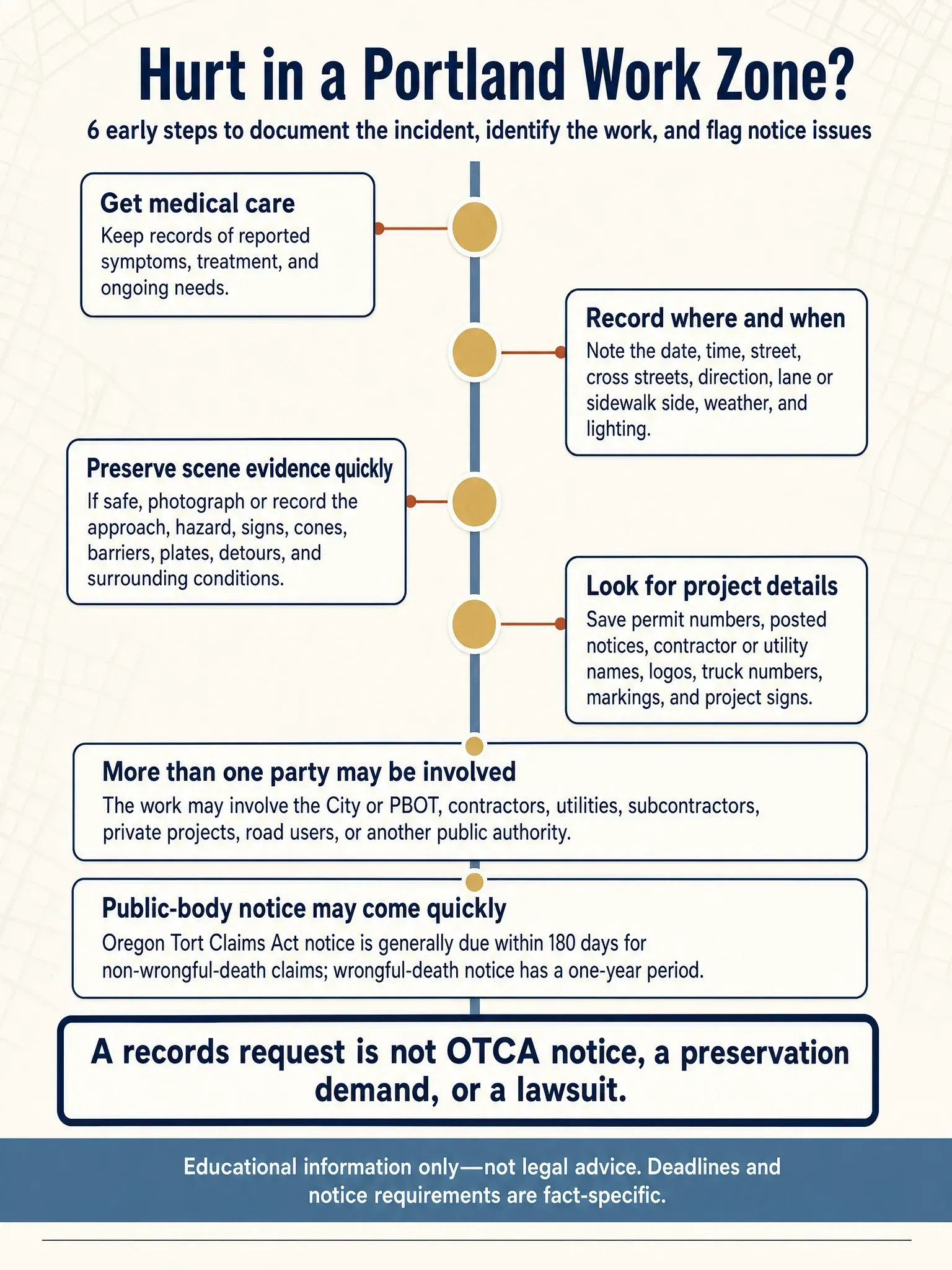
- Get medical care and document your symptoms. Medical records can document reported symptoms, treatment, and ongoing needs after the incident.
- Record the exact location and time. Work-zone records often depend on date, time, street, direction of travel, lane, sidewalk side, and nearby cross streets.
- Preserve scene evidence quickly. Photos and video should show the approach, signs, cones, barriers, plates, detours, lighting, and surrounding context.
- Identify visible project information. Look for permit postings, contractor names, utility markings, truck logos, crew names, or project signs.
- Do not assume the first visible party is the only potentially responsible party. City work, City-contracted work, utility work, private construction, and non-PBOT roads can require different analysis.
- Evaluate public-body notice early. If any public body may be involved, Oregon Tort Claims Act notice may be due much sooner than people expect.
- Separate records requests from legal notices. Public records requests can help investigate, but they are not the same as OTCA notice or evidence-preservation demands.
- Be careful with recorded statements and blame assumptions. Comparative fault and multi-party responsibility are common issues in work-zone claims.
- Get fact-specific advice before deadlines pass. A short consultation can help identify the right entities, evidence sources, and notice requirements.
Johnson Law helps injured people evaluate Oregon personal injury claims, including cases involving public entities, contractors, utilities, and disputed fault. If you were hurt in a Portland work zone, an attorney may be able to help identify potentially responsible parties, discuss time-sensitive evidence, and review possible notice issues before deadlines become a problem.
FAQ: Portland Construction-Zone Injury Claims
Who is responsible for a construction-zone injury in Portland?
It depends on who controlled the work, what caused the injury, and which entity had responsibility for the unsafe condition. Possible parties may include the City of Portland, PBOT, a City contractor, a utility permit holder, a subcontractor, a private contractor, another road user, an adjacent project participant, or another public road authority.
Do I have to file a claim with the City of Portland within 180 days?
If the City of Portland or another Oregon public body may be responsible, Oregon Tort Claims Act notice generally must be given within 180 days for non-wrongful-death claims. Wrongful-death notice has a one-year period. The specific notice analysis is fact-dependent, and notice is separate from filing a lawsuit.
Does an unsafe cone layout or missing sign automatically prove negligence?
No. Permits, traffic-control plans, PBOT manuals, construction specifications, and MUTCD-related standards can be important evidence. But liability still depends on duty, breach, causation, damages, defenses, immunities, and fault allocation.
What records should I request after a Portland work-zone injury?
Potential records include permits, traffic-control plans, inspection logs, work orders, start-work notices, complaints, photos, maintenance records, incident reports, and bureau or contractor communications. A public records request may help locate City records, but it is not the same as a preservation demand, OTCA notice, or a lawsuit.
What if I was hurt by utility work or a street plate?
Utility work in Portland rights-of-way may involve street-opening or utility permits, PBOT inspection notices, surface-repair requirements, and temporary traffic-control obligations. Records may help identify the utility, contractor, permit conditions, inspection history, and whether the field setup matched the approved plan.
What if I was working when I was injured in the work zone?
Workers’ compensation may apply, but a third-party claim may also be possible if someone outside your employer caused or contributed to the injury. Employer immunity, workers’ compensation exclusivity, paying-agency notice, and lien rules can materially affect the claim, so worker-injury cases should be reviewed carefully.
Sources
- Oregon Revised Statutes, ORS chapter 30, including ORS 30.260 to 30.300, Oregon Tort Claims Act.
- Oregon Revised Statutes, ORS chapter 31, including ORS 31.600 and ORS 31.610, comparative fault and several liability.
- Oregon Revised Statutes, ORS chapter 656, including ORS 656.154 and ORS 656.593, third-person remedies and workers’ compensation recovery distribution issues.
- City of Portland, File a claim against the City and Liability Claim Filing FAQ.
- City of Portland, General Liability Claim Form and Risk Management Liability Claims Process.
- Portland City Code, Chapter 17.24 Permits and Section 17.24.017 Temporary Street Closure.
- City of Portland Administrative Rule, TRN-2.08 Traffic Control Plan Rules & Procedures.
- Portland Bureau of Transportation, Temporary Traffic Control Manual and Utility Management / Street Opening Permits.
- City of Portland, 2020 Standard Construction Specifications, Part 00200.
- Oregon Department of Transportation, Work Zone Traffic Control, Oregon Temporary Traffic Control Handbook, and MUTCD implementation materials.
- City of Portland, Public Records Requests.
Client-First Fee Promise
Client First = Bills First, Fees Second
Your unpaid medical bills do not have to make your lawyer's fee bigger. Johnson Law subtracts qualifying medical bills before calculating our fee, helping clients keep more of their settlement.
Applies to qualifying cases. Results vary.