Motorcycle Crash Caused by Road Hazards: Can You Sue the City or State for Poor Maintenance?
Motorcycle Crash Caused by Road Hazards: Can You Sue the City or State for Poor Maintenance?
Educational information only, not legal advice. Oregon motorcycle road-hazard claims against public bodies are fact-specific, deadline-sensitive, and highly dependent on roadway ownership, notice, and evidence.
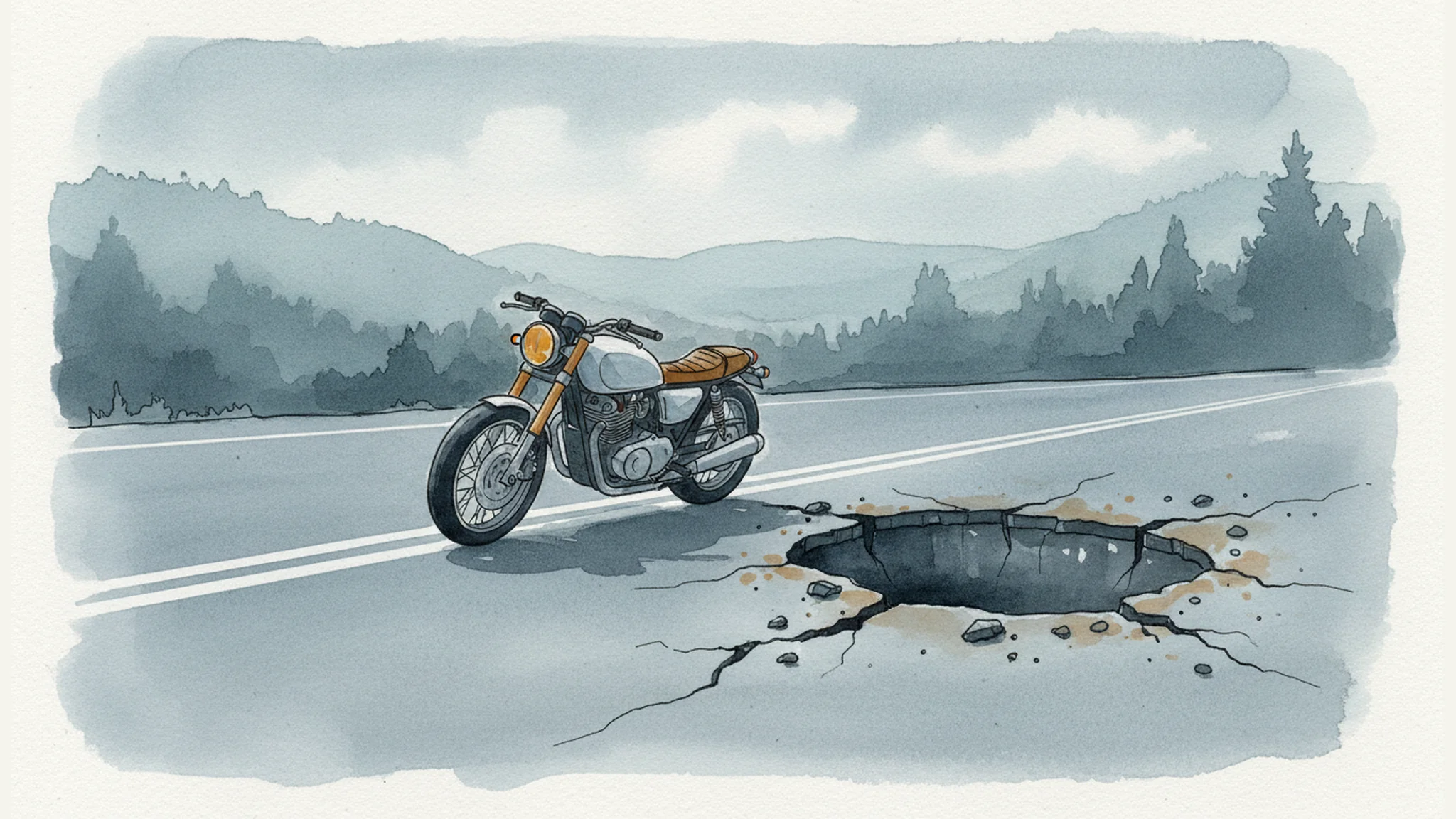
When a rider goes down because of a pothole, broken pavement edge, loose gravel, standing water, or a missing warning, the first reaction is often simple: the road was bad, so the city should pay.
Sometimes there may be a viable claim against a city, county, or the state.
But in Oregon, that is not the same kind of case as an ordinary negligence claim against another driver. Public-body claims usually rise or fall on different issues:
- Who actually owned or maintained the road?
- Was the dangerous condition something the public body knew or should have known about?
- Was there a fair chance to repair it or warn about it?
- Did the rider preserve enough evidence before the road was patched or the records disappeared into routine systems?
If you want the broader rider-side context first, see our motorcycle accident practice area page, our post on preserving evidence after an accident, and our related article on cyclist injury claims involving road debris versus roadway conditions.
1) Quick answer
Yes, sometimes.
Under the Oregon Tort Claims Act, public bodies can be sued for torts subject to important limits. See ORS 30.265. That means a motorcycle crash caused by poor road maintenance is not automatically barred just because the defendant is a government entity.
But that does not mean every crash involving a bad road becomes a successful claim.
In practice, Oregon public-body road-hazard cases usually turn on:
- correct roadway ownership,
- strict notice timing,
- proof of notice or maintenance history,
- whether the issue is really maintenance rather than a protected policy choice,
- and whether the rider can prove the roadway condition actually caused the crash.
2) Why a government road-hazard case is different from an ordinary crash claim
Claims against public bodies are governed by Oregon’s public-body tort statutes, not just general negligence concepts.
Tort-claim notice matters fast
Under ORS 30.275, notice is generally required:
- within 180 days for most injury claims, and
- within one year for wrongful death claims.
That same statute also generally requires the action to be commenced within two years.
Those deadlines are one reason riders should not treat a city-or-state road claim like a normal “deal with it later” insurance file. If the injury instead involves TriMet, MAX, Portland Streetcar, or transit property, our Portland transit injury claims guide covers how the same OTCA timing issues can show up in the transit context.
Statutory limits can still matter
Even if liability exists, Oregon public-body claims remain subject to statutory damages limitations. See ORS 30.271, ORS 30.272, and ORS 30.273.
The safest practical takeaway is simple: a serious motorcycle injury claim against a public body is not valued the same way as a private-driver case.
Immunity arguments are often part of the fight
ORS 30.265 preserves immunity for certain discretionary functions or duties. So the public body may argue that what the rider is really attacking is a protected policy, planning, or design choice rather than negligent maintenance or failure to warn.
That distinction matters a lot.
3) The first question is usually not fault. It is ownership.
Before arguing about negligence, a rider usually needs to identify who was responsible for that stretch of road.
That may be:
- a city,
- a county,
- ODOT / the state,
- or occasionally another public body with control over the roadway or related feature.
This is where people lose time. A rider may assume a road “inside town” belongs to the city when it is actually state-controlled, or assume a major route is state-owned when the local entity handles that segment or feature. For a pothole-specific Portland example, see how to check PBOT-versus-ODOT responsibility and keep hazard reporting separate from claim notice.
If notice goes to the wrong public body first, the clock problem can get ugly fast.
4) What riders usually must prove besides “the road was bad”
A successful road-maintenance claim usually needs more than scene anger and one photo of a pothole.
The condition was actually dangerous
That sounds obvious, but it still has to be shown with specifics:
- depth or size,
- location in the lane,
- broken pavement edge or drop-off,
- loose gravel accumulation,
- water masking a hole,
- missing signage or warnings,
- lighting and visibility conditions.
The public body had notice, or should have had notice
This is one of the biggest issues.
The case may depend on whether the responsible entity had:
- prior complaints,
- prior inspection findings,
- prior patch work,
- work orders,
- service logs,
- nearby prior crashes,
- or enough time that the condition should have been discovered through reasonable maintenance practices.
There was a fair opportunity to repair or warn
Not every dangerous condition exists long enough to make a public body negligent.
A newly formed pothole after severe weather may be a very different case from a defect that was reported repeatedly for weeks.
The hazard actually caused this crash
The rider still has to connect the roadway defect to the loss.
That can become contested if the defense argues:
- excessive speed,
- poor lane position,
- rider inattention,
- mechanical problems,
- or some separate cause of the fall.
If another vehicle was also involved, Oregon comparative-fault issues can still matter under ORS 31.600.
5) Maintenance failures are not the same thing as broad design complaints
This is where public-body cases often get over-simplified.
In Little v. Wimmer, the Oregon Supreme Court recognized that the state’s highway improvement, maintenance, repair, and operation duties can support liability for negligent ongoing maintenance and rejected the idea that the state has discretion to make “non-decisions” about those mandated functions.
That is useful for riders for one narrow reason: a road case is not automatically dead just because the defendant says “government immunity.”
But that still does not mean every road-condition complaint avoids immunity.
The safer distinction is this:
- a claim focused on failure to inspect, maintain, repair, or warn about a known or knowable hazard may be very different from
- a claim framed as you designed this whole roadway badly years ago.
Likewise, Daugherty v. Oregon State Highway Commission is helpful for another narrow point: operational maintenance is not automatically a protected discretionary function. But the plaintiff in that case still lost because the proof of negligence was not enough on those facts.
That is the right tone for these cases generally. The real fight is almost never won by a slogan.
6) What evidence usually matters most after a motorcycle road-hazard crash
These cases are unusually evidence-sensitive because the roadway may be repaired quickly and the bike may be moved before anyone properly documents the scene.
High-value evidence often includes:
- Wide and close-up photos of the exact defect before repair.
- Measurements showing depth, width, height differential, or lane encroachment if it can be done safely.
- Exact location proof such as cross streets, mile markers, GPS history, and map screenshots.
- Video from helmet cam, dashcam, nearby businesses, or homes.
- Weather and lighting details from the time of the crash.
- Photos of the motorcycle and gear before repair or disposal, especially damage patterns consistent with the roadway event.
- Witness information from anyone who saw the condition or had seen it before.
- Police or crash report information identifying the roadway condition.
If you are worried that the best proof may disappear, our broader guide on preserving evidence after an accident covers the spoliation side in more detail.
If the hazard came from active road work, a utility cut, a steel plate, a lane shift, or temporary traffic-control devices, our Portland-focused guide to construction-zone injury claims involving City work and permitted utility work explains the added permit and traffic-control-plan issues.
7) Maintenance history and prior complaints may be the real battleground
Many riders think the case is mainly about the pothole itself.
Often it is really about the paper trail behind the pothole.
Useful categories may include:
- prior public complaints,
- service-request logs,
- inspection records,
- work orders,
- patch or resurfacing history,
- prior claims,
- prior similar incidents,
- and records showing whether the road had been flagged but not fixed.
That is why fast investigation matters. A road hazard can be patched in hours or days, while the maintenance-history evidence may require prompt public-records and claim-handling steps.
8) Practical steps after this kind of motorcycle crash
If you are physically able after the crash:
- Get medical care promptly.
- Photograph the exact roadway condition before the area changes.
- Capture the precise location with cross streets, landmarks, or GPS screenshots.
- Preserve helmet, jacket, gloves, boots, and motorcycle damage before repair or disposal.
- Identify witnesses, especially anyone who knew the hazard existed before the crash.
- Report the dangerous condition through the responsible public body’s reporting channel when appropriate.
- Do not wait casually on the notice issue if a public-body claim may exist.
- Keep copies of crash reports, tow records, repair photos, and all communications.
If your motorcycle and gear were badly damaged too, our companion article on recovering helmet, jacket, and aftermarket-parts value after a totaled motorcycle covers the property-loss side without losing sight of the injury claim.
Bottom line
An Oregon rider injured by a dangerous roadway condition may sometimes have a claim against a city, county, or the state.
But these are rarely simple “the road was bad, therefore pay me” cases.
What usually matters most is:
- who owned or maintained the road,
- whether OTCA notice was handled correctly,
- whether the public body had actual or constructive notice,
- whether the issue is best framed as maintenance or warning rather than protected policy,
- and whether the rider preserved enough evidence before the scene changed.
FAQ
Can I sue the city if a pothole caused my motorcycle crash?
Sometimes, yes. But the right defendant may be a city, county, or the state, and Oregon public-body claims are subject to OTCA notice, immunity, and damages-limit issues.
What if I do not know whether the road belonged to the city, county, or state?
That question should be answered quickly. Ownership or maintenance responsibility is often the first practical issue in a public-body road-hazard claim.
Do I have to give notice before suing a public body in Oregon?
Usually yes. Under ORS 30.275, notice rules apply to claims against public bodies, and the timing is generally much shorter than many people expect.
Is a bad road enough by itself to prove negligence?
Not usually. Riders often must show more than the existence of a hazard. Notice, maintenance history, repair opportunity, and causation are often the real disputed issues.
What if the road was repaired right after the crash?
That can make the case harder, which is why fast photos, video, witness information, and records requests matter so much.
Sources
Client-First Fee Promise
Client First = Bills First, Fees Second
Your unpaid medical bills do not have to make your lawyer's fee bigger. Johnson Law subtracts qualifying medical bills before calculating our fee, helping clients keep more of their settlement.
Applies to qualifying cases. Results vary.