Construction Scaffolding Fall: Workers’ Comp vs. Third-Party Lawsuit Explained Clearly
Construction Scaffolding Fall: Workers’ Comp vs. Third-Party Lawsuit Explained Clearly
Educational information only, not legal advice. Oregon construction injury claims are fact-specific. A scaffold fall can involve workers’ compensation, third-party claims, OSHA evidence, liens, insurance disputes, and fast-changing jobsite proof.
Quick answer: you may have workers’ comp and a separate third-party claim
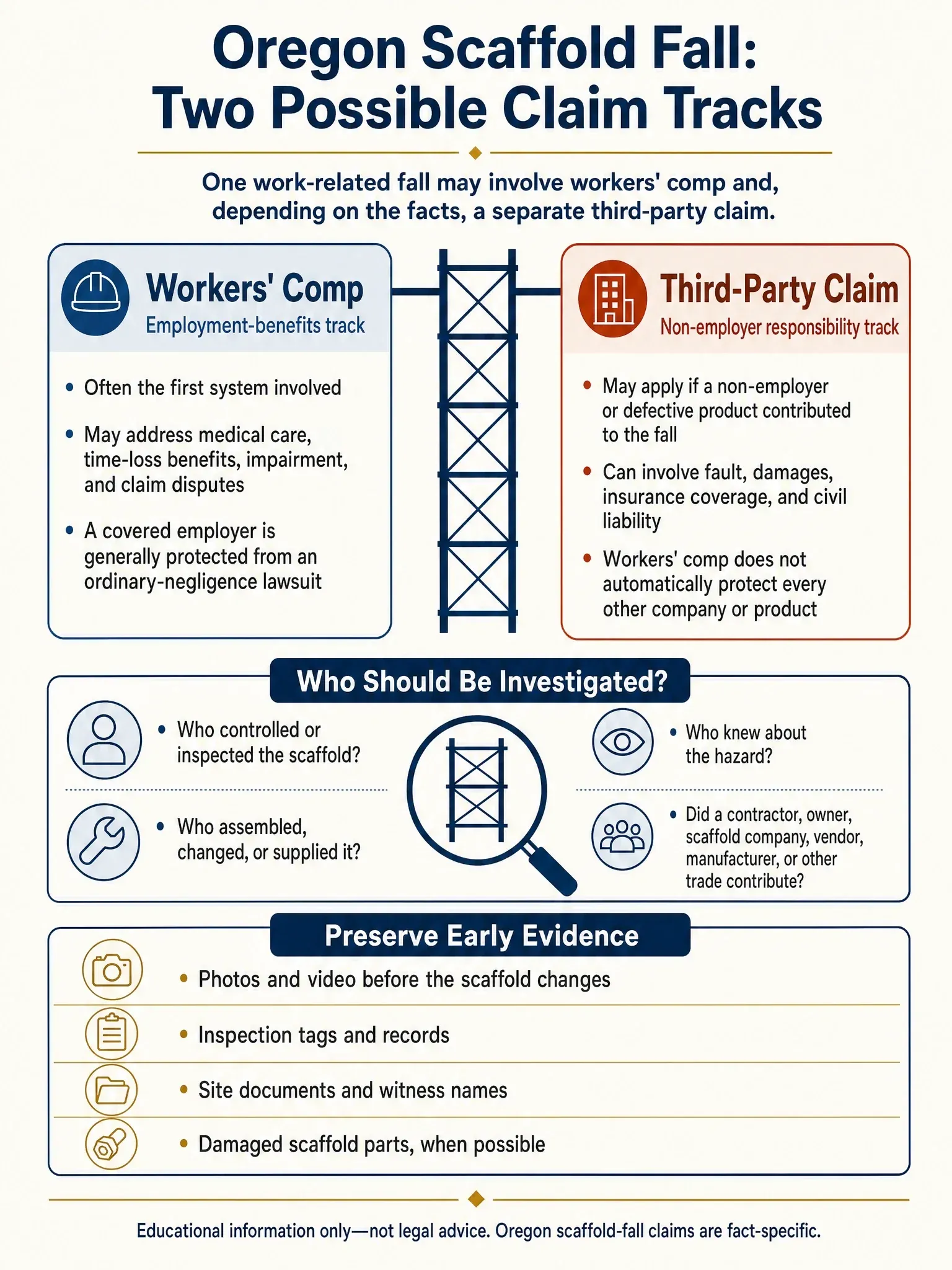
If you fell from scaffolding while working on an Oregon construction site, workers’ compensation may cover part of the injury-related benefits. But that does not automatically answer who caused the fall or whether someone outside your employer may have legal responsibility.
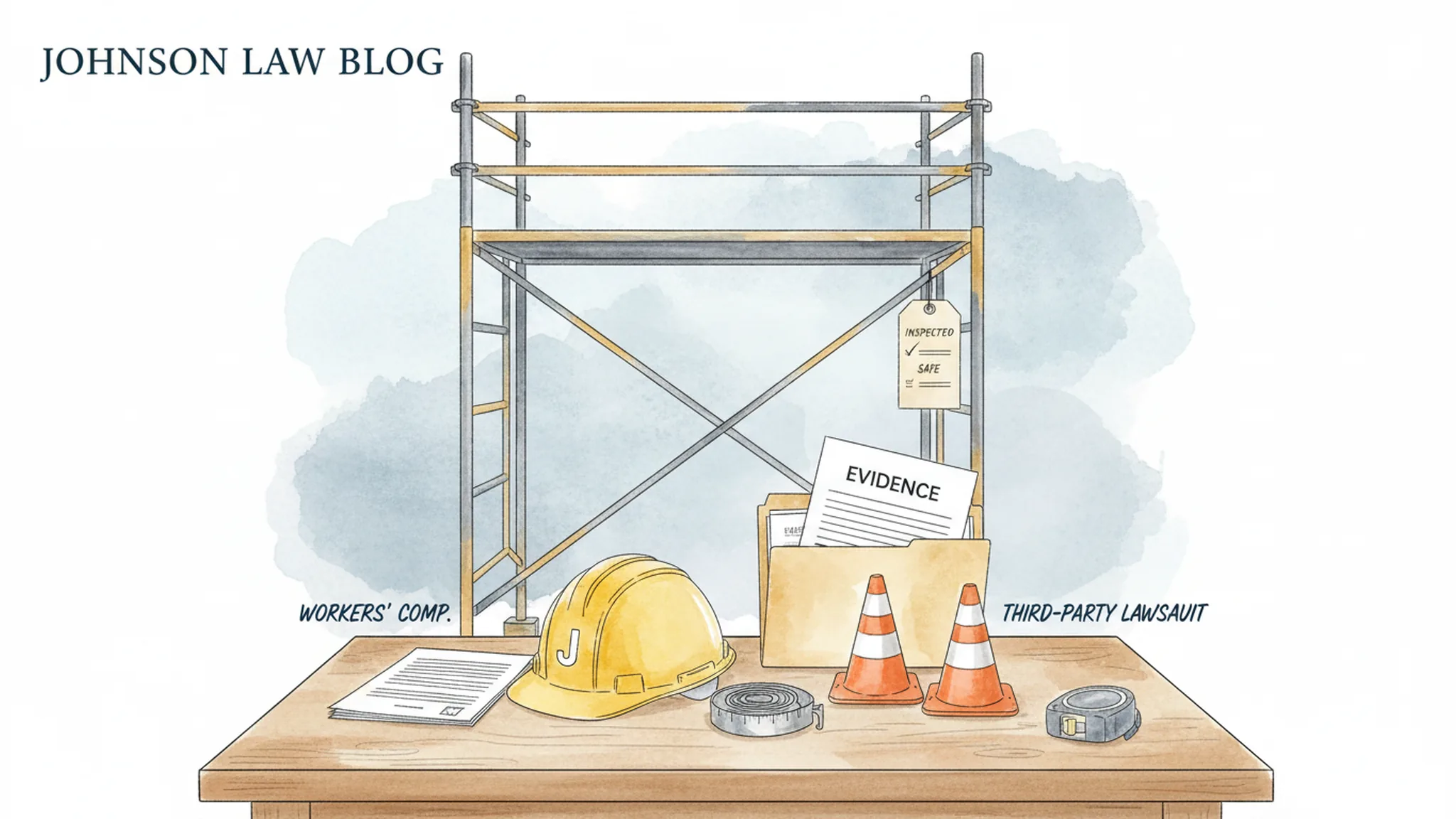
A scaffold fall may need two tracks:
- Workers’ compensation, for benefits tied to your employment; and
- A third-party injury claim, if a contractor, property owner, scaffold company, rental vendor, manufacturer, or other non-employer contributed to the hazard.
For the broader employer-suit rule, start with our guide: Can I sue my employer after a workplace injury in Oregon?. If multiple companies were on the site, also read our post on how fault gets split in multi-contractor jobsite injuries.
Workers’ comp: the employment-benefits track
When a worker is injured in the course of employment, Oregon workers’ compensation often becomes the first system involved. A complying employer’s liability is generally exclusive under ORS 656.018, which means the worker usually cannot sue the employer for ordinary negligence.
That can feel unfair when the injury is severe. But the exclusivity rule does not erase every other claim. It mainly protects the covered employer from a normal civil lawsuit. It does not automatically protect every other company or product involved in the scaffold.
Workers’ comp may address issues like medical treatment, time-loss benefits, permanent impairment, claim acceptance, claim denial, and return-to-work disputes. A personal injury claim focuses on fault, damages, insurance coverage, and civil liability.
Third-party claim: the non-employer responsibility track
ORS 656.154 recognizes that a worker injured by the negligence or wrong of a person not in the same employ may have a remedy against that person.
In a scaffold fall, possible third parties to investigate may include:
- a subcontractor that assembled or altered the scaffold;
- a general contractor that controlled access, sequencing, or site safety;
- a property owner or construction manager with control over the work area;
- a scaffold rental, erection, or inspection company;
- a manufacturer of a defective scaffold component, plank, guardrail, caster, pin, or brace;
- a maintenance vendor or delivery company; or
- another trade that created a tripping, collision, loading, or struck-by hazard around the scaffold.
The legal issue is not simply “the scaffold was unsafe.” The better questions are: Who controlled the scaffold? Who inspected it? Who changed it? Who supplied it? Who knew about the hazard?
Evidence that matters after a scaffold fall
Construction sites change quickly. Scaffolds are moved, tags are replaced, crews rotate, and contractors point fingers. Evidence preservation should start early.
Important evidence may include:
- photos and video of the scaffold before it is moved;
- inspection tags and competent-person inspection records;
- scaffold assembly instructions and manufacturer materials;
- rental agreements, delivery tickets, and pickup records;
- daily reports, job hazard analyses, and toolbox talk notes;
- site safety plans and contractor scopes of work;
- incident reports from the employer, general contractor, owner, and scaffold vendor;
- witness statements from other trades;
- weather, lighting, surface, and access conditions; and
- the actual damaged scaffold parts, planks, rails, pins, wheels, or braces when possible.
If the scaffold component itself failed, preserving the part may be critical. A product-defect theory is much harder if the component is repaired, discarded, or returned before it can be inspected.
OSHA rules can matter, but they do not automatically prove the case
Oregon OSHA construction rules include scaffold requirements in Division 3, Subdivision L. Those rules can help identify what should have been done and what records may exist.
But an OSHA issue is not the same thing as an automatic civil recovery. A third-party claim still has to connect duty, breach, causation, damages, and the correct defendant. Sometimes an OSHA citation points toward the employer, which may be protected by workers’ compensation exclusivity. Sometimes it points toward a non-employer contractor or vendor. Sometimes it is useful background but not the decisive proof.
The practical use of OSHA evidence is often this: it helps frame what reasonable scaffold setup, inspection, access, fall protection, and hazard-control practices should have looked like.
Common defense arguments
Scaffold fall cases often draw predictable defenses:
- Blame the employer: A third party may argue your employer controlled the work and is solely responsible.
- Blame the worker: Defendants may raise comparative fault under ORS 31.600.
- Blame another contractor: Multiple companies may shift responsibility to absent or partially responsible entities.
- No control: A property owner, general contractor, or vendor may argue it did not control the specific scaffold hazard.
- Changed condition: The defense may claim the scaffold looked different at the time of the fall than it did later.
These defenses are why immediate photos, witness names, site documents, and preservation letters can matter.
Workers’ comp liens can affect the final recovery
If workers’ compensation pays benefits and a third-party claim later resolves, Oregon’s third-person recovery statutes, including ORS 656.576 to 656.596, can affect distribution, reimbursement, and offsets.
That means the gross settlement number is not the whole story. The net recovery may depend on medical bills, comp payments, attorney fees, costs, liens, and negotiated reductions. Our post on medical bills, liens, and subrogation explains why this paperwork can change settlement strategy.
FAQ
Can I receive workers’ comp and still bring a claim against a scaffold company?
Sometimes. Workers’ comp may apply because you were working, while a separate claim may exist against a non-employer scaffold company, contractor, owner, rental vendor, or product manufacturer whose negligence or defective product contributed to the fall.
Does an OSHA violation prove my lawsuit?
Not by itself. OSHA evidence can be important, but a civil claim still requires proof against the right defendant and a causal connection to the injury.
What if my employer set up the scaffold?
If only your covered employer was responsible, workers’ compensation exclusivity may limit a civil lawsuit against that employer. But other parties may still need investigation, including who supplied, inspected, modified, or controlled the scaffold or surrounding work area.
Why does the scaffold need to be preserved?
Because the physical condition can answer key questions: missing parts, wrong assembly, damaged components, defective planks, altered rails, wheel locks, base support, and load issues.
Get the scaffold evidence before the jobsite changes
After a serious scaffold fall, the site may look different within hours. Photos, tags, documents, video, and witness information can disappear quickly. Johnson Law can help evaluate whether an Oregon scaffold injury is limited to workers’ compensation or may also involve a third-party injury claim.
Sources
Client-First Fee Promise
Client First = Bills First, Fees Second
Your unpaid medical bills do not have to make your lawyer's fee bigger. Johnson Law subtracts qualifying medical bills before calculating our fee, helping clients keep more of their settlement.
Applies to qualifying cases. Results vary.