Workers’ Comp Denial After a Job Injury: The Most Common “Reason Codes” and How They’re Used

Workers’ Comp Denial After a Job Injury: The Most Common “Reason Codes” and How They’re Used
A workers’ compensation denial after a job injury can feel personal. It may feel like the insurer is saying you were not really hurt, that you waited too long, or that your injury is somehow your fault.
In Oregon, though, a denial letter is usually a formal dispute about specific legal, medical, or timing issues. The letter should tell you why the claim was denied and explain your hearing rights. The exact wording matters because different denial reasons point to different evidence questions and deadlines.
One wording note: this article uses “reason codes” the way many injured workers use the phrase in everyday conversation—as shorthand for common denial reasons or concepts that may appear in a denial letter. This is not saying Oregon has one official standardized public list of workers’ comp denial “reason codes” for every claim.
This article is educational information about Oregon workers’ compensation issues. It is not legal advice and does not decide whether any individual claim is compensable.
First, Read the Denial Letter for the Reason and Deadline
Before trying to decode every phrase, start with two questions:
- What reason does the letter give for the denial?
- What deadline does the letter give for requesting a hearing or objecting?
Those questions matter because Oregon workers’ compensation deadlines can move quickly.
What the Denial Letter Should Tell You
Oregon law generally requires the insurer or self-insured employer to give written notice of claim acceptance or denial within 60 days after the employer has notice or knowledge of the claim. When a claim is denied, the denial must state the reason for the denial and inform the worker about Expedited Claim Service and hearing rights.
The Oregon Workers’ Compensation Division also explains that if a claim is denied, the insurer will send a letter explaining why and what appeal rights apply.
That means the denial letter is not just a formality. It is the document that frames the dispute.
The Hearing Deadline to Notice Immediately
To object to a denial of a claim for compensation, Oregon law generally requires a hearing request no later than the 60th day after the denial is mailed. A request filed by the 180th day may be allowed if the claimant establishes good cause for missing the 60-day deadline.
That good-cause caveat is important, but it is not something to rely on casually. If you have a denial letter, a careful practical step is to read the appeal language promptly, preserve the envelope and letter, and pay attention to the mailing date and any stated hearing deadline.
Common Denial Reason 1: “Not Work-Related” or Causation Is Disputed
Many Oregon workers’ comp denial reasons come back to one core idea: whether the injury is legally and medically connected to work.
Under Oregon law, a compensable injury generally means an accidental injury that arises out of and in the course of employment, requires medical services or results in disability or death, and is established by medical evidence supported by objective findings.
In plain English, an insurer may dispute causation by arguing that:
- the injury did not happen at work;
- the incident did not happen the way it was reported;
- the medical condition is not connected to the work incident;
- non-work causes better explain the condition; or
- the medical evidence does not support the connection.
Oregon law also places the burden on the worker to prove compensability. A worker cannot meet that burden simply by disproving other possible explanations; there still needs to be proof that the claim fits Oregon’s compensability requirements.
This is why details from the first report, the first medical visit, witness information, and job-duty evidence can become important.
Common Denial Reason 2: The Injury Was Reported Late or Notice Was Incomplete
Late reporting is another common denial concept. It can be confusing because there is both practical guidance and statutory timing language.
Oregon Notice Basics
The Oregon Workers’ Compensation Division tells workers to report an injury to the employer right away. WCD also tells workers to complete Form 801, “Report of Job Injury or Illness,” and give it to the employer.
Oregon law requires notice of an accident resulting in injury or death to be given immediately to the employer, but no later than 90 days after the accident.
Notice does not have to use one particular form, but it must be in writing and must tell the employer when, where, and how the injury occurred.
Why Late-Report Denials Require Careful Wording
A denial based on late reporting does not always mean “the claim is over no matter what.” Oregon law includes exceptions. Failure to give notice can bar a claim, but the statute includes circumstances involving notice within one year, employer knowledge of the injury or death, death within 180 days, and good cause for not giving notice within 90 days.
Those exceptions are fact-specific. The main practical point is this: dates and written records matter.
Form 801 asks for information such as the date and time of injury, the time work began and ended, what caused the injury or illness, what the worker was doing, witness names, health care provider information, and whether the worker has more than one job. Those categories show why a denial letter may focus heavily on timing and first reports.
Common Denial Reason 3: Insufficient Medical Evidence or No Objective Findings
Oregon workers’ compensation claims often depend on medical evidence supported by objective findings. That does not mean every claim requires dramatic test results. It does mean the medical record has to support the legal elements of the claim.
Denial language in this category may point to issues such as:
- the first medical history did not mention work;
- the provider’s notes are unclear about how the injury happened;
- objective findings are missing or disputed;
- the medical opinion does not connect the condition to the work incident; or
- the claimed condition does not match what was reported at the first visit.
WCD tells workers that if they see a doctor after an injury, they should tell the doctor it is work-related. The doctor should help complete Form 827 and send it to the insurer within 72 hours of the visit.
That first medical history can become especially important. If a worker was rushed, embarrassed, in pain, or unsure how to describe the injury, the chart may not tell the whole story. But the chart is still part of the evidence insurers review.
Common Denial Reason 4: Preexisting Condition or Combined Condition
Few denial phrases feel more frustrating than “preexisting condition.” Many people have some prior ache, old injury, degenerative finding, or medical history. That does not automatically answer whether a work injury is compensable.
What “Preexisting” Should and Should Not Mean
For Oregon industrial injury claims, a preexisting condition generally means a condition that contributes to disability or the need for treatment and, with exceptions for arthritis or arthritic conditions, was diagnosed or treated before the relevant injury, new condition, or worsening.
Oregon law also includes an important nuance: a condition that merely makes a worker more susceptible to injury does not necessarily “contribute to disability or need for treatment” for this definition.
So a denial letter’s use of “preexisting” language should be read carefully. It may be disputing whether work caused the need for treatment, whether a prior condition combined with the injury, or whether the work incident remains the major contributing cause.
Combined-Condition Burden Rule for Injury Claims
For combined-condition injury claims, once the worker establishes an otherwise compensable injury, the employer bears the burden to prove the otherwise compensable injury is not, or is no longer, the major contributing cause of the disability or need for treatment of the combined condition.
That is a technical rule, and occupational disease combined-condition claims have different burden rules. The practical point is that “preexisting condition” language is not always simple. The exact medical opinions, prior records, accepted conditions, and denial wording matter.
Common Denial Reason 5: The Injury Was Outside the Course and Scope of Employment
Another common denial concept is that the injury did not arise out of and in the course of employment. This can lead to disputes about where the worker was, what the worker was doing, and whether the activity was work-related.
Examples of issues that may appear in this type of dispute include:
- whether the worker was performing job duties at the time;
- whether the injury occurred on work premises or during a work task;
- whether the activity was personal rather than work-related; or
- whether a statutory exclusion applies.
Oregon’s compensable-injury definition excludes certain injuries, including injuries from recreational or social activities primarily for the worker’s personal pleasure and injuries whose major contributing cause is alcohol, cannabis, or unlawful controlled-substance consumption unless statutory exceptions apply.
Those are examples of statutory exclusions, not a claim that those issues are present in most denials. If a denial letter uses this kind of language, the facts around the activity, location, job duties, and timing become central.
Common Denial Reason 6: Worker Status, Employer Status, or Coverage Is Disputed
Some denials or coverage disputes focus less on the injury itself and more on whether Oregon workers’ compensation law covers the relationship.
Oregon workers’ compensation coverage depends partly on worker and employer status. Employers with one or more subject workers in Oregon are generally subject to Oregon’s workers’ compensation law, and the statutory definition of “worker” excludes independent contractors.
Independent contractor status can be fact-intensive. Oregon’s independent contractor statute looks at criteria such as freedom from direction and control, whether the person is engaged in an independently established business, required licensing where applicable, and responsibility for other needed licenses or certificates.
Oregon law also lists categories of nonsubject workers. This article does not try to list every category. The main takeaway is that a denial based on worker status or coverage can turn on contracts, actual control, work arrangements, business setup, and statutory exclusions.
Common Denial Reason 7: Occupational Disease, New/Omitted Condition, or Aggravation Rules Do Not Fit the Claim Yet
Not every disputed work-related medical condition is handled the same way. Oregon law treats sudden accidental injuries, occupational disease claims, new or omitted condition claims, and aggravation claims differently.
Occupational Disease Disputes
An occupational disease claim is different from a sudden accident claim. Oregon occupational disease claims require proof that employment conditions were the major contributing cause of the disease. The existence of the disease or worsening of a preexisting disease must be established by medical evidence supported by objective findings.
That distinction often matters for gradual conditions such as some repetitive strain, back, or carpal tunnel claims. For more on that topic, see Johnson Law’s discussion of repetitive strain and occupational disease claims.
New or Omitted Condition Disputes After Acceptance
Sometimes the original claim is accepted, but a later dispute arises over a condition that was not formally accepted.
After an Oregon claim is accepted, new or omitted medical condition claims are allowed only when the worker clearly requests formal written acceptance of the new or omitted condition from the insurer or self-insured employer. Medical bills, requests for treatment authorization, or the fact that medical services were provided do not by themselves create a new or omitted medical condition claim.
That is why a denial may say, in effect, that the condition being treated is not an accepted condition or was never properly claimed as a new or omitted condition.
Aggravation or Worsening Disputes
An aggravation claim has its own requirements. Oregon law requires medical evidence of an actual worsening of the compensable condition supported by objective findings. A worsened condition is not established only by missed time from work or inpatient hospital treatment.
Aggravation claims also have prescribed-form and signature requirements, and Oregon law includes qualified five-year timing rules tied to claim closure or injury date depending on claim classification. Because those details are claim-specific, the key is to read the denial and related notices carefully.
Common Denial Reason 8: IME or Medical Opinion Evidence Is Being Used Against the Claim
An independent medical examination, or IME, is a mandatory examination scheduled by the insurer with doctors authorized by Oregon’s Department of Consumer and Business Services. WCD states that benefits may be stopped if a worker does not attend a scheduled IME.
An IME-related denial may rely on medical opinions about:
- whether work caused the condition;
- whether objective findings support the diagnosis;
- whether the worker needs treatment or restrictions because of the work injury;
- whether a preexisting or combined condition is the major cause; or
- whether the work injury remains the major contributing cause of the need for treatment.
WCD also explains that if a claim was denied based on an IME and the attending physician does not concur with the IME report, the worker may be eligible to request a worker-requested medical examination. WCD cautions that the denied claim must be appealed in writing to the Workers’ Compensation Board within 60 days of the denial.
That option is not guaranteed and may not apply in every case. But it shows why IME reports, attending physician responses, and appeal deadlines should be treated as important documents.
What to Track After a Denial: Dates, Documents, Medical History, and Witnesses
After a denial, it is normal to feel overwhelmed. A practical first step is to organize the evidence without trying to solve every legal issue at once.
WCD advises injured workers to read all claim letters and notices, pay attention to appointments, time limits, and dates, keep copies of letters sent and received, and keep medical appointments.
Helpful items to preserve may include:
- the denial letter, envelope, and any appeal-rights pages;
- the incident report and Form 801;
- witness names and contact information;
- the first medical history describing how the injury happened;
- Form 827 or other medical claim paperwork;
- work restrictions and off-work slips;
- job-duty descriptions, schedules, and time records;
- photos of the injury location, equipment, hazard, or visible injuries;
- text messages, emails, or supervisor communications about the incident;
- prior medical records if the denial mentions a preexisting condition;
- IME notices, IME reports, and attending physician responses; and
- notes about appointments, missed work, and changes in symptoms.
This checklist is not a substitute for legal advice. It is a way to avoid losing information that may help explain what happened, when notice was given, what work duties were involved, and how the medical record developed.
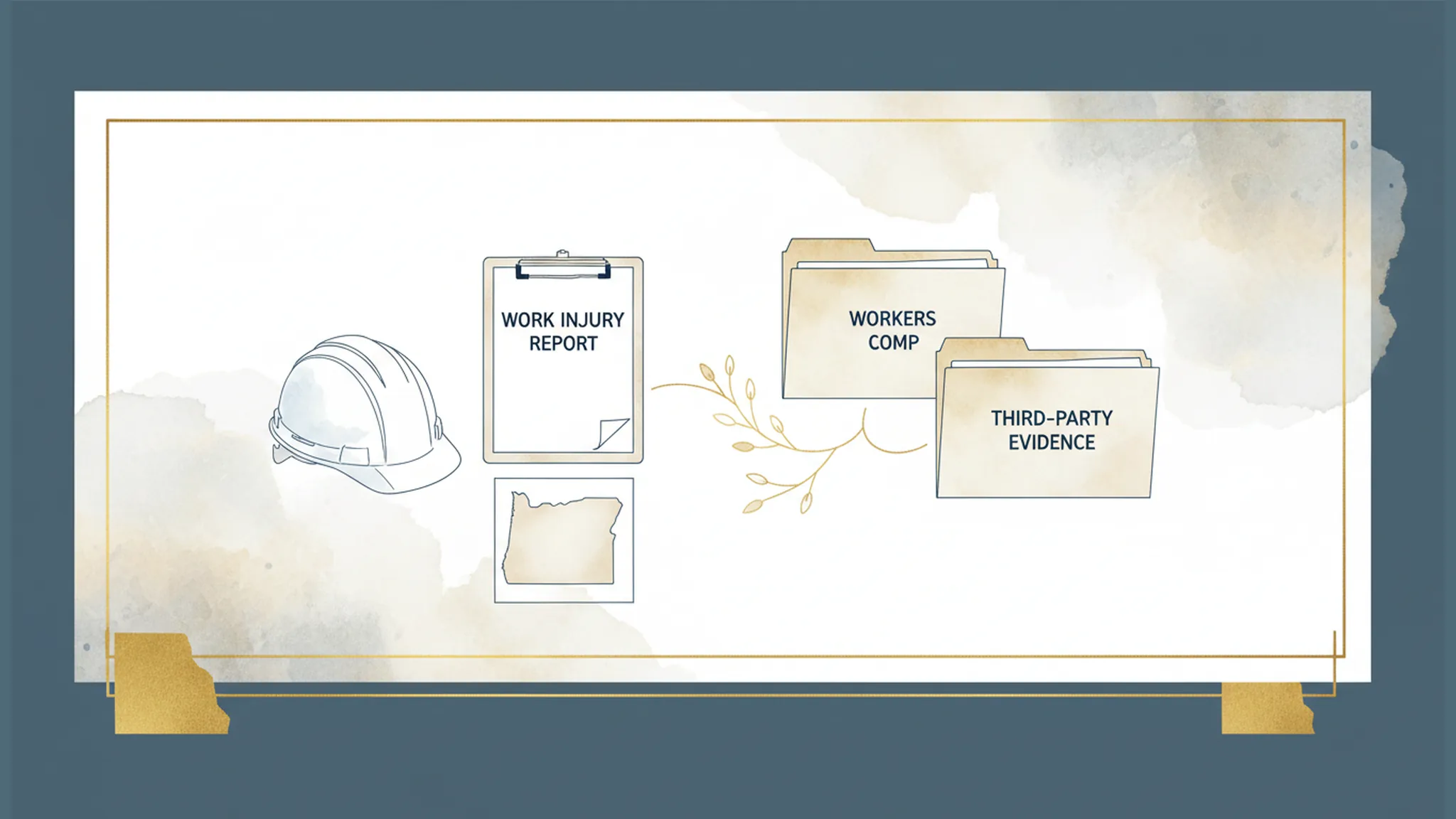
A Workers’ Comp Denial Is Separate From a Third-Party Injury Claim
A workers’ comp denial does not automatically mean you can sue someone else. It also does not automatically mean no civil claim exists.
Workers’ compensation and third-party injury claims are separate systems. Oregon law allows workers injured by the negligence or wrong of a third person not in the same employ to elect to seek a remedy against that third person. Oregon also has a technical provision for certain civil negligence actions after some workers’ compensation claims are finally determined not compensable because the worker failed to establish that the work-related incident was the major contributing cause. That technical rule is separate from a third-person claim, and it does not create a civil negligence right that does not otherwise exist.
In practical terms, a third-party claim depends on issues such as non-employer fault, control of the hazard, product defects, property conditions, contractor responsibilities, evidence, and deadlines. For a broader overview, see Johnson Law’s guide to when a workplace injury may involve more than workers’ comp.
Examples can include warehouse forklift injuries that may involve third-party claims or disputes over fault allocation on a multi-contractor jobsite. Those examples do not mean every denied comp claim has a civil case. They simply show why the two questions should be kept separate.
When the Denial Letter Mentions Your Rights, Take the Timing Seriously
If you received a denial letter, the next step is not to panic—but it is also not to ignore it.
Three Oregon timelines are especially important:
- Accident notice: Oregon law requires notice immediately, but no later than 90 days after the accident, with statutory exceptions and good-cause concepts that may matter in some situations.
- Acceptance or denial: The insurer or self-insured employer generally must accept or deny the claim in writing within 60 days after the employer has notice or knowledge of the claim.
- Hearing request after denial: A hearing request generally must be made by the 60th day after the denial is mailed; a request by the 180th day may be allowed if good cause is established for missing the 60-day deadline.
WCD also states that injured workers have the right to file a workers’ compensation claim, seek medical care, and access benefits for time off, and that employers cannot force workers not to file a claim or to say an injury did not happen while working.
A denial letter can feel like the system has already made up its mind. But legally, the letter is often the start of a defined dispute process. The most important immediate tasks are to understand the stated reason, protect the deadline, preserve the evidence, and keep the workers’ comp question separate from any possible third-party claim review.
FAQ
Are “Reason Codes” Official Oregon Workers’ Comp Denial Codes?
This article uses “reason codes” as shorthand for common denial reasons or concepts that may appear in a denial letter. Unless your letter or an official Oregon source uses a specific code, it is safer to think in terms of the actual denial reason stated in the letter.
How Long Does an Oregon Workers’ Comp Insurer Have to Accept or Deny a Claim?
Oregon law generally requires written acceptance or denial within 60 days after the employer has notice or knowledge of the claim. The exact notice date and claim facts can matter.
How Long Do I Have to Appeal an Oregon Workers’ Comp Denial?
To object to a denial of a claim for compensation, a hearing request generally must be made no later than the 60th day after the denial is mailed. A request filed by the 180th day may be allowed if good cause is established for missing the 60-day deadline.
Can My Claim Be Denied Because I Reported the Injury Late?
Late notice can be a denial issue. Oregon law requires notice immediately, but no later than 90 days after the accident. However, the statute includes exceptions and good-cause concepts, so the exact facts and denial wording matter.
Does a Preexisting Condition Mean My Oregon Workers’ Comp Claim Is Over?
Not necessarily. Oregon has specific definitions for preexisting conditions, and a condition that merely makes someone more susceptible to injury is not necessarily the same as a condition that contributes to disability or the need for treatment. Combined-condition rules can also be technical.
Does a Workers’ Comp Denial Mean I Can Sue Someone Else?
Not automatically. Workers’ compensation and third-party civil claims are separate. A third-party claim depends on non-employer fault, control, duties, evidence, and deadlines. A denial may be one reason to look carefully at the facts, but it does not prove a civil claim exists.
Sources
- ORS Chapter 656 – Workers’ Compensation, including ORS 656.005, 656.262, 656.265, 656.266, 656.267, 656.273, 656.319, 656.802, 656.154, and 656.019.
- ORS Chapter 670 – Independent Contractors, including ORS 670.600.
- Oregon Workers’ Compensation Division, Reporting an injury and filing a claim.
- Oregon Workers’ Compensation Division, Injured worker overview.
- Oregon Workers’ Compensation Division, Form 801, “Report of Job Injury or Illness”.
- Oregon Workers’ Compensation Division, Independent and worker-requested medical examinations.
Client-First Fee Promise
Client First = Bills First, Fees Second
Your unpaid medical bills do not have to make your lawyer's fee bigger. Johnson Law subtracts qualifying medical bills before calculating our fee, helping clients keep more of their settlement.
Applies to qualifying cases. Results vary.