Trench Collapse Injury: What Makes These Claims High-Stakes and Evidence-Heavy
Trench Collapse Injury: What Makes These Claims High-Stakes and Evidence-Heavy
A trench collapse injury lawsuit in Oregon is rarely simple. The collapse itself may be the most visible event, but the legal analysis often depends on technical excavation evidence: who controlled the trench work, how the soil was classified, whether a protective system was used, what the competent person observed, and whether another contractor or company contributed to the hazard.
For an injured worker or a family dealing with a fatal trench incident, the first questions are usually immediate and practical: Is this only a workers’ compensation claim? Can someone outside the employer be responsible? What evidence needs to be preserved before the site changes?
This article is educational information only and is not legal advice. Trench-collapse claims are fact-specific, and a collapse does not automatically prove negligence, an OSHA violation, or a viable lawsuit.
What Makes a Trench Collapse Injury Claim Different From a Typical Work Injury?
Oregon OSHA treats a trench as a type of excavation that is generally deeper than it is wide and not more than 15 feet wide at the bottom. OSHA describes cave-ins as the greatest risk to workers’ lives in trenching and excavation work, and the federal Subpart P definition of a cave-in focuses on the sudden movement of soil or rock into an excavation in an amount that can entrap, bury, injure, or immobilize a person.
Those definitions matter because a trench collapse claim often requires more than a general account of how someone was hurt. The claim may require a detailed reconstruction of the site conditions before the collapse, including trench dimensions, wall conditions, protective systems, water, spoil piles, nearby equipment, and changing soil conditions.
That is why trench-collapse cases can become evidence-heavy quickly. The worksite may be repaired, backfilled, reconfigured, or shut down. Equipment may be moved. Contractors may leave. Agency investigations may begin. The facts that explain why the collapse happened can be time-sensitive.
The First Legal Question: Workers’ Compensation, a Third-Party Claim, or Both?
For an Oregon worker injured in a trench collapse, workers’ compensation is often part of the first claim path. A separate civil lawsuit may also be considered in some cases, but it depends heavily on who may have caused or contributed to the hazard.
Workers’ Compensation May Be the First Claim Path
Oregon’s workers’ compensation law generally gives a covered employer exclusive-remedy protection for most injury claims by subject workers arising out of and in the course of employment. In practical terms, an injured worker often cannot simply sue a covered direct employer for an ordinary workplace injury.
That does not mean the worker has no claim. Workers’ compensation may address work-related injuries through that system. But it does mean the civil-liability analysis must start with the worker’s employment status, the employer’s coverage, and any special facts that could affect the exclusive-remedy rule.
For a broader discussion of when an Oregon work injury may involve claims beyond workers’ compensation, see Johnson Law’s guide to Oregon workplace injury exceptions.
A Third-Party Lawsuit May Be Possible, But It Is Fact-Specific
Oregon law also allows an injured worker, or certain beneficiaries if death results, to seek a remedy against a negligent or wrongful third person not in the same employ when the injury is due to that third person’s negligence or wrong. In a trench-collapse setting, that fact-specific analysis may involve a general contractor, excavation subcontractor, property owner, utility, engineer, equipment supplier, staffing company, or another entity involved in the project.
The key word is “may.” A third-party claim is not automatic just because multiple companies were present or because a trench collapsed. Responsibility can turn on contracts, jobsite control, work scope, safety duties, who selected or moved the protective system, who had authority to stop work, and what the evidence shows about the hazard.
Oregon also has election, lien, paying-agency, and offset rules that can apply when a worker pursues damages against a third party. Those issues can affect strategy and settlement, but they require case-specific legal review rather than one-size-fits-all advice.
For more background on how lawyers analyze which company controlled the jobsite hazard, see Johnson Law’s article on fault allocation on a multi-contractor jobsite.
Oregon Excavation Rules That Often Shape the Evidence
Oregon OSHA administers Oregon’s workplace-safety rules, including construction excavation requirements in Division 3, Subdivision P. Federal OSHA and eCFR materials are also useful for definitions and Subpart P text, but Oregon-specific analysis should begin with Oregon OSHA’s excavation framework.
The point of discussing these rules is not to say that any single fact proves civil liability. Instead, the rules show what investigators, lawyers, and experts may examine when evaluating how a trench collapse happened.
Cave-In Protection and the Five-Foot Rule
Oregon OSHA states that workers in excavations five feet deep or deeper must be protected from cave-ins. But five feet is not the only important number. Oregon OSHA also states that workers must be protected at any depth if a competent person determines there is cave-in potential.
Under Subpart P, each employee in an excavation generally must be protected from cave-ins by an adequate protective system unless the excavation is entirely in stable rock or is less than five feet deep and a competent-person ground examination shows no indication of a potential cave-in.
That means a shallow trench is not automatically safe or exempt from concern. Soil type, water, vibration, nearby loads, previously disturbed ground, and other conditions may matter.
Protective Systems: Sloping, Benching, Shoring, and Shielding
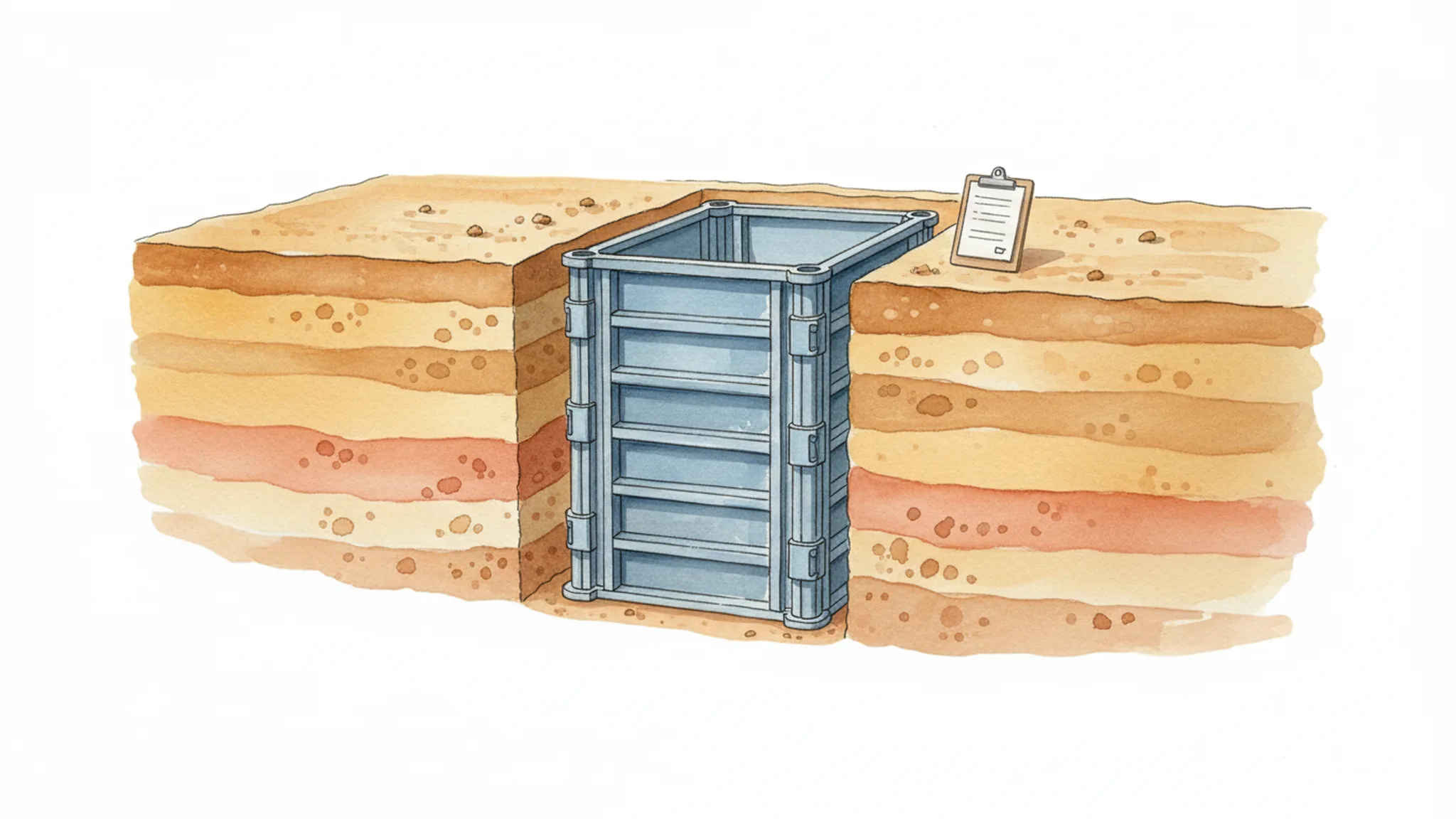
OSHA identifies three core ways to reduce cave-in risk: sloping or benching trench walls, shoring trench walls with supports, and shielding workers with trench boxes or similar systems. Oregon’s excavation rules include appendices addressing soil classification, sloping and benching, shoring, and protective-system selection.
The selected system must fit the actual conditions. Subpart P requires protective systems to have the capacity to resist, without failure, all loads that are intended or reasonably expected to be applied or transmitted to the system. In a real case, that can make evidence about trench-box tabulated data, engineering designs, shoring plans, measurements, nearby equipment, surcharge loads, spoil piles, pipe, materials, and water conditions important.
No single protective method is automatically required in every trench. The question is whether the selected method, if any, fit the trench and conditions at the time workers were exposed.
Soil Classification and Changing Conditions
Soil evidence is often central in a trench-collapse claim. Appendix A to Subpart P requires each soil and rock deposit to be classified by a competent person as Stable Rock, Type A, Type B, or Type C, based on at least one visual and at least one manual analysis.
That classification is not necessarily a one-time event. If properties, factors, or conditions affecting soil classification change after the initial classification, re-evaluation and reclassification are required. Rain, water seepage, vibration, previously disturbed soil, changing trench dimensions, and equipment movement can all become part of the evidence picture.
Evidence may include soil-test records, manual or visual analysis notes, photos of trench walls, weather records, water conditions, samples if lawfully preserved, and testimony from workers who saw conditions change.
Water, Spoil Piles, Materials, and Safe Exit Routes
Trench evidence is not limited to whether a trench box was present. Subpart P also addresses conditions around the excavation.
Workers may not work in excavations with accumulated or accumulating water unless adequate precautions are taken, and water-removal equipment and operations must be monitored by a competent person when used. Employees must also be protected from excavated or other materials or equipment falling or rolling into excavations, including by keeping materials or equipment at least two feet from excavation edges or using adequate retaining devices.
Safe exit routes can matter too. In trench excavations four feet or more deep, a stairway, ladder, ramp, or other safe means of egress must be located so employees need no more than 25 feet of lateral travel.
These details may not decide a case by themselves, but they can help explain the worksite conditions before and during the collapse.
The Competent Person’s Role and Why It Matters
The “competent person” concept is one of the most important parts of excavation safety analysis. It also is one of the areas where readers should be careful not to oversimplify.
What “Competent Person” Means
Under Subpart P, a competent person is someone capable of identifying existing and predictable hazards in the surroundings or working conditions and who has authority to take prompt corrective measures to eliminate them. The authority-to-correct element matters. Training alone does not necessarily answer whether the person had the required authority at the site.
Oregon OSHA’s competent-person fact sheet explains that Subdivision P requires competent-person actions such as analyzing, classifying, determining, designing, evaluating, inspecting, monitoring, and removing employees from hazardous areas when necessary.
In a trench-collapse case, lawyers may ask: Who was designated as the competent person? Were they on site when required? What authority did they have? What conditions did they observe? Did they have the training and information needed to classify soil and evaluate protective systems? Did they remove workers when conditions became unsafe?
Inspection Timing and Stop-Work Decisions
Subpart P requires daily inspections of excavations, adjacent areas, and protective systems by a competent person when employee exposure can reasonably be anticipated. The rule also requires inspection before work starts, as needed throughout the shift, and after rainstorms or other hazard-increasing occurrences.
If the competent person finds evidence of a possible cave-in, protective-system failure, hazardous atmosphere, or another hazardous condition, exposed employees must be removed from the hazardous area until necessary precautions have been taken.
Oregon OSHA’s excavation guide also states that a designated competent person with training in soil analysis, protective systems, and Oregon OSHA Division 3, Subdivision P must be on site to classify soil, select a protective system, oversee installation, and inspect the system after installation. The guide also notes that the competent person may leave briefly if no hazards exist, but must be present when a protective system is moved.
Documentation can be important evidence, but it should not be overstated. Inspection forms, daily reports, pre-task plans, toolbox-talk records, photos, texts, superintendent notes, weather records, equipment movement records, and witness testimony may all matter if they exist. Paperwork alone does not prove compliance or noncompliance, and the specific documentation duties can depend on the rule and the facts.
Evidence That Can Shape an Oregon Trench Collapse Injury Lawsuit
Because trench conditions can change quickly, evidence preservation is often an important early issue. Preservation should happen lawfully and safely. Injured workers and families should not enter restricted areas, disturb the scene, interfere with rescue efforts, violate employer safety rules, trespass, or obstruct Oregon OSHA or law enforcement investigations.
Site and Physical Evidence
Site evidence may include the trench’s depth, width, length, wall condition, soil appearance, ladder or ramp location, protective-system placement, trench-box condition, shoring materials, water accumulation, spoil-pile placement, nearby equipment, pipe or materials near the edge, and the location of workers before the collapse.
This evidence can be hard to reconstruct after emergency response, backfilling, weather, repair work, or normal construction activity changes the site.
Project Records and Safety Documents
Project records can help identify who controlled the trench work and what precautions were selected. Relevant records may include contracts, subcontract scopes, site-safety plans, competent-person designations, soil-classification records, pre-task plans, inspection records if available, toolbox talks, engineering designs, trench-box tabulated data, utility plans, and incident reports.
These records can be especially important when several companies were involved. The presence of multiple contractors does not itself establish fault, but it often makes the control and responsibility analysis more complex.
Digital, Witness, and Agency Evidence
Other evidence may include photos, videos, text messages, emails, equipment telematics, weather data, witness statements, 911 or rescue records, Oregon OSHA reports, and citations if issued.
Oregon OSHA investigations and citations can be important evidence, but they do not automatically establish civil liability or workers’ compensation eligibility. Oregon OSHA itself cautions that reporting an incident does not assign fault, prove a rule violation, or establish workers’ compensation eligibility.
Oregon OSHA Reporting and Scene Preservation After a Serious Trench Incident
After a serious trench incident, medical care and safety come first. Rescue, emergency response, and official investigations should not be disrupted.
Oregon OSHA requires employers to report work-related fatalities and catastrophes within eight hours. For reporting purposes, Oregon OSHA describes a catastrophe as two or more employee fatalities or three or more employees admitted to a hospital or clinic from the same incident. Employers must report in-patient hospitalization, loss of an eye, and certain amputations or avulsions within 24 hours. Oregon OSHA also instructs employers not to disturb the scene of a fatality or catastrophe until Oregon OSHA investigates, unless law enforcement directs otherwise or disturbance is necessary to reach victims safely or prevent injuries.
For workers and families, the safer evidence-preservation approach is usually to preserve what is already lawfully available: personal photos or messages, names of witnesses, medical records, incident paperwork, and communications received. An attorney can evaluate whether preservation letters, records requests, agency records, or other lawful steps are appropriate.
Deadlines and Wrongful Death Issues Require Careful Review
Legal deadlines can affect whether a claim can be pursued, but deadline analysis depends on the type of claim, the parties involved, and special rules that may apply.
Personal Injury Time Limits
Oregon personal injury actions for injury to the person or rights of another not arising on contract and not otherwise enumerated generally must be commenced within two years under ORS 12.110. That general rule does not answer every case. Tolling, exceptions, public-body notice issues, special statutes, and other facts can change the analysis.
Wrongful Death Claims
If a trench collapse is fatal, Oregon wrongful death law requires careful review. Under ORS 30.020, the personal representative brings the wrongful death action for statutory beneficiaries. The statute generally requires the action to be commenced within three years after discovery or reasonable discovery of the injury causing death, subject to statutory outer limits.
Family members should not assume that each person files separately or that the deadline analysis is simple. Johnson Law also has more information about Oregon wrongful death claims.
How a Lawyer Evaluates Responsibility Without Assuming Fault
A careful trench-collapse investigation does not begin by assuming fault. It begins by identifying the people and companies involved, the safety duties that applied, the conditions at the site, and the evidence that supports or contradicts each possible theory.
Oregon’s Safe Employment Act requires employers to furnish employment and a place of employment that are safe and healthful and to use reasonably necessary devices, safeguards, practices, methods, operations, and processes to protect workers’ life, safety, and health. Oregon law also requires employers, owners, employees, and other persons to comply with safety and health orders, standards, rules, and regulations prescribed by the state. Oregon OSHA’s general workplace rules address proper instruction, supervision, safe work practices, and compliance with applicable safety and health rules.
In a trench case, those general duties may be considered alongside excavation-specific evidence. A lawyer may ask:
- Who controlled the trench work?
- Who selected, installed, moved, or removed the protective system?
- Who classified the soil and inspected the excavation?
- Who placed spoil piles, equipment, pipe, or materials near the trench edge?
- Who had authority to stop work or remove workers from the trench?
- Did weather, water, vibration, or changed conditions require re-evaluation?
- Were contractors, subcontractors, utilities, property owners, engineers, suppliers, or staffing companies involved?
- Do contracts or indemnity provisions affect responsibility or insurance issues?
Oregon construction indemnity law can affect risk-transfer provisions, but that analysis is contract-specific. It should not be treated as a shortcut for deciding civil liability.
If the trench collapse happened in a Portland street, sidewalk, utility cut, or permitted work zone, public-body, permit, and right-of-way issues may also need review. Johnson Law discusses related issues in its article on Portland utility trench or construction-zone injury claims.
For readers looking for a broader practice-area overview, Johnson Law also provides information about Oregon construction injury claims.
What to Do After a Trench Collapse Injury in Oregon
Every case is different, but safe early steps can help protect health and preserve information:
- Get emergency medical care and appropriate follow-up care.
- Report the work injury through appropriate workplace channels when safe and possible.
- Do not enter unsafe or restricted areas, disturb the scene, or interfere with rescue, Oregon OSHA, law enforcement, or employer site controls.
- Preserve information already lawfully available to you, such as personal photos, messages, witness names, medical records, and incident paperwork.
- Ask case-specific questions early, because workers’ compensation, third-party claims, lien and election issues, agency investigations, and deadlines can interact.
Johnson Law can discuss the facts of an Oregon trench collapse injury and help evaluate whether the matter involves workers’ compensation only, a possible third-party claim, or other legal issues. A consultation does not guarantee a particular result, and the viability of any claim depends on the evidence and applicable law.
FAQ
Can I sue my employer after a trench collapse injury in Oregon?
Often, a covered direct employer has workers’ compensation exclusive-remedy protection for work injuries. That means many injured workers cannot sue their direct employer for an ordinary workplace injury. Status disputes, noncomplying-employer issues, exceptions, and possible third-party claims require case-specific review.
What is a third-party trench collapse injury lawsuit?
A third-party trench collapse injury lawsuit is a claim against a negligent or wrongful person or entity not in the same employ, when the facts support that claim. In a trench case, potential third parties might include certain contractors, property owners, utilities, engineers, suppliers, staffing companies, or others involved in the project. Their responsibility depends on control, duties, conduct, and evidence.
Does an Oregon OSHA citation prove my injury lawsuit?
No. An Oregon OSHA investigation or citation may be important evidence, but it does not automatically establish civil liability, a workers’ compensation claim, or the value of a case. Civil responsibility still depends on the facts, applicable law, and proof.
What evidence matters most after a trench collapse?
Important evidence may include trench dimensions, soil classification, protective systems, competent-person inspections, water conditions, spoil piles, egress, contracts, safety plans, inspection records if available, witness accounts, photos, video, weather data, equipment records, incident reports, and Oregon OSHA records.
Are trenches under five feet deep exempt from cave-in protection?
Not always. Oregon OSHA states that workers in excavations five feet deep or deeper must be protected from cave-ins, but workers must also be protected at any depth if a competent person determines there is cave-in potential.
Who brings an Oregon wrongful death claim after a fatal trench collapse?
Under Oregon law, a wrongful death action is brought by the personal representative for statutory beneficiaries. Timing and other requirements under ORS 30.020 require case-specific legal review.
Sources and Source Notes
- Oregon OSHA, Excavation
- Oregon OSHA, Division 3 construction rules, including Subdivision P Excavations
- eCFR, 29 CFR Part 1926 Subpart P — Excavations
- Oregon OSHA, Excavation safety: requirements for competent persons
- Oregon OSHA, Excavations: Safe practices for business owners and contractors
- Oregon OSHA, Report a fatality or injury
- Oregon Revised Statutes, ORS Chapter 656 — Workers’ Compensation
- Oregon Revised Statutes, ORS Chapter 654 — Occupational Safety and Health
- Oregon Revised Statutes, ORS Chapter 12 — Limitations of Actions
- Oregon Revised Statutes, ORS Chapter 30 — Actions and Suits in Particular Cases
Client-First Fee Promise
Client First = Bills First, Fees Second
Your unpaid medical bills do not have to make your lawyer's fee bigger. Johnson Law subtracts qualifying medical bills before calculating our fee, helping clients keep more of their settlement.
Applies to qualifying cases. Results vary.