Cornell Road Safety Changes in Hillsboro: What's Planned at 17th and 21st Avenues
Cornell Road Safety Changes in Hillsboro: What’s Planned at 17th and 21st Avenues
Washington County is planning changes at Cornell Road’s intersections with 17th and 21st Avenues in Hillsboro. As of September 1, 2026, the project was still in design and public review. The improvements had not been built.
The proposal would restrict vehicle movements at 17th Avenue and add a four-way signal at 21st Avenue, along with lighting, curb-ramp, sidewalk, sign, and marking work. These later plans may help identify records worth reviewing after a collision, but they do not establish what the road looked like on an earlier incident date or prove that a prior condition caused a crash.
Key Takeaways
- As of September 1, 2026, the project was in design and public review; the planned improvements had not been built.
- The 17th Avenue proposal would limit vehicle access to right-in/right-out movements using a traffic separator. County sources conflict about the pedestrian crossing treatment there.
- The 21st Avenue proposal includes a four-way signal and marked pedestrian crossings on all legs.
- The estimated construction window runs from summer 2027 through spring 2028, but the schedule may change.
- Later project plans can identify records to investigate, but they do not by themselves prove an earlier defect, negligence, notice, causation, or fault.
Project Status as of September 1, 2026
As of the date of this article, Washington County described the Cornell Road project as being in design and public review. An online open house was scheduled to run from August 29 through September 14, 2026. Because the designs and schedule may change, readers checking the project after September 1 should consult the official County materials for updates.
The County identifies Cornell Road as a Washington County road and 17th and 21st Avenues as City of Hillsboro roads. That division provides useful jurisdictional context, but road ownership alone does not determine who owns or maintains every light, sign, marking, sidewalk segment, or traffic-control asset in the project area.
What Is Planned at Cornell Road and 17th Avenue?
At 17th Avenue, the proposal would limit vehicle access to right-in/right-out movements. A traffic separator would be used to restrict other vehicle movements.
This is a proposed configuration, not one that was operating as of September 1, 2026. County materials conflict about the pedestrian crossing at 17th Avenue. The County’s main project page says the project will construct “a crosswalk,” while the detailed 17th Avenue open-house list calls for a “crosswalk closure sign”; the published concept exhibit does not depict a marked crossing across Cornell Road at 17th. Until the County clarifies the design, the available materials do not support saying that a crosswalk will be added or remain open.
What Is Planned at Cornell Road and 21st Avenue?
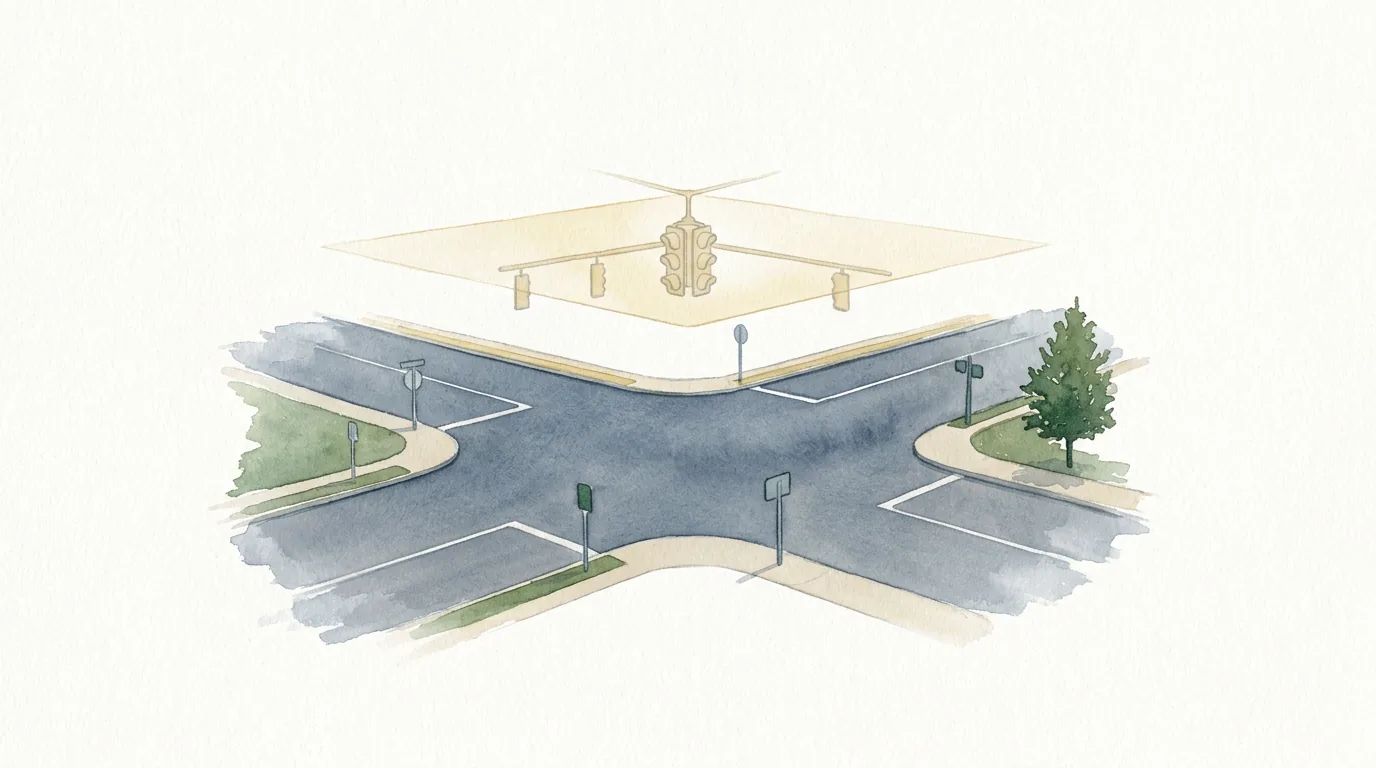
At 21st Avenue, the project would add a four-way traffic signal. The proposal also includes marked pedestrian crossings on all four legs of the intersection.
The planned signal had no operating history as of September 1, 2026. It is therefore too early to attribute any measured crash reduction or other result to it.
Other Improvements Included in the Cornell Road Project
Across the two intersections, the proposed project also includes:
- six streetlights;
- ADA curb ramps;
- signs and pavement markings;
- sidewalk work; and
- limited stormwater work.
Washington County identifies turning conflicts, visibility challenges, and limited pedestrian access as concerns in the project area. Those statements explain the County’s project rationale. They do not, by themselves, establish that an earlier facility was legally defective, that an agency was negligent, or that a particular condition caused a collision.
Estimated Design, Bidding, and Construction Timeline
Washington County’s estimated schedule as of September 1, 2026, was:
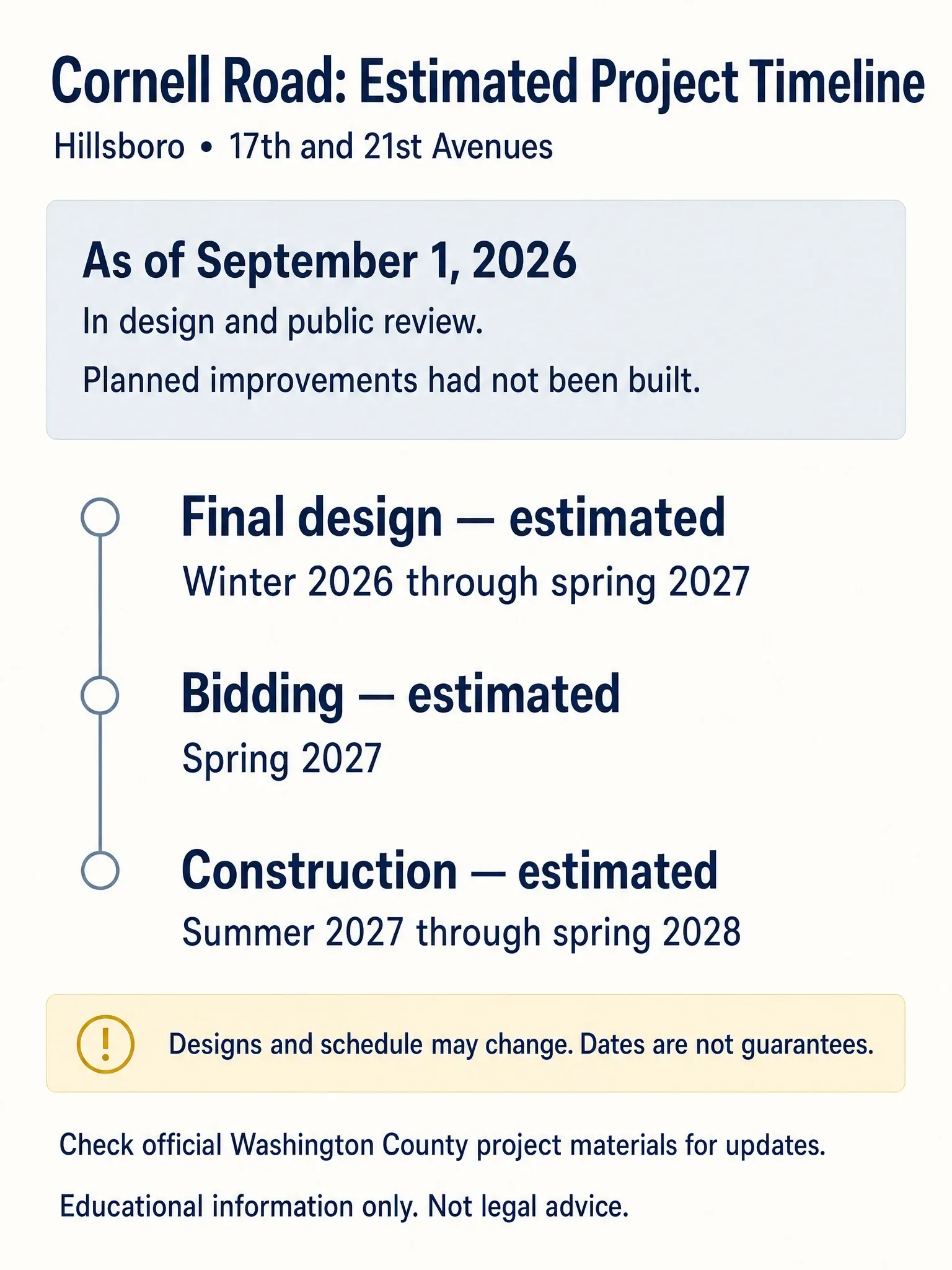
| Project stage | Estimated timing |
|---|---|
| Final design | Winter 2026 through spring 2027 |
| Bidding | Spring 2027 |
| Construction | Summer 2027 through spring 2028 |
These dates are estimates, not guarantees. Design revisions, bidding, funding, or other project developments could affect the schedule.
The County lists a 2024 project cost estimate of $2.3 million. It says the project would use funding from ODOT’s All Roads Transportation Safety program, including more than $2 million in ARTS funding, together with a County Road Fund match. That funding decision does not prove that an earlier condition was defective, that anyone was negligent, or that the condition was responsible for a crash. The cost estimate may also change.
Why the Crash Date Matters More Than a Later Project Plan
A proposed project can show what an agency planned to change at a particular point in time. It cannot, without more, show which traffic controls, markings, sight conditions, or maintenance practices existed when an earlier collision occurred.
An incident-date investigation should instead match the location to records from the relevant date. That distinction matters because a road can change over time through restriping, sign replacement, maintenance, nearby development, vegetation growth, temporary work, or a later capital project. A current drawing or future design should not be treated as a substitute for dated evidence.
Records That May Document Incident-Date Conditions
ODOT’s safety-investigation guidance identifies several categories of information that may be relevant to roadway review. For a collision near Cornell Road and 17th or 21st Avenue, potentially useful materials may include:
- dated photographs or aerial imagery;
- as-built plans;
- traffic-control and signal records, when applicable;
- maintenance records;
- sign and pavement-marking records;
- lighting information;
- roadway geometry and sight-distance materials;
- traffic-volume information; and
- field observations or records of obstructions.
The useful records will depend on the location, date, and circumstances. Not every record will exist, remain available indefinitely, or be open to public inspection. A public-record request is also not automatically a demand that an agency preserve material that might otherwise be lost or deleted.
Readers seeking a broader discussion can review the firm’s article on sign, signal, and roadway-design evidence. Information about Hillsboro crash records and local evidence may also provide local context. Those broader subjects are separate from the narrow question of what this Cornell Road project proposes.
Limits of Crash and Project Data
ODOT cautions that statewide crash data compiled from driver and police reports may be incomplete. Reporting, coding, location, and publication-lag issues can also affect what a search appears to show.
The supplied research did not locate the Cornell Road traffic study, the project’s specific ARTS application type, its analysis years, an underlying crash list, or a benefit-cost worksheet. Without those materials and defined query boundaries, a precise intersection crash count should not be inferred from the project’s existence or funding.
A Portland-specific article discusses using public crash and project data as an investigative lead. Its methodology may be useful, but the Portland datasets and project context discussed there should not be assumed to govern this Hillsboro project.
Cornell Road Project Evidence: What It Shows—and What It Does Not
The official project material supports several dated, limited points. It documents the project’s status as of September 1, 2026; the proposed vehicle-access change at 17th Avenue; the proposed signal and marked crossings at 21st Avenue; the other listed improvements; the County’s stated project-area concerns; and the estimated cost, funding, and schedule.
That material does not, on its own, establish:
- the precise controls or physical configuration present on an earlier crash date;
- which public entity owned or maintained a particular asset;
- that a prior road feature was legally defective;
- negligence or prior notice;
- causation or fault in a particular collision; or
- any measured safety result after construction.
The project’s rationale and the proof needed to evaluate a specific crash are different things. A crash-specific analysis requires evidence tied to the incident’s date, exact location, conditions, and involved conduct.
Where to Check for Project Updates
For changes after September 1, 2026, check the Washington County Cornell Road project page and the official online open-house materials. Those sources may reflect later design decisions, scheduling changes, or construction updates.
Anyone seeking records about a collision should identify the exact incident date and location in any request. Later plans can be useful leads, but dated materials are needed to document earlier conditions.
A routine public-records request should not be assumed to satisfy Oregon Tort Claims Act notice. For many claims against an Oregon public body other than wrongful-death claims, ORS 30.275 generally requires notice within 180 days after the alleged loss or injury; wrongful-death notice generally is due within one year. The statute specifies ways notice may be satisfied and includes tolling provisions and exceptions. A separate two-year period to commence an action also generally applies. Deadline questions require prompt, case-specific review.
This article provides general educational information only and is not legal advice. The availability and significance of records depend on the facts of a particular incident.
Frequently Asked Questions
Have the Cornell Road Changes at 17th and 21st Avenues Been Completed?
No. As of September 1, 2026, the project was in design and public review, and the improvements had not been built. Check the official Washington County project page for developments after that date.
What Is Planned at Cornell Road and 17th Avenue?
The proposal would restrict vehicle access to right-in/right-out movements using a traffic separator. County materials conflict: the main project page says the project will construct “a crosswalk,” while the detailed 17th Avenue open-house list calls for a “crosswalk closure sign,” and the concept exhibit does not depict a marked crossing across Cornell Road at 17th. The County should clarify the final treatment.
What Is Planned at Cornell Road and 21st Avenue?
The proposal includes a four-way signal and marked pedestrian crossings on all legs. The signal was not operating as of September 1, 2026, so there were no measured operating results to attribute to it at that time.
When Is Construction Expected?
The County’s estimate places construction from summer 2027 through spring 2028, after final design from winter 2026 through spring 2027 and bidding in spring 2027. All of those dates are estimated and may change.
Do the Planned Improvements Prove Cornell Road Was Defective Before the Project?
No. A later plan does not by itself prove a prior defect, negligence, notice, causation, or fault in a specific collision. Those questions require evidence tied to the relevant date, location, and circumstances.
Which Records May Help Show What the Intersection Looked Like on a Crash Date?
Dated plans and imagery, maintenance records, traffic-control records, sign and marking records, lighting information, geometry and sight-distance materials, and field observations may be relevant. Availability depends on what was created, retained, and lawfully accessible.
Sources
- Washington County — Cornell Road at 17th and 21st Avenues
- Washington County — Cornell Road Online Open House
- Washington County — 17th Avenue Proposed Improvements
- Washington County — 17th Avenue Concept Exhibit
- Washington County — 21st Avenue Proposed Improvements
- Washington County — Project Background
- Washington County — Estimated Project Timeline
- ODOT — All Roads Transportation Safety Program
- ODOT — Crash Data Disclaimers
- ODOT — Safety Investigation Manual
- Oregon Revised Statutes, Chapter 30
Client-First Fee Promise
Client First = Bills First, Fees Second
Your unpaid medical bills do not have to make your lawyer's fee bigger. Johnson Law subtracts qualifying medical bills before calculating our fee, helping clients keep more of their settlement.
Applies to qualifying cases. Results vary.