Headlight Glare After a Crash: What Aim, Height and Lamp Testing Can Show
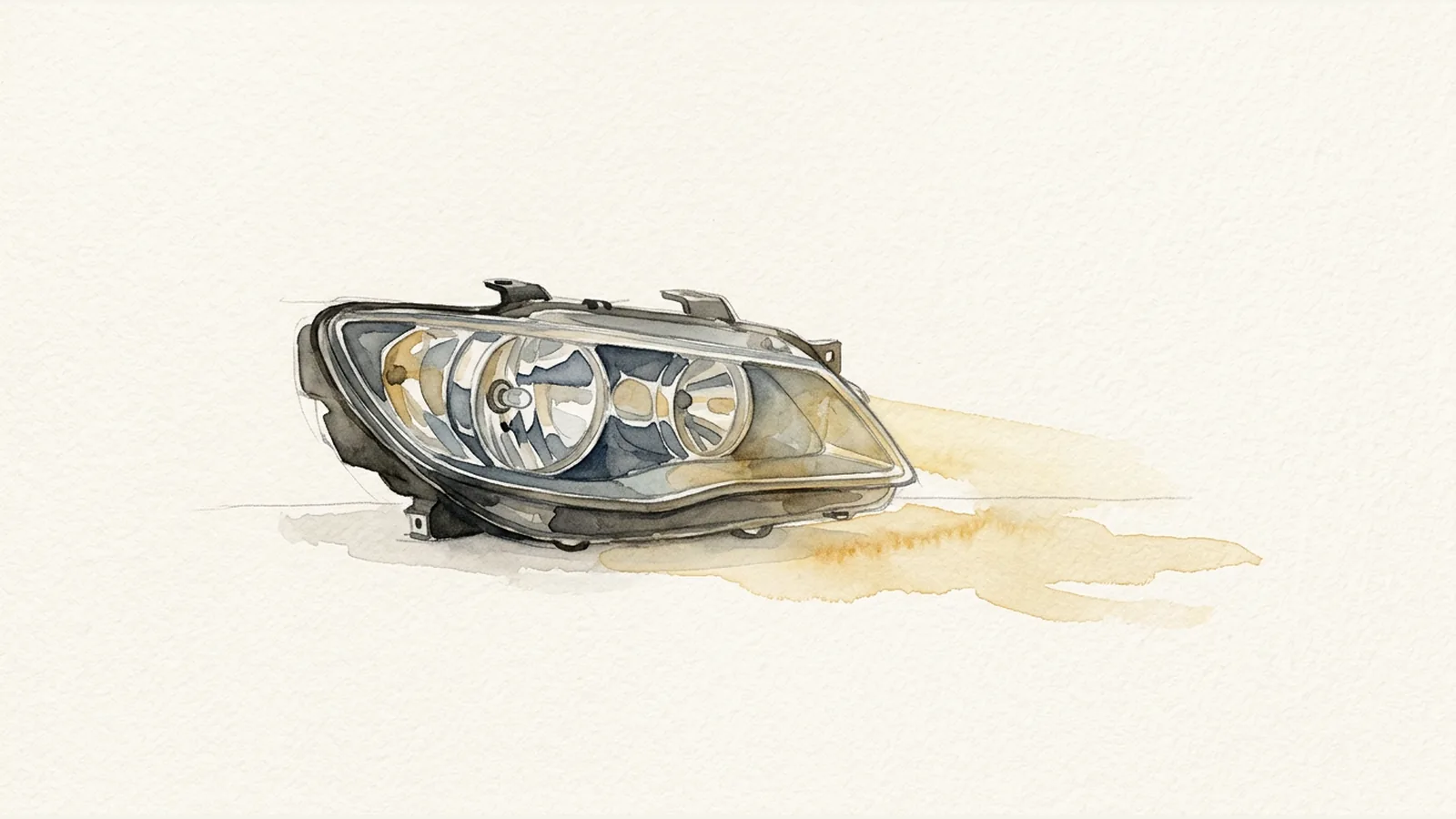
A headlight inspection can help assess lamp aim, mounting height, configuration and damage after a nighttime crash. But the useful question is not simply whether a light looks bright. It is what the hardware and measurements can establish about the lighting conditions relevant to that collision.
A phone photograph is not a calibrated glare measurement. A lamp knocked out of alignment by an impact does not prove it was misaligned beforehand. And an “LED” label does not answer whether the complete headlamp complies with federal standards.
Three distinctions guide a useful assessment:
- Perceived discomfort and reduced visibility are different glare problems.
- Lamp-component measurements and vehicle-level glare testing answer different questions.
- Evidence of equipment performance does not, by itself, establish crash causation or legal fault.
“Too bright” can describe two different glare problems
NHTSA’s glare report distinguishes disability glare, which reduces visibility, from discomfort glare, the discomfort someone perceives from light.
Light scattered within the eye can reduce the contrast of an object against its surroundings. That is a visibility issue, not simply whether the light feels unpleasant. The distinction helps explain why “those headlights hurt my eyes” and “I could not distinguish the object” are not interchangeable observations.
Both descriptions may be worth recording accurately. Neither should be upgraded into a measurement or a diagnosis. Discomfort alone does not establish that glare caused a crash, and a general explanation of light scatter cannot establish what a particular person could see.
What aim, height and lamp configuration can change
Aim and mounting height need context
In a 2008 NHTSA sensitivity analysis, upward mis-aim produced the greatest increases in disability and discomfort glare among the parameters evaluated. Mounting height was also statistically significant.
The limits belong beside that finding: the analysis used halogen and HID photometric data and simulation. It was not a definitive comparison of modern LED headlights or a study establishing that every taller vehicle is unsafe.
For an individual vehicle, those findings support asking about aim and height rather than relying on a brightness label. A qualified assessment can also consider loading, roadway geometry and optical damage. It must distinguish what is observable now from what can be supported about the pre-crash configuration.
An LED assembly is not the same as a replacement bulb
A complete headlamp assembly and a replacement light source are different pieces of equipment. NHTSA’s February 13, 2024 Baker interpretation distinguishes integral LED assemblies from LED replacement bulbs.
A bulb fitting into a housing does not, by itself, establish compliance of the resulting assembly. Neither does the LED label or a photograph. The interpretation’s replacement-source conclusion depended on the Part 564 listings at that time; it should not be treated as a verified inventory of permitted sources in October 2026.
What testing can establish—and what a phone photo cannot
Beam photometry is more than advertised brightness
Photometry measures light. As the Baker interpretation explains, FMVSS 108 includes minimum and maximum luminous-intensity requirements at specified points. The question is therefore not just “how bright is the bulb?” but how the lamp distributes light across the required measurement points.
A marketed brightness description does not establish that distribution. Nor can a picture of a bright-looking lamp substitute for measurements against the applicable requirements. The complete assembly matters, not just the light source named on a package.
Component tests and vehicle-level tests are different
The separate 2022 adaptive driving beam rule distinguishes laboratory photometry of components from vehicle-level track glare testing. These are different technical inquiries, not interchangeable proof.
That distinction does not mean every crash investigation must repeat certification testing, or that the same test framework applies identically to every lamp. It means an assessment should identify what was tested and what the result actually supports.
Original phone images and video may provide context, but they are not calibrated intensity measurements or a reconstruction of the observer’s vision. Qualified inspection can assess aim, mounting height, optical damage, beam mode and roadway geometry. Even a sound measurement needs to be connected to the relevant crash circumstances before drawing a conclusion about causation.
Preserve the lamp’s configuration—not just its damaged appearance
Where feasible, keep the information needed to understand what equipment was present before repair or adjustment:
- Hardware: lamp assemblies, modules, bulbs and identifying markings.
- Configuration records: repair or retrofit receipts, suspension modifications and vehicle-loading information.
- Contemporaneous accounts: original video and witness descriptions concerning beam use and glare.
These are practical preservation suggestions, not a statement of statutory duties. Descriptions remain observations, not numerical measurements.
The condition before and after impact must also stay separate. A post-crash aim measurement may describe collision damage rather than the lamp’s earlier aim. Documenting condition before repairs, where feasible, and arranging qualified assessment can help preserve that distinction; it does not guarantee a definitive answer.
Do not disassemble or adjust lamps to create your own test, or attempt a hazardous nighttime reenactment. For the broader process, see preserving physical evidence before it changes.
NHTSA’s October 7 notice is not a new headlight rule
On October 7, 2026, NHTSA filed a notice for public inspection, scheduled for publication October 8. Document 2026-20648, docket NHTSA-2026-1981, concerns an intent to establish a vehicle-lighting negotiated-rulemaking advisory committee.
It seeks committee-related comments and nominations. It is not an advance notice of proposed rulemaking, a substantive proposed equipment rule or a final rewrite of FMVSS 108. A later proposed rule is contemplated after recommendations, approval and regulatory review. This notice adopts no new substantive headlamp requirements.
The listed subjects include glare, replaceable light sources, beam photometry, aim, mounting height and physical testing. It also mentions semiautomatic beam switching, which is not synonymous with adaptive beam shaping. Adaptive driving beam, or ADB, is not expressly named in that topic list.
ADB has a separate history: the final rule permitting its certification was published and became effective February 22, 2022. ADB changes beam distribution to improve illumination while limiting glare toward other vehicles. That rule did not impose a universal retrofit mandate, and the October 7 committee notice should not be described as doing so.
Equipment performance and beam-use rules are separate questions
Equipment testing asks how a lamp performs. Beam-use rules address how lighting is used on the road.
- Oregon: ODOT’s guidance quoting ORS 811.515(6) gives an oncoming distance of 500 feet and ordinarily requires low beams when following within 350 feet, with an overtaking/passing exception.
- Washington: RCW 46.37.230 addresses oncoming vehicles within 500 feet and bars the uppermost beam when approaching behind within 300 feet.
Each source includes a low-beam qualification deeming the specified beam compliant for avoiding oncoming glare regardless of road contour or loading. Perceived glare alone therefore does not prove a beam-use violation.
Under 49 USC 30103(e), federal compliance does not itself exempt a person from common-law liability. Conversely, a suspected equipment problem does not establish liability. Duties, causation, damages and potential preemption remain case-specific. Broader nighttime pedestrian visibility and fault disputes require a separate analysis.
Questions about headlamp inspection after a crash
Can a phone photo prove headlights exceeded a glare limit?
Not by itself. Keep originals as possible context, but do not treat them as calibrated measurements of intensity.
Does post-crash misalignment prove the lamp was misaligned before impact?
No. The collision may have changed its position. Qualified assessment and supporting information must distinguish pre-crash condition from impact damage.
Did NHTSA adopt a new brightness rule on October 7, 2026?
No substantive rule was adopted by the committee-intent notice filed that day.
If headlamp condition may matter to your injury claim, you can ask Johnson Law about whether a qualified inspection would be useful. An inspection is not a promise of proof or recovery.
Source notes
Sources are linked beside their limited claims. The 2008 study is not a modern LED comparison; the 2024 interpretation is not a verified October 2026 replacement-source inventory. The October 7 committee filing and the effective 2022 ADB rule are separate regulatory events.
This article provides educational information only, not legal advice.
Client-First Fee Promise
Client First = Bills First, Fees Second
Your unpaid medical bills do not have to make your lawyer's fee bigger. Johnson Law subtracts qualifying medical bills before calculating our fee, helping clients keep more of their settlement.
Applies to qualifying cases. Results vary.