Car Seat After an Oregon Crash: When to Replace It and What to Preserve
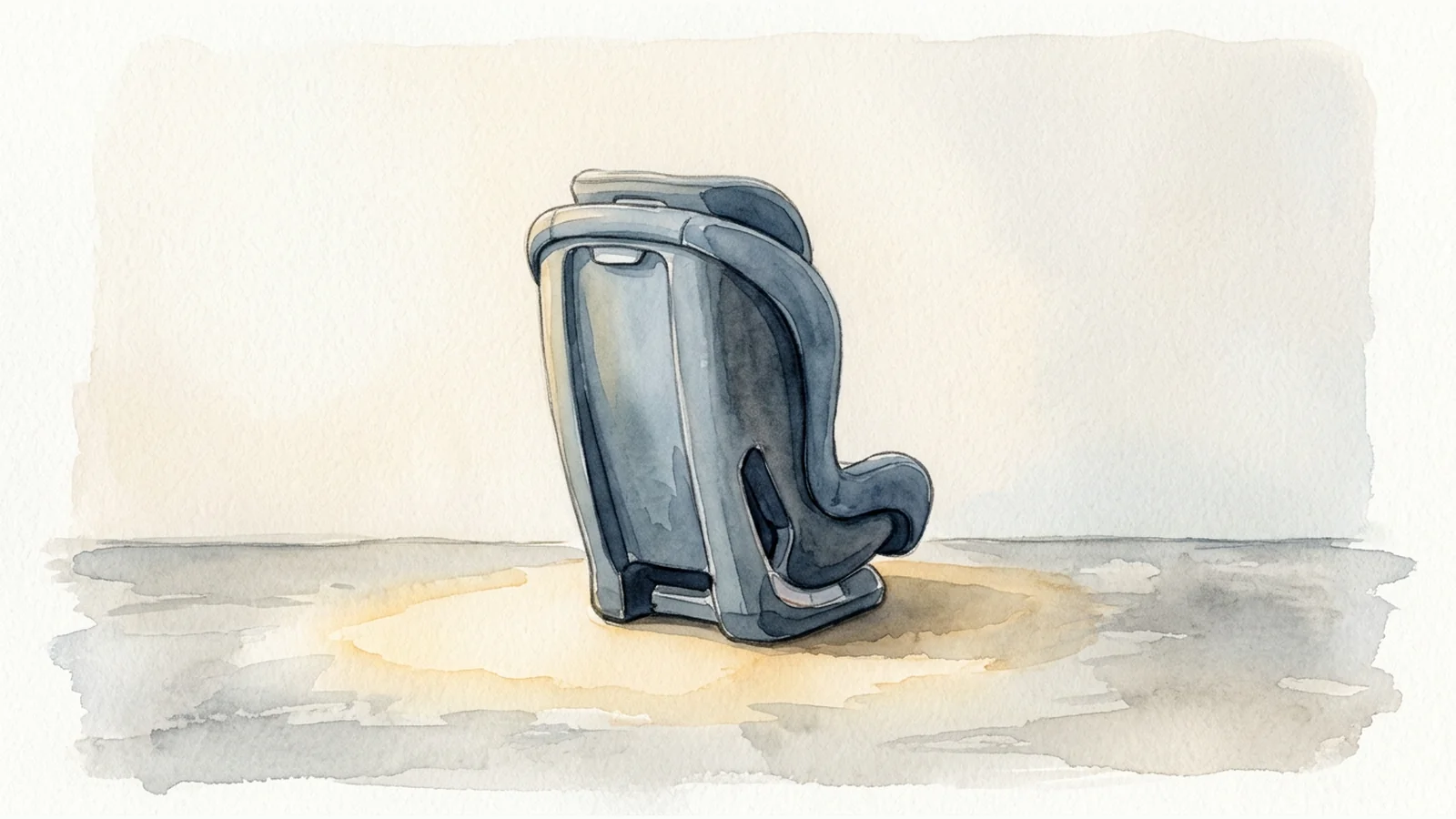
NHTSA recommends replacing a car seat after a moderate or severe crash and says never to reuse a seat involved in such a crash. A minor crash does not automatically require replacement under NHTSA’s guidance, but every condition in its five-part checklist must be met—and you must still follow the specific manufacturer’s instructions.
A seat that looks fine, or held no child during the crash, is not automatically safe to keep using. If you cannot confirm the crash facts or the instructions for your model, do not treat that uncertainty as clearance to reuse it.
Medical needs come first. After that, separate three decisions: whether the seat can be used safely, whether insurance will pay for a replacement, and whether the involved seat should be kept as evidence. Replacing a seat for transportation does not mean throwing the old one away.
Does the car seat need to be replaced?
NHTSA’s minor-crash guidance requires all five conditions
NHTSA’s car-seat crash guidance defines a minor crash using all five of these conditions:
- “The vehicle was able to be driven away from the crash site.”
- “The vehicle door nearest the car seat was not damaged.”
- “None of the passengers in the vehicle sustained any injuries in the crash.”
- “If the vehicle has air bags, the air bags did not deploy during the crash.”
- “There is no visible damage to the car seat.”
If any condition fails, the crash does not meet that definition. If a condition is unknown, you do not have a confirmed basis to apply the minor-crash guidance.
Calling the collision a “fender bender” does not answer these questions. Neither does the repair cost, speed, total-loss decision, or the fact that your child was unharmed. And meeting all five conditions does not override a manufacturer’s stricter instructions.
Check the exact manufacturer and model instructions
Manufacturer guidance is not identical across brands. For example:
- Graco recommends replacing a car seat after any accident, including when damage is uncertain after a parking-lot bump.
- Britax directs caregivers to discontinue use after moderate or severe crashes and points to NHTSA’s criteria for minor crashes.
These examples do not replace checking the manual and applicable guidance for your exact model. Save the instructions you rely on and ask the manufacturer to clarify anything uncertain.
Graco explains that crash damage can include internal or hard-to-see damage, such as shell fractures, hairline cracks, or damage to foam or buckles. That does not mean every crash damages every seat. It means appearance alone is not a reliable substitute for crash-replacement guidance.
What if the seat was empty, or it was a booster or detachable base?
An empty seat is not automatically exempt. Graco’s guidance expressly recommends replacement even when no child occupied the seat, because crash energy can damage it. That is an attributed manufacturer rule, not a claim that every brand has the same instructions.
For a booster, detachable base, or other component, check the actual product instructions and ask the manufacturer about the involved components. Do not assume that an empty booster or a base left in the vehicle falls outside the guidance.
When replacement is needed, choose a restraint appropriate for your child’s age and size and compatible with the vehicle. A crash is not a reason to move a child prematurely to a booster or adult belt. Follow both the restraint and vehicle manuals. NHTSA’s car-seat selection and installation resources include help finding technicians and inspection stations; inspections are free in most cases. Installation assistance is not certification that an old seat has no hidden crash damage.
Will insurance pay for a replacement car seat?
Safety guidance and payment are different questions. Graco explains that replacement payment depends on the policy or agreement. Whether you are asking your own insurer or seeking payment through another driver’s liability claim also matters; neither the manufacturer’s replacement recommendation nor this article determines coverage or responsibility.
Oregon’s Division of Financial Regulation (DFR) recommends notifying your insurer promptly and reviewing your declarations and coverage. Most policies require prompt notice.
Ask the insurer:
- Does the applicable coverage or claim include replacement of this seat and any involved base?
- Does a deductible apply, and what replacement amount will be considered?
- Which documents or photographs are needed?
- Is inspection required, and what should be retained before anything is discarded or transferred?
Useful documentation may include model and label photos, the seat’s position in the vehicle, crash facts relevant to the checklist above, manufacturer instructions, purchase information if available, and the replacement receipt. These are practical suggestions, not a legally mandated checklist. Graco also provides a replacement-policy letter that an insurer may request.
An insurance denial is not safety clearance. Graco recommends replacement under its guidance even if payment is denied. When replacement guidance applies, arrange an appropriate alternative restraint rather than treating a pending payment decision as permission to keep using the involved seat.
For insurance questions or complaint assistance, Oregon DFR offers help at 888-877-4894. That resource does not guarantee payment. The cited guidance does not establish an automatic Oregon car-seat reimbursement entitlement; a payment dispute needs its own policy and legal review.
Replace for transportation—but preserve the involved seat when evidence may matter
If the seat should be retired, keep it out of use. If inspection, a claim, or a suspected failure may matter, preserve it while using an appropriate replacement for transportation. Ask about evidence and inspection needs before disposal rather than assuming that reimbursement ends the need to retain the product.
The actual seat can help an investigation assess its condition, installation, instructions, and performance. But needing replacement does not establish a defect. Neither a child’s injury nor a recall alone establishes that a seat caused an injury or that a product-liability claim is valid.
Our broader guide to preserving crash evidence explains why avoiding unnecessary alteration or loss can matter. The practical precautions below help keep information available; they are not a guarantee of legal compliance or an instruction that every family must store every seat indefinitely.
Keep the seat, base, hardware, labels, and records together
Preserve the product without changing it
If it can be done safely, keep the restraint system and its parts together, including:
- The shell and detachable base.
- Harness straps, buckle, and chest clip.
- Tether strap and hook, lower-anchor connectors, and load leg if present.
- Inserts, pads, cushions, and covers.
- Broken or detached pieces and any related part found loose in the vehicle.
Do not repair a broken part, disassemble the seat, or conduct informal tests to see whether it “still works.” Avoid cleaning the covers, straps, buckles, or pads before obtaining case-specific preservation guidance. Changes can make the original post-crash condition harder to evaluate.
Photograph identity and installation labels; save the matching records
Photograph the seat from each side and take clear label close-ups without removing the labels. Capture whatever is present:
- Manufacturer, model, serial or lot information, manufacture date and place, expiration date, and separate base identification.
- Certification and warning labels, belt-routing diagrams, lower-anchor information, tether labels, and recline or level indicators.
- Height and weight limits, airbag warnings, and any missing, torn, covered, faded, or damaged label areas.
Save the matching seat manual and relevant vehicle-manual pages. If you relied on an online manual, keep the PDF, screenshots, or web address. Make later notes separately rather than marking up the original instructions.
Keep available packaging, inserts, registration confirmations, recall notices, safety communications, purchase or gift receipts, order confirmations, warranty documents, return records, and seller or manufacturer messages. If the box cannot be kept, photographs may still preserve useful information.
If you check NHTSA’s recall resources, save the search and results. Keep any complaint submission as well. A recall can be an investigative lead, but recall status alone does not resolve whether a particular seat was defective or caused an injury. The absence of a recall does not resolve those questions either.
Save the crash and seating-position details
Collect information only when it is safe and lawfully available. Useful details include:
- Where the seat was installed and whether it was rear-facing, forward-facing, or used as a booster.
- Whether it was attached using a seat belt, lower anchors, tether, base, or load leg; photograph visible belt paths, buckle positions, and anchor areas.
- Nearby interior damage, door intrusion, airbag deployment or non-deployment, broken glass, and loose parts.
- Scene photographs, driver and witness information, available reports, tow and repair records, and total-loss documents.
- Relevant medical or EMS records available to you, insurer communications, and a simple timeline of events.
Keep records relevant to each condition in the earlier minor-crash checklist. Do not reconstruct uncertain facts as if they were known; note what remains unclear.
The broader crash and tow-yard photograph guide can help identify additional vehicle information to save. Where vehicle safety-system performance is also in question, our discussion of airbag non-deployment and related evidence addresses that separate issue. Non-deployment, like a damaged child seat, is not itself a defect diagnosis.
Store the seat securely and document inspection or transfer requests
Keep the involved seat out of use and store it in a dry, secure place away from weather, pets, and unnecessary handling. Keep parts together. Put loose pieces in a clean container and identify where they were found. Label the storage container with the crash date, vehicle, seating position, and person storing it, while keeping papers protected from damage.
Do not cut straps unless you have case-specific guidance and a safety reason to do so. Preventing reuse and preserving the product’s condition need to be considered together.
Record each transfer: who received the seat, when, where it went, and why. If a tow yard, repair shop, insurer, manufacturer, or another custodian already has it, write down the location, contact information, and any stated plans for inspection or disposal.
Before a requested transfer, ask for details in writing:
- Who wants the seat, and for what purpose?
- Where will it be stored?
- Will anyone clean, repair, disassemble, test, alter, or dispose of it?
- Could inspection or testing be destructive?
- Can you or a representative attend an inspection?
- What are the return arrangements?
These questions do not establish a right to attend or prevent an inspection, and they are not advice to refuse lawful obligations. When evidence may matter, get case-specific guidance before changes or testing that cannot be undone.
When a suspected seat failure calls for case-specific help
An Oregon family’s concern about a seat needs individual evaluation, not a conclusion based on a photograph or recall search. A careful investigation may consider crash severity, installation, the child’s size, restraint mode, component condition, and whether an alleged failure contributed to an injury.
Consider seeking guidance before disposal, shipment, or testing when:
- A child has significant injuries or a component appears to have failed.
- Seat or vehicle safety-system performance is disputed.
- An insurer or manufacturer requests the seat for testing or disposal.
- You are uncertain which instructions applied or how the restraint was used.
This article does not determine whether an Oregon product-liability claim exists or calculate its deadline. Preserving the product keeps facts available; it does not prove liability or guarantee recovery.
Johnson Law can discuss evidence concerns following a child injury. Our car-accident practice page provides broader information about crash claims; a payment or product-defect question still requires review of the actual facts.
Frequently asked questions
Does an empty car seat still need replacement?
It may. Graco expressly recommends replacement even if the child was absent. Check the instructions for your exact manufacturer, model, and involved components; an empty seat is not automatically exempt.
What if I cannot confirm one of the minor-crash conditions?
Do not assume that condition was met. Review the checklist and model-specific guidance, and ask the manufacturer for clarification. An unknown fact is not clearance to reuse the seat.
Can I wait for insurance approval before replacing the seat?
Payment approval does not determine safety. If replacement guidance applies, arrange an appropriate alternative restraint while addressing reimbursement separately. Keep receipts and ask about retaining the old seat.
Can an installation technician certify that the old seat is safe after a crash?
Installation assistance can help with correct selection and use. It is not certification that a crash-involved seat is free of hidden damage, and it does not replace manufacturer crash instructions.
Should I send the seat to the insurer or manufacturer?
Document who is requesting it, the proposed handling and testing, and return arrangements. When a claim or suspected failure may matter, seek case-specific guidance before an undocumented transfer or alteration. Do not interpret this as advice to disregard lawful obligations.
Does a recall prove my child’s injury claim?
No. Preserve the notice and product information, but a recall does not establish that a defect caused a particular injury. No recall does not automatically rule out a defect concern either.
Educational disclaimer: This article provides educational information only, not legal advice, and does not create an attorney-client relationship. Safety decisions require the applicable manufacturer instructions and crash facts. Coverage, preservation, product-liability, and deadline issues are fact-specific. Seek prompt medical care when needed.
Sources
- NHTSA: Car Seat Use After a Crash — replacement after moderate or severe crashes, all five minor-crash criteria, and following manufacturer instructions.
- Graco: Do I Need to Replace My Car Seat After an Accident? — attributed replacement guidance, empty seats, possible hidden damage, insurance-policy distinction, and replacement-policy letter.
- Britax: After a Car Crash — attributed manufacturer guidance, subject to the actual model’s instructions.
- Oregon DFR: After an Accident — insurer notice, coverage review, documentation, and consumer assistance; not an automatic car-seat payment mandate.
- NHTSA: Car Seats and Booster Seats — appropriate replacement selection, manuals, and installation assistance.
- NHTSA: Check for Recalls — recall-search resource.
Client-First Fee Promise
Client First = Bills First, Fees Second
Your unpaid medical bills do not have to make your lawyer's fee bigger. Johnson Law subtracts qualifying medical bills before calculating our fee, helping clients keep more of their settlement.
Applies to qualifying cases. Results vary.