Jackknife Truck Crash on I-5: What Evidence Proves Speed, Braking, and Load Shift?
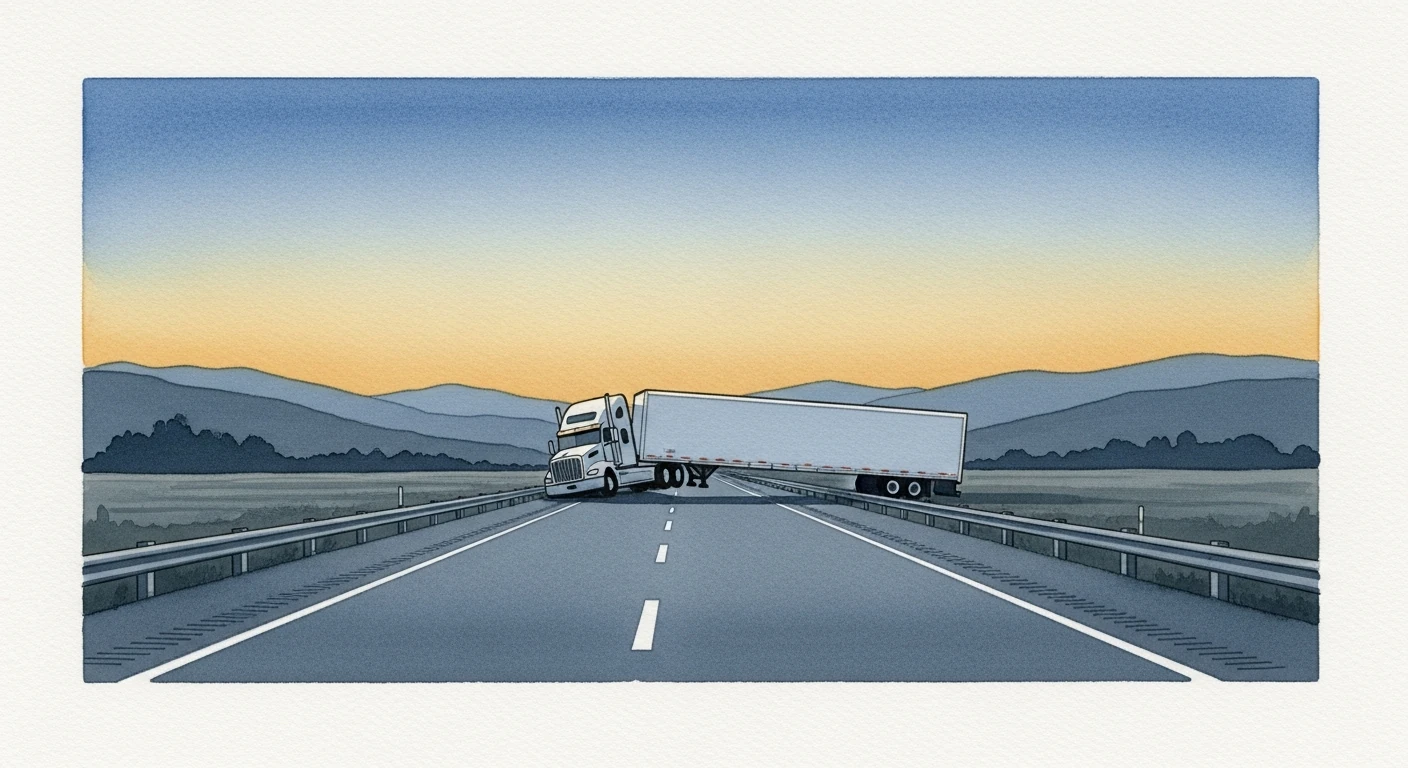
Jackknife Truck Crash on I-5: What Evidence Proves Speed, Braking, and Load Shift?
Jackknife crashes are not “mystery events.” They are usually the end result of a detectable sequence: speed that outpaces conditions, braking that overwhelms traction, or cargo movement that destabilizes the trailer. On busy stretches of I-5, that sequence can escalate from a single truck emergency into a multi-vehicle catastrophe within seconds.
What determines accountability is evidence quality—not assumptions. In serious truck collisions, investigators use a mix of digital records, physical scene measurements, maintenance history, and cargo documents to answer specific questions: How fast was the truck moving? Did the driver brake too hard? Were brakes and tires in safe condition? Did cargo move because it was improperly secured?
This guide explains how those questions are answered and what records matter most in Oregon jackknife cases.
Why jackknife cases are evidence-driven
A jackknife happens when the tractor and trailer lose alignment and the trailer swings outward, often into a sharp “V” relative to the cab. Once that angle grows, recovery becomes extremely difficult. A loaded combination vehicle carries enormous momentum, and a small loss of traction can become a full-lane hazard quickly.
National data confirms the stakes. Large-truck crashes account for thousands of fatal and serious collisions each year, and occupants of passenger vehicles face the greatest injury burden in those events. See:
In a legal claim, no single clue usually decides fault. Instead, investigators build a timeline by combining:
- Electronic evidence (ECM/EDR events, telematics, ELD logs)
- Scene evidence (skid/yaw marks, gouges, debris path)
- Mechanical evidence (brake condition, tire condition, defects)
- Cargo evidence (securement method, weight distribution, manifest accuracy)
- Human evidence (witness statements, dispatch communications, inspections)
The physics behind speed, braking, and trailer swing
The core mechanism is traction failure. If tractor drive wheels decelerate too quickly relative to trailer momentum, the trailer can push the tractor sideways at the fifth wheel. Risk rises sharply when one or more of these conditions are present:
- Wet, icy, or contaminated pavement
- Sudden hard braking
- Curve entry at excessive speed
- Uneven brake application or out-of-adjustment brakes
- Shifted or top-heavy cargo
Federal safety rules require commercial drivers to operate at a speed safe for current conditions—even if posted limits are higher. See 49 CFR § 392.14 (hazardous conditions).
Proving speed: what data is most persuasive
1) ECM/EDR truck data (“black box” records)
A commercial truck may distribute recordable information across an engine or powertrain module, transmission controller, ABS or stability system, collision-avoidance equipment, cameras, and other systems. There is no universal heavy-truck “black box.” Depending on the specific manufacturer, model, software, calibration, configuration, and event trigger, some modules may record:
- Vehicle speed before trigger
- Throttle position
- Brake-switch status
- Engine RPM
- Cruise control status
These records can help test competing narratives (“I was slowing early” vs. “hard braking from highway speed”), but their labels and limits matter. A brake field may report only brake-pedal-switch status—not brake pressure, force, wheel-end response, or achieved deceleration. Speed may be calculated from drive-wheel rotation and may not match independent ground speed during wheel spin, lockup, or skidding. NTSB technical reporting documents these limitations in systems it examined; they should not be generalized into a universal field list.
A crash may not satisfy a module’s trigger, and power loss, damage, limited memory, or overwrite behavior may leave no saved event. The absence of a hard-brake record does not prove that no braking or collision occurred. Likewise, a failed diagnostic-port download does not establish that every recoverable record is gone; a qualified examiner may need a system-specific, direct-to-module or bench method. Transport Canada’s heavy-vehicle EDR guidance explains why access, triggers, data fields, timing, and survivability must be assessed for the actual truck.
2) Telematics + ELD corroboration
Electronic logging devices primarily record hours-of-service and duty-status information under 49 CFR Part 395. A compliant ELD uses speed information to determine motion status, but federal rules do not require a continuous speed trace, braking input, steering input, or other standardized high-frequency crash record. A broader fleet platform may separately collect telematics data even when ELD and telematics functions appear in the same product.
Telematics records may be hosted in a vendor account rather than stored on the truck and may contain sampled speed, location, or maneuver-alert fields. ELD records serve a different purpose: they may help establish duty-status and driving-time chronology. Even when one fleet platform displays both datasets, neither should be described as continuous unless the particular system actually retained continuous information.
3) Scene-based speed reconstruction
Accident reconstruction specialists compare electronic records against physical measurements:
- Skid length and direction
- Yaw marks (sideways slip while rotating)
- Pavement drag factors
- Grade and curvature of roadway
Physical reconstruction is critical when electronic data is incomplete or disputed.
Proving braking errors and brake-system contribution
Jackknife investigations should separate driver input from mechanical capability. A driver may have braked abruptly—but brake condition can still be a major causal factor.
1) Driver braking behavior
Evidence of panic braking may come from ECM event snapshots, witness observations, and mark patterns at the scene. Investigators ask:
- Was there delayed perception/reaction?
- Was braking threshold abrupt enough to lock traction?
- Did the driver use an engine retarder in low-traction conditions?
2) Brake adjustment and maintenance records
Commercial carriers must inspect, repair, and maintain vehicles under 49 CFR Part 396. Relevant records include:
- Driver Vehicle Inspection Reports (DVIRs)
- Shop work orders and brake measurements
- Out-of-service findings from roadside inspections
- Prior notes about pull, imbalance, or air system issues
If records show repeat brake defects without timely correction, that can strongly support negligent maintenance.
3) Post-crash mechanical inspection
A qualified heavy-vehicle inspector may evaluate:
- Brake stroke and adjustment
- Lining/drum condition
- Air system leaks and response
- Tire tread depth and inflation
- ABS warning history (if available)
Findings are compared against pre-crash paperwork to determine whether a known condition likely worsened loss of control.
Proving load shift: documents, photos, and securement math
Cargo movement is often under-investigated, yet it can be the decisive cause in a jackknife. Federal cargo rules are detailed and specific. See FMCSA Cargo Securement Rules and 49 CFR Part 393, Subpart I.
1) Paper trail review
Investigators compare:
- Bill of lading
- Manifest and loading instructions
- Scale tickets and axle weights
- Dispatch/shipper communications
Red flags include understated weight, rear-biased distribution, side-biased stacking, or commodity-specific securement steps that were skipped.
2) Securement adequacy and method
Cargo securement is not just “straps were present.” It requires correct method, condition, and aggregate working load limit. Evidence may include:
- Number and rating of tie-downs
- Strap/chain damage and anchor condition
- Blocking/bracing/dunnage placement
- Commodity-specific securement compliance (e.g., coils, machinery, logs)
3) Trailer interior and spill pattern
Photos from inside the trailer and spill direction outside can reveal when and how cargo moved:
- Freight collapsed to one wall
- Load shifted forward into nose
- Broken restraints concentrated at one anchor row
These patterns help reconstruction teams identify whether cargo motion preceded the jackknife or resulted from impact.
Other high-value evidence often overlooked
Dispatch pressure and scheduling
Text logs, dispatch instructions, and delivery penalties can contextualize driver choices. If schedule pressure encouraged unsafe pace during weather or congestion, that can matter.
Weather and road-condition records
I-5 conditions can change rapidly by segment and elevation. Investigators may use:
This helps evaluate whether speed and following distance matched real conditions.
Enforcement and crash documentation
Official reports provide baseline scene facts and involved-party statements. Depending on location and agency, supporting records can include diagrams, photos, and measurements.
Time-sensitive preservation: first days matter most
In severe truck crashes, evidence can disappear quickly unless preservation is addressed promptly. Common losses include overwritten electronic events, repaired equipment, moved trailers, and discarded damaged tie-down hardware. Preservation should be tailored to the truck’s actual systems: a generic request for “the black box” may miss separate vehicle modules and vendor-hosted accounts.
High-priority preservation targets usually include:
- Tractor and trailer in post-crash condition
- Native ECM/EDR images and extraction, calibration, and configuration reports from relevant modules
- Native ELD and telematics records, edit history, account metadata, and vendor-hosted data
- DVIRs, maintenance files, and brake work orders
- Bills of lading, manifests, scale records, and loading photos
- Scene measurements, drone imagery, and roadway mark documentation
Preservation may also need to identify module serial information, software and tool versions, timestamps and clock offsets, chain of custody, and available metadata. Screenshots, PDFs, or summary exports can omit information needed to authenticate or interpret the underlying record, and unnecessary operation, power cycling, repair, or reprogramming can alter some systems.
A practical evidence checklist for jackknife collisions on I-5
If you are building or evaluating a claim, this framework keeps the investigation focused:
Speed proof checklist
- ECM/EDR pre-event speed data obtained
- Telematics speed trace preserved
- Scene reconstruction calculations documented
- Weather and traffic conditions mapped to timeline
Braking proof checklist
- Hard-brake event timing identified
- Brake-system inspection completed
- Maintenance and DVIR history reviewed
- Tire and ABS-related data documented
Load-shift proof checklist
- Manifest, BOL, and scale records compared
- Tie-down counts/ratings evaluated
- Blocking/bracing method documented
- Trailer interior movement pattern analyzed
Causation integration checklist
- Unified second-by-second timeline prepared
- Conflicts between witness and data resolved
- Alternate causes tested and ruled in/out
- Conclusions supported by source records, not assumptions
Key regulations and safety resources worth citing
For readers who want primary-source standards, these are the most useful starting points:
- FMCSA Regulations & Guidance
- 49 CFR Part 392 (Driving of Commercial Motor Vehicles)
- 49 CFR Part 393 (Parts and Accessories Necessary for Safe Operation)
- 49 CFR Part 395 (Hours of Service)
- 49 CFR Part 396 (Inspection, Repair, and Maintenance)
- FMCSA Cargo Securement Rules
- NHTSA Crash Data Tools
Final takeaways
Jackknife cases are won by reconstruction quality. The strongest claims do not rely on a single dramatic photo or one witness statement. They rely on a disciplined record: electronic data, scene science, mechanical condition evidence, and cargo-securement proof aligned on a common timeline.
For collisions on I-5, the central questions are usually straightforward:
- Was the truck traveling too fast for existing conditions?
- Did braking technique and brake condition contribute to traction loss?
- Did cargo shift because securement or loading practices failed?
When those questions are answered with objective records, fault analysis becomes far clearer—and accountability is far harder to avoid.
Related Resources
Learn more about related topics and next steps:
Client-First Fee Promise
Client First = Bills First, Fees Second
Your unpaid medical bills do not have to make your lawyer's fee bigger. Johnson Law subtracts qualifying medical bills before calculating our fee, helping clients keep more of their settlement.
Applies to qualifying cases. Results vary.