Rear-End by a Commercial Truck: Why “Stopping Distance” Standards Matter
Rear-End by a Commercial Truck: Why “Stopping Distance” Standards Matter
If you have ever watched a fully loaded truck approach slowing traffic, you already understand the risk: when a commercial vehicle cannot stop in time, the impact can be life-changing.
In a commercial truck rear end accident, insurers often try to simplify the story. They may say traffic “stopped suddenly,” weather was “unpredictable,” or everyone is partly to blame. But in many cases, the real question is more specific:
Did the truck have enough following distance, speed control, and braking condition for real road conditions?
That is why stopping-distance standards matter. They are not just theory from a driver handbook. They are practical safety rules that can shape fault, claim value, and evidence strategy in Oregon.
In plain terms: a commercial truck rear-end collision often comes down to whether the driver and carrier acted reasonably for speed, weight, weather, visibility, and traffic flow. Objective records usually decide that question better than opinions at the scene.
If a truck could not stop in time, the evidence usually focuses on truck following distance, braking condition, and closing speed in the seconds before impact.
Quick answer: why stopping-distance standards matter in truck rear-end crashes
Stopping-distance standards matter because they help determine whether a rear-end crash was preventable.
In a serious commercial truck rear end accident, investigators and insurers usually look at:
- Following distance before braking
- Truck speed relative to traffic and weather
- Brake system condition and maintenance history
- Driver reaction time factors (fatigue, distraction, visibility)
- Electronic timing and speed data before impact
If those factors show the truck did not have enough safety margin, liability often becomes much clearer.
What “stopping distance” actually includes
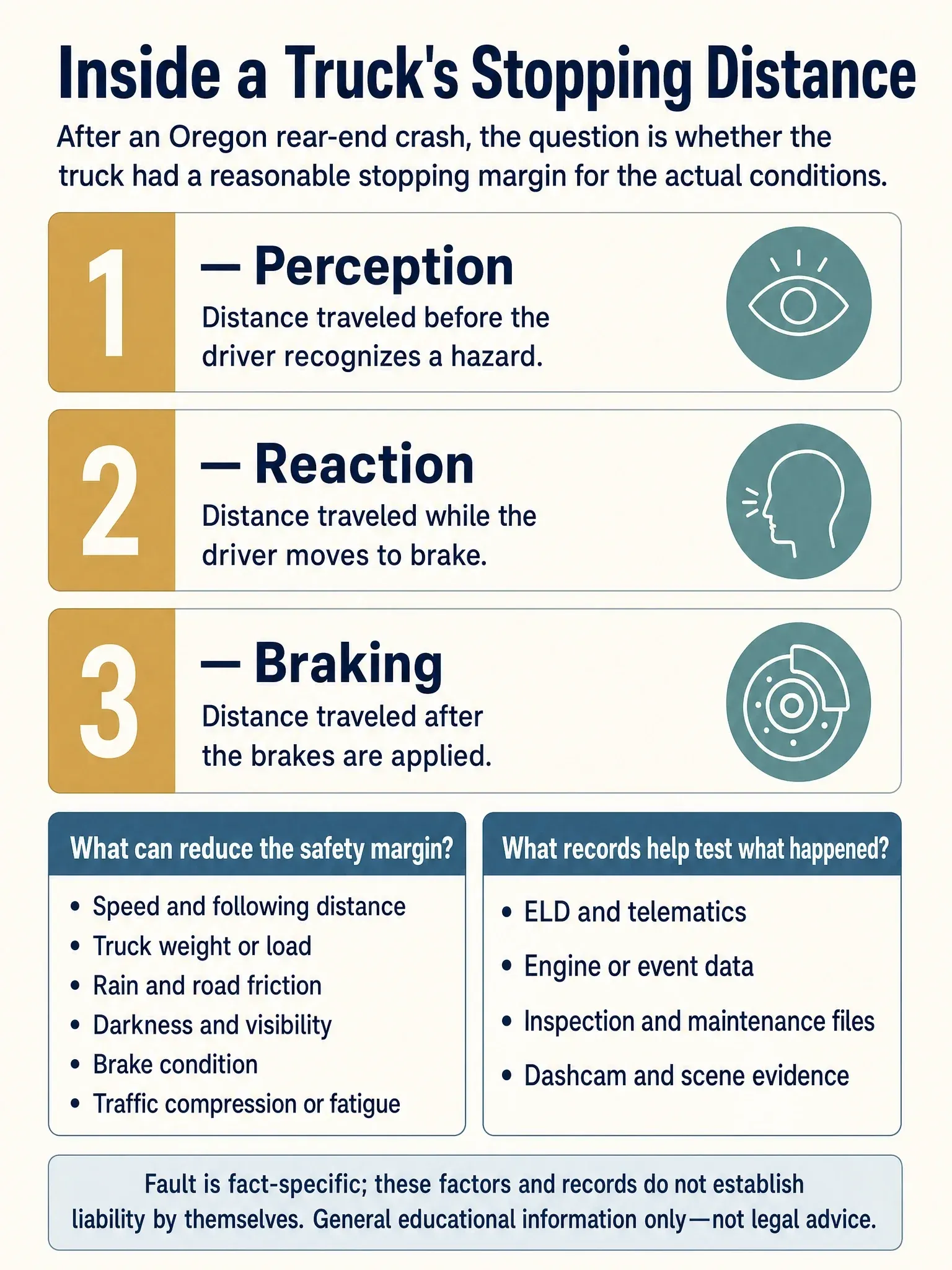
People often think stopping distance means only brake performance. In reality, it includes three phases:
- Perception distance – how far the truck travels before the driver recognizes a hazard
- Reaction distance – how far it travels while the driver moves to brake
- Braking distance – how far it travels after brakes are applied
When speed increases, total stopping distance increases significantly. When vehicle weight increases, margin for error shrinks further. Add rain, darkness, worn brakes, traffic compression, or driver fatigue, and rear-end risk rises quickly.
Why commercial trucks need more space than passenger vehicles
A passenger vehicle and a heavy commercial truck do not respond the same way to the same road event.
Key reasons include:
- Higher gross vehicle weight and momentum
- Longer braking timelines, especially when fully loaded
- Trailer dynamics that can destabilize braking in poor conditions
- Greater consequence of delayed reaction in dense freeway traffic
This is why professional truck operation emphasizes conservative following distance and speed adaptation, not just legal speed limits.
Where stopping-distance standards come from
In trucking cases, standards usually come from a combination of federal safety regulations, state traffic law, and company safety policies.
Common reference points include:
- Federal motor carrier safety regulations and driver duties
- Vehicle inspection, repair, and maintenance requirements
- Hazardous conditions driving requirements
- Oregon traffic rules about prudent speed and following distance
High-authority reference materials:
- FMCSA – Regulations
- 49 CFR Part 392 – Driving of Commercial Motor Vehicles
- 49 CFR Part 393 – Parts and Accessories Necessary for Safe Operation
- 49 CFR Part 396 – Inspection, Repair, and Maintenance
- Oregon Legislature – ORS Chapter 811 (Rules of the Road)
Typical rear-end scenarios where stopping distance becomes the core issue
In Oregon truck cases, this question appears in repeat patterns:
1) Freeway slow-down chain reaction
Traffic compresses ahead. The truck brakes late or cannot slow quickly enough, pushing one or multiple vehicles forward.
2) Wet-weather rear-end impact
Road friction drops, but truck speed/following distance does not adjust enough for rain, spray, and reduced visibility.
3) Downhill approach into congestion
Grade, load weight, and braking demand combine to reduce stopping margin before queued traffic.
4) Nighttime closing-speed misjudgment
The truck approaches slower vehicles too quickly in low-light conditions where distance judgment is harder.
In each scenario, “sudden stop” arguments often appear. The evidence question is whether the truck had a reasonable safety cushion before the stop occurred.
Who is usually at fault in a commercial truck rear-end accident in Oregon?
There is no automatic rule for every crash, but in many rear-end truck accident Oregon claims, investigators start with these questions:
- Was the truck following too closely for speed and conditions?
- Was truck speed reasonable for weather, visibility, and traffic compression?
- Did the truck have known braking or maintenance issues?
- Did dispatch pressure or scheduling decisions reduce safe margins?
If records show poor truck following distance or delayed braking response, fault often points heavily to the truck side of the case. If records show multiple causes, fault can be split under Oregon comparative-fault rules.
Liability map in a commercial truck rear-end accident
Many people assume the driver is the only possible defendant. In real truck cases, responsibility may involve more than one party.
| Party | Common stopping-distance related failure | Evidence that often proves it |
|---|---|---|
| Driver | Following too closely; speed not adjusted for conditions | ELD timeline, dashcam, witness statements, citation data |
| Motor Carrier | Dispatch pressure, weak safety oversight, inadequate training | Dispatch records, policy manuals, supervision records |
| Maintenance Provider | Brake inspection/repair failures affecting stopping ability | Work orders, DVIRs, maintenance logs, parts history |
| Other entities (fact-specific) | Operational decisions affecting route timing/load conditions | Contracts, trip planning documents, communications |
That broader liability view is often critical in high-damage claims.
Evidence checklist: proving stopping-distance failure after a truck rear-end crash
In a commercial truck rear end accident, the strongest cases are usually built with technical records, not assumptions.
Priority evidence often includes:
- ELD and telematics data (speed, braking timeline, duty status)
- Engine control module/event data tied to seconds before impact
- Driver Vehicle Inspection Reports (DVIRs)
- Brake maintenance and repair files
- Dispatch messages and schedule pressure evidence
- Dashcam or nearby surveillance footage
- Police report plus supplements/diagrams
- Scene photos showing traffic layout, weather, skid evidence, and vehicle rest positions
- Medical records and symptom timeline documenting injury progression
Many of these records can be overwritten in normal business cycles, which is why early preservation strategy matters.
Oregon comparative fault: why insurers fight stopping-distance narratives
Oregon uses modified comparative fault. Insurers may still argue that the front vehicle “stopped too fast,” merged poorly, or contributed to the outcome.
In practice, objective timing and speed evidence can rebut overbroad blame-shifting. If records show a truck closed distance too quickly for conditions, comparative-fault arguments may narrow.
What to do in the first 24–48 hours after a rear-end truck collision
1) Get medical care immediately
Even when pain starts later, early evaluation protects both health and documentation.
2) Report the crash correctly
Oregon crashes may trigger DMV reporting obligations depending on damage/injury details.
3) Preserve visual evidence before repairs
Photograph all vehicles, roadway marks, debris, weather, and identifying truck information (USDOT number, unit number, trailer number, plate).
4) Save witness and camera leads fast
Nearby businesses, traffic cameras, or private dashcams can be time-limited.
5) Avoid technical guesses in recorded statements
You can give factual information without speculating about braking mechanics before records are reviewed.
Stopping distance and severe injuries: why these claims are high stakes
Rear-end crashes involving commercial trucks can produce:
- multi-level spinal injuries
- traumatic brain injury patterns
- complex orthopedic trauma
- prolonged work disruption and rehabilitation
Because damages can be substantial, liability disputes often become more technical and more aggressive. That makes early, organized evidence collection even more important.
Soft but practical: when speaking with a personal injury lawyer helps
Not every crash needs a lawsuit. But when a case involves a commercial truck rear end accident, legal guidance can be useful early because:
- key trucking records may be lost if not requested quickly,
- multiple entities may share fault,
- insurers may frame stopping-distance issues to minimize payout,
- technical evidence can materially change claim value.
Early legal guidance can help preserve records, identify responsible parties, and evaluate settlement offers with a clearer evidence picture.
If you want Oregon-specific next steps, these pages may help:
Bottom line: what matters most after a truck rear-end crash
- Stopping-distance analysis is usually a data question, not a guess.
- Truck following distance and braking timeline often decide fault arguments.
- Early preservation of ELD, telematics, and maintenance records can materially change claim value.
- Oregon comparative-fault rules make strong objective evidence especially important.
Related Oregon truck accident resources
- Truck maintenance failure accident liability guide
- Independent contractor truck driver responsibility in Oregon
- Falling cargo truck crash liability and evidence
- Jackknife truck accident evidence guide
Frequently asked questions
What is a commercial truck rear end accident?
A commercial truck rear-end accident is a collision where a commercial truck strikes the back of another vehicle. In legal analysis, the key issue is often whether the truck had a reasonable stopping margin for traffic and road conditions.
Why is stopping distance so important in truck crashes?
Stopping distance helps determine preventability. If speed, following distance, braking condition, or reaction time left the truck unable to stop safely, that evidence can strongly affect fault analysis.
Are truck drivers always at fault in rear-end collisions?
Not always. Fault is fact-specific. However, trailing-vehicle conduct is heavily examined, and objective records are usually central when liability is disputed.
Who is usually at fault in an Oregon rear-end truck crash?
It depends on the evidence, but the trailing truck is often closely examined for following distance, speed, and braking decisions. Carrier-level factors such as dispatch pressure and maintenance may also affect fault.
Can the trucking company be liable too?
Yes. Carrier-level decisions about dispatch pressure, training, supervision, and maintenance can create company liability in addition to driver fault.
What records matter most in a stopping-distance dispute?
ELD/telematics timelines, event data, maintenance logs, inspection reports, dashcam video, and scene evidence are often the highest-value records.
Does weather excuse a rear-end truck crash?
Not automatically. Bad weather usually increases the duty to reduce speed and increase following distance. Whether those adjustments were made is a core evidence question.
How soon should evidence be preserved?
As soon as possible. Some electronic and business records can be overwritten quickly in regular operations.
Does Oregon comparative fault apply to truck rear-end cases?
Yes. Comparative fault can reduce recovery depending on percentages, which is why strong objective evidence is important.
Is this page legal advice for my specific crash?
No. This is general educational information. Case outcomes depend on specific facts, records, and applicable law.
Sources
- Federal Motor Carrier Safety Administration (FMCSA)
- FMCSA – Regulations
- FMCSA – Large Truck and Bus Crash Facts
- 49 CFR Part 392
- 49 CFR Part 393
- 49 CFR Part 396
- National Highway Traffic Safety Administration (NHTSA) – Speeding
- Insurance Institute for Highway Safety (IIHS) – Advanced Driver Assistance & Front Crash Prevention
- Oregon DMV – Accident and Insurance Report
- Oregon Legislature – ORS 31.600
- Oregon Legislature – ORS Chapter 811
This page provides general educational information and is not legal advice.
Client-First Fee Promise
Client First = Bills First, Fees Second
Your unpaid medical bills do not have to make your lawyer's fee bigger. Johnson Law subtracts qualifying medical bills before calculating our fee, helping clients keep more of their settlement.
Applies to qualifying cases. Results vary.