Amazon Delivery Van Crash: Who Is Responsible—Driver, DSP, or Amazon?
Amazon Delivery Van Crash: Who Is Responsible—Driver, DSP, or Amazon?
Educational information only, not legal advice. Oregon delivery-van crash claims are fact-specific. The right answer depends on the driver’s status, the delivery company structure, the route, the insurance policies, and the evidence preserved early.
Quick answer: start with the driver, then map control and insurance
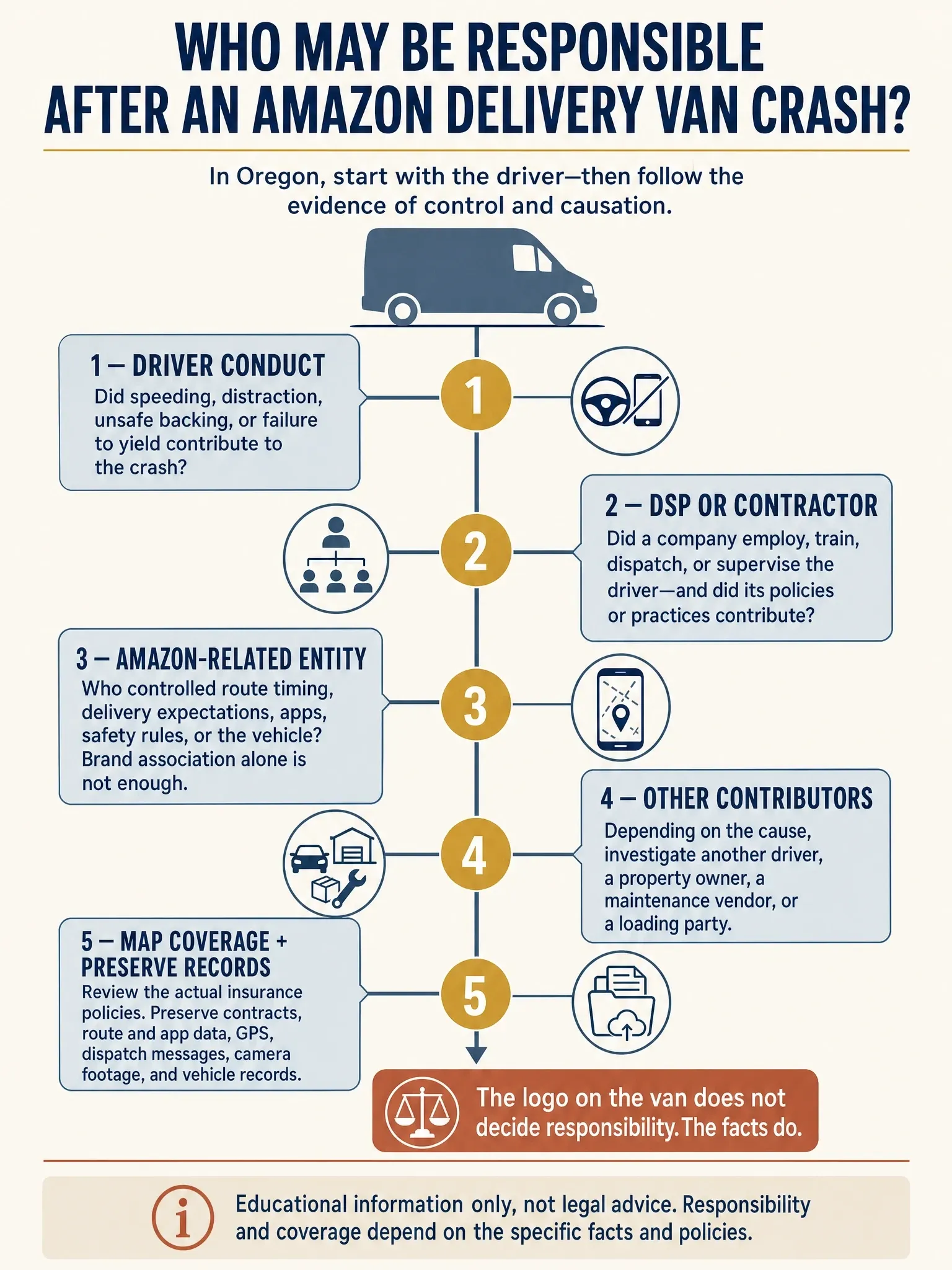
If an Amazon delivery van hits you in Oregon, the responsible parties may include more than the person behind the wheel.
A serious claim often has to examine:
- the driver’s negligence, such as speeding, distraction, unsafe backing, or failure to yield;
- the delivery service partner or contractor, if it employed, trained, dispatched, or supervised the driver;
- an Amazon-related entity, if facts show enough operational control or a direct safety failure;
- another driver, property owner, maintenance vendor, or loading party, depending on what caused the crash; and
- all available auto, commercial, umbrella, and work-related insurance.
The name painted on the van is not the whole case. The better question is: who controlled the delivery work, who had safety duties, and which records prove it?
For a related commercial-vehicle issue, see our guide to independent contractor truck driver responsibility in Oregon. If the vehicle was a package truck operated in a FedEx, UPS, or similar delivery system, our post on delivery-truck collision claims explains the broader commercial evidence framework.
Why Amazon delivery crashes are different from ordinary car wrecks
An ordinary two-car crash usually starts with driver fault and insurance coverage. An Amazon delivery crash can add several complications:
- The delivery system may use multiple entities. A driver may work for a delivery service partner, contractor, staffing company, or another business rather than directly for Amazon.
- Route and app data may matter. Delivery instructions, route timing, scanner activity, GPS data, and package logs may show what the driver was doing and why.
- Branding can be misleading. A van may look like part of one company’s fleet while the employment, vehicle ownership, and insurance structure point elsewhere.
- Commercial policies may apply. The coverage picture can differ from a regular personal-auto claim.
- Evidence can disappear quickly. Delivery data, camera footage, dispatch messages, and vehicle telematics may be overwritten or hard to obtain without prompt preservation.
That is why early investigation should focus on both the crash scene and the delivery operation behind the van.
The driver is usually the first liability question
The driver’s conduct still matters. Delivery branding does not erase basic roadway duties.
Common negligence issues include:
- failing to yield at an intersection or crosswalk;
- unsafe backing from a driveway or loading zone;
- stopping suddenly without adequate warning;
- double-parking or blocking visibility;
- speeding to meet delivery timing pressure;
- looking at a handheld device, scanner, navigation system, or delivery app;
- opening a door into a cyclist or traffic lane; and
- leaving packages, dollies, or the van in a way that creates a hazard.
Oregon comparative fault can reduce or bar recovery depending on fault allocation. Under ORS 31.600, fault percentages can matter if insurers argue that the injured person, another driver, or some other party shares blame.
The driver’s story is only one part of the evidence. Objective records—vehicle location, app activity, witness statements, photos, and scene measurements—often matter more.
When the DSP or delivery contractor may be responsible
Many Amazon-branded delivery routes are handled through delivery service partners or contractors. If a DSP employed or supervised the driver, it may be a central party in the claim.
Potential DSP issues include:
- hiring and driver qualification;
- training on backing, parking, intersections, and pedestrian safety;
- route assignment and delivery timing expectations;
- vehicle inspection and maintenance practices;
- discipline for unsafe driving or prior complaints;
- policies for phone, scanner, and navigation use while driving; and
- post-crash reporting and evidence preservation.
The key is not simply “the DSP exists.” The key is whether the DSP’s conduct, policies, or control contributed to the crash.
Useful records may include the driver’s file, route records, safety training acknowledgments, vehicle inspection forms, prior incident reports, maintenance records, and communications about delivery timing.
Can Amazon itself be responsible?
Sometimes Amazon-related entities are named in delivery crash investigations. Whether that claim is viable depends on the actual facts and law, not the brand association alone.
Questions that may matter include:
- Who controlled route timing, package volume, and delivery expectations?
- Who set safety policies or required use of particular devices or apps?
- Who owned, leased, branded, or maintained the van?
- Did any Amazon-related system encourage unsafe conduct, such as rushing, unsafe parking, or distracted device use?
- What contracts define the relationship between Amazon, the DSP, the driver, and the vehicle owner?
- Did Amazon-related entities have notice of prior safety problems and fail to respond?
A claim against Amazon is not automatic. But it should not be dismissed based only on the phrase “independent contractor” or “delivery service partner.” Real-world control and causation are the focus.
Insurance coverage: why the label on the van is not enough
After a delivery van crash, insurance adjusters may point fingers between policies.
Possible coverage sources can include:
- the driver’s personal auto policy;
- a DSP or contractor commercial auto policy;
- a vehicle owner or leasing company policy;
- umbrella or excess coverage;
- uninsured/underinsured motorist coverage if another driver caused the crash and lacks enough insurance;
- personal injury protection benefits under Oregon auto policies; and
- work-related benefits if the injured person was working at the time.
Oregon’s motor vehicle insurance rules include personal injury protection requirements in ORS 742.520 and uninsured/underinsured motorist concepts in ORS 742.502. Coverage still depends on the actual policies, exclusions, endorsements, and facts.
For a broader Oregon insurance overview, see our Oregon auto insurance guide.
Evidence to preserve after an Amazon delivery van crash
Delivery-van cases are often built from specific records, not assumptions.
Try to preserve or request:
- photos of the van, license plate, unit number, and any company markings;
- the driver’s name, employer, insurance card, and police report information;
- package, route, scanner, GPS, and app activity data;
- dash camera, home security camera, business camera, and traffic camera footage;
- vehicle inspection and maintenance records;
- dispatch messages and delivery timing records;
- driver qualification, training, and prior safety incident records;
- witness names and contact information;
- scene photos showing sightlines, crosswalks, driveways, loading zones, and weather; and
- all insurance correspondence before recorded statements or broad releases.
Many systems overwrite quickly. A preservation letter can be important when commercial data is involved. Our guide to preserving evidence after an accident explains why timing matters.
What if you were hit while working?
If you were working when the delivery van hit you, the case may involve both work-related benefits and a third-party injury claim.
Oregon workers’ compensation exclusivity generally protects a complying employer from ordinary civil lawsuits for workplace injuries under ORS 656.018. But ORS 656.154 can allow a worker to pursue a claim against a negligent third person who is not in the same employ.
That means a construction worker, cyclist courier, warehouse worker, pedestrian employee, or other person hit by a delivery van may need to coordinate benefits, liens, and a third-party claim carefully.
Common defense themes
Delivery crash claims are often defended by narrowing responsibility too quickly. Common themes include:
- “The driver alone caused it.”
- “The driver was not an Amazon employee.”
- “The van was owned or insured by someone else.”
- “The injured person appeared suddenly.”
- “There is no app or route data available.”
- “Commercial coverage does not apply.”
Some of those defenses may have force in a specific case. Others may become less persuasive once contracts, dispatch records, app data, maintenance records, and insurance documents are reviewed.
Bottom line
An Amazon delivery van crash in Oregon should be investigated as a commercial delivery case, not just a simple car wreck with a familiar brand in the background.
The practical questions are:
- What did the driver do?
- Who employed, trained, dispatched, or supervised the driver?
- Who controlled the route, vehicle, app, and safety rules?
- Which insurance policies actually apply?
- What evidence must be preserved before it disappears?
If you were injured, consider getting advice before signing a release or giving broad recorded statements, especially before the responsible entities and insurance layers are understood.
Sources
Client-First Fee Promise
Client First = Bills First, Fees Second
Your unpaid medical bills do not have to make your lawyer's fee bigger. Johnson Law subtracts qualifying medical bills before calculating our fee, helping clients keep more of their settlement.
Applies to qualifying cases. Results vary.