Kia EV9 Recall 26V545/SC379: What Owners Should Know About the Passenger Airbag
Kia EV9 Recall 26V545/SC379: What Owners Should Know About the Passenger Airbag
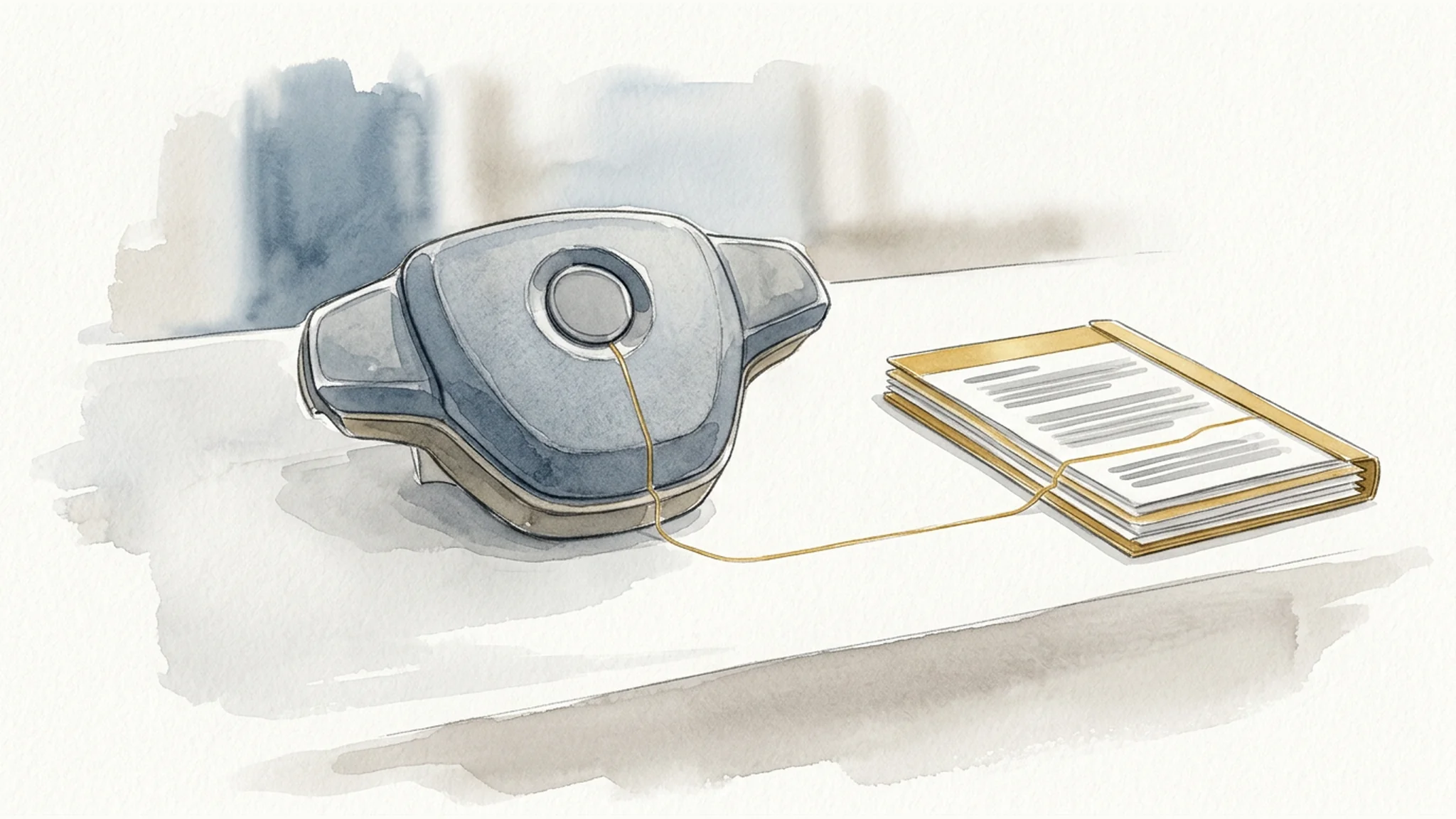
Certain 2025–2026 Kia EV9s are included in a federal safety recall involving the front-passenger-seat occupant detection system, or ODS. Improper routing may allow a tube beneath the passenger-seat cushion to become pinched and damaged. If the ODS malfunctions, it may fail to deactivate the front passenger frontal air bag when a child or child restraint is present.
Owners should check their VIN through an official recall lookup and arrange the free dealer remedy if their EV9 is included. They should not use a child or child restraint to test the system. Kia instructs owners never to install a child restraint in the EV9’s front-passenger seat and says children age 13 and under should ride in a rear seat.
If an owner sees a warning light or unexpected indicator behavior before repair, the owner should seek current instructions from Kia or an authorized dealer rather than testing the system. If a crash or injury has already occurred, prompt coordination may also help document the passenger seat and recall-related components before inspection or repair changes them—without delaying necessary safety work.
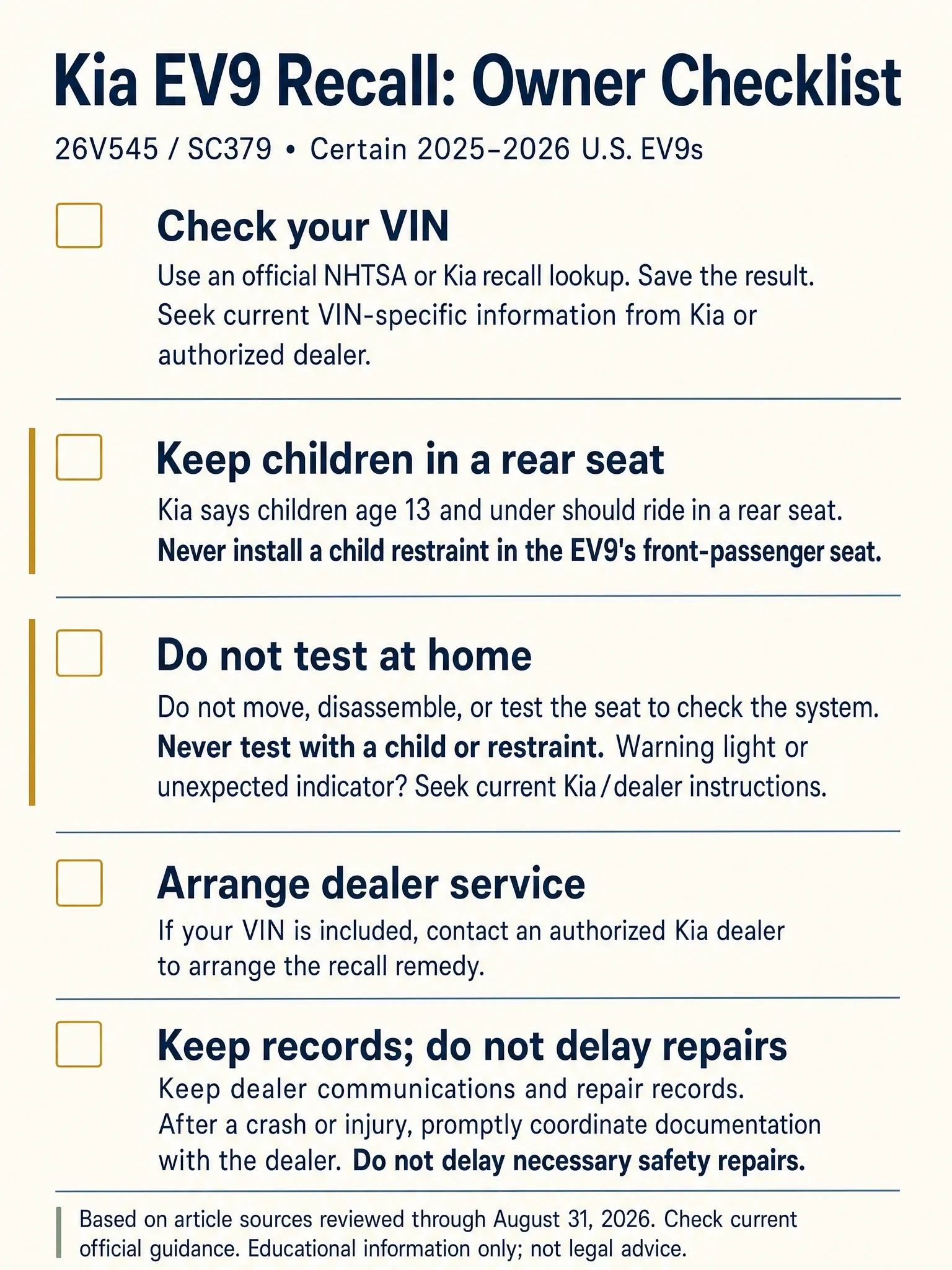
The EV9 Recall in One Minute: Campaign 26V545/SC379
NHTSA campaign 26V545000, known within Kia as campaign SC379, covers 21,290 potentially affected U.S. vehicles. That number describes the recall population; it does not mean that all 21,290 EV9s contain the condition.
In its Part 573 Safety Recall Report, Kia estimated that approximately 6% of the recall population contains the defect. This is Kia’s estimate—not a verified defect rate and not proof that a specific EV9 has a damaged ODS tube.
Kia reported the condition as a noncompliance with Federal Motor Vehicle Safety Standard No. 208 involving the front-passenger occupant-classification sensor. The stated concern is narrow: a damaged or malfunctioning ODS may fail to suppress the front passenger frontal air bag when a child or child restraint is present, increasing the child’s risk of injury if the air bag deploys in a crash.
The public campaign materials available as of August 31, 2026, did not provide verified counts of crashes, deployments, injuries, fatalities, complaints, warranty claims, or damaged tubes. Recall inclusion therefore should not be treated as proof that a particular EV9 malfunctioned or caused an injury.
How the EV9 Decides Whether to Suppress the Passenger Airbag
What the occupant detection system controls
Kia’s 2026 EV9 owner’s manual describes the ODS as a detection device and electronic system in the front-passenger seat. It determines whether the passenger’s frontal air bag should be activated or deactivated based on the system’s classification.
The distinction matters: this ODS controls only the front passenger frontal air bag. Its status does not tell an owner whether the knee, seat-mounted side, curtain, or every other passenger-side air bag is active.
Adult and child-restraint classifications
Kia’s manual describes these two relevant states:
- When the system classifies the occupant as an adult, the PASSENGER AIR BAG OFF indicator is off and the front passenger frontal air bag is activated.
- For the qualifying infant child-restraint classification in Kia’s table, the OFF indicator is on and the front passenger frontal air bag is deactivated.
These states explain system behavior. They do not mean that owners may place a child restraint in the front seat. Kia separately instructs owners never to do that.
FMVSS No. 208 sets performance requirements for advanced air-bag systems, including specified suppression and activation tests and an OFF telltale under an automatic-suppression option. It does not require every manufacturer to use one particular ODS technology, and a compliance test does not establish how an occupant was classified in a specific real-world event.
What Can Go Wrong in the Recalled EV9s
The routed tube beneath the passenger-seat cushion
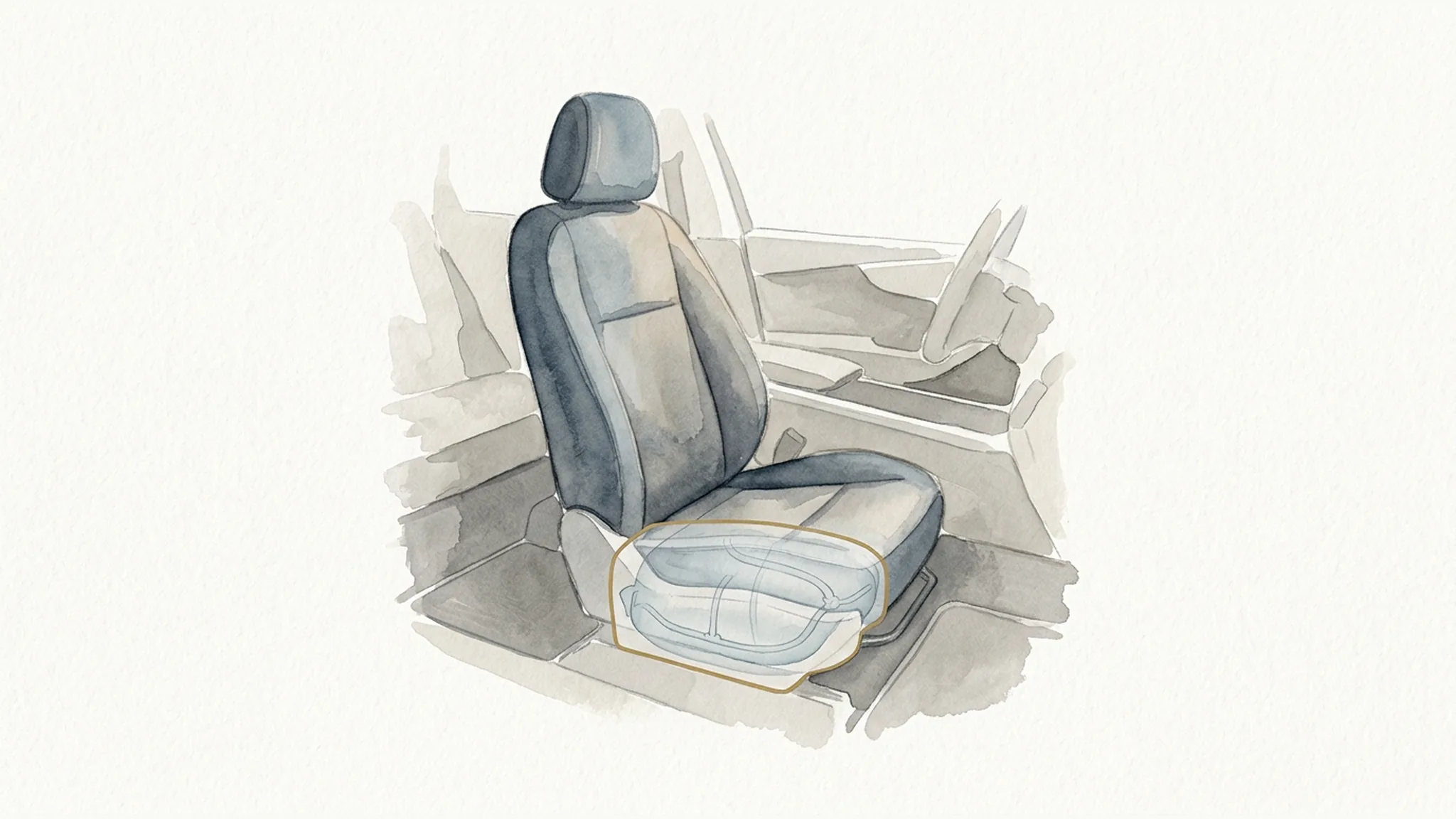
According to Kia’s Part 573 report, the potential problem begins with improper routing of the ODS mat bladder tube beneath the front-passenger-seat cushion. The tube can be pinched when the seat is raised to its highest position, and repeated height or tilt adjustments can damage it.
That description identifies a potential failure mechanism. It does not show that ordinary seat adjustment damaged a particular EV9 or that every vehicle in the recall population has a damaged tube.
Why tube damage matters
If the tube is damaged and the ODS malfunctions, the system may fail to deactivate the front passenger frontal air bag when a child or child restraint is present. The resulting safety concern is the increased risk of injury to a child if that frontal air bag deploys during a crash.
This recall is about possible suppression failure for one identified air bag. It should not be broadened into a conclusion about all of the vehicle’s passenger-side restraints.
What the PASSENGER AIR BAG OFF Indicator Does—and Does Not—Tell You
Expected indicator states
The OFF indicator is a status telltale, not a complete diagnostic test. Under the behavior described in Kia’s manual:
- The indicator illuminates briefly during startup before occupant classification is complete.
- It remains on when the system deactivates the front passenger frontal air bag for the qualifying child-restraint classification described in Kia’s table.
- It is off for a properly classified adult while the front passenger frontal air bag is activated.
An OFF indicator that is not illuminated therefore does not, by itself, show that the ODS has malfunctioned.
Warning-light and malfunction limits
Kia’s manual says an ODS malfunction can involve an illuminated SRS air-bag warning light while the PASSENGER AIR BAG OFF indicator remains off and the front passenger frontal air bag remains activated. An owner who sees a warning light or unexpected indicator behavior should seek current instructions from Kia or an authorized dealer rather than trying to diagnose the system at home.
Do not place a child or child restraint in the front seat to test the indicator.
Other conditions that may affect classification
Kia also says classification can be affected by circumstances such as off-center or reclined seating, posture, feet on the dashboard, improper belt use, heavy objects, aftermarket seat covers or heaters, thick cushions, liquid, or seat modifications. These are possible case-specific influences. Their appearance in the manual does not establish that any one of them affected classification in a particular EV9.
Is Your 2025 or 2026 EV9 Included?
Recall scope is not a VIN determination
Kia identified the recall population as all 2025 and certain 2026 EV9s manufactured at Kia Georgia from May 17, 2024, through May 13, 2026. Kia says Korean-built 2025 EV9s are not affected.
Even an EV9 that appears to fit the general description requires a VIN check. Kia says affected vehicles were not produced in sequential VIN order, so model year, assembly location, or production date alone cannot determine whether one vehicle is included.
Use an official VIN lookup
Owners should use an official NHTSA or Kia recall lookup and keep a copy or screenshot of the VIN-specific result. As of the August 31, 2026 research cutoff, NHTSA said affected VINs were planned to become searchable on September 4, 2026. That was a future date at the cutoff; this article does not claim that VIN availability occurred as planned.
Owner-notice timing
The NHTSA Recall Acknowledgment reported that Kia planned to begin mailing owner notices on October 20, 2026. That also was a planned future date as of August 31, not proof that notices were later mailed on schedule.
Owners do not need to infer their status from the general recall population or wait for this article to be updated. They can seek current, VIN-specific information directly from an official recall lookup, Kia, or an authorized dealer.
What the Recall Repair Involves
Dealers will inspect the ODS mat bladder-tube routing. If necessary, they will replace the ODS mat and bladder tube and ensure proper routing. Kia separately states that dealers will replace the seat-cover assembly. The remedy is free of charge.
The “if necessary” language applies to replacement of the ODS mat and bladder tube; Kia’s filed report separately states that the seat-cover assembly will be replaced. At the August 31 research cutoff, final inspection criteria, parts details and availability, and procedures concerning removed parts were not fully established in the public filed materials.
Owners may want to request and keep:
- The VIN-specific recall result before the appointment
- Appointment confirmations and dealer communications
- The inspection and repair order, including findings and parts actually listed
- The recall completion record
- Any photographs or dealer notes that are actually created
Owners should not assume that the dealer will create photographs or that removed components will be available to them. If a pre-repair incident makes those items important, prompt coordination is more reliable than assuming a particular dealer procedure.
Recall-remedy records can document what a dealer inspected and changed without proving why a later event occurred. For a separate example of that distinction, see NHTSA’s post-remedy GM engine investigation.
Child-Seat Safety Does Not Depend on Testing the Recall Yourself
Kia instructs owners never to install a child-restraint system in the EV9’s front-passenger seat and says children age 13 and under should ride in a rear seat. NHTSA air-bag safety guidance says children under 13 should ride in the back. NHTSA also warns never to place a rear-facing restraint in front of an active frontal air bag.
The ODS table’s child-restraint classification does not override those instructions. Do not put a child or restraint in the front seat to see whether the OFF indicator illuminates.
For questions about transporting a child before recall service, follow current Kia and NHTSA guidance and obtain current campaign instructions from Kia or the dealer. Do not improvise a front-seat test or alternate seating arrangement based on the indicator alone.
If an Incident Happened Before the Recall Repair
A warning light or unexpected indicator state before repair does not establish that the recalled condition is present; the owner should seek current Kia or dealer instructions rather than test the system. If a crash or injury occurred, prompt coordination may also be important because SC379 inspection or repair could change the passenger seat and related components.
Coordinate safety and documentation before components change
Do not postpone a necessary safety repair simply to preserve evidence. Instead, promptly coordinate safety and documentation with the dealer. When a crash or injury is involved, qualified counsel or an appropriate expert may also help coordinate inspection and repair before module work, component replacement, salvage, or disposal changes what is available.
Depending on what already exists and can be documented safely without moving, disassembling, or testing the seat, useful campaign-specific information may include:
- The vehicle, VIN, recall-lookup result, and recall and repair history
- Photographs of the accessible, undisturbed front-passenger seat position and condition
- Existing photographs or video of the PASSENGER AIR BAG OFF indicator or SRS warning light, with the time and actual circumstances recorded rather than inferred; do not recreate the event with a child or child restraint
- The child restraint, if one was involved, and existing information about how it was installed and positioned; preserving a restraint is not a recommendation to keep using it
- Existing dealer scans, diagnostic records, repair orders, and communications
- When internal ODS components may matter, documentation arranged through the dealer, counsel, or a qualified inspector before those components are removed or changed
Do not move, disassemble, or test the seat, and do not try to recreate indicator behavior with a child or child restraint. Access to removed components is not guaranteed. The practical goal is to ask and coordinate before potentially relevant parts or records change—not to delay safety work or assume that the recall proves a claim.
For broader guidance after a crash, see how to approach preserving vehicle evidence before repair or salvage.
EDR and electronic-data limits
The EV9 has an event data recorder designed to capture limited crash or near-crash information. Kia’s EDR owner-manual section lists general categories such as vehicle-system operation, belt status, pedal input, and speed, and notes that access requires special equipment and access to the vehicle or recorder.
Federal EDR rules require passenger frontal-air-bag deployment timing. Right-front suppression status and occupant size or position classification, however, are required only if the manufacturer records those fields in downloadable nonvolatile memory. The EV9 manual does not promise that a download will include ODS classification, suppression status, or diagnostic trouble codes. Some nondeployment events may be overwritten or may not be retained.
Prompt coordination may therefore matter, but no one should promise that an EV9’s EDR contains occupant-classification data. An EDR download alone cannot establish a defect, the occupant’s classification, an injury mechanism, or medical causation. Readers looking beyond this recall-specific issue can learn more about how passenger-airbag non-deployment evidence is evaluated after a crash.
What This Recall Can—and Cannot—Establish About One EV9
Recall inclusion can provide a reason to verify a VIN, obtain an inspection and free repair, retain records, and investigate an incident involving the front-passenger seat. It does not establish that:
- A particular EV9 had a damaged ODS tube
- The system misclassified an occupant
- The front passenger frontal air bag was activated or suppressed incorrectly
- The condition caused a crash or injury
The available public sources also do not support an inference about the number of incidents. Kia’s approximately 6% estimate remains a manufacturer estimate about the recall population, not a finding about an individual vehicle.
If a crash or injury occurred before repair, owners may need to address both safety and time-sensitive documentation. Johnson Law can discuss the circumstances with owners in Oregon or Washington and help them identify appropriate next steps. A conversation is not a promise that the recall applies, that evidence exists, or that a claim will succeed.
Frequently Asked Questions
Which Kia EV9s are included in recall 26V545/SC379?
The campaign covers all 2025 and certain 2026 EV9s manufactured at Kia Georgia from May 17, 2024, through May 13, 2026. Kia says Korean-built 2025 EV9s are not affected. Because affected vehicles were not produced in sequential VIN order, only an official VIN lookup can determine whether a particular EV9 is included.
Does 21,290 mean every recalled EV9 has a defective sensor?
No. The 21,290 figure is the potentially affected recall population. Kia estimated that approximately 6% of that population contains the defect, but that estimate is not a verified rate and neither number establishes the condition of one EV9.
What does the PASSENGER AIR BAG OFF indicator mean in a Kia EV9?
The indicator briefly illuminates during startup. In the relevant manual classifications, it is off for an adult while the front passenger frontal air bag is activated and on for a qualifying infant child-restraint classification while that air bag is deactivated. The indicator is a status telltale—not a standalone test for the recall condition.
Can I put a child seat in the EV9’s front-passenger seat if the OFF light is on?
No. Kia instructs owners never to install a child restraint in the front-passenger seat and says children age 13 and under should ride in a rear seat. NHTSA says children under 13 should ride in the back and warns never to put a rear-facing restraint in front of an active frontal air bag.
What will a Kia dealer do for recall SC379?
The dealer will inspect the ODS mat bladder-tube routing and, if necessary, replace the ODS mat and bladder tube and ensure proper routing. Kia separately states that the seat-cover assembly will be replaced. The remedy is free of charge. The filed sources do not provide all final dealer procedures.
What should I do if a warning light appears or a crash happens before repair?
For a warning light or unexpected indicator behavior, seek current instructions from Kia or an authorized dealer rather than testing the system. After a crash or injury, promptly coordinate safety and documentation rather than delaying a necessary repair. Record only what is safely accessible and undisturbed, such as the VIN and recall result, existing photographs or video, the seat’s visible condition, and existing dealer records. Do not move, disassemble, or test the seat or recreate indicator behavior with a child or child restraint. Preserving an involved child restraint is not advice to keep using it. Arrange any documentation of internal ODS components through the dealer, counsel, or a qualified inspector. Electronic data may be limited, and the EDR is not guaranteed to store ODS classification or suppression status.
Sources
- NHTSA campaign 26V545000
- Kia Part 573 Safety Recall Report filed with NHTSA
- NHTSA Recall Acknowledgment
- Kia New Vehicle Delivery Hold Notice filed with NHTSA
- Kia 2026 EV9 Owner’s Manual: Occupant Detection System
- NHTSA: Vehicle Air Bags and Injury Prevention
- 49 C.F.R. § 571.208: Occupant Crash Protection
- Kia 2026 EV9 Owner’s Manual: Event Data Recorder
- 49 C.F.R. § 563.7: EDR Data Elements
- 49 C.F.R. § 563.9: EDR Data Capture
This article provides general educational information based on sources reviewed through August 31, 2026. It is not legal advice, and recall status, owner-notice timing, and repair information may change. Check current official information for your VIN and circumstances.
Client-First Fee Promise
Client First = Bills First, Fees Second
Your unpaid medical bills do not have to make your lawyer's fee bigger. Johnson Law subtracts qualifying medical bills before calculating our fee, helping clients keep more of their settlement.
Applies to qualifying cases. Results vary.