Loss of Consortium in Washington: What Spouses and Registered Domestic Partners Should Know
Loss of Consortium in Washington: What Spouses and Registered Domestic Partners Should Know
When one person is seriously hurt, the effects often reach beyond medical treatment and missed work. The injury may also change the day-to-day life of a marriage or qualifying domestic partnership: who provides care, how the couple shares responsibilities, and whether they can offer each other the same companionship, affection, assistance, or emotional support as before.
Washington law may recognize those relationship losses through a loss-of-consortium claim. The claim belongs to the spouse or state registered domestic partner whose relationship has been harmed—not to the person who suffered the physical injury.
But legal relationship status alone does not establish a claim. The claimant must connect a real loss within the relationship to a legally actionable injury to the other person. Comparative fault, deadlines, government-claim rules, workplace immunity, releases, and settlement decisions may also reduce or complicate the claim.
This article addresses Washington law, including practical issues that may arise in Vancouver and Clark County. It discusses a claim based on injury to a living spouse or partner, which is different from a wrongful-death action.
What “Loss of Consortium” Includes in Washington
Washington’s pattern jury instruction describes consortium as the fellowship of spouses or state registered domestic partners and the right to the other person’s company, cooperation, and aid. The interests it identifies include:
- emotional support;
- love and affection;
- care;
- services;
- companionship, including sexual companionship; and
- assistance.
These categories reflect the many ways an injury can alter a relationship. A person might take over tasks the injured partner once handled, become a caregiver, lose shared activities, or experience changes in affection and intimacy. The question is not simply whether life became harder. The evidence must show actual changes caused by the injury.
Washington’s consortium instruction is included only when the evidence justifies it. That means a physical injury does not automatically produce consortium damages, even when the injury is significant. Washington authorities do not establish a minimum injury threshold, a fixed valuation formula, or a rule that relationship strain by itself is enough.
How this differs from the injured person’s damages
Consortium damages compensate the spouse or registered domestic partner for that person’s relationship loss. They are distinct from the injured person’s own pain-and-suffering damages, disability, lost earnings, or other personal losses.
The distinction also applies to economic losses. Medical-expense damages in a Washington injury claim concern the injured person’s medical care. A consortium claim instead concerns harm to protected aspects of the couple’s relationship.
Who May Bring a Washington Loss-of-Consortium Claim?
Eligibility depends in part on the couple’s legal relationship—not merely on how long they have been together or how committed the relationship is.
Spouses and state registered domestic partners
Washington recognizes a spouse’s loss-of-consortium claim when a tortious injury to the other spouse harms the marital relationship. Washington law also generally gives state registered domestic partners the same substantive and procedural rights that state law grants because a person is or was a spouse. Washington’s pattern consortium instruction expressly refers to both spouses and state registered domestic partners.
“State registered domestic partner” has a specific legal meaning. It refers to a person in a partnership that satisfies chapter 26.60 RCW and has a partnership certificate issued by the Washington Secretary of State. It should not be used as a general label for every unmarried partner.
The inclusion of state registered domestic partners is strongly supported by Washington’s spouse-equivalence statute and pattern jury instruction. The approved research for this article did not locate a Washington appellate decision directly deciding a contested injury-based consortium claim brought by a state registered domestic partner.
Out-of-state legal unions require individual review
Washington may recognize a nonmarital legal union validly formed elsewhere if it is substantially equivalent to a domestic partnership under chapter 26.60 RCW. Whether a particular civil union or partnership meets that standard depends on the law and status of that union and should be evaluated individually.
Cohabitation or a committed intimate relationship alone is not enough
A long-term relationship can be deeply significant without meeting the legal status required for this particular claim. In Vance v. Farmers Insurance Co. of Washington, the Washington Court of Appeals held that a committed intimate relationship existing before marriage did not itself support a spousal loss-of-consortium claim.
That rule does not exclude a qualifying state registered domestic partnership. It does mean that cohabitation or a marriage-like relationship, standing alone, is not treated as a marriage or registered partnership for this purpose.
The relationship generally must exist when the injury occurs
As a general rule, the marriage or qualifying domestic partnership must exist when the wrongful conduct and resulting injury occur. Marrying after a known accident ordinarily does not create a consortium claim for the premarital injury. The timing of domestic-partnership registration or recognition likewise requires careful attention.
The Washington Supreme Court recognized a narrow qualification in Green v. A.P.C. involving a latent toxic injury the injured spouse did not and could not have known about when the couple married. That decision should not be read as a broad exception for a couple who marries or registers after an ordinary, known injury. Even under Green, the consortium claimant still had to prove when the relationship loss began and what damages resulted.
A Separate Claim That Still Depends on the Underlying Injury
Loss of consortium is sometimes loosely called a “derivative” claim because it arises from another person’s injury. That label is incomplete—and, under Washington law, inaccurate if left unqualified.
Washington characterizes the consortium claim as separate and independent, not derivative. The deprived spouse or registered domestic partner owns the claim and any consortium damages. Washington authority permits the claimant to join the injured person’s lawsuit or bring an independent action.
At the same time, “separate” does not mean disconnected. Tortious wrongdoing against the injured spouse or partner remains a necessary component of the consortium claim. The claimant must also prove that the underlying injury caused a loss within the relationship. An illness, disability, or hardship that is not tied to legally actionable wrongdoing does not become a consortium claim merely because it affects a couple.
Why coordination still matters
The claim’s separate ownership can matter for filing, proof, settlement, and allocation of damages. It does not mean that filing separately is always the best choice or that the consortium claim automatically survives every defense or resolution affecting the injured person’s case.
Related claims may involve overlapping evidence and defenses. The wording of a release, the structure of a settlement, a judgment or dismissal, and claim-preclusion questions may affect the consortium claimant. Because the effect of those issues depends on the documents and procedural history, it may be important to evaluate both claims together before either person files a lawsuit or signs a settlement or release.
What Must Be Proved?
A useful way to organize the evidence is around two connected questions:
- Was the spouse or partner injured through legally actionable wrongdoing?
- What protected aspects of the claimant’s relationship changed because of that injury?
The second question calls for more than a general statement that the relationship became “strained.” Evidence may address the relationship before and after the injury, including changes in:
- time and activities shared as companions;
- emotional support, affection, or care;
- household or other services one partner provided;
- assistance with daily life;
- sexual companionship; and
- the duration of those changes.
The claimant and injured person may be able to describe these changes in concrete terms. Other evidence may also help establish what changed and why, depending on the facts. The approved Washington sources do not say expert testimony is always required.
Specificity matters. For example, identifying responsibilities one partner handled before the injury and how those responsibilities changed afterward is more informative than applying a legal label to the relationship. The evidence must also connect the change to the injury rather than assume causation from timing alone.
No single type of testimony guarantees recovery, and not every relationship change is compensable. The scope, duration, credibility, and cause of the claimed loss remain case-specific.
How Comparative Fault Can Reduce the Consortium Claim
Washington generally reduces compensatory damages in proportion to a claimant’s contributory fault rather than treating that fault as a complete bar. For loss of consortium, Washington law expressly charges the injured person’s contributory fault to the consortium claimant.
If the injured spouse or partner is found 30% at fault, for example, that fault is also chargeable to the person asserting loss of consortium. The consortium claim may be separately owned, but it does not escape this statutory connection to the underlying case.
Fault allegations against the injured person therefore deserve attention when evaluating both claims. The presence of multiple potentially responsible people or entities can make the allocation more complicated.
Deadlines and Government-Defendant Rules Require Early Attention
The general Washington limitations period applicable to a consortium claim is three years under RCW 4.16.080(2). That is a starting point, not a deadline that can safely be calculated from this article.
Medical-negligence law, product-liability provisions, governmental claim-presentment requirements, statutes of repose, tolling doctrines, federal or maritime law, and other specialized rules may change the analysis.
Accrual may differ from the injured person’s claim
A consortium claim does not necessarily accrue on the same date as the injured person’s claim. In Reichelt v. Johns-Manville Corp., the Washington Supreme Court rejected automatic accrual when the injured person’s claim accrued. Green describes accrual in terms of when the consortium claimant knew or should have known the claim’s essential elements.
That inquiry is fact-specific. A claimant should not assume the deadline always runs from the accident, diagnosis, end of treatment, settlement, or discovery of the loss’s full extent. Continuing relationship harm also should not be assumed to restart the limitations period.
Claims involving Clark County or another public entity
Additional steps apply when a tort claim is brought against Clark County or another Washington local governmental entity. Under RCW 4.96.020, the claimant must present a claim to the entity’s designated agent within the applicable limitations period and wait 60 calendar days after presentment before filing suit. The limitations period is tolled during that 60-day period.
Claims against the State of Washington use a different statutory process. Cities, counties, school districts, transit entities, and other public bodies may also have different designated agents.
Because a consortium claim belongs separately to the deprived spouse or registered domestic partner, that person should not assume the injured person’s government claim form automatically presents the claimant’s relationship loss. When a crash or other injury involves a public vehicle, public property, or a government employee, identifying the correct defendant and process early can matter.
Workplace Injuries: Employer Immunity and Possible Third-Party Claims
Washington workplace injuries require a distinction between an employer-side claim and a claim against a potentially responsible third party.
Why an employer-side consortium claim is generally barred
Washington’s Industrial Insurance Act generally replaces civil causes of action against an employer for covered workplace injuries. Washington Supreme Court precedent applies that exclusivity to a spouse’s consortium action against an immune employer and an immune fellow employee.
Exceptions and immunity questions can be technical. The deliberate-injury provision, whether someone qualifies as a coemployee, and other statutory facts cannot be resolved by the general rule alone.
When a third party may be responsible
RCW 51.24.030 may permit a damages claim when someone outside the worker’s same employ is legally responsible for the injury. Washington Department of Labor & Industries guidance gives examples that can include another driver, a product manufacturer, a property owner, or, in some circumstances, a general contractor.
Third-party cases may involve notice, election, assignment, settlement-approval, and distribution requirements. Whether a consortium claim is available still depends on eligibility, actionable wrongdoing, relationship loss, and the other rules discussed above.
Consortium allocations and L&I reimbursement
For chapter 51.24 RCW, the statutory definition of “recovery” excludes loss of consortium. In Flanigan v. Department of Labor & Industries, the Washington Supreme Court held that L&I’s reimbursement right did not extend to a spouse’s separately identified third-party recovery for consortium.
That does not mean parties can avoid distribution or reimbursement issues simply by attaching a “consortium” label to part of an undifferentiated settlement. Any allocation must be genuine and documented, and settlement wording and approval requirements should be addressed carefully.
Loss of Consortium Is Not the Same as Wrongful Death
A personal-injury consortium claim addresses injury-caused relationship loss while the injured spouse or partner is living. Washington wrongful death is a different, statutory cause of action for losses caused by a death.
Under RCW 4.20.010, the decedent’s personal representative maintains the wrongful-death action for economic and noneconomic damages sustained by statutory beneficiaries because of the death. The primary beneficiaries identified in RCW 4.20.020 are the decedent’s spouse, state registered domestic partner, and children, including stepchildren. Parents or siblings may qualify only if none of those primary beneficiaries exists.
That structure differs from a spouse’s or partner’s own nonfatal-injury consortium claim. Although RCW 4.22.020 imputes the injured person’s or decedent’s contributory fault to the claimant in both kinds of action, the shared fault rule does not make the claims identical.
If an injured person later dies, wrongful-death law, survival law, beneficiary status, prior claims, releases, and accrual may change the analysis. There is no safe one-size-fits-all rule for converting or continuing an earlier consortium claim.
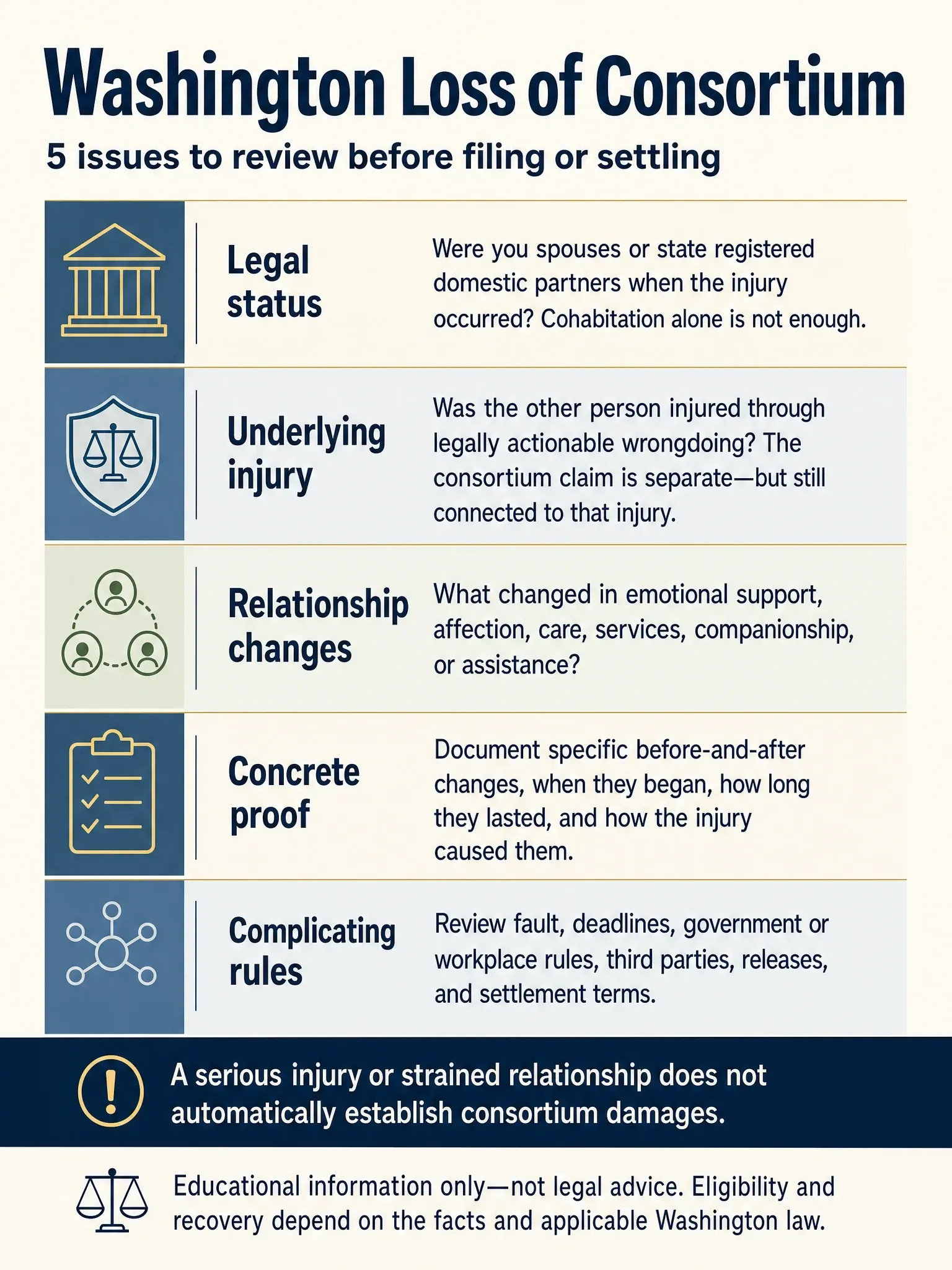
Practical Questions to Address Before Filing or Settling
These questions can help identify issues that need attention:
- What was the claimant’s legal relationship status when the wrongful conduct and injury occurred?
- If the couple formed a legal relationship elsewhere, is that union substantially equivalent to a Washington registered domestic partnership?
- What specific functions or aspects of the relationship changed, and when did each change begin?
- What evidence connects those changes to the underlying injury?
- What fault allegations or defenses affect the injured person’s case?
- Does the claim involve a public entity, covered workplace injury, potentially responsible third party, or specialized body of law?
- Have the injured person’s and consortium claimant’s deadlines both been evaluated?
- Could a release, dismissal, judgment, filing decision, or settlement allocation affect either claim?
Preserving a careful account of before-and-after changes can be useful. So can keeping relevant records and considering both people’s claims before signing a release or finalizing a settlement. This is not about overstating private relationship difficulties. It is about accurately documenting the losses the claimant contends were caused by the injury.
Getting Help With a Vancouver or Clark County Injury Claim
Loss-of-consortium questions often require several issues to be evaluated together: legal relationship status, the underlying injury, evidence of relationship change, comparative fault, deadlines, defendants, and the effect of any release or settlement.
For people seeking Vancouver and Clark County personal-injury help, an attorney can review those issues in the context of the specific claim. This article provides general educational information about Washington law and is not legal advice. The viability and value of any claim depend on its facts and the law that applies.
Frequently Asked Questions
Can an unmarried partner claim loss of consortium in Washington?
Generally, cohabitation or a committed intimate relationship alone does not establish the legal status required for a spousal consortium claim. A Washington state registered domestic partner is treated differently under spouse-equivalence legislation, and an out-of-state legal union may qualify if it is substantially equivalent under Washington law. Relationship status should be reviewed individually.
Is a Washington loss-of-consortium claim separate from the injured person’s claim?
Yes. Washington calls the claim separate and independent, and the spouse or registered domestic partner owns it. But the claim still requires legally actionable wrongdoing against the injured person and resulting harm to the relationship. Fault, defenses, releases, settlements, and procedural choices involving the underlying case may affect it.
What evidence may support loss of consortium?
Evidence may address concrete before-and-after changes in companionship, emotional support, affection, care, services, sexual companionship, and assistance. The claimant should connect those changes to the injury and address their duration. Relationship strain or serious injury alone does not automatically establish damages.
How long do I have to bring a loss-of-consortium claim in Washington?
The generally applicable limitations period is three years, but accrual is fact-specific and may differ from accrual of the injured person’s claim. Government claims, medical negligence, product liability, federal or maritime law, statutes of repose, tolling, and other rules may alter the deadline. A person should not calculate a filing date from the general rule alone.
Can loss of consortium be claimed after a workplace injury?
An action against an immune employer or fellow employee is generally barred by Washington’s workers’ compensation system. A legally responsible third party outside the worker’s same employ may present a different route under chapter 51.24 RCW. Third-party status, notice, settlement, distribution, and genuine allocation of consortium damages require careful analysis.
Is loss of consortium the same as damages in a wrongful-death case?
No. The consortium claim discussed here belongs to a qualifying spouse or registered domestic partner and arises from injury to a living person. A Washington wrongful-death action is maintained by the decedent’s personal representative for losses statutory beneficiaries sustain because of the death.
Source Notes
Washington authorities supporting this article include:
- Washington Pattern Jury Instructions—Civil, WPI 32.04, addressing the meaning of consortium, covered relationship interests, and related Washington authority.
- RCW 26.60.015, RCW 26.60.020, and RCW 26.60.090, addressing spouse-equivalent treatment, state registered domestic partners, and recognition of substantially equivalent out-of-state unions.
- Vance v. Farmers Insurance Co. of Washington and Green v. A.P.C., addressing relationship status and timing, including Green’s narrow latent-injury qualification.
- Lund v. Caple, addressing the claim’s separate status and its necessary connection to tortious wrongdoing against the injured spouse.
- RCW 4.22.005 and RCW 4.22.020, addressing comparative fault and imputation of the injured person’s fault.
- RCW 4.16.080 and the authorities discussed in WPI 32.04, addressing the general limitations period and consortium-claim accrual.
- RCW 4.96.020, addressing claim presentment and the waiting period for tort claims against Washington local governmental entities.
- RCW 51.04.010 and RCW 51.24.030, addressing industrial-insurance exclusivity and third-party workplace-injury claims.
- RCW 4.20.010 and RCW 4.20.020, addressing Washington wrongful-death actions and beneficiaries.
Authorities and procedures can change. The source notes are provided for reader reference and do not substitute for advice about a particular claim.
Client-First Fee Promise
Client First = Bills First, Fees Second
Your unpaid medical bills do not have to make your lawyer's fee bigger. Johnson Law subtracts qualifying medical bills before calculating our fee, helping clients keep more of their settlement.
Applies to qualifying cases. Results vary.