Is My Case Too Small for a Personal Injury Lawyer in Washington?

Is My Case Too Small for a Personal Injury Lawyer in Washington?
The Washington statutes and professional rules reviewed for this article do not establish a universal minimum claim value for hiring a personal injury lawyer. A claim that looks modest on paper is not automatically too small for representation—but it is not automatically a practical fit, either. Law firms may apply their own lawful case-selection criteria based on the facts and work a matter may require.
The more useful question is whether representation is likely to provide enough practical benefit to justify the attorney fee, possible case expenses, and complexity involved. That assessment depends on more than a medical-bill total or an early settlement estimate. Fault, evidence, insurance coverage, medical balances, liens, reimbursement rights, and deadlines may all affect the answer.
This article offers a framework for Washington readers, including people in Vancouver and Clark County. It cannot determine whether a particular firm would accept a case or whether handling a claim without a lawyer would be appropriate.
There Is No Universal Minimum Claim Value in Washington
The Washington statutes and professional rules reviewed for this article do not create a universal dollar floor for hiring a lawyer in a personal injury case. A lawyer may evaluate each matter individually, and different firms may reach different case-fit decisions.
That is partly because “small” can describe several different things:
- limited medical treatment;
- relatively low billed charges;
- modest available insurance limits;
- a minor-looking incident;
- a claimant’s early estimate of the potential recovery; or
- the amount that may remain after resolving fees, costs, bills, liens, and reimbursement claims.
Those are not interchangeable. For example, relatively low medical bills do not create a formula for Washington pain-and-suffering damages. At the same time, neither the seriousness of an injury nor the amount billed establishes how much can actually be recovered.
Why a dollar threshold can be misleading
An apparent claim value may not account for disputed responsibility, gaps in medical or wage documentation, limited coverage, or difficulty connecting an injury to the incident. A seemingly modest matter can require substantial investigation. A larger-looking claim may have limited practical recovery sources.
The time and expense required also matter. Obtaining records, investigating insurance, addressing causation disputes, communicating with multiple insurers, negotiating a claim, and preparing for possible litigation can change the case-fit analysis. No single factor predicts whether a lawyer will accept a matter.
“Case value” is not the same as likely net recovery
A gross settlement or judgment is not necessarily what a claimant ultimately receives. Several separate categories may affect the net amount:
- Attorney fees compensate a lawyer under the written fee agreement.
- Case expenses or costs may include expenditures needed to investigate or pursue the matter, as addressed in the agreement.
- Medical bills are charges for treatment and remain distinct from attorney fees and case expenses.
- Liens and reimbursement rights may create claims against recovery proceeds if their legal requirements are satisfied.
- Subrogation rights may allow an insurer that paid a claim to seek repayment from a responsible party or applicable recovery.
These categories should not be collapsed into one number or one promise. Understanding which medical-expense number matters in a Washington injury claim is one part of evaluating the economics.
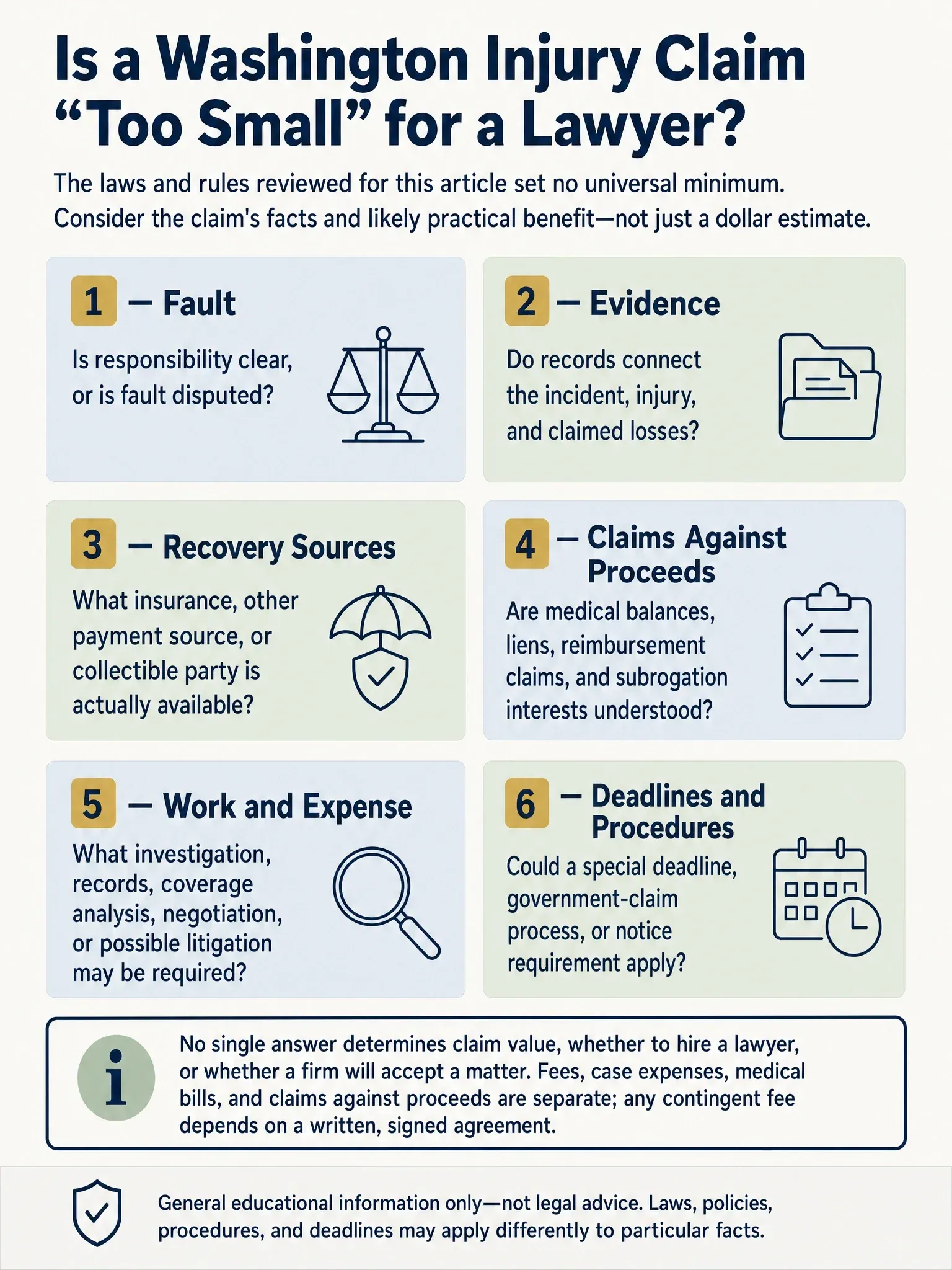
Six Factors That Can Matter More Than the Apparent Size of the Claim
1. Whether fault is clear or disputed
Washington follows a comparative-fault rule. Under RCW 4.22.005, fault attributed to an injured claimant proportionately reduces compensatory damages but does not bar recovery.
That rule makes liability important even in a modest claim. If the parties disagree about what happened, each person’s role, or whether the claimant contributed to the incident, developing the evidence may require more work. The existence of a dispute does not establish what percentage of fault—if any—will be assigned.
2. Whether the evidence connects the incident, injury, and losses
Even a comparatively modest claim needs supporting evidence. Depending on the facts, useful documentation may include:
- medical records and bills;
- proof of missed work or lost wages;
- photographs, reports, witness information, and other collision or incident evidence; and
- records or other proof connecting the incident to the claimed injury and losses.
Having one type of document does not prove the entire claim. An insurer may dispute how the incident occurred, whether it caused the injury, whether treatment was related, or whether the claimed losses are supported. Missing or inconsistent evidence can make a claim more complicated than its apparent dollar amount suggests.
Practical preservation steps may include keeping copies of insurer correspondence, medical records and bills, wage records, receipts, photographs, and incident information. Organizing these materials does not determine the claim’s value, but it can help clarify what is documented and what remains uncertain.
3. What insurance or other recovery source is actually available
An injury may be well documented, but practical recovery still depends on an available source of payment or a collectible responsible party. Coverage questions can therefore matter as much as the extent of the injury.
In Washington auto claims, personal injury protection and underinsured motorist coverage are two examples:
- Personal injury protection (PIP): Washington auto insurers must offer optional PIP, and a named insured who declines it must reject it in writing. According to the Washington Office of the Insurance Commissioner, PIP applies regardless of fault and may cover medical expenses, wage loss, replacement services, and funeral expenses, subject to the policy. Whether PIP exists and what it covers depend on the policy and applicable limits and conditions.
- Underinsured motorist coverage (UIM): Washington auto policies generally must include UIM protection unless it is rejected in writing, subject to statutory exclusions and conditions. Whether UIM applies depends on the policy and the particular facts. A special rule applies when an unidentified vehicle causes an accident without making physical contact. For this type of “phantom vehicle” UIM claim, Washington law requires corroborating competent evidence beyond the testimony of people making UIM claims from the accident, and the accident must be reported to the appropriate law-enforcement agency within 72 hours.
Multiple policies, unclear limits, a written rejection, an uninsured or underinsured driver, or a coverage dispute can add complexity to a claim that otherwise looks small. PIP and UIM are examples rather than an exhaustive coverage analysis.
4. Medical balances, liens, reimbursement, and subrogation
Medical treatment may create more than a stack of bills. Depending on the facts and statutory compliance:
- specified medical providers and ambulance services may have liens on a qualifying traumatic-injury recovery;
- the Washington Department of Social and Health Services may have subrogation or lien rights for qualifying medical assistance paid because of another person’s negligence or wrongful conduct; and
- an insurer that paid a claim may have subrogation rights.
Not every medical bill creates a valid lien. Washington’s medical-provider lien statute includes disclosure, notice, filing, and enforcement requirements. No assumption should be made that a particular lien is valid or that it can or will be reduced.
The Washington Office of the Insurance Commissioner advises policyholders to notify their insurer before settlement to avoid impairing the insurer’s subrogation rights. These interests can affect how proceeds are distributed and why gross recovery and net recovery are different.
5. How much time, expense, and procedural work the claim may require
A claim’s practical fit also depends on the work necessary to evaluate and pursue it. Investigation, records collection, coverage analysis, disputed causation, negotiations, and possible litigation can all require time and case expenses.
Washington’s attorney-fee rule identifies considerations such as time, labor, difficulty, required skill, the amount involved, results, time limits, and whether a fee is fixed or contingent. Those are fee-reasonableness factors—not a mandatory intake checklist and not a formula for predicting whether a firm will accept a case.
The relevant question is not simply, “How much are my bills?” It is also, “What work and expense would be required to establish responsibility, injury, losses, coverage, and a legally supportable recovery?”
6. Whether a deadline or special claim process applies
Washington generally requires an action for injury to a person to be commenced within three years under RCW 4.16.080. That is only a general rule. Accrual, tolling, government-claim procedures, and claim-specific statutes can change the deadline.
Claims against local governments have additional requirements. RCW 4.96.020 requires presentment to the designated agent and generally imposes a 60-calendar-day waiting period before suit, along with specific form, delivery, and tolling rules. Claims against Washington State have a separate presentment process under RCW 4.92.100 and RCW 4.92.110. When a public vehicle is involved, the separate guide to Washington government-vehicle evidence and claim-filing rules explains why identifying the entity and preserving agency-held records may require prompt attention.
Contacting an insurer, negotiating, or submitting a claim does not necessarily preserve the deadline for filing a lawsuit. A modest claim still deserves prompt attention to applicable dates. For broader process context, see the Washington personal-injury claim timeline.
When Handling a Modest Claim Yourself May Be Worth Considering
Some people consider dealing directly with an insurer or using a court process without full attorney representation. Whether that approach is sensible is case-specific. A comparatively straightforward-looking claim may still contain an issue the claimant has not identified.
Questions that may help identify a comparatively straightforward claim
Instead of relying on a dollar threshold, consider asking:
- Is responsibility genuinely undisputed, or has another party alleged that I share fault?
- Is treatment complete enough to understand the injury, related bills, and ongoing concerns?
- Are the medical, wage, and incident records organized and consistent?
- Is the available insurance coverage known?
- Are outstanding medical balances, liens, reimbursement interests, and insurer subrogation rights understood?
- Is there any government entity, special notice process, or approaching deadline involved?
Clear answers may make the issues easier to understand, but they do not establish that self-representation is advisable or that a particular result will follow.
Warning signs that the claim may be more complex than it looks
Potential complications include:
- disputed fault or allegations of comparative fault;
- disagreement about whether the incident caused the injury;
- incomplete or conflicting evidence;
- multiple insurers or uncertain coverage;
- a possible UIM claim;
- a no-contact accident involving an unidentified vehicle, which may trigger the phantom-vehicle UIM corroboration and 72-hour reporting requirements;
- provider liens, DSHS interests, or insurer subrogation;
- a state or local government defendant and the applicable presentment process;
- an approaching legal deadline; or
- damages that may exceed the limit of the forum the claimant is considering.
No one item automatically means that a lawyer is required. It does mean that the claim may not be as simple as its treatment history or bill total suggests.
Could Washington Small Claims Be an Option?
Washington small claims may provide a possible forum for some qualifying money-only disputes. Eligibility does not establish what a personal injury claim is worth or whether small claims is strategically appropriate.
Statewide limits and restrictions
Under RCW 12.40.010, Washington small-claims departments hear money-only claims up to:
- $10,000 for a natural person; and
- $5,000 for other claimants.
RCW 12.40.080 generally does not allow attorneys, legal paraprofessionals, or people other than the parties to participate in small-claims litigation without judicial consent.
The limits describe the forum’s authority, not a valuation rule. A claim falling below the cap is not necessarily simple, and a claimant still needs to consider proof, legal defenses, collection, liens, and deadlines.
Clark County considerations
For Vancouver and Clark County readers, Clark County District Court listed a $50 filing fee and a filing-fee-waiver motion as of August 12, 2026. Court fees and procedures can change, and service or other costs may apply, so the Clark County small-claims instructions should be checked before filing.
Clark County also states that a claimant whose damages exceed the small-claims cap must waive recovery above the limit to use that forum. Giving up potential recovery above a court’s limit is different from proving what a claim is worth, and the consequence should not be overlooked.
Procedures and additional costs may vary by county. Clark County information should not be treated as a statewide procedural guide.
How Fees and Costs Fit Into the Net-Benefit Question
In eligible Washington civil matters, a contingent-fee agreement must be in writing and signed by the client. Under Washington RPC 1.5, the agreement must explain how the fee will be calculated, what expenses are involved, whether expenses are deducted before or after the fee is calculated, and the expenses for which the client may remain liable.
Before signing any agreement, a prospective client can ask the lawyer to distinguish:
- the attorney fee calculated under the agreement;
- case costs or expenses incurred in pursuing the matter;
- medical bills owed for treatment; and
- liens, reimbursement claims, or subrogation interests that may affect proceeds.
These are distinct categories that may affect the amount a claimant ultimately receives. Their validity, amount, treatment, and the claimant’s responsibility for them can depend on the written fee agreement and the facts, so they should be evaluated separately when considering potential net benefit.
Johnson Law’s approved fee description
For eligible personal injury matters, Johnson Law, P.C. calculates its attorney fee after outstanding medical bills are paid, according to the written fee agreement.
More information appears in Johnson Law’s Client-First Fee Promise. This description does not determine whether a particular matter is eligible or will be accepted, and it does not make case costs, medical bills, liens, or reimbursement rights the same as attorney fees.
Questions to Ask When Speaking With a Personal Injury Lawyer
A conversation with a prospective lawyer can help a person understand what information is missing and how the lawyer evaluates case fit. It is not a promise that a firm will accept the matter.
Questions about the claim
- What facts or records would you need before assessing this claim?
- Which liability, causation, or comparative-fault issues do you see?
- What insurance coverage or collection issues should be investigated?
- Could medical liens, DSHS reimbursement, or insurer subrogation affect the proceeds?
- Which deadlines or special notice requirements may apply?
Questions about representation, fees, and alternatives
- Is this a matter your firm would consider for full representation, and what factors guide that decision?
- How would the written agreement calculate the attorney fee?
- What case expenses might arise, when would they be deducted, and could I remain responsible for any of them?
- How are medical balances, liens, and reimbursement claims handled separately from attorney fees and case expenses?
- If the firm does not accept the matter, are there neutral court or bar resources I can consult about other paths?
Washington’s professional rules permit limited representation when it is reasonable and the client gives informed consent, but no lawyer or law firm is required to offer that service. A person should not assume that Johnson Law or another firm provides limited-scope assistance, document review, or any other specific alternative to full representation.
The Bottom Line: Evaluate Complexity and Likely Net Benefit, Not a Made-Up Threshold
The Washington statutes and professional rules reviewed for this article do not establish a universal minimum that determines whether a personal injury case is “large enough” for a lawyer. The practical fit may turn on the quality of the evidence, disputed fault, available coverage or collectability, liens and reimbursement rights, deadlines, and the time and expense needed to pursue the matter.
A self-directed insurance claim or small-claims case may be among the paths a person considers, but neither is automatically suitable merely because the apparent damages are modest. Before choosing a path, identify what remains uncertain and keep attorney fees, case expenses, medical bills, liens, and potential net recovery distinct.
Washington residents seeking information about Johnson Law can review its page concerning Vancouver and Clark County personal-injury help. Nothing in this article promises that Johnson Law will accept a particular matter, provide a particular type of service, or obtain a particular result.
This article provides general educational information only and is not legal advice. Laws, court procedures, insurance policies, and deadlines may apply differently to particular facts. Statutes, court rules, local fees, and agency guidance should be checked for changes before anyone relies on them.
Frequently Asked Questions
Is there a minimum claim value for hiring a personal injury lawyer in Washington?
The Washington statutes and professional rules reviewed for this article do not establish a universal minimum. Firms may use their own lawful case-selection criteria, and practical fit depends on factors such as responsibility, evidence, coverage, liens, deadlines, required work, and expenses—not only an estimated dollar value.
Can I take a Washington personal injury claim to small claims court?
Potentially. Washington small-claims departments hear qualifying money-only claims up to $10,000 for a natural person and $5,000 for other claimants. Procedural rules apply, and using small claims does not establish what the claim is worth or whether that forum is appropriate.
Can a lawyer represent me in Washington small claims court?
Attorneys, legal paraprofessionals, and people other than the parties generally may not participate in Washington small-claims litigation without judicial consent under RCW 12.40.080.
How long do I have to bring a personal injury claim in Washington?
Three years is the general period for an action involving injury to a person. Accrual, tolling, government-claim procedures, and claim-specific statutes can change the applicable deadline, so the general rule should not be treated as a case-specific calculation.
Do low medical bills mean my injury claim is too small?
Not necessarily. Medical bills are one part of the analysis. Evidence, causation, fault, insurance coverage, collectability, liens, expenses, and legally supportable noneconomic harm may also matter. Low bills do not establish a formula for any other category of damages.
What should I ask about fees before hiring a personal injury lawyer?
Ask how the written agreement calculates the attorney fee, what case expenses may arise, when expenses are deducted, and whether you could remain responsible for any expenses. Also ask how medical bills, liens, reimbursement claims, and subrogation interests are handled separately.
Source Notes
- RCW 4.16.080 — general limitations period for actions involving injury to a person.
- RCW 4.22.005 — effect of contributory fault on compensatory damages.
- Washington RPC 1.2 — scope of representation, including limited representation.
- Washington RPC 1.5 — attorney fees and written contingent-fee agreements.
- RCW 12.40.010 and RCW 12.40.080 — Washington small-claims limits and participation restrictions.
- Washington Courts small-claims brochure — statewide overview and notice that local costs and procedures may differ.
- Clark County: Start a Small Claims Case and Clark County Small Claims Information — local filing information and waiver of recovery above the cap.
- RCW 48.22.085 and Washington OIC guidance on PIP — PIP offering, rejection, and general covered categories.
- RCW 48.22.030 — UIM coverage requirements, exclusions, and conditions, including the corroboration and 72-hour reporting requirements for no-contact phantom-vehicle claims in subsection (8).
- Washington OIC guidance on filing an auto-insurance claim — claim documentation and insurer subrogation guidance.
- RCW 60.44.010, RCW 60.44.020, and RCW 60.44.060 — qualifying medical-provider and ambulance liens and statutory disclosure, filing, and enforcement requirements.
- RCW 43.20B.060 — DSHS subrogation and lien rights for qualifying medical assistance.
- RCW 4.96.020 — local-government claim presentment, waiting period, delivery, and tolling provisions.
- RCW 4.92.100 and RCW 4.92.110 — separate presentment requirements and waiting period for tort claims against Washington State.
Sources, court procedures, local fees, and agency guidance were researched on August 12, 2026, and should be checked for changes before being relied on in a particular matter.
Client-First Fee Promise
Client First = Bills First, Fees Second
Your unpaid medical bills do not have to make your lawyer's fee bigger. Johnson Law subtracts qualifying medical bills before calculating our fee, helping clients keep more of their settlement.
Applies to qualifying cases. Results vary.