
Medical Bills vs. Amounts Paid in Washington Injury Claims: Which Number Matters?
Medical Bills vs. Amounts Paid in Washington Injury Claims: Which Number Matters?
When a medical provider bills $10,000 but an insurer pays less, it is natural to ask which number counts in an injury claim. In Washington, there is no single number that automatically controls every part of the case.
For an ordinary negligence claim, the central damages question is the reasonable value of necessary medical care received—not simply the highest or lowest number on an account. But other figures may still matter for settlement negotiations, evidentiary disputes, outstanding balances, liens, reimbursement claims, and the amount the claimant ultimately receives.
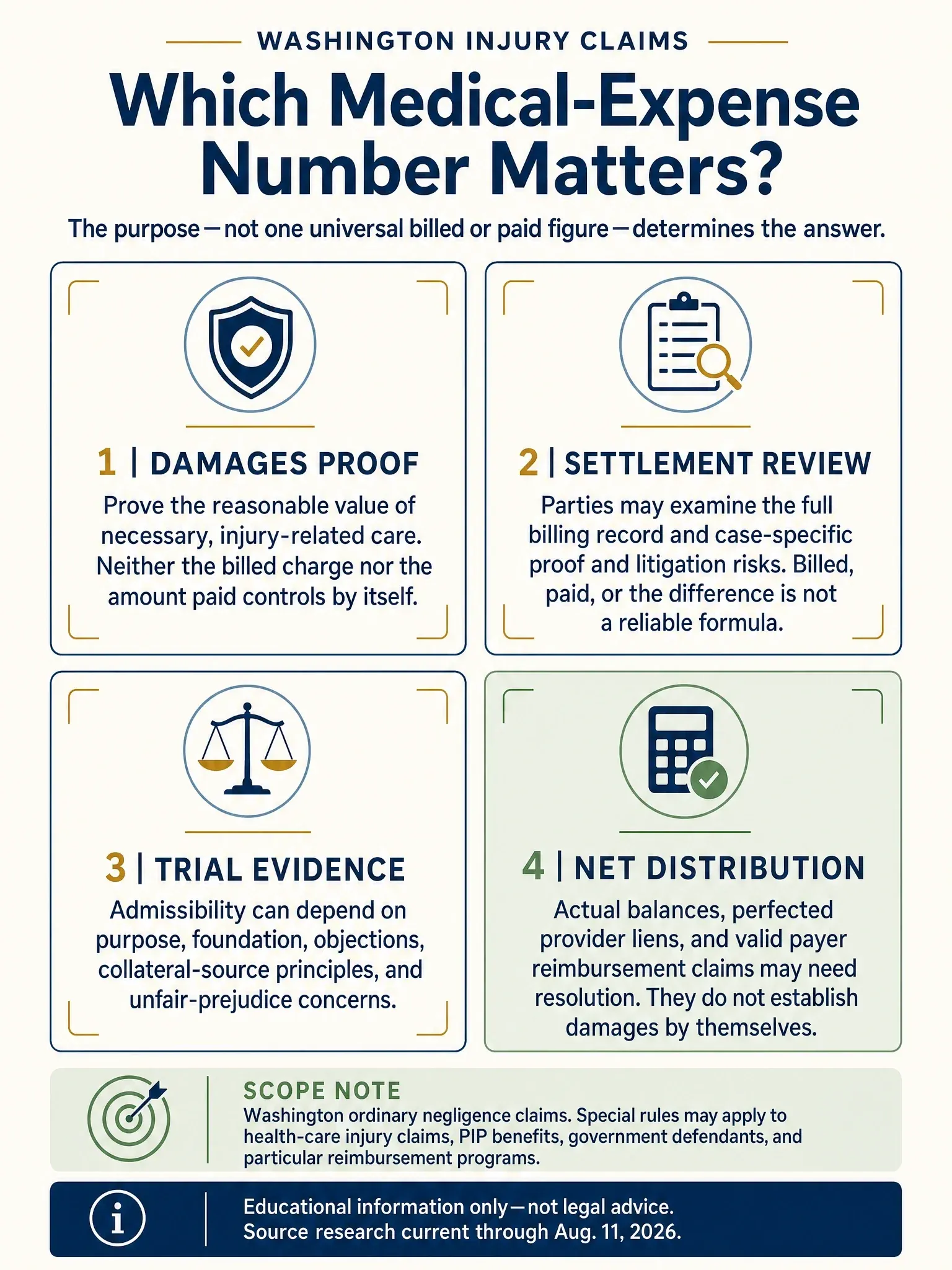
Those are related issues, but they are not interchangeable. A useful way to analyze the account is to ask four separate questions:
- What medical-expense damages can the claimant prove?
- What information will the parties consider during settlement negotiations?
- What evidence may be admitted at trial?
- What valid balances, liens, or reimbursement interests may need to be resolved from a recovery?
This article addresses Washington law, including its practical application in Vancouver and Clark County. Special rules may apply to health-care injury claims, first-party personal injury protection (PIP) benefits, government defendants, and particular reimbursement programs.
The Short Answer: The Purpose Determines Which Number Matters
| Question | The figure or issue that matters |
|---|---|
| Claimed past medical-expense damages | The proved reasonable value of necessary care received—not an automatic billed-amount or paid-amount rule. |
| Settlement evaluation | The parties may assess the full billing record along with causation, liability, comparative fault, policy limits, proof problems, and litigation risk. |
| Trial evidence | Admissibility may depend on the purpose for which evidence is offered, its foundation, objections, collateral-source principles, and unfair-prejudice concerns. |
| Net settlement distribution | Actual balances, perfected provider liens, and valid payer reimbursement claims may need to be identified and resolved. |
The same account can contain several relevant numbers without any one of them answering every question. The number used to support claimed damages is not necessarily the amount still owed to the provider. It also may not be the amount a health plan can seek in reimbursement or the amount a claimant receives after a settlement is distributed.
Medical expenses are generally a form of economic loss, distinct from Washington pain-and-suffering damages. Neither type of loss should be reduced to a mechanical multiplier based on a medical statement.
First, Separate the Numbers on the Medical Account
Before deciding what a billing record may show, identify what each entry actually means. Consider a hypothetical account showing:
- a $10,000 original charge;
- a $6,000 plan-allowed amount;
- a $4,500 payer payment;
- $1,500 in stated patient responsibility; and
- a $4,000 adjustment.
This example does not establish that the injury claim is worth $10,000, $6,000, $4,500, or any other amount. It simply shows why the terms must be kept separate.
Billed charge
The billed charge is the provider’s stated price for the service. It may be evidence supporting a claimed medical expense, but the bill’s face amount does not conclusively prove that the treatment was caused by the injury, was necessary, was reasonably priced, or is recoverable.
Allowed amount and payer payment
The allowed amount generally reflects the figure a health plan recognizes under the applicable arrangement. The payer payment is the amount the insurer or public program actually paid.
These entries are not necessarily the same. Neither one automatically becomes the measure of damages in a third-party Washington injury claim. A payer’s decision may reflect its contract, program rules, claims process, or other considerations that do not decide the reasonable value of the care for tort purposes.
Patient responsibility and outstanding balance
Patient responsibility may include a deductible, copayment, coinsurance, or another amount assigned to the patient. An outstanding balance is the amount the account currently shows as unpaid.
Even then, a statement should not be assumed to establish a legally collectible debt without review. Coverage terms and state or federal balance-billing protections may affect some emergency, in-network-facility, ground-ambulance, or other covered services. Those protections are service- and coverage-specific; they do not apply to every medical balance.
Adjustment or write-off
An adjustment changes the provider’s account balance. It may reflect a provider-payer contract, a public-program rule, charity care, a billing correction, a discount, or another reason.
An adjustment is not itself a payment. It also should not automatically be treated as an amount the patient owes, a recoverable loss, or an irrelevant bookkeeping entry. Its significance may depend on why it occurred, whether the provider accepted another amount as payment in full, whether the adjustment can be reversed, and whether anyone can still lawfully collect the amount.
What Must Be Proved as Past Medical Expense in Washington?
Washington Pattern Jury Instruction 30.07.01 states the measure of past medical-expense damages as the “reasonable value of necessary medical care, treatment, and services” received to the present time. The instruction does not designate gross charges or amounts paid as an automatic measure.
Care that has not yet been received presents a separate proof question. The guide to future medical costs in a Washington injury case explains why a projection must support probable injury-related need as well as the anticipated care and its cost; existing bills alone do not establish all of those points.
The claimant bears the burden of proving that the treatment was necessary and that the claimed expense was reasonable. The claimant also must connect the claimed care to the injury at issue. These requirements keep causation, necessity, reasonableness, and payment status analytically separate.
A bill is evidence, not an automatic award
Medical records and bills can help document dates, services, diagnoses, and charges. Under the Washington authorities collected in the pattern-instruction comment, however, records and bills alone do not establish necessity and reasonableness.
The supporting foundation depends on the case. Expert testimony will generally be needed unless an admission or another adequate foundation supplies the necessary proof, but there is not an absolute rule in the approved sources that every individual bill always requires expert testimony.
Neither billed nor paid is determinative
In Hayes v. Wieber Enterprises, Inc., the Washington Court of Appeals stated that neither the amount billed nor the amount paid is itself determinative; the question is whether the sum requested for the medical services is reasonable.
The physician in Hayes billed about $5,800 and accepted about $3,300 from the patient’s insurer as payment in full. On that record, the trial court excluded the payment evidence after the physician testified that the charge was reasonable and the defense offered no evidence that the charge was unreasonable. The appellate court found no abuse of discretion.
That decision illustrates a case-specific evidentiary ruling. It does not guarantee recovery of every gross charge, establish that every contractual write-off is damages, or make payment evidence inadmissible for every purpose.
Reasonableness proof must fit the actual dispute
In Gerlach v. The Cove Apartments, LLC, the Washington Supreme Court agreed that the methodology offered by a health economist did not help determine whether that plaintiff’s medical expenses were reasonable. The analysis relied on average procedure costs, hospital cost-to-charge ratios, and lower Medicare reimbursement accepted by the plaintiff’s physicians.
The lesson is not that every kind of market, rate, billing-practice, or payment evidence is always barred. It is that the evidence and methodology offered must be relevant and adequately connected to the actual reasonableness dispute.
Why Settlement Negotiations Can Look Beyond the Trial Measure
A presuit demand, insurance evaluation, or mediation is not a jury instruction. In negotiations, both sides may examine the entire billing ledger—including charges, allowed amounts, payments, adjustments, and outstanding balances—while assessing what could be proved if the case proceeded.
They may also consider:
- liability and causation disputes;
- comparative fault;
- whether treatment was necessary and related to the injury;
- the strength of the reasonableness foundation;
- likely evidentiary rulings;
- existing liens and reimbursement claims;
- available policy limits;
- treatment disputes, litigation expense, and delay; and
- collectibility and other case-specific uncertainty.
These considerations may influence a negotiated result, but they do not create a legal formula. A settlement cannot be calculated reliably by selecting the billed amount, selecting the paid amount, or subtracting one from the other.
ER 408 does not choose the billing figure
Washington Evidence Rule 408 generally prevents compromise offers and statements made during compromise negotiations from being used to prove liability, the invalidity of a claim, or the amount of a disputed claim. The rule preserves otherwise discoverable evidence and allows evidence offered for certain other purposes.
ER 408 does not prohibit negotiators from discussing billed, paid, adjusted, or outstanding amounts. Nor does it declare which figure represents recoverable damages. It addresses specified uses of compromise material as evidence.
Settlement value and net recovery are different questions
The amount the parties agree will resolve a claim is not the same as the claimant’s eventual net distribution. After an agreement, time may still be needed to confirm balances and address asserted liens or payer recovery rights. The Washington settlement and disbursement timeline explains that broader process.
Trial Admissibility and the Collateral-Source Rule Are Separate Questions
Payment evidence may appear relevant to a dispute about a medical charge yet also reveal that the claimant had insurance or another independent benefit. That can raise collateral-source and unfair-prejudice concerns.
The admissibility result may depend on the evidence offered, its purpose and foundation, the objections made, and whether a party has opened the door. It should not be predicted from the word “payment” alone.
What the collateral-source rule generally does
Washington’s common-law collateral-source rule generally prevents an at-fault party from reducing otherwise recoverable damages merely because an independent source paid injury-related expenses. In Ciminski v. SCI Corp., the Washington Supreme Court applied the doctrine to Medicare Part A benefits even without proof that the plaintiff personally financed the benefit.
The doctrine prevents an improper reduction based on an independent payment. It does not, by itself, establish that the billed charge is reasonable. It also does not eliminate a provider lien or a payer’s valid right to seek reimbursement.
What the collateral-source rule does not do
The protection is not absolute. Washington authority recognizes that a party may open the door to otherwise excluded evidence, and relevance and unfair-prejudice analysis can be fact-specific.
A payment from the at-fault party—or from a fund created by that party—also may present a different offset question. But the party seeking a credit must establish the contractual and factual basis for it and connect the payment to the damages awarded. A label such as “PIP payment” does not resolve the issue without the policy, source, allocation, and other necessary proof.
ER 409 is not the collateral-source rule
Washington Evidence Rule 409 addresses offers or payments of injury-related medical and similar expenses. It makes that evidence inadmissible when offered to prove liability for the injury.
By its terms, ER 409 is not a universal exclusion for every other purpose. It also is not the rule that determines the reasonable value of care, and it should not be confused with collateral-source doctrine.
Health-care injury claims have a statutory exception
Qualifying health-care injury actions under chapter 7.70 RCW require separate analysis. RCW 7.70.080 allows evidence that a claimant has already been compensated from specified sources and permits responsive evidence concerning repayment obligations and the cost of securing that compensation.
That statutory framework should not be imported into an ordinary auto-collision, premises-liability, or other negligence claim.
What Payment Data May Show—and What It Does Not Prove
Payment data and reimbursement rates can be disputed as indicators of reasonable value. Washington’s approved authorities do not support a universal conclusion that such data always controls, always must be excluded, or never has evidentiary value.
Hayes and Gerlach do not create a categorical ban or guarantee
In Hayes, the accepted insurance payment did not show that the billed charge was unreasonable on the record presented. In Gerlach, the average-cost, cost-to-charge, and Medicare-rate methodology offered was not helpful in assessing that plaintiff’s expenses.
Those decisions do not conclusively resolve every potential dispute involving self-pay comparisons, provider collection practices, negotiated market information, or other billing evidence offered with a different foundation or for a different purpose.
Schiff concerns first-party PIP/MedPay review, not tort damages
In the 2024 case Schiff v. Liberty Mutual Fire Insurance Co., the Washington Supreme Court held that the insurer’s challenged use of FAIR Health charge data and an 80th-percentile practice was not unfair or unreasonable and did not violate the Consumer Protection Act or the PIP requirements at issue. The court reasoned that charges for the same treatment in the same geographic area were relevant to reasonableness. FAIR Health used billed charges rather than amounts paid.
But Schiff involved first-party PIP/MedPay claim handling, not the measure of third-party tort damages. The opinion was divided. It does not fix damages at the FAIR Health 80th percentile or make any database figure conclusive in an ordinary negligence case.
Write-Offs, Liens, and Subrogation Answer Different Questions
| Term | What it generally describes | What it does not establish by itself |
|---|---|---|
| Write-off or adjustment | An entry changing a provider’s account balance. | Reasonable-value damages, payment, collectibility, or who owes the adjusted amount. |
| Lien | An asserted legal claim against the injury claim or recovery. | The validity or reasonableness of every underlying charge. |
| Subrogation or reimbursement | A payer’s asserted right to recover injury-related payments from a third-party recovery. | The amount of tort medical-expense damages. |
These concepts can affect settlement handling and net proceeds even when they do not establish the damages figure presented to a jury.
Provider liens can affect settlement handling
Under chapter 60.44 RCW, qualifying hospitals, ambulance operators, nurses, practitioners, physicians, and surgeons that provide care for a traumatic injury may assert liens against the patient’s claim or recovery. The statute includes filing and notice requirements.
The notice of lien must be filed with the county auditor in the Washington county where the services were performed. For qualifying services performed in Clark County, the notice is filed with the Clark County Auditor. If treatment was provided in another Washington county, that county’s auditor records may also need to be checked.
Liens arising from one accident or event may not exceed 25 percent of the recovery in the aggregate under that chapter. That ceiling does not cap medical damages, validate each underlying charge, or limit separate governmental or contractual reimbursement claims.
A settlement also does not automatically discharge a perfected chapter 60.44 lien. The statutory payment-and-discharge or written release or waiver requirements must be addressed.
Government-program recovery can remain after the damages dispute
Washington Apple Health must seek reimbursement for qualifying injury-related payments when a third party is responsible. Washington Health Care Authority guidance describes notice and holdback duties, including 30 days’ notice before settlement proceeds are disbursed. Fee-for-service and managed-care payments can also result in more than one asserted lien.
Medicare may make conditional payments while a liability, no-fault, or workers’ compensation payer has not paid promptly. CMS guidance explains that Medicare may then seek repayment after a settlement, judgment, award, or other payment. Because additional claims may be processed, an interim conditional-payment amount can change.
These recovery processes affect settlement resolution. They do not set Washington’s tort measure of reasonable medical expense.
Private-plan and PIP reimbursement is fact-specific
Washington’s made-whole doctrine generally may limit an insurer’s recovery from a third-party recovery until a fault-free insured has been fully compensated for the entire loss. When an insurer obtains reimbursement from a recovery created through the insured’s efforts, Washington authority also generally may require a proportionate contribution to reasonable legal expenses.
Those principles are not universal. The result can depend on plan language, fault, allocation, the payment source, statutes, and federal law. They should not automatically be extended to Medicare, Apple Health, Medicare Advantage, L&I, or a self-funded ERISA plan.
An asserted reimbursement demand also should not be assumed enforceable merely because it was sent. The governing source of the claimed right and the supporting facts require review.
A Separate PIP Payment Decision Does Not Set Third-Party Damages
Washington PIP is optional first-party auto coverage that insurers must offer unless the consumer rejects it in writing. PIP medical benefits address reasonable and necessary expenses under the insured’s own coverage and policy terms.
That is a different process from proving damages against an at-fault party. A PIP carrier’s payment, reduction, or denial may be important to the claimant and provider, but it does not automatically establish what medical-expense damages are recoverable in the liability claim. Schiff does not change that distinction.
A Practical Document Checklist for Washington Claimants
Preserving a complete record helps separate damages proof from billing and repayment issues. For each provider and date of service, track:
- the original billed charge;
- the insurer or program’s allowed amount;
- each payer payment;
- each patient payment;
- stated patient responsibility;
- every adjustment or write-off and any stated reason;
- the current outstanding balance;
- explanations of benefits and the provider’s detailed ledger;
- any provider lien, conditional-payment letter, or reimbursement notice; and
- records or other supporting evidence relevant to causation, necessity, and reasonableness.
Johnson Law’s medical expense tracker can be used as an organizational aid. It is not a damages calculator or legal authority.
Useful questions to clarify include:
- Did the provider accept a particular amount as payment in full?
- Why was each adjustment made, and can it be reversed?
- Is the stated patient balance legally collectible?
- What evidence supports causation, necessity, and reasonable value?
- In which Washington county were qualifying services performed, and was a provider lien properly filed and noticed there?
- Which payer reimbursement interests are asserted, and what law or plan language supports them?
- Are the asserted liens or reimbursement claims perfected and enforceable?
What This Means for a Vancouver or Clark County Claim
Vancouver and Clark County do not have a separate general rule for measuring medical-expense damages. The Washington framework described above applies.
Local facts can still matter. Same-treatment charge information from the relevant geographic area may arise in a reasonableness dispute, although no comparison is automatically conclusive. For qualifying services performed in Clark County, provider-lien notices are filed with the Clark County Auditor. Treatment performed elsewhere in Washington may require checking the auditor records in the county where the service was provided. A claim against Vancouver, Clark County, a public hospital district, transit district, school district, or another government entity may also present distinct procedural or substantive issues requiring separate review.
The Bottom Line: Build the Claim Around Proof, Not One Billing Figure
In a Washington injury claim, the full bill does not automatically control—and neither does the amount paid. The better approach is to keep four questions separate:
- What is the reasonable value of necessary, injury-related care, and how can it be proved?
- What information and risks will the parties assess during negotiations?
- What evidence may properly reach the jury?
- What balances, liens, or reimbursement interests may have to be resolved before the claimant receives net proceeds?
Preserve the complete billing and payment record. Investigate what each adjustment means, whether a balance remains collectible, and what repayment rights are actually supported. Assuming that either the highest or lowest number controls can obscure the real proof and settlement issues.
If a Washington injury claim involves disputed medical bills, adjustments, liens, or reimbursement demands, learn how Johnson Law assists clients with Vancouver and Clark County personal-injury claims.
This article provides general educational information about Washington law. It is not legal advice for any particular claim, and reading it does not create an attorney-client relationship. The law and the application of these rules can change and depend on the specific facts, evidence, policies, plans, and parties involved.
Frequently Asked Questions
Can I claim the full medical bill in a Washington injury case if insurance paid less?
There is no automatic full-bill rule. The claimant must prove the reasonable value of necessary, injury-related care. The billed charge and the amount paid may each be relevant in a particular dispute, but neither figure is determinative by itself. Hayes should not be read as a guarantee that every gross charge or contractual adjustment is recoverable.
Does Washington limit medical-expense damages to the amount actually paid?
The approved Washington authorities do not establish a universal paid-amount limit for an ordinary negligence claim. The measure is the proved reasonable value of necessary care, subject to case-specific proof and evidentiary rulings.
Are insurance payments admissible at a Washington personal-injury trial?
Collateral-source evidence is generally excluded when offered to reduce damages merely because an independent source paid. But admissibility can depend on purpose, foundation, objections, prejudice, and whether a party opened the door. A court must evaluate the evidence in context.
Is a medical write-off part of my injury claim?
Not automatically, and not automatically excluded. A write-off is an account adjustment, not a payment or outstanding balance. Its significance depends on why it occurred, whether another amount was accepted as payment in full, whether anyone can collect the adjusted amount, and what evidence supports the reasonable value of the care.
Do medical liens or health-insurance reimbursement claims reduce my settlement?
Valid liens or reimbursement claims may affect how settlement funds are distributed and therefore may affect net proceeds. Different provider, government-program, PIP, and private-plan claims follow different rules. Their existence does not by itself establish the medical-expense damages figure.
Does PIP’s decision about a medical bill determine what the at-fault insurer owes?
No. PIP is a first-party coverage process governed by its own rules and policy terms. A third-party negligence claim separately requires proof of reasonable and necessary injury-related medical expense.
Source Notes
- Washington Pattern Jury Instruction—Civil 30.07.01, including its discussion of Patterson v. Horton, 84 Wn. App. 531, 929 P.2d 1125 (1997).
- Hayes v. Wieber Enterprises, Inc., 105 Wn. App. 611, 20 P.3d 496 (2001).
- Gerlach v. The Cove Apartments, LLC, 196 Wn.2d 111, 471 P.3d 181 (2020).
- Ciminski v. SCI Corp., 90 Wn.2d 802, 585 P.2d 1182 (1978); Cox v. Spangler, 141 Wn.2d 431, 5 P.3d 1265 (2000); and Gilmore v. Jefferson County Public Transportation Benefit Area, 190 Wn.2d 483, 415 P.3d 212 (2018).
- Armstrong v. Carter, No. 83587-4-I (Wash. Ct. App.), concerning the proof required for an asserted offset.
- Washington Evidence Rules 408 and 409.
- RCW 7.70.080, concerning qualifying health-care injury actions.
- Schiff v. Liberty Mutual Fire Insurance Co., 2 Wn.3d 762, 542 P.3d 1002 (2024).
- Chapter 60.44 RCW, concerning qualifying health-care provider liens and county-auditor filing requirements.
- Washington Health Care Authority personal-injury and casualty-recovery guidance.
- Centers for Medicare & Medicaid Services, Medicare’s Recovery Process.
- Daniels v. State Farm Mutual Automobile Insurance Co., 193 Wn.2d 563, 444 P.3d 582 (2019) and Mahler v. Szucs, 135 Wn.2d 398, 957 P.2d 632 (1998), for the qualified Washington made-whole and legal-expense principles discussed above.
These sources address different questions and should not be combined into a single billed-versus-paid formula. Source research was current through August 11, 2026; laws and agency guidance should be checked before being relied upon in a particular matter.
Client-First Fee Promise
Client First = Bills First, Fees Second
Your unpaid medical bills do not have to make your lawyer's fee bigger. Johnson Law subtracts qualifying medical bills before calculating our fee, helping clients keep more of their settlement.
Applies to qualifying cases. Results vary.