Medical Bills vs. What Insurance Paid: Which Number Matters in Settlement Negotiations?
Medical Bills vs. What Insurance Paid: Which Number Matters in Settlement Negotiations?
When you are hurt and medical bills start arriving, the paperwork can look contradictory. A hospital may list one total. A health insurance explanation of benefits may show a lower “allowed amount.” Personal injury protection, or PIP, may pay a different number. A provider may show an adjustment or write-off. Later, a lien or reimbursement letter may claim money from a settlement.
So which number matters in settlement negotiations?
The most honest Oregon answer is: more than one number can matter, but each number matters for a different purpose. Billed charges may matter when presenting medical-expense damages. Paid and allowed amounts may matter when an adjuster argues about reasonableness or when the parties evaluate the billing history. Liens, subrogation claims, Medicare conditional payments, Medicaid/Oregon Health Plan recovery, and unpaid balances may matter when estimating what the injured person may actually keep.
This article is general educational information about Oregon injury claims. It is not legal advice for a specific case. Medical-bill, lien, PIP, Medicare, Medicaid, and health-plan issues can be highly fact-specific.
For related background, Johnson Law also explains how medical bills, liens, and subrogation can affect an Oregon injury settlement, why a settlement’s gross number can differ from the final check, and how case costs differ from attorney fees.
The Short Answer: More Than One Number Can Matter
In a settlement negotiation, do not reduce the medical-expense issue to a single total without understanding what that total represents.
A practical Oregon framework looks like this:
- Billed charges may matter because Oregon economic damages include objectively verifiable monetary losses, including reasonable charges necessarily incurred for medical and related care.
- Paid or allowed amounts may matter because insurers often use them to argue about the reasonable value of care, and because they help identify what actually happened in the billing process.
- Liens and reimbursement claims may matter because they can affect the final distribution of settlement funds, even if they do not define the full value of the injury claim.
- Unpaid balances and patient responsibility may matter because someone needs to confirm whether the balance is actually owed, disputed, adjusted, protected by other law, or subject to a lien.
Settlement value is not medical-bill arithmetic. Liability, causation, treatment necessity, injury severity, treatment gaps, policy limits, comparative fault, and the client’s net recovery can all affect negotiations. A well-supported settlement analysis separates those issues instead of pretending one number answers everything.
The Four Numbers Used in a Valuation Discussion
For negotiation purposes, distinguish four basic figures:
- Billed charges: what the provider charged for the injury-related care.
- Allowed amounts: the maximum covered amount recognized under a payer arrangement.
- Payments and adjustments: what a payer or patient paid and what the provider removed or changed.
- Outstanding or repayable amounts: balances or reimbursement interests that may affect net recovery.
The first three can become evidence in a dispute over the reasonable value of care. The fourth is important to settlement planning but does not automatically define damages. If you need to identify and reconcile the underlying statements, EOBs, ledgers, and lien notices, use Hospital Bills, Liens, and “Balances” in Oregon.
Oregon Damages Law: Why Paid Amounts Do Not Automatically Cap Medical-Expense Claims
Oregon law does not treat the amount paid by insurance as an automatic ceiling on medical-expense damages.
Reasonable and necessary medical charges under Oregon law
ORS 31.705 defines economic damages to include objectively verifiable monetary losses, including reasonable charges necessarily incurred for medical, hospital, nursing, rehabilitative, and other health care services.
That wording matters. The damages question is not simply, “What did insurance pay?” The better question is whether the medical charges were reasonable, necessary, and connected to the injury claim.
Those questions can still be disputed. A defendant or insurer may challenge whether treatment was caused by the incident, whether the amount was reasonable, whether treatment was necessary, or whether some charges are unrelated. But the mere existence of a lower insurance payment does not, by itself, answer the Oregon damages question.
What White v. Jubitz says—and what it does not say
The leading Oregon case on this issue is White v. Jubitz Corp., 347 Or 212, 219 P3d 566 (2009). In White, the Oregon Supreme Court held that the injured plaintiff’s medical-expense claim was not limited to the amounts Medicare paid. The plaintiff could claim the reasonable value of medical charges billed and necessary for treatment.
White also explains that Oregon law permits a plaintiff to claim reasonable medical charges without limiting the claim to the amount the plaintiff paid, still owes, or had paid by a third party on the plaintiff’s behalf.
That is an important rule, but it should not be overstated. White involved Medicare payments and Medicare write-offs. It was not a promise that every insurance company must settle every Oregon case based on gross billed charges. It also does not resolve every private-insurance, ERISA plan, Medicaid/OHP, PIP reimbursement, provider-lien, or balance-billing issue.
In settlement negotiations, White is best understood as a damages principle: paid amounts do not automatically cap the claim. It is not a simple settlement formula.
Collateral Benefits: Why Trial Rules and Settlement Talks Are Not the Same Thing
Oregon’s collateral-benefit statute is another place where people can get confused. It matters, but it does not mean every third-party payment disappears from practical settlement discussions.
What a jury may hear versus what a court may review later
ORS 31.580 applies after damages are awarded in a civil action for bodily injury or death. It permits, but does not require, a court to deduct certain collateral benefits before entry of judgment unless an exception applies.
The timing is important. ORS 31.580 is not simply a rule about what an insurance adjuster may mention in pre-suit negotiation. The statute also provides that evidence of the collateral benefit and the cost of obtaining it is not admitted at trial, but is received by the court by affidavit after the verdict.
That distinction helps explain why settlement talks can feel different from courtroom rules. During negotiation, the parties may discuss bills, payments, write-offs, liens, and reimbursement claims because they are trying to evaluate risk and net recovery. At trial and after verdict, Oregon law may treat collateral-benefit evidence differently.
Why repayable benefits are different from money you simply keep
ORS 31.580 excludes from deduction collateral benefits that the injured person or estate is obligated to repay. The statute also excludes certain insurance benefits for which the injured person or family members paid premiums, as well as retirement, disability, pension, and federal Social Security benefits.
That is one reason liens and reimbursement claims matter. If money must be repaid, it should not be treated as a benefit the injured person simply receives free and clear. But the exceptions in ORS 31.580 are specific. It is not accurate to say that every third-party payment is irrelevant or that every collateral benefit is protected in the same way.
Why adjusters may still talk about paid amounts during negotiation
Even when Oregon law supports claiming reasonable billed medical charges, an adjuster may still focus on what insurance paid or allowed. The adjuster may argue that the paid amount is better evidence of reasonable value, that the billed charge is inflated, or that the settlement should account for what the injured person will actually have to repay.
Those arguments do not necessarily control. But they are common enough that a settlement demand should be ready to address them with organized records, not just one large medical-bill total.
Why Paid Amounts Still Matter in Settlement Negotiations
If paid amounts do not automatically cap damages, why pay attention to them at all? Because settlement negotiations are practical and document-heavy.
Adjusters use paid amounts to argue about reasonableness
Hospital gross charges, payer-specific negotiated rates, allowed amounts, and actual payments can be very different. CMS hospital price-transparency materials recognize several different charge concepts, including gross charges, discounted cash prices, payer-specific negotiated charges, and de-identified negotiated-charge ranges.
That billing reality gives insurers room to argue. A liability adjuster may say the full billed charge is not the best measure of reasonable value. The injured person may respond that Oregon law permits a claim for reasonable billed charges when supported by the treatment evidence. The negotiation often turns on documentation: records, bills, coding, payment ledgers, and explanations for why the treatment was necessary and injury-related.
Plaintiffs use bills, records, payments, and liens to show the full picture
A useful settlement demand does not hide the complicated paperwork. It organizes it.
The demand package may include provider bills, medical records, EOBs, PIP payment ledgers, health-insurance payment records, Medicare or Medicaid correspondence, lien notices, reimbursement letters, and proof of unpaid balances. Each document helps answer a different question:
- What treatment was provided?
- What was billed?
- What was paid, adjusted, or denied?
- What does the patient still owe?
- Who claims repayment from the settlement?
- What documents support causation, reasonableness, and necessity?
If those billing questions are still unresolved, mediation may happen too early or stall on missing information. For the broader ADR context, see Johnson Law’s guide to when mediation is useful and when it may be premature.
For related planning, this topic connects closely to medical bills, liens, and subrogation in an Oregon injury settlement, gross settlement versus the final net check, and health-insurance reimbursement from a settlement.
Net recovery depends on what must be repaid
The settlement amount is not always the same as the amount the injured person receives at the end. Attorney fees, case costs, provider liens, insurer reimbursement, Medicare or Medicaid/OHP recovery, and unpaid medical balances can affect the net check.
That does not mean the defense gets to value the injury claim only by the net check. It means settlement planning should identify repayment issues before the release is signed, not after the funds arrive.
Payment Source Does Not Decide Third-Party Settlement Value
PIP, health insurance, Medicare, or OHP may produce a paid figure different from the original charge. Those payment systems have their own coverage, rate, priority, and reimbursement rules. They do not by themselves decide the reasonable value of a third-party bodily-injury claim.
For Oregon PIP payment order, use the guide to MedPay, PIP, and health insurance after a crash. For classification of repayment obligations, use the medical-payment obligation map.
Repayment Obligations Affect Net Recovery, Not the Damages Rule
Provider liens and payer reimbursement claims may reduce the amount ultimately distributed. They should be identified before a release is signed, but they should not be confused with the legal question of reasonable medical-expense damages.
For Oregon provider-lien perfection and limits, see Medical Liens 101. For private and employer health-plan reimbursement, see Subrogation Explained.
A Practical Way to Compare the Numbers Before Negotiation
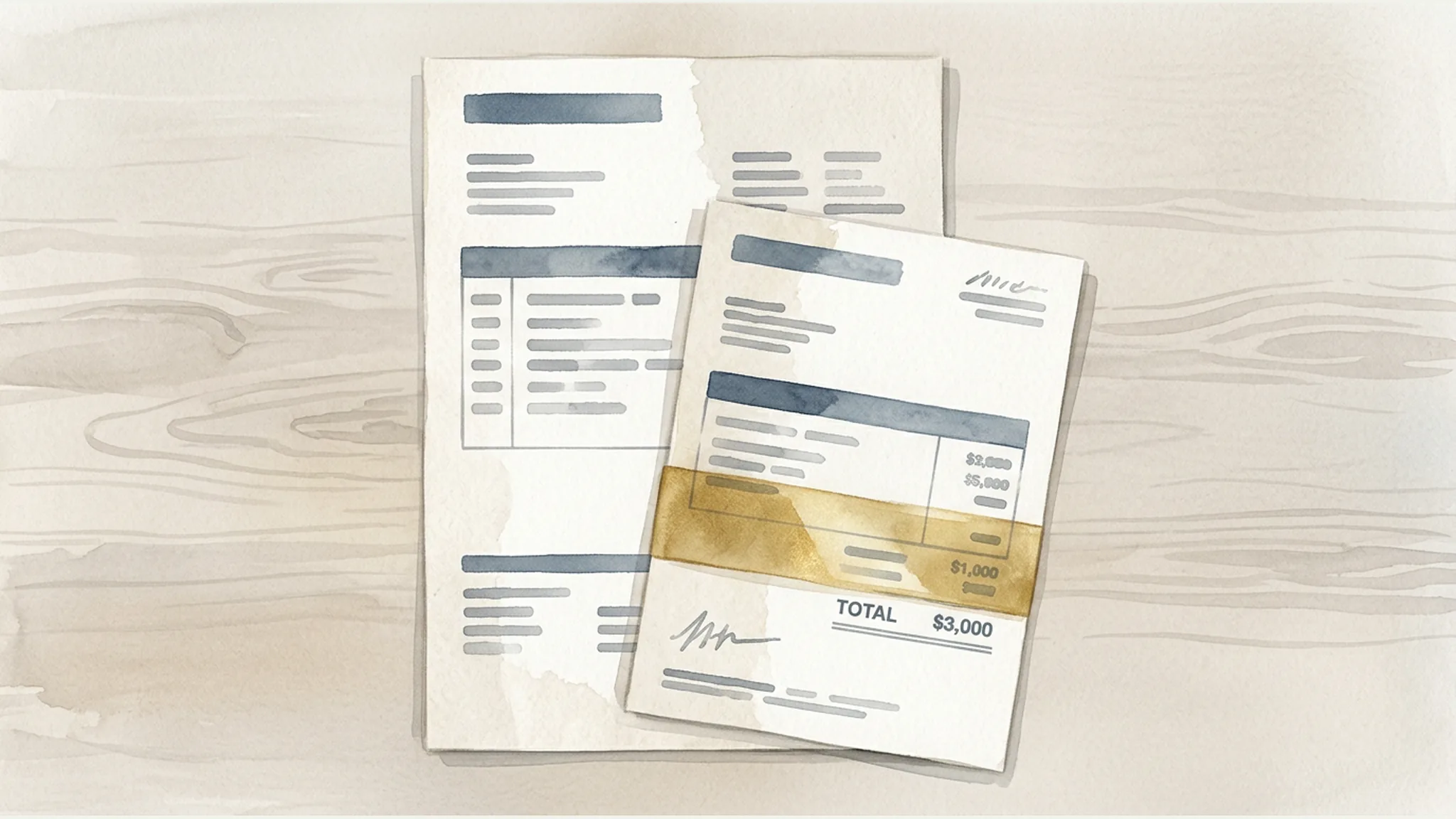
Instead of asking, “Which number is the real number?” build a medical-bill table. The table should separate damages proof from payment history and repayment claims.
Build a medical-bill table, not a single total
For each provider and date range, track:
- Provider name
- Date of service
- Type of treatment
- Billed charge
- Allowed amount, if shown
- Amount paid by PIP, health insurance, Medicare, Medicaid/OHP, or another payer
- Adjustment or write-off
- Patient responsibility or unpaid balance
- Denied or disputed charges
- Lien notice or reimbursement correspondence
- Medical records supporting causation, reasonableness, and necessity
This format makes it easier to see why the totals differ. It also makes it easier to respond when an adjuster points to only the lowest number.
Separate claimed damages from repayment claims
The amount claimed as medical-expense damages and the amount that must be repaid are related, but they are not the same thing.
A demand may claim reasonable medical charges as part of damages. Separately, the settlement team may evaluate who must be paid back from the proceeds. Mixing those questions can distort both the settlement value and the client’s net recovery estimate.
Ask what is unpaid, what was written off, and what must be repaid
Before negotiation or settlement, useful questions include:
- Is this charge connected to the injury claim?
- Was the treatment medically necessary and reasonable?
- Was the bill paid by PIP, health insurance, Medicare, Medicaid/OHP, or another payer?
- Was any part adjusted or written off?
- Is the patient still being billed?
- Has a provider filed or served a lien notice?
- Has an insurer or government payer asserted reimbursement or subrogation?
- Are there deadlines, notice rules, plan terms, or full-compensation issues that affect repayment?
The answers can change how a settlement demand is presented and how a proposed settlement is evaluated.
What This Means for Your Settlement Demand
A good settlement demand does not pretend that medical bills are simple. It explains them clearly.
Use billed charges to tell the injury-treatment story when supported
Billed medical charges can show the scope of treatment after the injury. They can help explain emergency care, imaging, follow-up visits, therapy, surgery, medication, and other care. But the bills should be supported by medical records and a causation story that connects the treatment to the incident.
The demand should be prepared for disputes over reasonableness, necessity, causation, and treatment gaps.
Use paid and allowed amounts to anticipate defense arguments and net-recovery issues
Paid and allowed amounts are not the automatic cap. Still, they help anticipate what the defense may argue and what repayment issues may arise. If a bill shows a large adjustment, the demand may need to explain why the billed charge remains relevant under Oregon law. If a payer has a reimbursement claim, the settlement analysis should account for how that claim affects the final distribution.
Use lien and reimbursement information to avoid surprises at disbursement
The settlement demand and negotiation strategy should identify known liens and reimbursement issues. This is especially important when Medicare, Medicaid/OHP, PIP exhaustion, health-insurance subrogation, hospital liens, disputed balances, or policy-limit offers are involved.
No article can predict a case’s settlement value from billing totals alone. A well-supported negotiation position usually documents reasonableness, necessity, causation, and repayment exposure, then evaluates the settlement offer against both gross value and likely net recovery.
When to Get Help Sorting Out Medical Bills Before Settlement
Medical-bill issues deserve extra attention when any of these appear in the file:
- Medicare conditional payments
- Medicaid or Oregon Health Plan involvement
- PIP exhaustion or PIP reimbursement notices
- Hospital or provider lien notices
- Health-plan reimbursement or subrogation letters
- A self-funded employer health plan or ERISA language
- Large write-offs or adjustments
- Disputed, denied, or unrelated treatment charges
- Ongoing unpaid balances
- Policy-limits settlement offers
- Settlement checks that name unexpected payees
- Uncertainty about what the injured person will receive after fees, costs, liens, and reimbursements
Johnson Law helps injured Oregonians evaluate settlement issues, including medical bills, liens, reimbursement claims, and net recovery questions. The right analysis depends on the facts, the insurance policies, the medical records, and the applicable repayment rules. This article is educational information only and is not a substitute for legal advice about a specific claim.
FAQ
Do Oregon injury settlements use the full medical bill or the amount insurance paid?
Both may matter, but for different reasons. Oregon damages law may permit an injured person to claim reasonable billed medical charges, and the claim is not automatically capped by what insurance paid. Paid and allowed amounts can still matter in negotiation, reimbursement analysis, lien review, and net recovery planning.
Does White v. Jubitz mean insurance paid amounts never matter in Oregon?
No. White supports the point that an Oregon medical-expense claim is not automatically limited to Medicare paid amounts. It does not create a guaranteed settlement formula, and it does not resolve every private-insurance, ERISA, Medicaid/OHP, PIP, lien, or reimbursement scenario.
Can the defense tell the jury that my health insurance or Medicare paid less than the bill?
Oregon’s collateral-benefit statute treats collateral-benefit evidence differently at trial and after a verdict. ORS 31.580 provides that evidence of collateral benefits and the cost of obtaining them is not admitted at trial, but is received by the court by affidavit after the verdict for potential post-award issues. How that applies in a particular case should be evaluated with a lawyer.
If PIP paid my medical bills after an Oregon crash, do I still include those bills in my injury claim?
Often, yes, medical expenses paid by PIP may still be part of the damages presentation in a third-party motor-vehicle claim. Oregon PIP reimbursement statutes can require benefits furnished to be included as damages in certain motor-vehicle claims, but reimbursement rights, full-compensation rules, notice, and statutory conditions are fact-specific.
What is the difference between a medical lien and a write-off?
A write-off or adjustment is a billing reduction or accounting change. A medical lien is a claim against settlement, judgment, award, or compromise proceeds. They are not the same. A file can include both a write-off and a lien issue, or one without the other.
Why can my final settlement check be smaller than the settlement amount?
The headline settlement amount may be reduced by attorney fees, case costs, provider liens, insurer reimbursement, Medicare or Medicaid/OHP recovery, and unpaid medical balances. That is why gross settlement value and net recovery should be evaluated separately before settlement is finalized.
Sources
- ORS 31.705: Oregon economic and noneconomic damages definitions, including reasonable charges necessarily incurred for medical and related care.
- White v. Jubitz Corp., 347 Or 212, 219 P3d 566 (2009): Oregon Supreme Court decision addressing medical-expense claims and Medicare paid amounts/write-offs.
- ORS 31.580: Oregon collateral-benefit statute, including post-award timing, exceptions for repayable benefits and certain premium-paid insurance benefits, and affidavit procedure.
- CMS medical-billing resources on explanations of benefits and health-insurance terms: definitions used to distinguish billed, allowed, paid, and patient-responsibility amounts.
- ORS 742.536, ORS 742.538, and ORS 742.544: support for the damages-specific FAQ addressing PIP-paid expenses in Oregon motor-vehicle claims.
Disclaimer: This article provides general educational information about Oregon personal injury settlement issues. It is not legal advice and does not create an attorney-client relationship. Medical-bill, lien, reimbursement, Medicare, Medicaid/OHP, PIP, ERISA, and settlement-distribution issues depend on the facts, the policies and plan documents, and the law that applies at the time.
Client-First Fee Promise
Client First = Bills First, Fees Second
Your unpaid medical bills do not have to make your lawyer's fee bigger. Johnson Law subtracts qualifying medical bills before calculating our fee, helping clients keep more of their settlement.
Applies to qualifying cases. Results vary.