“My MRI Is Normal” — Can You Still Be Compensated for Pain?
“My MRI Is Normal” — Can You Still Be Compensated for Pain?
If your MRI came back “normal” but you still hurt, that result can feel defeating. It can also make you worry that an insurer, adjuster, or defense lawyer will treat your pain as if it does not count.
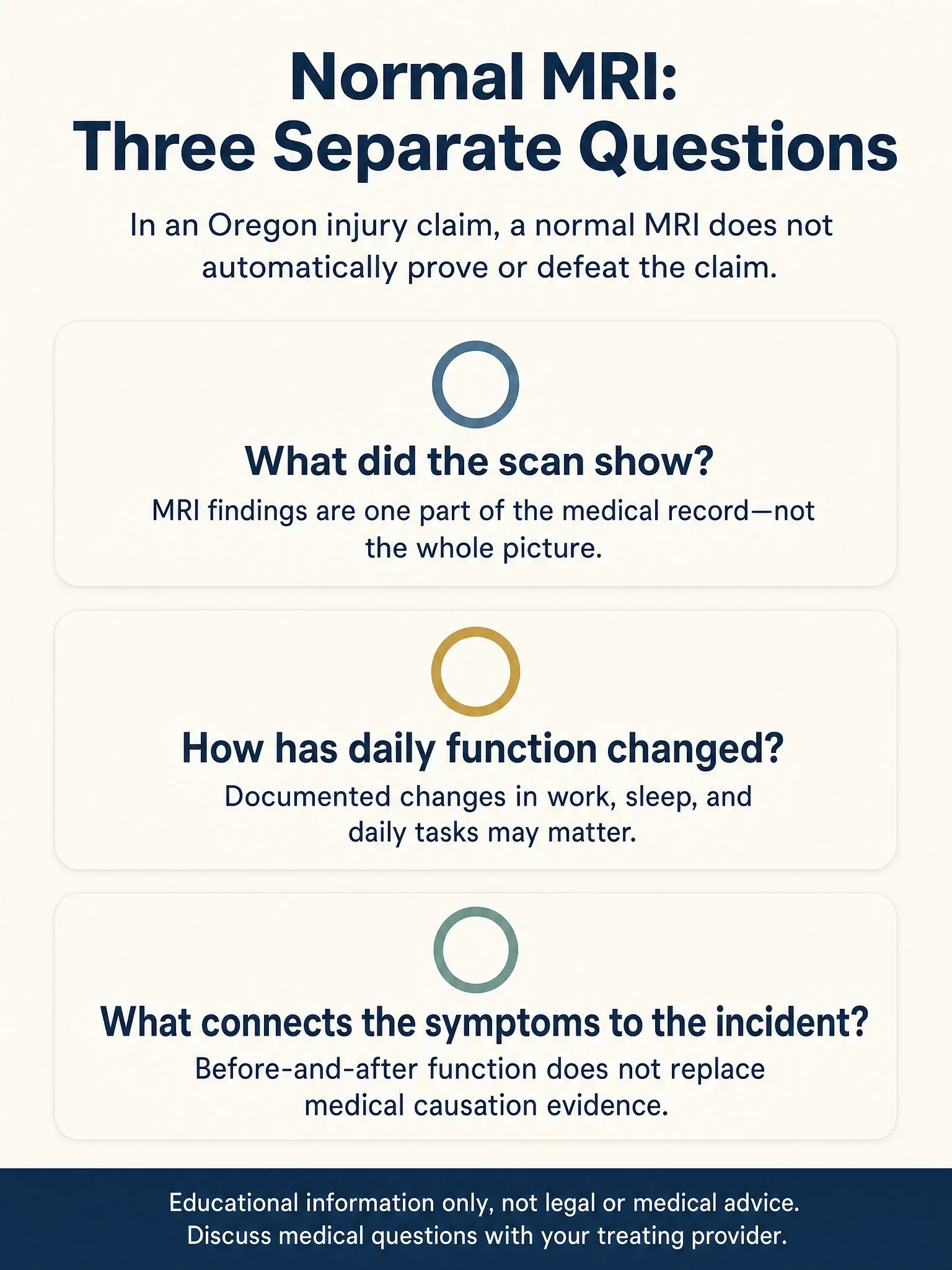
The short answer is this: a normal MRI does not automatically defeat a pain claim in Oregon. It also does not automatically prove the claim. A normal MRI changes the evidence conversation. Instead of relying on one scan to explain everything, the claim may depend more heavily on clinical findings, treatment records, symptom consistency, functional limits, treatment response, causation, and the medical support behind any ongoing restrictions.
This article is educational information, not legal or medical advice. Medical questions should be directed to your treating providers. Legal questions about a specific Oregon injury claim should be discussed with an Oregon injury attorney.
Short Answer: A Normal MRI Does Not Automatically Defeat a Pain Claim
An MRI is important evidence, but it is not the entire claim file.
In an Oregon injury claim, the injured person generally must prove the facts that are essential to the claim, including injury, causation, and damages. Oregon law also recognizes both economic damages and noneconomic damages. Economic damages can include objectively verifiable monetary losses such as reasonable and necessary medical and health-care charges, lost income, and past or future impairment of earning capacity. Noneconomic damages can include pain, mental suffering, emotional distress, inconvenience, and interference with normal activities.
That matters because pain and disrupted function are legally recognized categories of harm. But recognition is not the same as automatic compensation. A normal MRI injury settlement—if one is supported at all—usually depends on whether the overall evidence credibly connects the incident to the symptoms and shows how those symptoms affected the person’s life, work, treatment needs, and daily function.
Put another way: the question is not simply, “What did the MRI show?” It is, “What does the full medical and factual record show?”
Why an MRI Is Only One Part of the Evidence
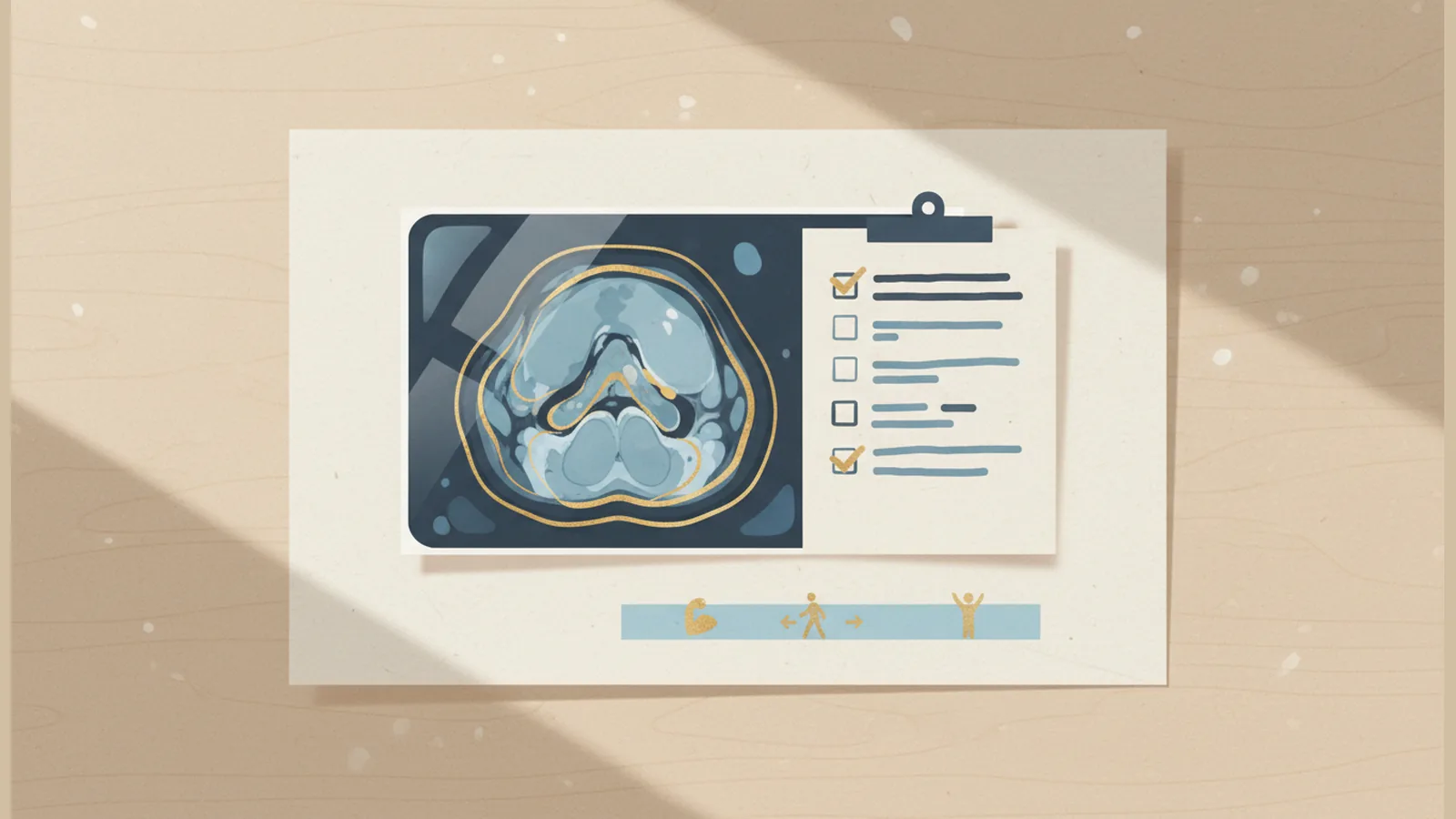
MRI results can be helpful. In some situations, imaging may identify problems such as certain spine, soft-tissue, or nerve-related issues. But medical evaluation of pain does not begin and end with imaging.
Imaging can be useful, but context matters
Medical sources describe pain evaluation as a broader clinical process. The National Institute of Neurological Disorders and Stroke explains that physical and neurological examinations may evaluate movement, reflexes, sensation, balance, coordination, inflammation, swelling, and circulation. Other diagnostic tools may be used in some situations, depending on the patient’s symptoms and the provider’s medical judgment.
That is why a normal MRI should be treated as one data point. It may rule out some concerns. It may make some theories harder to prove. But it does not, by itself, answer every question about pain, function, or causation.
For a narrower discussion of a clinical pain diagnosis that is not established or excluded by one scan, see Johnson Law’s guide to CRPS diagnosis and proof issues in Oregon injury claims.
This is especially important when the claim involves symptoms that are evaluated through history, physical examination, treatment response, or function over time. For example, medical references describe sprains, strains, and other soft-tissue injuries as conditions that may be evaluated through symptoms, the injury circumstances, and physical examination findings, with imaging used when appropriate. That does not mean a normal MRI proves a soft-tissue injury exists. It means imaging is not the only medical evidence that may matter.
Pain and imaging do not always line up neatly
Pain is personal. NINDS describes a person’s own report as the best measure of the pain they feel. At the same time, a legal claim still needs support beyond simply saying, “I hurt.” The stronger record usually includes consistent medical history, exam findings, treatment notes, functional limitations, and provider-supported opinions or restrictions.
Imaging also has to be interpreted in clinical context. A systematic review published in the American Journal of Neuroradiology found that degenerative spine imaging features are common in people without symptoms and increase with age. The point is not that imaging never matters. It does. The point is that MRI findings—whether normal or abnormal—do not always map perfectly onto pain.
That cuts both ways. A normal MRI does not automatically mean there is no compensable pain. An abnormal MRI does not automatically prove that a particular incident caused the symptoms. The full context matters.
Medical Evidence That May Matter When the MRI Is Normal
When imaging does not provide a clear explanation, the focus often shifts to other parts of the medical record. The goal is not to “replace” the MRI with guesswork. The goal is to build an accurate, medically supported record of what happened and how the person’s function changed.
Clinical exam findings
Clinical findings can help show what providers observed and measured over time. In cases involving shooting, burning, or radiating symptoms, the analysis may also include whether the pain path fits neurological exam findings; Johnson Law discusses that narrower issue in its article on radiating pain and neurological exam findings. Depending on the injury and symptoms, records may address issues such as:
- range of motion;
- tenderness;
- swelling or bruising;
- muscle spasm;
- strength;
- reflexes;
- sensation or abnormal sensations;
- gait, balance, or weight-bearing;
- joint stability; and
- the ability to use the injured body part normally.
These findings do not all apply to every case. They also do not automatically prove causation. But they can provide context that an MRI report alone may not capture.
Function over time
Pain claims are often easier to evaluate when the record explains function, not just pain scores. Useful functional evidence may include documented changes in:
- work duties or missed work;
- lifting, bending, sitting, standing, driving, walking, or sleeping tolerance;
- household chores;
- exercise, recreation, or caregiving activities;
- flare-ups after activity; and
- provider-supported restrictions or modifications.
This is where medical records are not the whole story. Chart notes may be brief. Supporting documentation can add context, as long as it is accurate and consistent with the medical record.
Treatment response
Treatment response can also matter. Providers may document whether symptoms improved, worsened, plateaued, or flared with activity. Records may show whether conservative care helped, whether referrals were made, whether medications or therapy changed, or whether restrictions were adjusted.
NINDS describes the goal of pain management as improving quality of life and function, including work, school, and daily activities. That function-focused view can be important in an injury claim. The issue is not only whether pain exists; it is how the pain affects the person’s life and whether those effects are supported by the medical record.
Provider-selected additional testing
Some pain patterns may lead a provider to consider additional evaluation, such as electrodiagnostic testing. NINDS describes electromyography (EMG) as a tool for evaluating how nerves and muscles are functioning, and nerve conduction studies as measuring signal strength and speed along certain nerves.
That does not mean every person with pain and a normal MRI needs an EMG, nerve conduction study, repeat MRI, or specialist referral. Those are medical decisions. The safer takeaway is this: if symptoms continue, change, or involve nerve-type complaints such as burning, tingling, shooting, or electric-shock sensations, those concerns should be discussed with the treating provider rather than self-diagnosed or ignored.
Oregon Damages: What Compensation May Be Based On
Oregon injury claims are not valued by MRI results alone. A normal MRI may affect how the claim is evaluated, but damages still depend on the full evidence.
For a broader overview, see Johnson Law’s guide to personal injury settlement valuation factors. This article focuses on one narrower issue: how pain and function may be proven when imaging is normal.
Economic damages
Economic damages are objectively verifiable monetary losses. In an Oregon injury case, those may include reasonable and necessary medical, hospital, rehabilitation, and other health-care charges; lost income; and past or future impairment of earning capacity when supported by evidence.
In a normal-MRI case, economic damages may turn on questions such as:
- Was the treatment reasonable and related to the incident?
- Were missed wages or work limits medically supported?
- Did the symptoms affect earning capacity?
- Are any future care needs supported by medical evidence?
Medical bills alone do not prove every disputed issue, but they are part of the damages record.
Noneconomic damages
Oregon law also recognizes noneconomic damages, including pain, mental suffering, emotional distress, inconvenience, and interference with normal and usual activities.
This is the category many people are worried about when they ask whether pain “counts” after a normal MRI. It can count. But the evidence still matters. A credible noneconomic damages record often includes consistent symptoms, treatment history, clinical observations, functional changes, and testimony or documentation explaining how daily life changed after the incident.
Future care and permanency
Future care, permanent limitations, and long-term work effects should be handled carefully. They should not be assumed from pain alone or from a normal MRI alone. They need medical support.
If symptoms, treatment response, restrictions, or prognosis are still developing, settlement timing can matter. Johnson Law has a separate article on why maximum medical improvement can affect settlement timing for that issue. The basic point here is simple: if the medical picture is not stable, it may be harder to know the full scope of future care or lasting limits.
How Causation Is Proved When Imaging Does Not Tell the Whole Story
In a legal claim, it is not enough to show that someone has pain. The claim must connect the pain and losses to the incident at issue.
That causation question can become more contested when an MRI is normal. It can also become more contested when there were prior symptoms, degenerative findings, delayed treatment, or other possible explanations.
Before-and-after function
Before-and-after evidence can be important. What could the person do before the crash, fall, or other incident? What changed afterward? Did those changes appear in medical records, work records, family observations, activity records, or other documentation?
Before-and-after evidence is not a substitute for medical causation. But it can help tell the story of functional change, especially when the MRI does not provide a visible explanation.
Timing and consistency of symptoms
Medical sources emphasize that clinicians consider how an injury occurred and when pain started. In a claim setting, timing and consistency can also matter.
For example, records may address:
- when symptoms first appeared;
- whether symptoms were reported consistently;
- whether symptoms changed over time;
- whether treatment recommendations were followed; and
- whether activity limits were documented.
Consistency does not mean every note must be identical. Symptoms can evolve. Pain can flare. Treatment access can be complicated. But unexplained contradictions, long undocumented gaps, or unclear histories can give an insurer more room to dispute the claim.
Medical history and prior conditions
A prior condition or degenerative finding does not automatically defeat an Oregon injury claim. It may, however, make the causation and aggravation evidence more important.
The key questions often become: What symptoms or limits existed before the incident? What changed after it? Did providers connect the change to the incident? Are there other explanations? How does the medical record address those possibilities?
This is another place where imaging must be interpreted carefully. Degenerative findings can appear in people without symptoms. At the same time, a prior condition can be a real issue in a claim. The answer depends on the clinical and factual record, not on a label alone.
Common Insurer Arguments in “Normal MRI” Pain Claims
Insurers and defense lawyers may raise normal MRI results as part of a broader challenge to injury, causation, or damages. Those arguments should be taken seriously and answered with evidence and context, not assumptions.
“The MRI is normal, so nothing is wrong.”
This argument treats the MRI as if it were the entire medical record. A more accurate response is that imaging is one part of the evaluation. Clinical exam findings, treatment history, symptom consistency, and functional limitations may also matter.
That does not mean the MRI should be ignored. It means the claim should be evaluated in context.
“You waited too long or had gaps in treatment.”
Delays and treatment gaps can create problems in an injury claim. An insurer may argue that delayed care means the symptoms were not serious, were not related, or resolved.
Sometimes there are real-world explanations: symptoms developed over time, a person tried to work through pain, appointments were unavailable, insurance or transportation was difficult, or caregiving and work obligations got in the way. Those explanations are strongest when they are documented honestly and consistently.
“You had a preexisting condition.”
Preexisting conditions are common issues in pain claims. The question is not simply whether something existed before. The question is whether the incident caused a new injury, worsened an existing condition, or changed the person’s function.
Good records can help separate “this was already there” from “this changed after the incident.” That usually requires medical context and a clear before-and-after record.
“Pain is subjective.”
Pain is subjective, and medical sources recognize that a person’s own report is central to measuring pain. But in a legal claim, subjective pain is usually more persuasive when supported by consistent records, clinical findings, functional impact, treatment response, and medically supported limits.
The goal is not to exaggerate pain. The goal is to document it accurately.
Practical Documentation That Can Help Tell the Full Story
If your MRI is normal and pain remains an issue, practical documentation can help show the full picture. This is not about creating evidence after the fact or overstating symptoms. It is about preserving accurate information before details fade.
Keep treatment chronology clear
A simple timeline can help organize:
- date of the incident;
- first symptoms;
- first medical visit;
- imaging dates and results;
- physical therapy, chiropractic care, primary care, specialist visits, or other treatment;
- referrals;
- work restrictions; and
- major changes in symptoms or function.
Johnson Law’s treatment timeline template may help organize that chronology.
Track symptoms and function, not just pain scores
A pain score by itself may not explain much. A short journal can be more useful when it records function: what activity triggered symptoms, what you could not finish, what helped, what worsened symptoms, whether sleep was disrupted, and whether you had to modify work or home tasks.
For a practical starting point, see the pain symptom journal and the medical documentation checklist.
Save work, activity, and expense records
Depending on the case, helpful records may include:
- wage loss documentation;
- employer notes about restrictions or missed shifts;
- receipts for out-of-pocket medical or travel expenses;
- records of cancelled activities or modified responsibilities;
- photographs of visible bruising, swelling, assistive devices, or activity limitations when relevant; and
- communications with providers, insurers, or employers.
In auto-crash cases, medical bill payment may involve PIP benefits before the bodily-injury claim is resolved. Johnson Law has a separate overview of PIP in Oregon for that topic.
A Brief Oregon Note on Comparative Fault and Deadlines
Two Oregon legal guardrails are worth mentioning, even though they are not specific to normal MRI claims.
First, comparative fault can affect recovery. Under Oregon’s comparative fault framework, a claimant’s negligence does not necessarily bar recovery if the claimant’s fault was not greater than the combined fault of the persons specified in the statute, but damages are reduced in proportion to the claimant’s percentage of fault. Fault allocation is evidence-dependent.
Second, deadlines matter. Oregon generally has a two-year limitations period for many personal injury claims, but that is not a universal deadline calculator. Public-body claims, minors, medical malpractice, advance payments, and other circumstances may involve different or additional rules. If a deadline may be approaching, it is important to get legal advice promptly.
When to Be Careful About Settling Too Early
A normal MRI may affect how an insurer evaluates the claim or the timing of an offer, especially if the insurer believes the medical evidence is limited. An early offer may arrive before symptoms, treatment response, work restrictions, or prognosis are clear.
That does not mean every early offer is wrong. It does mean timing should be evaluated carefully. If future care, lasting limitations, or work impact are still uncertain, a settlement may not reflect the full record. Johnson Law has a separate article on evaluating quick cash settlement offers that explains that issue in more detail.
Bottom Line: Pain Still Needs Proof, Even When It Is Real
A normal MRI can be frustrating, especially when you know your pain is real. But it does not automatically end an Oregon injury claim. It also does not automatically establish one.
When imaging is normal, the important evidence often shifts to the rest of the record: medical history, clinical findings, treatment response, functional limitations, symptom consistency, causation, and medically supported restrictions or future needs.
The most helpful approach is usually accurate documentation, consistent medical follow-up, and careful attention to how the injury changed daily function. For medical questions, follow up with your treating providers. For legal questions about how a normal MRI affects an Oregon injury claim, consider speaking with an Oregon personal injury attorney.
FAQ
Can I still get an injury settlement if my MRI is normal?
Possibly, but it depends on the overall evidence. A normal MRI is one factor. The claim still needs support for injury, causation, damages, and credibility. Clinical findings, treatment records, functional limits, and consistent documentation may all matter.
Does Oregon law allow compensation for pain without a visible MRI finding?
Oregon law recognizes noneconomic damages such as pain, mental suffering, emotional distress, inconvenience, and interference with normal activities. But subjective pain still needs credible support and a connection to the incident.
What evidence helps if imaging does not show an injury?
Helpful evidence may include medical history, physical or neurological exam findings, treatment records, symptom consistency, functional limitations, work restrictions, treatment response, and provider-supported opinions. The useful evidence depends on the case.
Will the insurer use a normal MRI against me?
It may. Insurers may also raise delay in treatment, gaps in care, preexisting conditions, degenerative findings, or the subjective nature of pain. Those arguments are usually addressed through records, medical context, and accurate documentation.
Should I ask my doctor for an EMG or another MRI?
This article cannot give medical-testing advice. Additional testing is a medical decision for your treating provider based on your symptoms, exam, history, and clinical judgment. If you have ongoing or changing symptoms, discuss them with your provider.
Should I settle before I know why I still hurt?
Be cautious about settling before the medical picture is clear. If symptoms, treatment response, prognosis, future care, or work limits are still developing, settlement timing may affect whether the claim reflects the full record. Whether to accept any specific offer is a case-specific legal decision.
Source Notes
- ORS 40.105, Oregon Evidence Code Rule 305, for burden-of-persuasion framing.
- ORS 31.705 for Oregon economic and noneconomic damages definitions and separate damages categories.
- ORS 31.600 and ORS 31.605 for Oregon comparative fault and fault-allocation concepts.
- ORS 12.110, ORS 12.155, and ORS 30.275 for general personal-injury deadline framing, advance-payment caveats, and Oregon public-body notice/deadline caveats.
- National Institute of Neurological Disorders and Stroke, “Pain,” for pain as a personal experience, clinical evaluation concepts, diagnostic tools, and function-oriented pain management.
- National Institute of Neurological Disorders and Stroke, “Peripheral Neuropathy,” for nerve-symptom evaluation tools and EMG/nerve conduction study descriptions.
- Merck Manual Consumer Version, “Overview of Sprains and Other Soft-Tissue Injuries,” for soft-tissue symptoms, history, physical examination, and imaging context.
- RadiologyInfo.org, “Low Back Pain,” for the principle that imaging decisions depend on clinical scenario.
- Brinjikji et al., American Journal of Neuroradiology, “Systematic literature review of imaging features of spinal degeneration in asymptomatic populations,” for clinical-context cautions about degenerative imaging findings.
Client-First Fee Promise
Client First = Bills First, Fees Second
Your unpaid medical bills do not have to make your lawyer's fee bigger. Johnson Law subtracts qualifying medical bills before calculating our fee, helping clients keep more of their settlement.
Applies to qualifying cases. Results vary.