Dead-Red Laws in Oregon and Washington: When Can You Go?
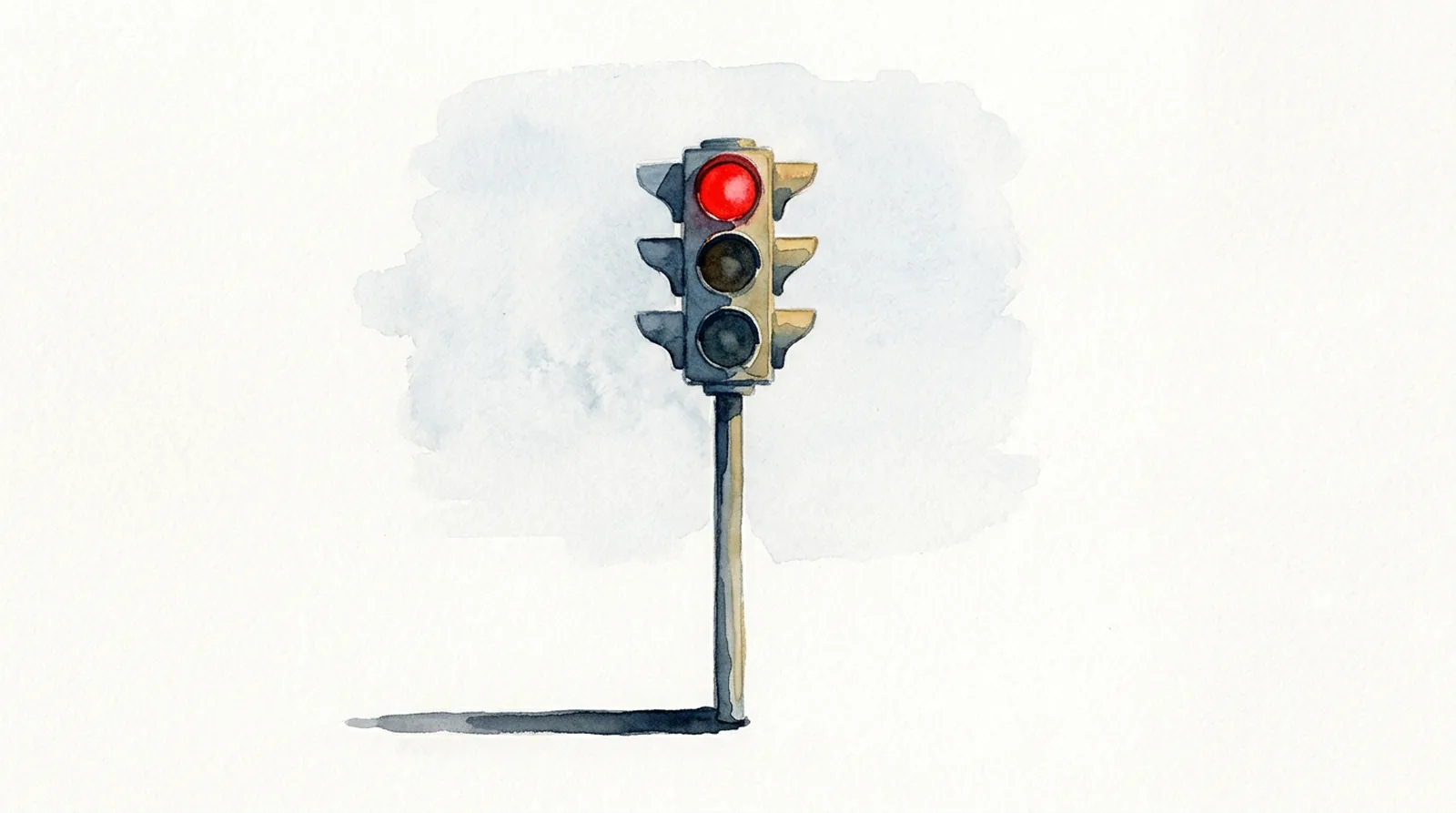
Imagine stopping your bicycle or motorcycle at a red light. The intersection looks empty. You wait. The signal remains impressively committed to red.
“How long do I have to sit here?” is understandable. But the legal answer starts with three different questions: Which state? Which vehicle? What is the signal actually doing?
Oregon and Washington allow certain riders to proceed after an unsuccessful signal cycle—but only when the actual detector-related conditions and other statutory requirements are satisfied. Neither state gives car drivers a general timed exception to proceed straight through an illuminated red.
Keep these distinctions in mind:
- A long wait is not proof of detector failure.
- One cycle is not a universal number of seconds.
- Vehicle eligibility differs across state lines.
- Dark signals, flashing signals, turns on red, and bicycle safety stops have separate rules.
The details matter, but they need not be mysterious. Here is how to sort them out.
The quick answer: a missed green is not permission for everyone
The narrow exceptions are in Oregon’s ORS 811.360(2)–(5) and Washington’s RCW 46.61.184. Both require more than patience followed by an empty intersection.
This table is a summary, not a stand-alone permission checklist. The full conditions below still apply.
| Question | Oregon | Washington |
|---|---|---|
| Which vehicles? | Bicycles and motorcycles; qualifying electric-assisted bicycles generally receive bicycle treatment. Mopeds are excluded from the motorcycle definition. | Bicycles, electric-assisted bicycles, mopeds, and street-legal motorcycles are expressly named. |
| What signal problem? | Vehicle-detection-controlled steady circular red, red bicycle signal, or red arrow; failure to detect the eligible vehicle and provide green. | A triggered signal, including a left-turn signal, whose detector is inoperative because of the vehicle’s size or composition. |
| What stop and wait? | Complete stop and one full unsuccessful cycle. | Full stop and failure to operate after one cycle. |
| What movement and safeguards? | Cautious proceeding; other controls, police prohibitions, traffic-yielding duties, and pedestrian-stopping duties remain. | Directly through or left as appropriate, with due care; other restrictions still matter. |
| What about cars or a stopwatch shortcut? | No straight-through car permission under this exception; no seconds substitute. | Same—and specified mistaken beliefs are not a defense. |
Think of the requirements as a combination lock, not a menu. Being on the right vehicle does not replace the unsuccessful cycle. Waiting through a cycle does not replace actual detector failure. And satisfying those conditions does not make conflicting traffic disappear.
First, identify the kind of red-light problem
Steady red, dark, and flashing are not the same
“Dead red” is an informal description, not one uniform legal category. A light that is visibly red has not become a dark signal just because it seems uninterested in changing.
For genuinely dark signals, the Oregon DMV driver manual instructs drivers to treat the intersection as an all-way stop. Washington’s dark-signal statute provides all-way-stop treatment when all approaches temporarily lack power or the driver’s approach displays no green, red, or yellow. Authorized flagger, police, or firefighter direction remains controlling.
For ordinary motor traffic, flashing red means stop; flashing yellow means proceed cautiously. See ORS 811.260 and RCW 46.61.065. Oregon has a bicycle-specific flashing-red distinction, discussed next.
A bicycle safety stop is a different rule
Oregon’s bicycle stop-as-yield provisions, ORS 814.414 and 814.416, cover qualifying stop signs and flashing red intersection signals—not ordinary steady reds. Riders must slow to a safe speed and preserve yielding, pedestrian, and care duties; the rules do not authorize prohibited directions or disregard of police instructions. Our guide to Oregon bicycle stop-sign and flashing-red rules explains that separate subject.
Washington’s bicycle safety-stop rule concerns qualifying stop signs. Riders must slow reasonably, yield, and stop when safety requires. Railroad stop signs and school-bus signals are excluded. It is not a steady-red exception or a general flashing-red rolling exception: Washington flashing red requires a stop.
The first useful diagnosis, then, is not “broken or working?” It is “steady, flashing, or dark?”
Oregon: what the one-full-cycle exception actually requires
Work through every condition—not just the wait
Oregon ordinarily requires a driver facing steady red to stop and remain stopped unless an authorized exception applies. Under ORS 811.260, the stopping location is the marked stop line; without one, before the marked near-side crosswalk; without either, before entering the intersection.
The detector exception in ORS 811.360(2)–(5) requires working through the whole sequence:
- You are operating an eligible bicycle or motorcycle. Vehicle classification matters, as explained below.
- You face a covered steady indication: a circular red, red bicycle signal, or red arrow controlled by vehicle detection.
- You come to a complete stop. This is not a rolling-stop provision.
- You wait one full cycle. A personally chosen waiting period does not replace that requirement.
- The detector fails to detect your bicycle or motorcycle and provide green. Delay alone does not establish this fact.
- Any proceeding is cautious and satisfies the remaining duties. The exception does not cancel other traffic controls or police prohibitions.
Those remaining duties deserve their own sentence: you must yield to traffic lawfully in the intersection or approaching closely enough to constitute an immediate hazard. Oregon’s pedestrian stopping requirements under ORS 811.028 also remain in force. “Yield to everyone” is not a complete substitute for that pedestrian rule.
The exception is not limited to making an ordinary right turn. But it does not erase lane restrictions or turn controls, either. A missed detection is not a reset button for the rest of the intersection.
For example, suppose an eligible rider has completely stopped, waited a full cycle, and actually experienced the covered detection failure. Even with those facts established, approaching cross traffic can still require the rider to wait. Meeting the detector conditions does not give the rider automatic right of way.
Why “two wheels” is not an eligibility test
ORS 814.405 generally treats electric-assisted bicycles as bicycles. But ORS 801.365 excludes mopeds from the definition of motorcycles, and Oregon’s detector exception does not separately name mopeds.
That is a meaningful distinction, not a vocabulary preference. A product’s sales label does not determine its legal classification. Do not assume every stand-up scooter, modified e-bike, or vehicle advertised as an “electric bike” qualifies. Unusual vehicles need a classification-specific answer before anyone can confidently apply the exception.
Washington: more named vehicles, but no “I thought it was broken” shortcut
Eligibility, actual failure, and permitted movement
RCW 46.61.184 expressly names bicycles, electric-assisted bicycles, mopeds, and street-legal motorcycles. Washington therefore names a vehicle Oregon’s exception does not: the moped. That does not make Washington universally more permissive; eligibility is only the beginning.
The Washington rule requires a full stop at the triggered signal. The detector must be inoperative because of the vehicle’s size or composition, and the signal must fail to operate after one cycle. With due care, the eligible operator may then proceed directly through or turn left, as appropriate.
Left-turn signals are included. This matters because being stranded in a left-turn lane is not necessarily outside the statute. It remains necessary to satisfy the actual detector conditions, use due care, and obey other applicable restrictions. The provision is separate from ordinary turns on red, discussed below.
Cars and trucks are not included in this detector exception. A car behind a qualifying motorcycle does not acquire the motorcycle’s permission by following it.
Why a reasonable-sounding guess can still be wrong
Washington’s statute addresses a tempting argument directly. A mistaken belief that the signal has a detector—or that it failed because of the vehicle’s size or composition—is not a defense when those statutory facts are absent.
That makes “I thought the light missed me” an incomplete legal explanation. An empty street, an unusually long wait, or another direction receiving green may be observations worth reporting. They are not substitutes for the required facts.
This does not mean a roadside rider can be handed a simple visual test that conclusively identifies every detector failure. The research supporting this guide supplies no such test. Signal technology and operation vary, and the cause of nonresponse can require site-specific evidence.
The practical takeaway is narrower and more useful: do not turn suspicion into certainty merely because the wait feels unreasonable. Understanding signal cycles and detection can explain the problem, but it cannot guarantee that a particular decision to proceed will satisfy the statute or defeat a citation.
Why the light may not detect you—and what a full cycle means
The pavement is not weighing your bike
An inductive loop detects vehicle metal, not vehicle weight. As ODOT’s bicycle-detection guidance explains, buried loops may be associated with circular, rectangular, or diamond-shaped pavement cuts. Position, geometry, materials, and detector configuration matter. Adding imaginary pounds to the bike is not the answer.
Nor does every detector leave an obvious outline in the pavement. Signals also use video and radar technology, discussed in WSDOT’s signal-design guidance and ODOT/FHWA detector research. No visible loop does not prove there is no detector. A camera used for detection also need not be a camera recording traffic violations.
None of this supports a guaranteed magnet trick, extra-weight fix, or engine-revving solution.
A signal cycle is not a kitchen timer
WSDOT describes a cycle as running from the start of green for one direction to the next start of green for that direction. Watching cross traffic move once does not necessarily mean you have observed a complete cycle.
Signals can also rest in main-road green when they have not detected cross traffic. Coordination with other signals and pedestrian-clearance time can lengthen a wait. A functioning signal can therefore feel unresponsive from one person’s position.
What if it never seems to complete a cycle at all? The research supporting this guide did not identify a controlling Oregon or Washington appellate answer for that specific problem. There is no supported elapsed-time fallback to offer here. WSDOT’s engineering explanation is helpful context, not a judicial test proving that a particular rider met the law.
That uncertainty is important. Replacing “one cycle” with “two minutes ought to be enough” would make the advice simpler—and unsupported.
Positioning can help, but cannot guarantee green
ODOT advises bicyclists to place their wheels over marked detection zones and remain there. Its video-detection advice includes staying on the correct side of the stop bar, sitting upright, and wearing lighter clothing.
Those are practical agency suggestions, not legal permission to proceed and not a promise of activation. Keep any positioning within a lawful stopping location. Do not cross the stop line to experiment with detection. The older leaflet’s practical two-minute suggestion is not the statutory Oregon waiting rule.
What can you lawfully do when the light stays red?
In a car, do not borrow a rider’s exception
Neither Oregon’s detector exception nor Washington’s authorizes a car driver to proceed straight through an illuminated red based on elapsed time.
Depending on the intersection, lawful options can include using the proper stopping position, making a permitted turn from your actual lane, rerouting lawfully, seeking assistance or reporting safely, and following authorized traffic direction. Not every intersection offers an immediate alternative.
These options do not include crossing a stop line to trigger a detector, backing into traffic, cutting across lanes, or following a rider through red. A route around the problem must itself be lawful.
A permitted turn on red has its own requirements
In Oregon, ORS 811.360(1) separately allows specified turns after the required stop, caution, and yielding, unless another control prohibits the movement:
- Right into a two-way street.
- Right or left into a one-way street in its direction of travel.
That left-on-red permission is not limited to starting on a one-way street. It does not authorize an ordinary left on red into a two-way street. The statute also addresses the specified red-arrow indications; “red arrows always prohibit every turn” is not an accurate Oregon shortcut. Pedestrian-stopping and other applicable duties remain.
In Washington, RCW 46.61.055(3) separately permits specified right turns and left turns into one-way streets from one- or two-way streets after stopping at circular red or red arrow, unless a sign prohibits the turn. Drivers must preserve the statute’s yielding and remaining-stopped duties for lawful approaching or intersection traffic, pedestrians, and personal delivery devices.
Neither state’s ordinary turn authorization requires proving a missed detector cycle. But neither permits just any turn from any lane.
A U-turn is another question entirely. Oregon generally prohibits U-turns at signalized intersections unless posted otherwise under ORS 811.365. Do not treat an unresponsive signal as permission to improvise one—or export that Oregon provision as Washington law.
Four other states show why there is no universal dead-red rule
Traffic advice travels easily. Legal permission does not. These selected comparisons explain why a rule someone remembers from another state may be real, yet still be wrong for an Oregon or Washington intersection.
Virginia: two cycles or two minutes, whichever is shorter
Virginia Code 46.2-833(B) covers motorcycles, mopeds, and bicycles. It allows proceeding after a full stop for two complete cycles or two minutes, whichever is shorter, with the additional requirements satisfied.
The operator must exercise due care, otherwise treat the signal as a stop sign, determine that proceeding is safe, and yield to vehicles approaching on the other highway from either direction. The waiting period does not create automatic right of way.
Unlike the Oregon and Washington provisions discussed above, this Virginia subsection does not expressly require detector failure. It also does not include cars. Here, a statutory time alternative really exists—but it belongs to Virginia, not to every red light in the country.
Wisconsin: 45 seconds comes with important strings attached
Wisconsin’s provision names motorcycles, mopeds, motor bicycles, and bicycles. It requires a stop of at least 45 seconds, no other vehicles present to actuate the signal, and a reasonable belief that the signal is vehicle-actuated before cautious proceeding.
The yielding requirements cover applicable traffic, pedestrians, personal delivery devices, bicyclists, electric scooter riders, and electric personal assistive mobility device riders proceeding through green or lawfully within a crosswalk or intersection, as specified in the statute.
That long yield list is not an eligibility list. Naming an electric scooter rider as someone to yield to does not grant that rider the exception. Likewise, “motor bicycle” is a statutory category, not an invitation to translate a product description casually. The provision also preserves the separate authorization in subdivision 2.
Wisconsin’s reasonable-belief language should not be imported into Washington, whose statute expressly rejects the specified mistaken beliefs.
Pennsylvania: broader vehicle coverage, but actual malfunction matters
Pennsylvania’s malfunction provision, 75 Pa.C.S. 3112(c), applies to vehicular traffic generally and expressly includes failure of a vehicle-detection device.
Traffic facing red or an unlighted signal must stop and follow the stop-sign yielding requirements in section 3323(b). That includes yielding to vehicles in the intersection or approaching hazardously and entering only when safe.
Traffic facing green or yellow may proceed with the specified caution. In other words, the intersection does not necessarily become an all-way stop: another approach may still have green.
Pennsylvania’s rule has no fixed timer. Its broader vehicle coverage does not mean “cars may run a long red.” Inconvenient delay alone does not establish that the signal is inoperative or malfunctioning.
Idaho: bicycles and motorcycles do not share the same red-light rule
Under Idaho Code 49-720(2), bicycles and human-powered vehicles may cautiously proceed through steady red after stopping and yielding to all other traffic. That provision does not require detector failure or waiting through a cycle. This guide does not extend it to Idaho e-bikes without a separate classification review.
Motorcycles have a different rule. Idaho Code 49-802(3)(e) requires a full stop, one unsuccessful cycle, actual size-related detector failure, and due caution and care. The specified mistaken belief is not a defense if the required conditions are absent. Lane and turn restrictions remain.
Notice the wording: Idaho’s motorcycle provision uses size; Washington uses size or composition. And Idaho’s bicycle steady-red rule is not Oregon’s or Washington’s bicycle rule. Remembering the nickname “Idaho stop” is no substitute for identifying the state and signal involved.
Report the signal problem—and document it safely
Give the responsible agency observations, not a guess dressed as certainty
A useful report identifies cross streets, travel direction, lane and intended movement, date and time, vehicle type, the indication shown, cycles observed, and detection markings. These are helpful observations, not a mandatory legal evidence checklist. Spokane County’s reporting guidance illustrates the location and observation details agencies need.
In Portland, PBOT accepts signal-problem reports through 24-hour maintenance dispatch at 503-823-1700. That is a Portland contact, not a statewide hotline; distinguish equipment-repair concerns from nonurgent timing suggestions. For immediate emergencies, call 911.
Elsewhere, city or county public works generally handles local streets. WSDOT can help identify state-highway signal ownership. Washington law requires operators of existing vehicle-activated signals to publicize written or email bicycle/motorcycle detection complaint procedures and retain complaint and response records. Reporting supplies neither permission to proceed nor proof of liability.
Do not create a second safety problem to collect evidence
Motor-vehicle phone restrictions in Oregon and Washington reach temporary traffic-control stops, subject to statutory exceptions. Do not take this guide as advice to film handheld while stopped at red. Use existing dashcam material, safe passenger observations, or notes made after lawful, safe parking.
If a collision occurred, focus on preserving original footage and other crash evidence. Do not assume a visible camera recorded it: WSDOT says its intersection/freeway camera network does not retain or record video. Other owners’ systems may differ; ask what actually exists. Footage, retention, and access are not guaranteed, and later photos or reports do not automatically prove earlier conditions.
Frequently asked questions about dead-red signals
Can I go through a red light after two minutes in Oregon or Washington?
There is no general two-minute rule. The qualifying rider exceptions require the actual statutory conditions, including an unsuccessful cycle. They do not authorize cars to proceed straight. Virginia’s time alternative stays in Virginia.
What if the light never seems to complete a cycle?
This guide has no supported elapsed-time fallback to offer. Normal resting green and coordination can complicate observations. Consider the lawful options above rather than inventing a waiting threshold.
Does Washington let me go if I reasonably believe the detector missed me?
Not on belief alone. RCW 46.61.184 expressly rejects the specified mistaken beliefs about detector existence or size/composition-related failure when the required facts are absent.
Do e-bikes and mopeds qualify for Oregon and Washington dead-red exceptions?
Oregon generally treats qualifying electric-assisted bicycles as bicycles but excludes mopeds from its motorcycle definition. Washington expressly names both electric-assisted bicycles and mopeds. Modified or unusually classified vehicles need individual review; a retail label is not enough.
Can I turn left on red from a two-way street?
In Oregon and Washington, the ordinary turn provisions discussed above can permit a left into a one-way street in its direction of travel after stopping and satisfying the other duties, absent prohibiting controls. That is not ordinary permission to turn left into a two-way street.
Is a dead-red signal the same as a power-outage signal or an Idaho stop?
No. Illuminated steady red, dark approaches, flashing indications, and state-specific bicycle rules are distinct. Idaho’s steady-red bicycle rule does not apply across state lines.
The useful habit is simple: identify the signal, vehicle, jurisdiction, and actual conditions. Do not substitute a timer for a rule. If a collision or citation has made those facts disputed, consider getting legal advice specific to the incident rather than relying on a general summary.
Educational information only, not legal advice.
Source notes
Core legal sources are Oregon’s traffic statutes, Oregon’s bicycle provisions, and Washington’s detector exception. The comparison-state statutes and government engineering/reporting guidance are linked alongside the relevant explanations above.
Client-First Fee Promise
Client First = Bills First, Fees Second
Your unpaid medical bills do not have to make your lawyer's fee bigger. Johnson Law subtracts qualifying medical bills before calculating our fee, helping clients keep more of their settlement.
Applies to qualifying cases. Results vary.