Roundabout Accidents in Oregon: Right-of-Way Rules, Common Mistakes, and How to Prove Fault
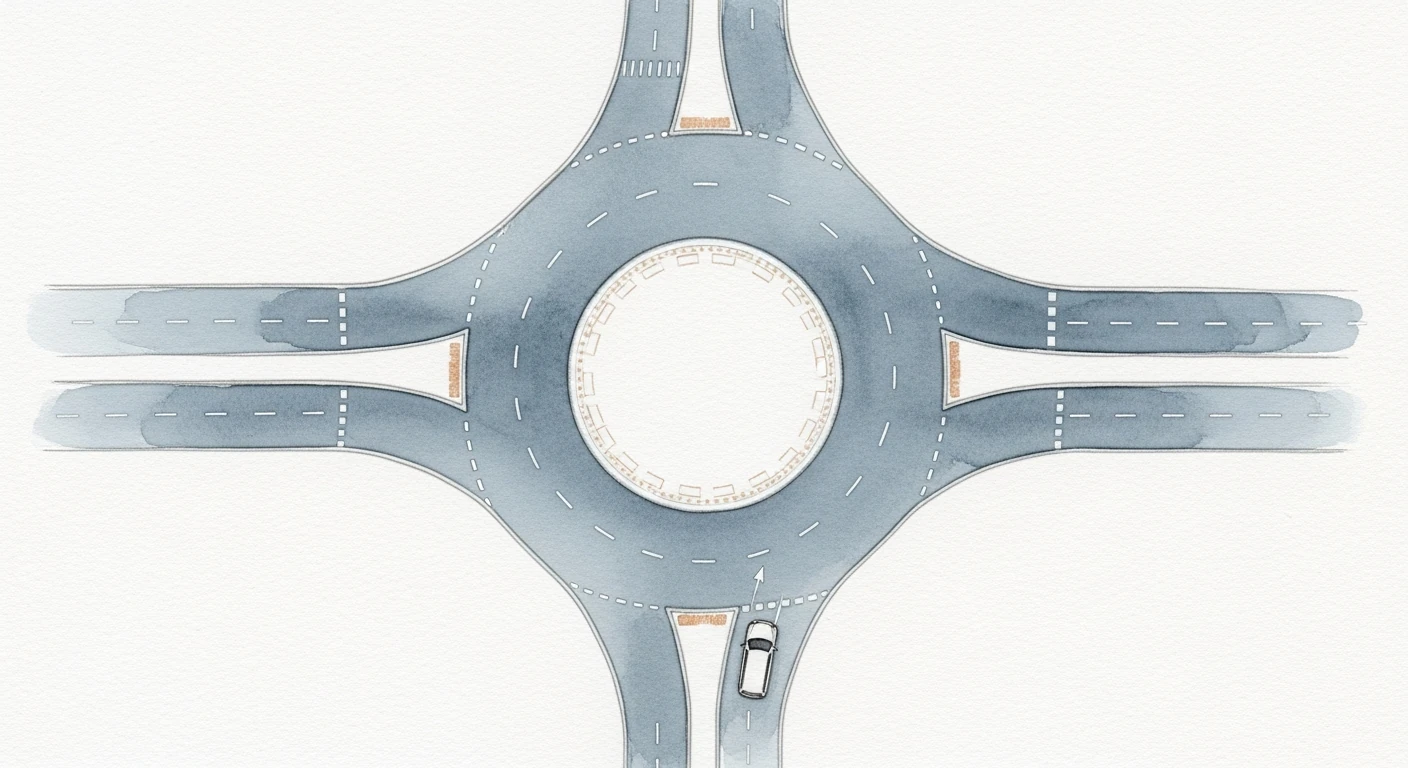
Oregon Roundabout Accidents: Right-of-Way Rules, Fault, and Evidence
Roundabouts are designed to reduce severe crashes, keep traffic moving, and simplify intersections. But when a collision happens, drivers often discover that insurers and even police reports can misread what “right-of-way” means inside the circle. Oregon’s rules are clearer once you know where to look, but roundabouts introduce lane-selection and exit duties that do not work like a four-way stop or signalized intersection.
This Oregon guide explains the core roundabout right-of-way rule, common multi-lane crash patterns, and the evidence that helps correct an unfair fault decision. If your crash is already turning into a percentage-fault dispute, our separate guide to Oregon comparative fault in car accidents explains how those percentages can affect recovery.
Important: This article is educational information only, not legal advice. Oregon crash claims turn on the exact signs, lane markings, vehicle positions, insurance coverage, injuries, and deadlines involved.
Quick Summary (If You Only Have Two Minutes)
- Entering traffic should yield to vehicles already circulating. Oregon’s Driver Manual instructs drivers entering a roundabout to yield to traffic inside and exiting the roundabout.
- Lane choice matters in multi‑lane roundabouts. Your lane sets your legal path and your right‑of‑way duties at exits.
- Outer‑lane drivers can cause sideswipes by continuing past an exit when signs or pavement arrows direct that lane to exit.
- Evidence can decide disputes. Photos of signs, pavement arrows, lane markings, vehicle positions, and video footage can correct insurer mistakes.
- You can challenge an insurer’s decision and, when appropriate, file a consumer complaint with the Oregon Division of Financial Regulation.
1. Oregon’s Core Roundabout Rule: Yield and Follow the Roundabout Layout
Oregon’s driver education materials set out the practical entry rule: before entering a roundabout, drivers must yield to traffic inside the roundabout and to traffic exiting the roundabout.
What that means in practice:
- You must slow down and yield at the entry line.
- You cannot force a vehicle already circulating to brake, stop, or swerve.
- The circulating vehicle has priority until a safe gap appears.
Source: Oregon Driver Manual, Turns and Intersections
Oregon also has a specific statute for certain multi-lane roundabout conflicts. Under ORS 811.292, a driver on a multilane circulatory roadway can violate the law by not yielding to a second vehicle lawfully exiting the roundabout from a position ahead and to the left, unless a traffic control device indicates otherwise.
Source: ORS 811.292 — Failure to yield right of way within roundabout
2. Why Roundabout Right‑of‑Way Confusion Happens
Roundabouts demand a different mental model than four‑way stops or signalized intersections. Instead of stop‑go cycles, you’re merging into a circulating stream. The result is a predictable mix of errors:
- Treating yield as stop. Drivers stop when the roundabout is clear, inviting rear‑end collisions.
- Using “first‑to‑arrive” logic. That works at four‑way stops; it does not apply to roundabouts.
- Ignoring lane‑based exit duties. In multi‑lane roundabouts, the lane you choose controls where you must exit.
Federal highway guidance notes that roundabouts rely on lane guidance and circulating yield rules to maintain safety and reduce severe crash types.
Source: Federal Highway Administration roundabout safety guidance
3. Single‑Lane vs. Multi‑Lane Roundabouts: Why the Differences Matter
Single‑Lane Roundabouts
Single‑lane roundabouts are simpler:
- Only one circulating lane exists.
- Entry drivers yield to circulating traffic.
- Exiting is straightforward because there are no inside/outside lane conflicts.
Most disputes here center on failure to yield on entry or unsafe speed.
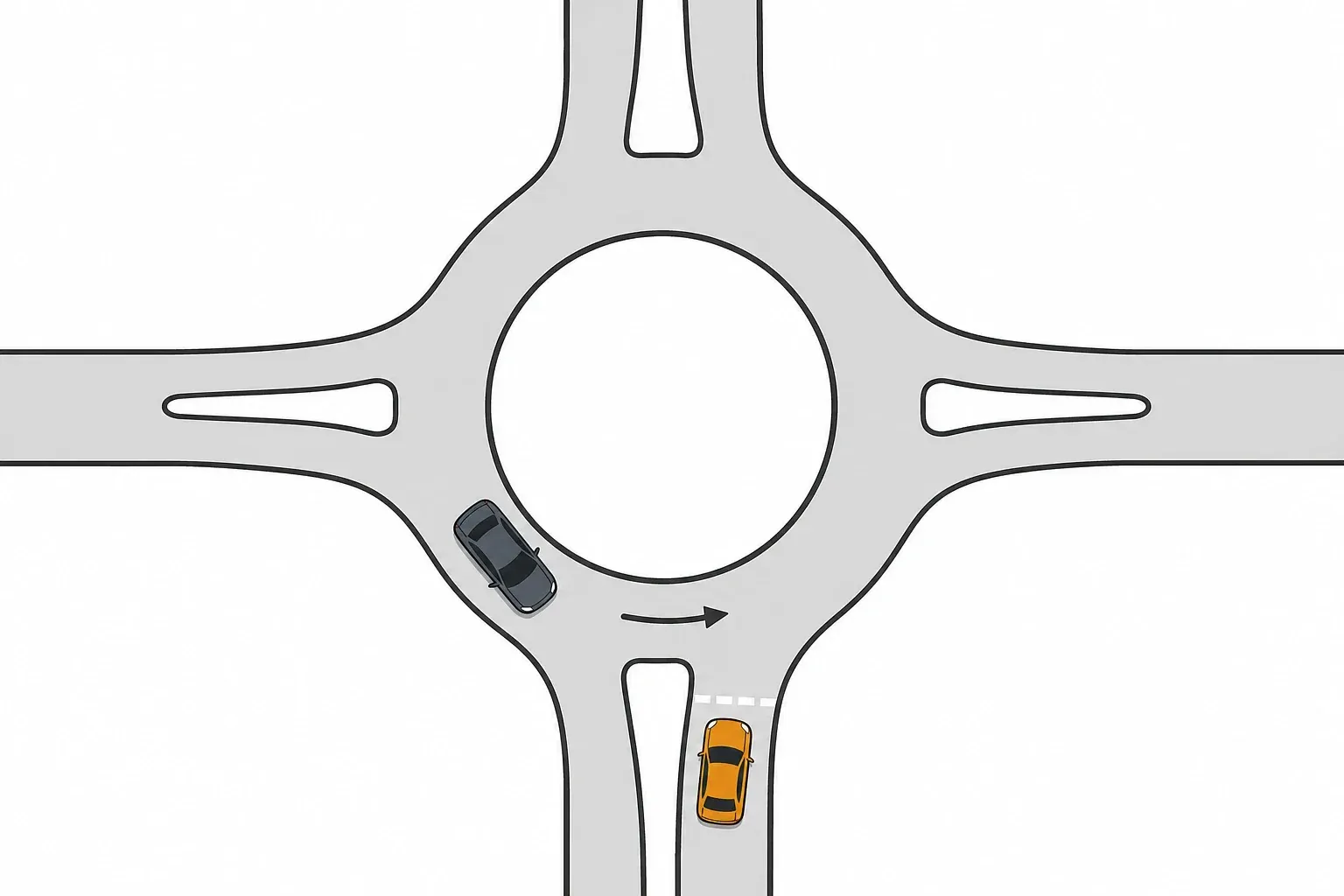
Simplified single-lane roundabout: a slate car circulates counterclockwise while a gold car approaches outside the circulating lane. Actual signs, markings, and vehicle positions matter.
Multi‑Lane Roundabouts
Multi‑lane roundabouts add another layer: lane choice and exit responsibilities. The rules depend on the diagrammatic signs and pavement arrows before entry. These markings tell you which lane is assigned to which exits.
Common pattern:
- Right/outer lane: first exit, and often the second exit.
- Left/inner lane: later exits or a U‑turn.
That means the outer‑lane driver should follow the exit shown for that lane. Continuing around from an exit-only lane can create a sideswipe conflict with an inner-lane driver who is exiting according to the sign and pavement arrows.
4. Lane Choice Sets Your Legal Path (And Your Duties)
Once you choose a lane in a multi‑lane roundabout, you are committing to the path assigned by signage and pavement markings. If your lane is marked to exit, continuing to circle can become powerful evidence that you failed to follow the posted lane-use pattern.
Two other Oregon rules become especially important inside the circle:
- Lane discipline (ORS 811.370) — drivers must stay within a marked lane as nearly as practicable and must not move from that lane until it can be done safely. Oregon also includes a commercial-motor-vehicle exception for multilane roundabouts.
- Exit-signal requirements (ORS 811.400) — drivers must use an appropriate signal when exiting from any position within a roundabout.
A Common Fault Pattern: The Exit Sideswipe
The most frequent disputed crash is an exit sideswipe in a multi‑lane roundabout:
- Driver A enters in the inner lane to take a later exit.
- Driver A signals and begins exiting where the sign indicates.
- Driver B stays in the outer lane and continues past the exit.
- Driver B sideswipes Driver A as Driver A exits.
In this scenario, Driver B may have violated the lane assignment or failed to respect the exit pattern shown to drivers before entry. Insurers who treat this like a standard “unsafe lane change” claim sometimes assign fault incorrectly because they skip the signs and pavement arrows that controlled the roundabout.
5. How Insurers Misread Roundabout Crashes
Insurance adjusters are typically trained on common intersection patterns: rear‑ends, red‑light violations, four‑way‑stop disputes. Roundabouts can be less familiar and may be underrepresented in claims training. That creates predictable errors:
- Over‑reliance on point‑of‑impact charts. Sideswipe damage often triggers a default “shared fault” assumption.
- Failure to account for lane assignment signs. The adjuster may not understand that the outer lane was required to exit.
- Simplified narratives win. “They cut me off” is easier to process than a multi‑lane, sign‑based exit rule.
That’s why a clear evidence package is essential. You may need to teach the roundabout rules to the adjuster using official sources and hard evidence. For a broader look at insurer fault arguments, see our guide to signs an Oregon crash may be more than a simple insurance claim.
6. Evidence That Changes Fault Decisions
A. Photos That Matter Most
At the scene (if safe), collect:
- Wide‑angle photos showing vehicle positions relative to exits and lane markings.
- Close‑up photos of pavement arrows, lane‑use markings, and solid white lines.
- Diagrammatic entry signs showing lane assignments.
- Damage photos that confirm the angle and sides involved.
These images transform a dispute from “he said, she said” into a map of who followed—or ignored—the roundabout’s lane assignments. For a deeper evidence list, see the crash photos people often forget to take in Oregon.
B. Video Footage (The Strongest Evidence)
- Dashcam footage is the fastest way to resolve a right‑of‑way dispute.
- Traffic cameras may be operated by ODOT or local agencies.
- Private cameras (gas stations, retail stores) can provide critical footage if requested quickly.
If you need camera footage, act fast. Recordings are often overwritten within days.
ODOT public records requests: ODOT Public Records Center
C. Neutral Witness Statements
Independent witnesses are powerful because they are not financially tied to the outcome. Get names, phone numbers, and (if possible) a brief written statement while memories are fresh.
D. The Police Report
The report anchors the timeline and includes citations, diagrams, and a narrative summary. Even if the report is incomplete, it still becomes part of the insurer’s file and can be corrected with supplemental evidence.
7. A Step‑by‑Step Evidence Checklist
At the scene:
- Call 911 if anyone is injured.
- Photograph vehicle positions before moving if safe.
- Photograph entry signs and pavement arrows.
- Get witness names and contact info.
- Note time, weather, and visibility.
Within 24–48 hours:
- Request the police report number.
- Back up photos and videos to cloud storage.
- Identify possible traffic cameras and nearby businesses.
- Submit any urgent public records requests for footage.
Before you speak at length with an insurer:
- Review photos and video before describing lane positions from memory.
- Avoid guessing about speed, impact angle, or who “must have” had the right-of-way.
- Keep the discussion factual: where each vehicle entered, which lane each vehicle used, what signs and arrows showed, and where impact occurred.
8. Oregon‑Specific Resources That Help Your Roundabout Claim
Roundabout claims in Oregon often turn on public roadway design details: the lane-use sign on approach, pavement arrows, yield markings, and sometimes local or state camera footage. Preserve those details early because they can change before an adjuster reviews the claim.
Oregon Department of Transportation (ODOT)
Oregon Driver Manual
Official driver guidance on yield rules, roundabout navigation, and lane use:
Oregon Division of Financial Regulation (DFR)
If an insurer ignores evidence or issues an unfair decision, you can file a consumer complaint:
9. How to Respond to an Unfair Insurance Decision
If the insurer assigns fault incorrectly, you can push back with a structured response:
- Request a written explanation for the decision and the evidence relied on.
- Respond in writing with your evidence package and cite the roundabout rules.
- Explain lane‑assignment logic using the entry signs and pavement arrows.
- Escalate to a supervisor if the adjuster doesn’t revisit the decision.
- File a DFR complaint if the insurer refuses to correct a clear error.
This is where links to official rules help. For example, citing ORS 811.292, ORS 811.400, and the Oregon Driver Manual can be persuasive because they are public and neutral.
If the insurer formally denies the claim or refuses to reconsider after receiving evidence, the next step is more structured than simply arguing by phone. Our Oregon guide on what to do if a car insurance company denies your claim explains denial letters, appeals, and regulator complaints in more detail.
10. Oregon Comparative Fault in Roundabout Crashes
Roundabout crashes are rarely just about one sentence in a police report. Oregon uses a comparative fault system under ORS 31.600, so an insurer may try to divide blame between drivers based on speed, lane position, signals, lookout, and whether each driver followed posted controls.
In practical terms, an adjuster may argue that:
- the entering driver failed to yield as described in the Oregon Driver Manual,
- the circulating driver was speeding or failed to keep a proper lookout,
- an inner-lane driver exited from the wrong lane,
- an outer-lane driver continued past an exit-only marking,
- or both drivers contributed to the collision.
That is why evidence of the actual roundabout layout matters. A photo of the approach sign or pavement arrow can be more useful than a general statement that someone “had the right-of-way.”
11. FAQs About Oregon Roundabout Crashes
Who has the right‑of‑way in an Oregon roundabout?
Vehicles already circulating generally have priority over entering vehicles. The Oregon Driver Manual tells drivers to yield to traffic inside and exiting the roundabout before entering. In multi-lane roundabouts, ORS 811.292 also addresses the duty to yield to a vehicle lawfully exiting from ahead and to the left, unless a traffic control device says otherwise.
Do I have to signal in a roundabout?
Oregon specifically requires an appropriate signal when exiting from any position within a roundabout. See ORS 811.400. Signals also help show that your movement matched the lane assignment shown before entering the roundabout.
What if I’m in the outer lane and want to go past the next exit?
You should follow the lane assignment signs and pavement markings. If your lane is designated for the next exit, continuing past it can become strong evidence against you if a collision occurs.
What if the other driver says I “cut them off” when I exited?
Provide photos of the entry sign and pavement arrows showing your lane was assigned to the exit. Those visuals often correct the misunderstanding.
Can I request public camera footage in Oregon?
Yes. ODOT and local agencies handle public records requests. Act quickly because footage can be overwritten. Start with the ODOT Public Records Center if a state facility or ODOT-held record may be involved.
Does Oregon PIP cover injuries from a roundabout crash?
Oregon auto policies generally include Personal Injury Protection (PIP), which may help pay certain medical expenses and wage-loss benefits regardless of who caused the crash. DFR’s car insurance FAQs explain PIP limits and timing. PIP does not decide fault. It is a first-party coverage issue that can run alongside a liability claim against another driver.
What if both drivers made mistakes in the roundabout?
Both drivers can be assigned a share of fault. Oregon comparative fault rules may reduce recovery based on your percentage of responsibility, and a high enough percentage can bar recovery. That makes evidence of signs, lane use, signals, and video especially important.
Are Portland-area roundabout crashes handled differently?
The same Oregon traffic principles apply, but Portland-area crashes may involve different public records sources, nearby business cameras, TriMet-related footage, or city roadway records depending on the location. Identify the exact intersection and responsible road authority early.
12. Practical Tips for Avoiding Roundabout Collisions
- Choose your lane early. Check signs before entry.
- Yield on entry. Don’t enter until traffic inside has a safe gap.
- Don’t stop inside the circle. Keep traffic moving unless necessary to avoid a collision.
- Stay in your lane. Avoid drifting and respect solid white lines.
- Exit decisively if your lane is assigned to that exit.
For general roundabout safety guidance, see the FHWA roundabout safety page.
13. Key Takeaways
- Oregon’s Driver Manual instructs drivers entering a roundabout to yield to traffic inside and exiting the roundabout.
- In multi‑lane roundabouts, lane choice controls exit duties and right‑of‑way inside the circle.
- Insurer mistakes are common, especially in exit sideswipe cases.
- Evidence — photos, signage, pavement arrows, video — can be the fastest way to correct fault decisions.
- Oregon provides formal complaint options through the Division of Financial Regulation.
If you were in a roundabout crash, build your evidence file early and use official sources to reinforce the rules. A clear, well‑organized record can help correct an incomplete or unfair fault analysis.
Related Resources
Client-First Fee Promise
Client First = Bills First, Fees Second
Your unpaid medical bills do not have to make your lawyer's fee bigger. Johnson Law subtracts qualifying medical bills before calculating our fee, helping clients keep more of their settlement.
Applies to qualifying cases. Results vary.