Arbitration Clauses and Insurance: When You’re Told You Have to Arbitrate in Oregon

Arbitration Clauses and Insurance: When You’re Told You Have to Arbitrate in Oregon
Being told that your insurance dispute “has to go to arbitration” can be confusing because arbitration is not one single procedure. In Oregon, an injury or insurance claim might be sent to arbitration because of court rules, a private contract, a UM/UIM coverage dispute, or a PIP benefits dispute. Each path can affect deadlines, discovery, costs, settlement leverage, and review rights differently.
A practical first step is to avoid assuming the insurance company controls the process. Ask what document or rule supposedly requires arbitration, who is bound by it, and what rights remain before and after the hearing. Arbitration may be required in some settings, mutually elected in others, and disputed in still others.
It also matters because arbitration timing may run alongside other claim deadlines. Policy deadlines and lawsuit deadlines are separate issues, and arbitration language does not automatically answer either one. If timing is part of the dispute, read more about insurance claim deadlines versus lawsuit deadlines.
Educational information only, not legal advice. This article is general educational information about Oregon arbitration and insurance issues. It is not legal advice and does not create an attorney-client relationship.
First, Ask: What Kind of Arbitration Are We Talking About?
Arbitration is a process for resolving disputes outside an ordinary trial. But in Oregon injury and insurance matters, the source of arbitration makes a major difference.
Four common sources are:
- Court-annexed mandatory arbitration after a lawsuit is filed in a qualifying Oregon circuit court case.
- A private arbitration clause in a policy, contract, or other written agreement.
- UM/UIM arbitration involving uninsured or underinsured motorist coverage with your own insurer.
- PIP arbitration involving personal injury protection benefits.
Those categories should not be blended together. A court notice is different from an insurance policy clause. A first-party claim with your own insurer is different from a third-party liability claim against someone else’s insurer. And a statutory option for arbitration is not always the same thing as automatic arbitration.
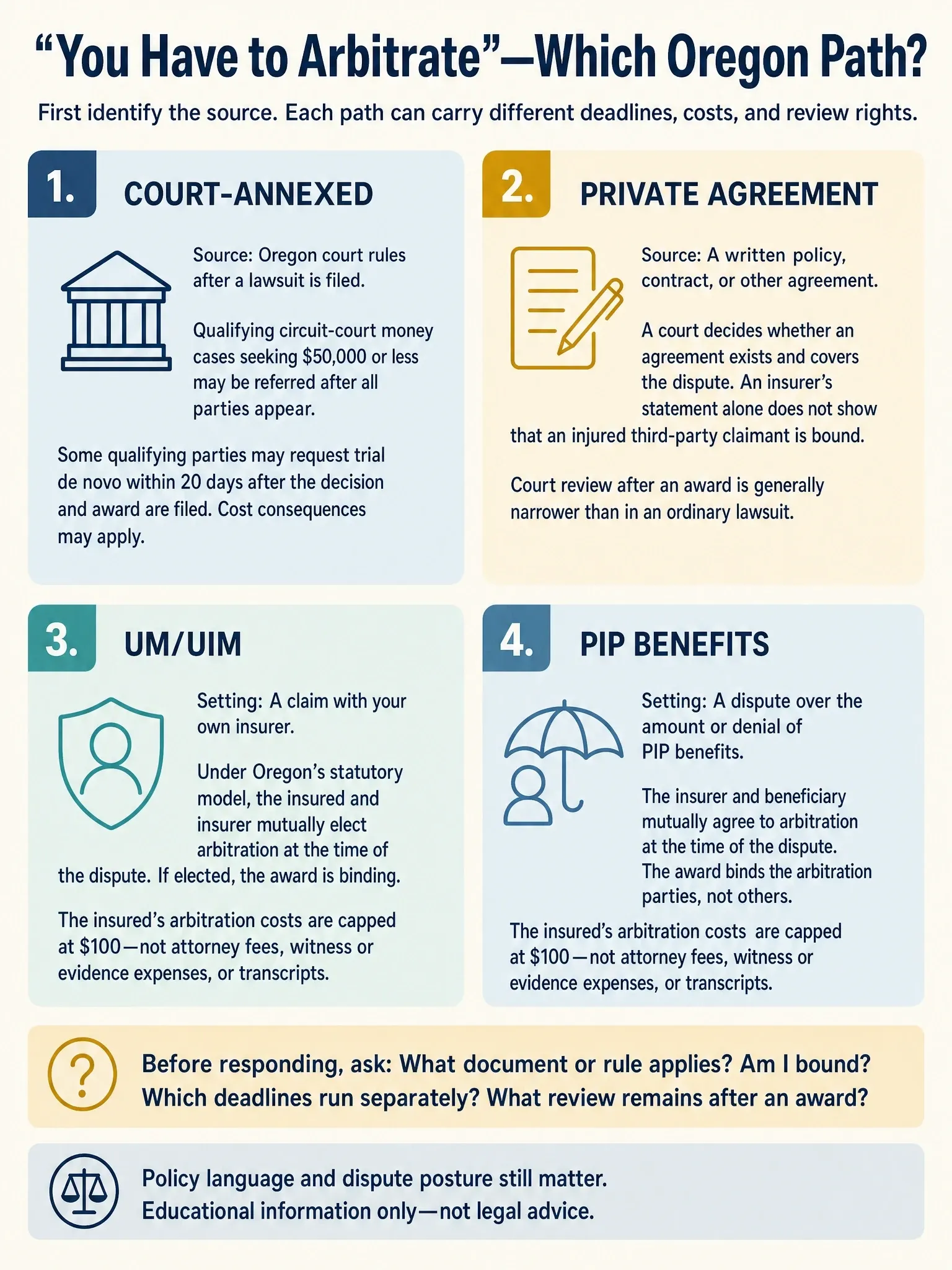
Court-Annexed Mandatory Arbitration Is Not the Same as an Insurance Arbitration Clause
Oregon circuit courts have mandatory arbitration programs for certain lower-dollar civil cases. Under Oregon law, circuit courts must require arbitration in matters involving $50,000 or less. A civil action is referred to mandatory arbitration when all parties have appeared, the only relief claimed is money or damages, and no party asserts damages over $50,000, excluding attorney fees, costs, disbursements, and interest.
That is court-annexed arbitration. It is part of the court system. It is not the same as an insurance company pointing to a private arbitration clause.
Why the $50,000 Threshold Matters
The $50,000 threshold matters because some Oregon injury cases may be routed to mandatory arbitration after a lawsuit is filed. That does not mean the insurer unilaterally chose the forum, and it does not necessarily mean the arbitration decision is the final word in every case.
For a claimant, the practical point is to identify whether the case is in court-annexed arbitration because of Oregon court rules or in private arbitration because of an alleged agreement. The answer affects what happens after the arbitration award.
Trial De Novo and Cost Consequences
After court-annexed arbitration, a qualifying party may request a trial de novo within 20 days after the arbitration decision and award is filed. Oregon law limits trial de novo requests to a party against whom relief is granted or a party whose claim exceeded the relief granted. A trial de novo is a new trial process after the arbitration result.
If no timely trial de novo request is filed, the court enters judgment on the arbitration decision and award, and that judgment may not be appealed. Oregon law also creates potential fee and cost consequences for a party who requests trial de novo and does not improve that party’s position after judgment.
Those cost consequences can affect settlement strategy. For more context on litigation expenses and risk, see our discussion of arbitration, expert, deposition, and appeal-related cost risk.
Private Arbitration Clauses: When a Contract May Change the Forum
Private arbitration is different. Oregon’s Uniform Arbitration Act generally treats a written agreement to submit an existing or future controversy to arbitration as valid, enforceable, and irrevocable, except on contract-law grounds that would allow revocation.
If one party shows an arbitration agreement and another party refuses to arbitrate, a court may compel arbitration unless the court finds that no enforceable arbitration agreement exists. Federal arbitration law may also affect enforceability analysis when the contract involves commerce.
Who Decides Whether Arbitration Applies?
Oregon law separates some threshold questions. Courts decide whether an arbitration agreement exists and whether a controversy is subject to that agreement. Arbitrators decide whether a condition precedent to arbitrability has been fulfilled.
That distinction matters when someone says, “You signed an arbitration clause,” or “The policy requires arbitration.” The next question is whether the clause exists, whether it is enforceable, whether it covers this dispute, and whether the person being told to arbitrate is actually bound by it.
Why Injured Third-Party Claimants Should Confirm Whether They Are Bound
An injured person making a claim against someone else’s liability insurer should be careful about assumptions. An insurer’s liability policy does not automatically force an injured third-party claimant into private arbitration unless that claimant is bound by an arbitration agreement or another applicable procedure.
That does not mean arbitration can never arise in a third-party setting. It means the policy, contract, claimant status, and procedural posture have to be identified before treating the insurer’s statement that arbitration is required as the final answer.
Insurance-Specific Examples: UM/UIM and PIP Arbitration in Oregon
Some Oregon insurance statutes address arbitration in specific first-party insurance contexts. Two common examples are UM/UIM coverage and PIP benefits.
UM/UIM Claims With Your Own Insurer
Oregon motor vehicle liability policies issued for delivery in Oregon generally must include uninsured motorist coverage, and that coverage must include underinsured motorist coverage. UM/UIM disputes are claims with your own insurer, even though they often arise because another driver had no insurance or not enough insurance.
Under Oregon’s statutory model provision, UM/UIM arbitration occurs if the insured and insurer mutually elect, at the time of the dispute, to settle the matter by arbitration. If arbitration is elected, the insured and insurer agree to be bound by the award, and judgment on the award may be entered in court.
Oregon law also limits the insured’s arbitration costs in that UM/UIM setting to $100, with other arbitration costs borne by the insurer. That cost rule does not include attorney fees, witness or evidence production expenses, or transcript costs. Unless the parties agree otherwise, the arbitration uses a three-arbitrator panel: one arbitrator selected by each party and a third selected by the first two.
For more context on coverage disputes with your own insurer, see our article on UM/UIM disputes with your own insurer.
PIP Benefit Disputes
Oregon personal injury protection, or PIP, can raise separate arbitration issues. Disputes about the amount or denial of PIP benefits are decided by arbitration if the insurer and beneficiary mutually agree at the time of the dispute.
PIP arbitration awards bind the arbitration parties, but they are not binding on other parties and may not be used for collateral estoppel. Oregon law caps the insured’s arbitration costs at $100 in this setting, with other arbitration costs borne by the insurer. As with UM/UIM arbitration, that cost rule does not include attorney fees, evidence or witness expenses, or transcript expenses.
The key point is that Oregon’s UM/UIM and PIP statutes should not be summarized as “all of these disputes are automatically arbitrated.” The statutory language matters, and so does the policy language.
What Arbitration Changes About Your Claim
Arbitration is not automatically better or worse than court. It changes the forum and often changes the pressure points.
Depending on the arbitration type, the process may affect how evidence is exchanged, who decides disputed facts, how formal the hearing is, what costs are at stake, and how final the award may be. It can also affect whether procedure, proof, or deadlines are driving the next step in settlement negotiations.
Evidence, Subpoenas, and Discovery
One common myth is that arbitration means there is no discovery. Oregon law is more nuanced.
In private arbitration, arbitrators may conduct the arbitration in the way they consider appropriate for a fair and expeditious disposition. At the hearing, a party has the right to be heard, present material evidence, and cross-examine witnesses who appear.
Oregon law also allows arbitrators and party attorneys to issue subpoenas for witness attendance and production of records or evidence at hearings. Arbitrators may permit depositions and discovery as appropriate in the circumstances.
So arbitration can limit, focus, or change discovery, but it does not necessarily eliminate every evidence tool.
Evidence to Preserve Before an Arbitration Dispute Gets Narrowed
If arbitration is being discussed, preserve the materials that may show what rule applies and what the underlying claim is worth. Useful items may include:
- the insurance policy, declarations pages, endorsements, and any arbitration demand;
- claim letters, denial letters, reservation-of-rights letters, and adjuster communications;
- medical bills, treatment records, wage records, and out-of-pocket expense documentation;
- photos, videos, repair estimates, crash reports, and witness information;
- court notices, pleadings, arbitration notices, and any deadlines connected to the award or hearing; and
- notes showing when key claim communications were sent or received.
This kind of preservation does not prove that arbitration applies or does not apply. It helps keep the procedural question, coverage question, and damages evidence from getting mixed together.
Costs and Fee-Shifting Pressure
Costs vary by arbitration type.
In court-annexed arbitration, a trial de novo request can create fee and cost consequences if the party requesting the new trial does not improve its position. In UM/UIM and PIP arbitration, Oregon statutes cap certain insured arbitration costs at $100, while excluding attorney fees, evidence or witness expenses, and transcript expenses.
Attorney-fee issues are also fact-specific. Oregon’s insurance attorney-fee statute generally allows attorney fees in an action on an insurance policy if settlement is not made within six months after proof of loss and the plaintiff’s recovery exceeds any tender. But the statute includes safe-harbor exceptions for certain PIP and UM/UIM claims when the insurer accepts coverage, limits the disputed issues in the way the statute describes, and consents to binding arbitration. If a denied insurance claim is part of the picture, see our overview of what happens if the insurance company denies your claim.
Timing, Settlement Posture, and Leverage
Arbitration can change timing and settlement leverage because it may create a different hearing track, different preparation needs, and different consequences after an award.
For example, the 20-day trial de novo deadline after court-annexed arbitration can be a critical decision point. In private arbitration, the limited grounds for court review may make the hearing itself especially important. In UM/UIM or PIP disputes, the statutory cost structure and attorney-fee safe harbors may affect how both sides evaluate risk.
The practical options and risks depend on the claim type, forum, policy language, damages evidence, and procedural deadlines.
What Arbitration Changes About Review, Appeal, and Finality
Arbitration often matters most after the decision is issued. The available review path depends on the arbitration type.
Court-Annexed Arbitration Finality
In Oregon court-annexed arbitration, a qualifying party may request trial de novo within 20 days after the arbitration decision and award is filed. If no timely request is filed, the court enters judgment on the award, and that judgment may not be appealed.
That makes the post-award deadline important. Missing it can change the case from an arbitration result that might have been challenged through trial de novo into a judgment with no appeal.
Private Arbitration Finality
Private arbitration generally has narrower court review than an ordinary lawsuit. Oregon courts must confirm a private arbitration award unless a timely request or petition is made to modify, correct, or vacate the award.
Oregon law lists specific grounds to vacate a private arbitration award, including corruption, fraud, undue means, evident partiality by a neutral arbitrator, arbitrator misconduct, refusal to consider material evidence, exceeding powers, no agreement to arbitrate, or prejudicial lack of proper notice.
Appellate review under Oregon’s Uniform Arbitration Act is also limited to specified orders and judgments, including certain orders about compelling or staying arbitration and judgments confirming, modifying, correcting, or vacating awards.
In practical terms, private arbitration can leave fewer ways to challenge an unfavorable award than ordinary litigation. That is why the enforceability question, evidence plan, and hearing preparation matter before the award is issued.
Questions to Ask Before You Accept “This Has to Go to Arbitration”
If an insurer, opposing party, or court notice says arbitration is required, organize the issue before responding. Useful questions include:
- What document or rule supposedly requires arbitration: a court notice, insurance policy, contract, UM/UIM provision, PIP provision, or something else?
- Is the person being told to arbitrate actually a party to the arbitration agreement?
- Is the dispute a first-party claim with your own insurer or a third-party liability claim against someone else’s insurer?
- Are there policy deadlines, lawsuit deadlines, or arbitration demand deadlines that need separate attention?
- What discovery, expert, transcript, attorney-fee, and trial de novo cost risks may apply?
- What review or appeal rights would remain after the award?
- Is the insurer accepting coverage and narrowing the dispute, or is coverage itself being denied?
- What letters, claim notes, denial explanations, medical bills, wage records, or expert materials need to be preserved for the arbitration hearing?
Those questions do not decide the issue by themselves, but they help identify whether the dispute is really about arbitration, coverage, damages, deadlines, or evidence.
When to Get Legal Advice
Arbitration clauses and insurance disputes are highly document-specific. Because of that, it may be helpful to have a lawyer review the arbitration demand, insurance policy, denial letter, court notice, and claim timeline together before you decide how to respond.
Oregon also regulates unfair claim settlement practices. Insurers may not engage in listed practices such as misrepresenting facts or policy provisions, failing to promptly acknowledge claim communications, refusing to pay without reasonable investigation, or failing to attempt good-faith prompt equitable settlement where liability is reasonably clear. Whether those rules affect a particular dispute requires careful legal analysis.
This article is for general educational information only. It is not legal advice and does not create an attorney-client relationship. Arbitration enforceability, claim deadlines, insurance coverage, attorney-fee issues, and appeal or review rights depend on the specific policy, contract, court rules, statutes, forum, and facts.
FAQ
Can my insurance company force me into arbitration in Oregon?
It depends on the source of the arbitration requirement, the claim type, the policy or contract language, and whether you are actually bound by an arbitration agreement. Oregon also has specific UM/UIM and PIP arbitration statutes that refer to mutual election or agreement at the time of the dispute.
Is court-annexed mandatory arbitration the same as private arbitration?
No. Court-annexed mandatory arbitration applies to qualifying Oregon circuit court cases, including certain civil actions seeking $50,000 or less. Private arbitration is based on an arbitration agreement and usually has narrower court-review options.
Does arbitration mean I lose the right to use evidence or question witnesses?
Not necessarily. Oregon arbitration law allows parties to be heard, present material evidence, and cross-examine witnesses who appear. Subpoenas, depositions, and discovery may also be available depending on the arbitration type and what the arbitrator permits.
Are UM/UIM claims automatically arbitrated in Oregon?
Under Oregon’s statutory model provision, UM/UIM arbitration occurs if the insured and insurer mutually elect arbitration at the time of the dispute. The policy language and dispute posture still matter.
Can I appeal an arbitration award?
Review options depend on the arbitration type. Court-annexed arbitration may allow a timely trial de novo request. Private arbitration has limited statutory grounds for court intervention and limited appellate review.
Who pays for insurance arbitration in Oregon?
It depends on the arbitration type. Oregon UM/UIM and PIP statutes cap certain insured arbitration costs at $100, with exclusions for items such as attorney fees, witness or evidence expenses, and transcript expenses. Other fee and cost issues are fact-specific.
Source Notes
- ORS 36.400 and ORS 36.405: Oregon court-annexed mandatory arbitration and the $50,000 qualifying threshold.
- ORS 36.425: trial de novo timing, judgment if no timely request is filed, appeal limitation, and possible fee/cost consequences.
- ORS 36.620 and ORS 36.625: enforceability of written arbitration agreements and the court role in compelling arbitration.
- ORS 36.665 and ORS 36.675: arbitration hearing procedure, evidence rights, subpoenas, depositions, and discovery.
- ORS 36.700, ORS 36.705, and ORS 36.730: confirmation, vacatur grounds, and limited appellate review for private arbitration awards.
- 9 U.S.C. § 2: general enforceability of written arbitration provisions in contracts involving commerce, subject to generally applicable contract defenses and statutory exceptions.
- ORS 742.502, ORS 742.504, and ORS 742.505: Oregon UM/UIM coverage and arbitration mechanics.
- ORS 742.520, ORS 742.521, and ORS 742.522: Oregon PIP arbitration mechanics.
- ORS 742.061: Oregon insurance attorney-fee statute and PIP/UM/UIM safe-harbor issues.
- ORS 746.230: listed unfair claim settlement practices.
Client-First Fee Promise
Client First = Bills First, Fees Second
Your unpaid medical bills do not have to make your lawyer's fee bigger. Johnson Law subtracts qualifying medical bills before calculating our fee, helping clients keep more of their settlement.
Applies to qualifying cases. Results vary.