Bike or Motorcycle Hit by a U-Turning Driver in Oregon: How Fault Is Usually Analyzed
Bike or Motorcycle Hit by a U-Turning Driver in Oregon: How Fault Is Usually Analyzed
If a driver makes a U-turn and hits a bicyclist or motorcyclist in Oregon, the U-turning driver is often the first place to look for fault. That is especially true if the U-turn was illegal, made without a proper signal, made from the wrong lane, made across a bike lane without yielding, or made when the driver could not see approaching riders.
But the answer is not automatic. Oregon fault rules still look at the whole crash: where the U-turn happened, what signs and signals were present, whether each person had enough time to react, whether the rider was in a lawful position, and whether either side violated traffic laws or failed to use reasonable care.
This article is educational information about Oregon law, not legal advice for any specific crash. Fault can change based on details that may not be obvious at the scene.
Key Takeaways
- A U-turning driver is often a major fault focus, but Oregon law does not make every U-turn crash automatic 100% driver liability.
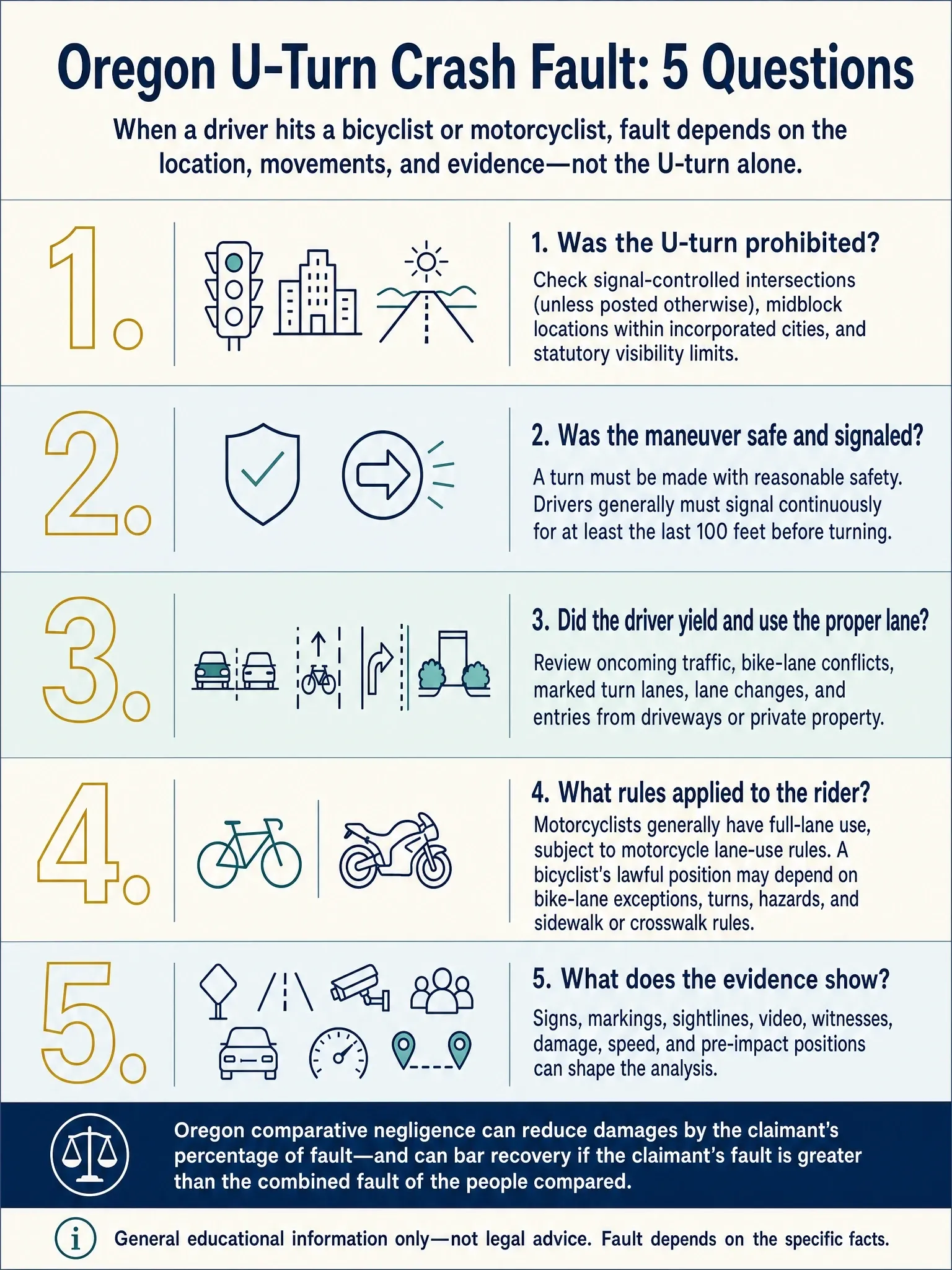
- Oregon prohibits U-turns in several situations, including certain signal-controlled intersections, midblock city locations, and places with limited visibility.
- Signals, yielding, lane choice, center-turn-lane use, driveway entries, and bike-lane conflicts can all affect fault.
- Motorcyclists generally have full-lane rights, while bicyclists have vehicle-like rights plus bicycle-specific lane, sidewalk, crosswalk, and signal rules.
- Oregon modified comparative negligence can reduce damages, or bar recovery, if the rider’s share of fault is too high.
Short Answer: The U-Turning Driver Is Often Scrutinized, But Fault Is Not Automatic
In a bike or motorcycle U-turn crash, investigators and insurers usually ask several practical questions:
- Was the U-turn legal at that location?
- Did the driver signal for the required distance before turning?
- Did the driver yield to an oncoming rider or a rider in a bicycle lane?
- Did the driver turn from the correct lane or swing across lanes unexpectedly?
- Was the rider speeding, passing unlawfully, lane-splitting, turning, or outside the position the law required?
- What did video, witnesses, vehicle damage, and roadway evidence show?
Those questions matter because Oregon uses modified comparative negligence. A claimant’s negligence does not necessarily bar recovery if the claimant’s fault was not greater than the combined fault of the people being compared, but any damages are reduced by the claimant’s percentage of fault. In plain English: a rider can be partly at fault and still have a claim in some cases, but a high enough share of fault can defeat recovery.
When Is a U-Turn Illegal in Oregon?
Oregon has a specific illegal U-turn statute. Whether the driver violated it can be an important part of the fault analysis, although it still does not automatically decide every civil-liability question.
U-Turns at Signalized Intersections
Under ORS 811.365, Oregon generally makes it illegal to turn a vehicle around to proceed in the opposite direction within an intersection controlled by an electrical signal, unless posted otherwise. That “unless posted otherwise” language is important. A traffic sign or traffic-control device at the intersection may change whether the U-turn was allowed.
Midblock U-Turns in Incorporated Cities
Oregon also prohibits U-turns on a highway within an incorporated city between intersections. That rule can matter in city crashes in places such as Portland, Salem, Eugene, Bend, and other incorporated Oregon cities when a driver turns around midblock and cuts across the path of a bicycle or motorcycle.
Visibility Limits
Even when a U-turn is not at a signalized intersection or a midblock city location, visibility can make the maneuver illegal. Oregon prohibits a U-turn where the driver’s vehicle cannot be seen by another driver approaching from either direction within 500 feet inside an incorporated city or 1,000 feet outside a city.
For riders, this makes sightlines important evidence. A hill, curve, parked vehicle, vegetation, darkness, weather, or roadway design may affect whether the turning driver could be seen—and whether the driver could reasonably see the rider.
Why an Illegal U-Turn Matters—but Does Not End the Civil Case
An illegal U-turn is a traffic violation in Oregon, and the violation classification increases if the offense contributes to an accident. That can matter. A citation, crash report, or officer’s observations may help show that the driver made a prohibited maneuver.
Still, a traffic violation is not the same thing as a complete civil fault allocation. Civil fault may also depend on speed, lane position, signal use, visibility, and whether the rider also did something that contributed to the crash.
Even a Legal U-Turn Can Be Unsafe
Some cases involve a different problem: the U-turn location may have been legal, but the movement itself was unsafe.
ORS 811.335 makes a turn unlawful if it cannot be made with reasonable safety. Oregon also requires drivers to stay as nearly as practicable within a single lane and not move from that lane until the movement can be made safely. If a U-turn begins with a sudden lane change, a swing across multiple lanes, or a movement from the curb or shoulder into traffic, those facts can become central.
Speed and roadway conditions can matter too. Oregon’s basic speed rule focuses on whether a speed was reasonable and prudent for conditions such as traffic, road surface, road width, intersection hazards, weather, and visibility. That rule can be relevant to either side. A driver may have turned too quickly or too abruptly for the setting; a rider may face a comparative-fault argument if speed left too little time to avoid a hazard that should have been visible.
Oregon’s careless-driving statute may also be part of the discussion if a person drove in a way that endangered, or would likely endanger, people or property. The key point for a U-turn crash is practical: legality of the location is only the starting point. The turn still had to be made with reasonable care.
Signals, Yielding, and Lane Position Usually Drive the Fault Analysis
After the basic U-turn question, many cases turn on signal use, yielding, and lane placement.
Did the Driver Signal Early Enough?
Oregon requires an appropriate turn signal continuously during not less than the last 100 feet traveled before turning. Oregon law recognizes turn signals through signal lights and, in appropriate situations, hand-and-arm signals.
If a driver did not signal before a U-turn, or signaled too late for a rider to react, that can be important evidence. But it should be framed carefully: failure to signal is a fact that supports fault; it is not a magic phrase that automatically decides civil liability by itself.
Useful signal evidence may include witness accounts, dashcam or surveillance video, turn-signal bulb condition, and the distance or time between the signal and the turn.
Did the Driver Yield to an Oncoming Rider?
ORS 811.350 requires a driver turning left within an intersection, or into an alley, private road, driveway, or place from a highway, to yield to an oncoming vehicle that is in the intersection or so close as to be an immediate hazard.
A U-turn is not always identical to an ordinary left turn, but many U-turns begin as a leftward movement across oncoming traffic. If a motorcyclist or bicyclist was approaching from the opposite direction and was close enough to be a hazard, the driver’s failure to yield may be a major issue.
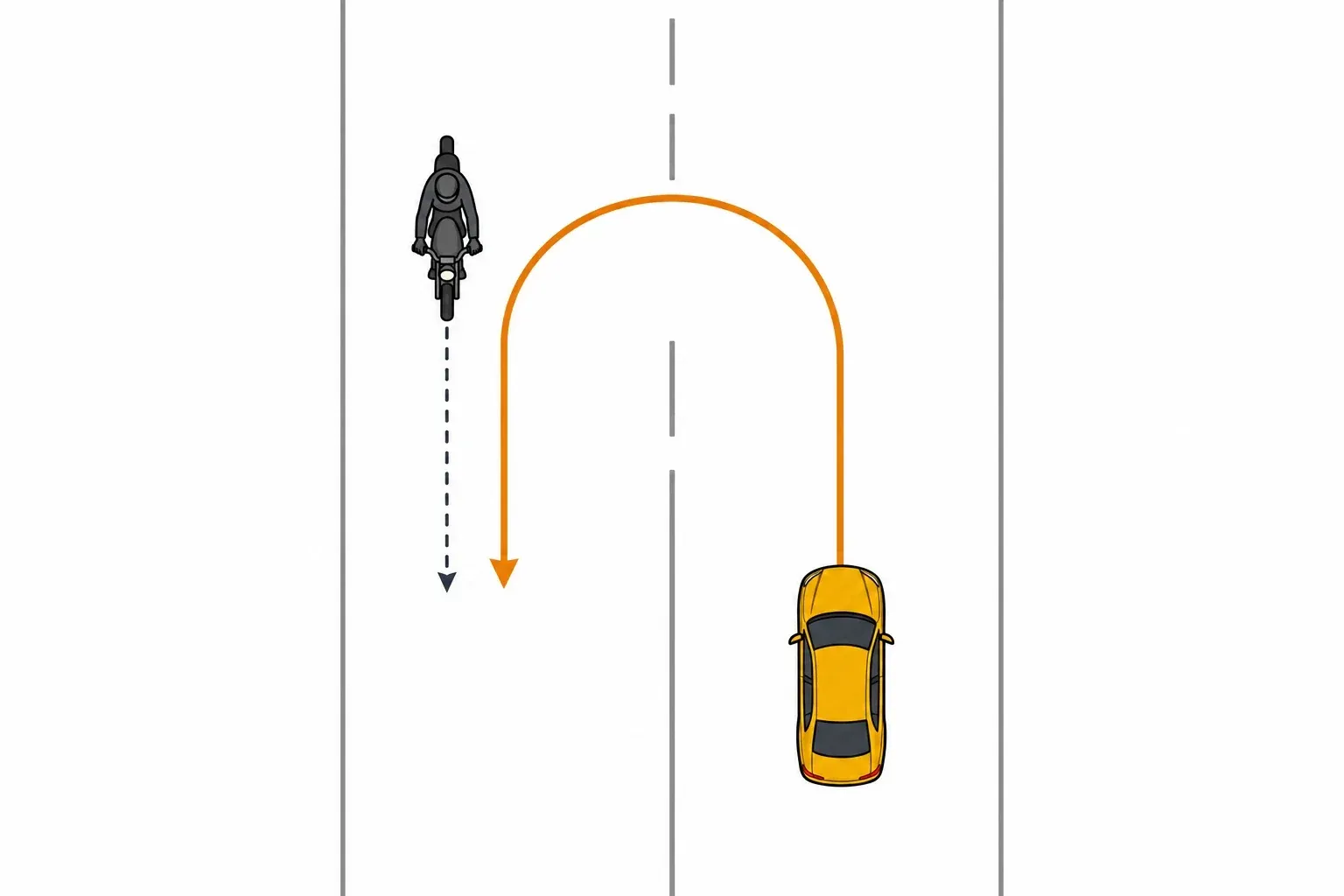
Schematic U-turn and approaching motorcycle: the gold arrow shows the car reversing direction, while the dashed arrow shows the motorcycle continuing straight. The paths are drawn apart and do not establish a collision point or determine fault.
This is also where motorcycle visibility disputes often arise. Drivers sometimes say they “never saw” the motorcycle. That statement may be evidence, but it does not end the analysis. The more useful questions are whether the rider was visible, where the motorcycle was positioned, whether the driver had time and distance to see it, and whether the driver turned when it was unsafe to do so. For more on that related issue, see Johnson Law’s discussion of drivers who say they did not see a motorcycle in left-turn crashes.
Was the U-Turn Made From the Proper Lane or Turn Lane?
Lane placement can be decisive in a U-turn crash. Oregon has rules for left-turn approach and for special left-turn lanes. Where a special lane for left turns by drivers proceeding in opposite directions is marked by traffic-control devices, a driver turning left must use that special lane rather than another lane.
Problems can arise when a driver:
- swings a U-turn from a through lane instead of a marked turn lane;
- starts from the curb, shoulder, or parked position;
- cuts across more than one lane;
- misuses a center turn lane; or
- begins the maneuver from a driveway, parking lot, alley, or private road.
If the driver entered the roadway from a private road, driveway, alley, or other place that is not another roadway, Oregon requires the driver to yield to vehicles approaching on the roadway.
If the Injured Rider Was on a Motorcycle
Motorcycle U-turn crashes often involve a driver turning across the motorcycle’s lane or claiming the motorcycle was hard to see. Oregon law gives motorcyclists important lane-use protections, but rider conduct can still be disputed.
Motorcyclists Are Generally Entitled to Full Use of a Lane
ORS 811.385 prohibits a motor vehicle operator from depriving a motorcyclist or moped operator of full use of a lane, subject to Oregon’s motorcycle and moped lane-use rules. In practical terms, a driver should not treat a motorcycle as if it only occupies a thin strip at the edge of the lane.
That matters when a driver makes a U-turn across a lane occupied by a motorcycle. The fault question is not whether the motorcycle was “small enough” for the driver to squeeze through. The questions are whether the driver had the right to turn, whether the turn could be made safely, and whether the driver yielded when required.
Rider Conduct Can Still Be Disputed
Oregon also has motorcycle-specific limits. For example, ORS 814.240 prohibits a motorcycle or moped operator from overtaking and passing in the same lane occupied by the vehicle being passed, unless the vehicle being passed is a motorcycle or moped. Oregon also prohibits operating a motorcycle or moped between lanes of traffic or between adjacent lines or rows of vehicles.
That means comparative fault may be argued if evidence shows lane-splitting, same-lane passing, unreasonable speed for conditions, or a sudden lane movement shortly before impact. Those are evidence questions, not assumptions. The driver’s insurer may raise them, but the actual fault analysis should be based on proof.
Readers dealing with serious motorcycle crash issues may also want to review Johnson Law’s page on Oregon motorcycle accident claims.
If the Injured Rider Was on a Bicycle
Bicycle U-turn crashes can involve a travel lane, a bicycle lane, a crosswalk, a sidewalk, or an intersection. The bicyclist’s location matters because Oregon gives bicyclists many vehicle-like rights and duties, while also applying bicycle-specific rules.
Bike-Lane Conflicts: A Driver May Enter for a Turn, But Still Must Yield
Oregon generally prohibits motor vehicles from operating in bicycle lanes or paths, but it allows a motor vehicle to operate in a bicycle lane when making a turn, entering or leaving an alley, private road, or driveway, or under certain official-duty circumstances.
That permission does not mean the driver can ignore a bicyclist. ORS 811.050 makes it an offense for a motor vehicle operator not to yield the right of way to certain riders, including a person operating a bicycle or electric assisted bicycle, upon a bicycle lane.
So if a driver’s U-turn crossed, entered, or swept through a bicycle lane, the key questions include whether the driver yielded, whether the bicyclist was visible, whether the bicyclist was traveling lawfully in the bike lane, and whether the driver had enough time and distance to avoid the conflict. For a related but distinct turning-conflict scenario, see Johnson Law’s article on right-hook bike crashes across a bike lane.
Was the Bicyclist Required to Be in the Bike Lane or Near the Right Edge?
Oregon generally requires a bicyclist to use an adjacent bicycle lane or path when applicable, but there are exceptions. A bicyclist may be outside the bike lane in situations such as safely passing, preparing for a left turn, avoiding debris or hazards, preparing for an authorized right turn, or continuing straight where the bike lane is to the right of a mandatory right-turn lane.
Oregon also generally requires a slower-moving bicyclist to ride as close as practicable to the right curb or edge, but that rule has exceptions too, including passing, preparing for a left turn, avoiding hazardous conditions, certain one-way street situations, riding no more than two abreast without impeding normal and reasonable traffic, and operating on a bicycle lane or path.
The practical takeaway: a bicyclist is not automatically at fault just because they were outside a bike lane or not at the far right edge. The reason for the bicyclist’s position matters.
Sidewalks and Crosswalks Can Change the Analysis
If the bicycle was on a sidewalk or in a crosswalk, ORS 814.410 gives the bicyclist the same rights and duties as a pedestrian on a sidewalk or in a crosswalk, except as otherwise specifically provided by law.
That can change the U-turn analysis. A crash involving a bicycle in a travel lane may be analyzed differently from a crash involving a bicyclist in a crosswalk. If the case turns on the rider’s position at an intersection, Johnson Law’s article on bike-versus-car right-of-way at unprotected intersections may be a useful related resource.
Bicycle Signals Matter When the Bicyclist Was Turning or Stopping
Oregon requires a bicyclist to signal a turn or stop for at least 100 feet before executing it. But the law does not require continuous signaling when circumstances require both hands for safe control or operation of the bicycle.
This usually matters only if the bicyclist was turning, stopping, or making a movement that required a signal. If the bicyclist was simply traveling straight and the driver made a U-turn into the bicyclist’s path, the driver’s turn, yield, and lane duties may be the more important focus.
Readers with bicycle crash questions may also find Johnson Law’s page on Oregon bicycle accident claims helpful.
How Oregon Comparative Negligence Can Affect a U-Turn Crash Claim
Oregon’s comparative negligence rule is the reason “the driver made a U-turn” does not automatically mean “the driver is 100% at fault.”
Under ORS 31.600, a claimant’s contributory negligence does not bar recovery if the claimant’s fault was not greater than the combined fault of the people being compared. But damages are reduced in proportion to the claimant’s percentage of fault.
In a U-turn crash, comparative fault arguments may focus on facts such as:
- whether the driver made an illegal or unsafe U-turn;
- whether the driver failed to signal or yield;
- whether the driver crossed a bicycle lane without yielding;
- whether the motorcyclist was lane-splitting, passing unlawfully, or traveling too fast for conditions;
- whether the bicyclist was required to be in a bike lane, was preparing for a turn, or was avoiding a hazard;
- whether either party changed lanes or moved suddenly before impact; and
- whether visibility and reaction time support one version of events over another.
Because percentages depend on evidence, it is usually risky to assume a fault split from the crash description alone.
Evidence That Often Matters After a U-Turn Crash
Evidence is often easiest to preserve immediately after the crash, if it can be done safely. Important evidence may disappear quickly as vehicles are moved, signals cycle, witnesses leave, and video is overwritten.
Scene and Roadway Evidence
Useful scene evidence may include:
- the exact U-turn location;
- traffic lights, posted U-turn signs, and other traffic-control devices;
- center-turn-lane markings and bike-lane markings;
- driveway, alley, parking-lot, shoulder, or curbside starting points;
- lane widths, sightlines, hills, curves, and obstructions;
- skid marks, braking evidence, gouge marks, debris, and final resting positions; and
- the point of impact on the vehicle, bicycle, or motorcycle.
Witness and Video Evidence
Video and witnesses can help answer questions that are otherwise hard to prove, including whether the driver signaled, how long the signal was activated, whether the rider was visible, and where each person was just before impact.
Potential sources include dashcam footage, helmet-camera footage, nearby business or residential surveillance video, transit or fleet cameras, and bystander statements.
Rider and Vehicle Evidence
Rider and vehicle evidence may include motorcycle lane position, bicycle lane or path position, speed evidence, damage patterns, turn-signal bulb condition, bicycle lighting or reflectors if relevant, and whether the rider was traveling straight, turning, passing, stopping, or avoiding a hazard.
Reporting and Timing Notes
Oregon drivers involved in a reportable motor-vehicle collision generally must submit an Oregon Traffic Collision and Insurance Report to DMV within 72 hours. Reporting is required in several situations, including crashes involving injury or death and crashes meeting certain damage or towing thresholds. ODOT notes that even if law enforcement files a report, drivers may still need to file their own report.
DMV reporting does not decide civil fault. It is an administrative requirement and a recordkeeping step.
Also keep deadlines in mind. Oregon personal-injury claims generally have a two-year filing deadline under ORS 12.110, and cases involving a public body, public employee, or public vehicle may involve shorter Oregon Tort Claims Act notice requirements under ORS 30.275. Those deadline issues can be fact-specific, so injured riders should avoid waiting if injuries are serious or a government entity may be involved.
What Injured Riders Should Avoid Assuming
After a U-turn crash, a few assumptions can create problems:
- Do not assume a citation equals full civil liability. A citation may help, but percentage fault still depends on the full evidence.
- Do not assume no citation means no claim. Officers do not always cite a driver, and civil fault can involve facts not resolved at the scene.
- Do not assume bicycle and motorcycle rules are interchangeable. Motorcyclists have full-lane protections and motorcycle-specific restrictions. Bicyclists have bike-lane, sidewalk, crosswalk, and bicycle-signal rules.
- Do not assume the U-turn was legal because there was no “No U-Turn” sign. Oregon prohibits U-turns in certain settings by statute, and signs can also change the analysis.
- Do not wait too long to preserve evidence. Video, witness memories, roadway conditions, and vehicle evidence can change quickly.
Bottom Line on Oregon U-Turn Bicycle and Motorcycle Crash Fault
In Oregon, a U-turning driver may be primarily at fault when the maneuver was illegal, unsafe, unsignaled, made from the wrong lane, or made without yielding to a bicyclist or motorcyclist. That is why the driver’s conduct is often the starting point after a U-turn crash.
But the final answer depends on the facts. Oregon comparative negligence means the rider’s conduct can also matter, including speed, lane position, passing, bicycle-lane use, signaling, and visibility. The strongest analysis usually comes from matching the roadway evidence to the specific Oregon rules that applied at that location.
Johnson Law helps injured people understand Oregon crash claims, including motorcycle and bicycle crashes. If you were hurt in a U-turn collision, consider speaking with a lawyer about the specific location, evidence, and deadlines involved. This article is general educational information and is not legal advice for your situation.
FAQs
Is a driver always at fault for hitting a motorcycle while making a U-turn in Oregon?
No. The U-turning driver may be a major fault candidate, especially if the U-turn was illegal, unsafe, unsignaled, or made without yielding. But Oregon comparative negligence and the motorcyclist’s conduct can affect fault.
Are U-turns illegal at Oregon traffic lights?
Oregon generally prohibits U-turns within intersections controlled by an electrical signal unless posted otherwise. Signs and traffic-control devices at the specific intersection matter.
Can a car enter a bike lane to make a U-turn or turn?
Oregon allows motor vehicles to operate in a bicycle lane for certain turns or entries and exits, but that does not erase the duty to yield when Oregon law requires it or the broader duty to use reasonable care.
Does a motorcyclist have the right to the whole lane in Oregon?
Oregon prohibits motor vehicle operators from depriving motorcyclists or moped operators of full use of a lane, subject to Oregon’s motorcycle and moped lane-use rules.
What if the driver did not signal before the U-turn?
Failure to signal can be important evidence because Oregon requires appropriate signals for turns, generally for not less than the last 100 feet before turning. But a signal violation should be treated as evidence relevant to fault, not as an automatic complete civil-liability answer.
What evidence helps prove fault after a U-turn crash?
Useful evidence may include signage, signal timing, lane markings, bike-lane or center-turn-lane layout, driveway or parking-lot entrances, video, witnesses, vehicle damage, point of impact, visibility, speed evidence, and the positions of the rider and driver before impact.
Sources and Further Reading
- ORS 811.365 — illegal U-turn rules.
- ORS 811.335, ORS 811.395, and ORS 811.400 — turn and signal rules.
- ORS 811.340, ORS 811.345, ORS 811.346, and ORS 811.350 — left-turn approach, special left-turn lanes, misuse of special left-turn lanes, and yielding to oncoming vehicles when turning left.
- ORS 811.370 and ORS 811.375 — lane control and lane-change rules.
- ORS 811.280 — yielding when entering a roadway from a private road, driveway, alley, or other non-roadway place.
- ORS 811.050, ORS 811.435, and ORS 811.440 — bicycle-lane yielding and motor-vehicle bicycle-lane rules.
- ORS 814.400, ORS 814.410, ORS 814.420, ORS 814.430, and ORS 814.440 — bicycle rights, duties, lane use, sidewalk/crosswalk treatment, and bicycle signals.
- ORS 811.385 and ORS 814.240 — motorcycle full-lane use and motorcycle/moped passing and lane-splitting restrictions.
- ORS 811.100 and ORS 811.135 — basic speed rule and careless driving.
- ORS 31.600 — Oregon comparative negligence.
- ORS 12.110 and ORS 30.275 — general personal-injury limitation period and Oregon Tort Claims Act notice rules.
- Oregon Department of Transportation, “Collision Reporting and Responsibilities” — Oregon DMV collision-reporting guidance.
Client-First Fee Promise
Client First = Bills First, Fees Second
Your unpaid medical bills do not have to make your lawyer's fee bigger. Johnson Law subtracts qualifying medical bills before calculating our fee, helping clients keep more of their settlement.
Applies to qualifying cases. Results vary.