Company Car Crash in Oregon: Can You Go After the Employer?
Company Car Crash in Oregon: Can You Go After the Employer?
Educational disclaimer: This article provides general educational information about Oregon company-car crashes, work-driving evidence, insurance, and deadlines. It is not legal advice and does not create an attorney-client relationship. Oregon injury claims are fact-specific, and deadlines, insurance coverage, workers’ compensation issues, and public-entity rules can change the analysis in a particular case.
If you were hit by someone driving a company car, delivery vehicle, work truck, or personal car being used for business, the employer may be part of the claim. But in Oregon, the answer is not automatic just because the driver was “on the clock,” wearing a uniform, or sitting in a vehicle with a company logo.
The key question is usually whether the driver was acting within the scope of employment when the crash happened. That means the details matter: where the driver was going, why they were driving, whether the trip was part of the job, whether the employer had control over the work, and what records exist to evaluate those facts.
The Short Answer: Maybe, but “On the Clock” Is Only Part of the Proof
Oregon recognizes respondeat superior, the rule that an employer can be legally responsible for an employee’s negligence when the employee was acting within the scope of employment. In that kind of claim, the injured person does not have to prove the employer personally drove badly. The claim is based on the employee’s work-related negligence being attributed to the employer.
But “on the clock” is only one piece of the picture. A driver may be paid but doing something personal. A driver may be in a company-owned vehicle but using it as an employment perk after hours. A driver may be off the clock but still completing an assigned work errand. Oregon law looks beyond labels and focuses on the actual facts of the trip.
That is why early investigation matters. Employer liability often turns on evidence that may not appear in a police report: timecards, dispatch logs, route sheets, work orders, supervisor texts, vehicle policies, GPS data, telematics, dashcam video, delivery records, and insurance documents.
Oregon’s Scope-of-Employment Test in Work-Driving Crashes
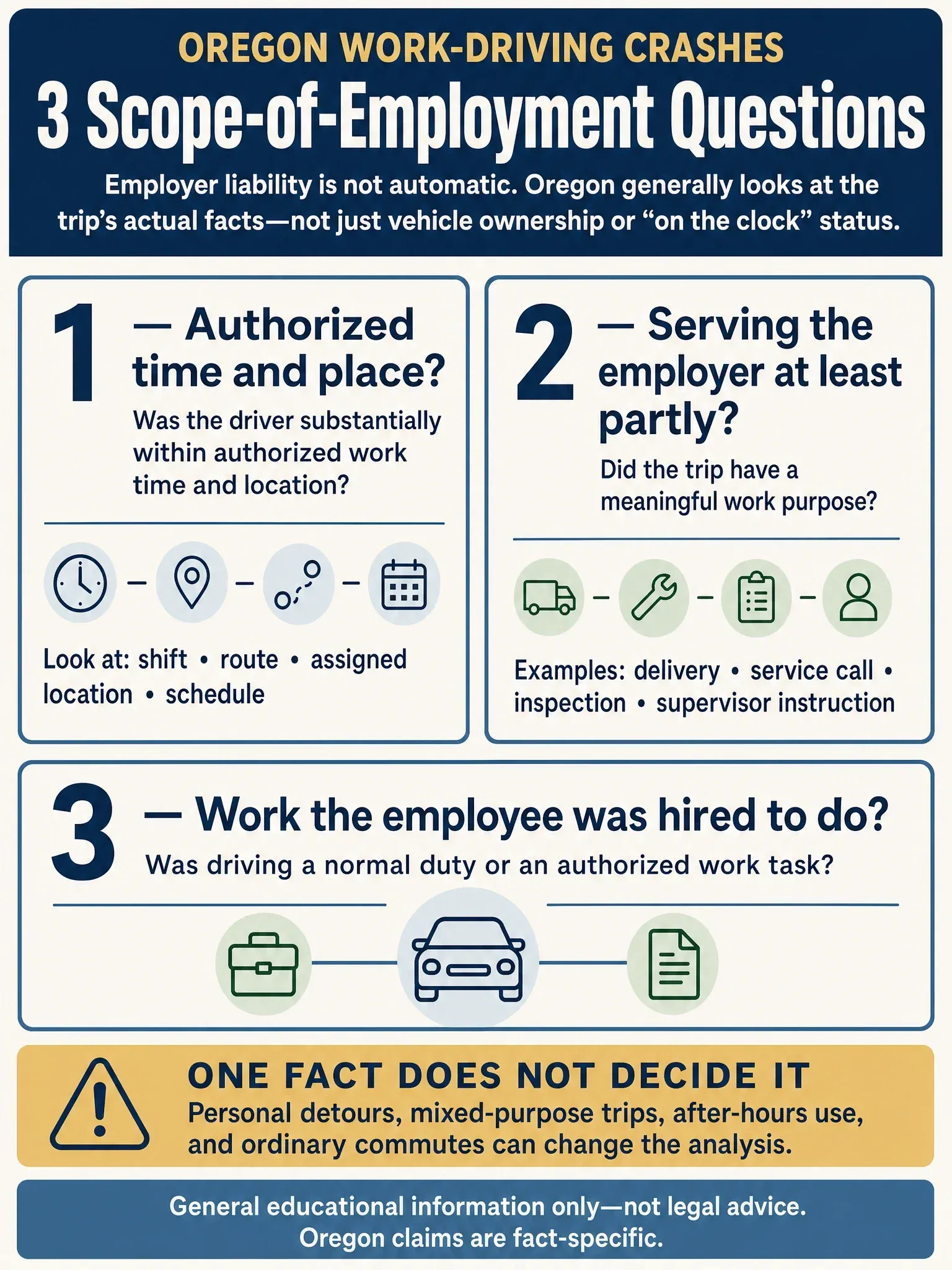
The Oregon Supreme Court has described three core requirements for scope of employment. In plain English, the employee’s conduct must generally be:
- substantially within authorized time and space limits;
- motivated, at least partly, by a purpose to serve the employer; and
- the kind of act the employee was hired to perform.
In company-vehicle crashes, those three points become practical evidence questions.
Authorized time and place
Time and place evidence may include the employee’s shift, timecard entries, route, assigned territory, delivery window, jobsite location, appointment schedule, or dispatch history.
If the crash happened during a scheduled shift while the driver was traveling between assigned jobs, that may support a work-related connection. If the crash happened late at night after the employee had finished work and stopped for personal reasons, the employer will likely argue the trip was outside the job.
The point is not that one fact decides the case. It is that time and location can help show whether the driver was where the employer expected the employee to be for work.
Purpose to serve the employer
Oregon’s test also asks whether the driver was motivated at least partly by a purpose to serve the employer. That can include making a delivery, going to a service call, transporting equipment, driving to an inspection, visiting a customer, or following a supervisor’s instruction.
Mixed-purpose trips can be harder. For example, a driver may be traveling from a worksite but also making a personal stop. The legal question becomes fact-specific: what was the purpose of the trip at the moment of the crash, and was the work purpose still meaningful?
Work the employee was hired to do
The third question is whether the conduct was the kind of work the employee was hired to perform. Some employees are hired to drive. Others drive only occasionally. Some are allowed or required to use vehicles for work errands. Others receive a company car mostly as a benefit.
For a delivery driver, service technician, inspector, route salesperson, or traveling employee, driving may be a normal part of the work. For an employee whose duties do not involve driving, a company car by itself may not be enough.
Oregon cases also recognize that scope-of-employment issues can be fact-dependent. When reasonable people could draw different conclusions from the evidence, the issue may need deeper investigation instead of a quick yes-or-no answer.
Evidence That May Show the Driver Was Working
Employer-liability evidence often comes from ordinary business records. Many of those records are controlled by the company, the insurer, a fleet vendor, a dispatch platform, or another third party. Some may be overwritten quickly.
Timecards, payroll records, and shift status
Time records can help show whether the driver was working, whether overtime applied, whether the driver had clocked out, and whether the trip matched the employer’s schedule.
Still, payroll status is not the entire test. A driver who is clocked in may make a personal detour. A driver who is technically off the clock may still be completing a required task. Timecards matter because they are part of the larger scope-of-employment picture.
Dispatch logs, route sheets, delivery records, and work orders
Dispatch and routing records can be especially important. They may show that the driver was assigned to a customer, delivery address, service call, inspection, jobsite, pickup, or route at the time of the crash.
Useful records may include:
- delivery manifests;
- route sheets;
- work orders;
- customer appointment records;
- dispatch notes;
- app-based assignment records;
- mileage records;
- fleet-management reports; and
- jobsite or inspection schedules.
These records can connect the crash location and time to a work assignment.
Job instructions, vehicle policies, and supervisor communications
Employer control can also matter. Written policies, supervisor instructions, and vehicle-use rules may show whether the driver was authorized to use the vehicle, whether the employer expected the employee to drive, and whether the trip fit the job.
Texts, emails, call logs, and messaging-app records may show that a supervisor directed the driver to a location, changed the route, added a stop, or expected the employee to report after completing the trip.
GPS, dashcam, telematics, phone records, and surveillance
Modern work vehicles may create electronic evidence. Depending on the vehicle and employer, that can include:
- GPS location history;
- dashcam or inward-facing camera video;
- electronic logging or fleet data;
- speed, braking, and impact data;
- route-optimization software records;
- phone-use records;
- nearby business or traffic-camera video; and
- maintenance or inspection records.
Not every case has these records, and an injured person usually cannot simply demand all of them informally. But identifying them early can help a lawyer send preservation requests and, if a lawsuit is filed, pursue formal discovery or subpoenas.
DMV crash report and police-report leads
Oregon DMV crash materials can also provide leads. Oregon requires drivers involved in reportable crashes to submit an Oregon Traffic Collision and Insurance Report within 72 hours when injury, death, or certain property-damage or towing thresholds are met. The DMV form includes checkboxes and fields that may identify employer-vehicle, on-the-job, paid driving or delivery, government-vehicle, or emergency-vehicle facts.
Those boxes do not decide civil liability. A police report or DMV report is a starting point, not the final word. But the forms can point to employment, insurance, vehicle ownership, and witness information that should be investigated.
Why a Company Car Alone May Not Be Enough
A company-owned vehicle is important evidence. It may identify a business, insurer, fleet owner, or policy. But Oregon law does not treat company ownership as automatic employer liability in every crash.
Personal errands and after-hours trips
If the employee had left work and was using the vehicle for personal reasons, the employer may argue the driver was outside the scope of employment. Oregon case law includes examples where an employer was not held responsible because the employee’s trip had become personal and the employer did not control the route, speed, or mode of travel.
This is why the timing and purpose of the trip matter. Was the driver still completing a work assignment? Had the driver ended the workday? Was the driver going somewhere the employer directed? Was the driver on a substantial personal detour?
Company vehicle as an employee benefit
Some employees have access to a company vehicle as a benefit or convenience. In that situation, the fact that the vehicle belongs to the company may not be enough. The injured person still needs evidence tying the trip to the employee’s work duties or to the employer’s business.
For example, if the employee’s duties did not involve driving the vehicle and the employee had no work duties after leaving for the day, the employer may have a stronger argument that the crash was outside the job.
Ordinary commutes and the “going and coming” rule
Oregon generally treats an ordinary commute to or from work as outside the course of employment. That does not mean every trip near the beginning or end of a workday is automatically excluded. Assigned travel, required vehicle use, work errands, jobsite-to-jobsite travel, or travel that is itself part of the job may require a closer look.
The practical question is whether the trip was just ordinary commuting or whether the employer had assigned, authorized, or benefited from the driving in a way that fits Oregon’s scope-of-employment test.
Work Errands, Routes, and Traveling Employees: Facts That May Support Employer Liability
The other side of the analysis is just as important: some work-driving facts can support a claim against the employer.
Driving between jobsites or inspections
When travel is a normal and necessary part of the job, the scope analysis may look different from a standard commute. Oregon authority has recognized employer-liability evidence where an employee was returning from an out-of-town inspection trip and was required to report after returning.
Evidence that may matter includes inspection assignments, jobsite schedules, mileage reimbursement, route instructions, supervisor communications, and reports the employee was required to make after the trip.
Deliveries, service calls, and assigned routes
Delivery drivers, service technicians, route drivers, repair workers, sales representatives, and other traveling employees may generate records that show whether the crash occurred during an assigned route or work task.
If the crash involved a larger commercial delivery operation, the claim may also involve specialized records and business structures. For related issues, see Johnson Law’s articles on FedEx and UPS truck collision claims, Amazon delivery van responsibility, and food delivery driver coverage issues.
Personal vehicles used for employer-authorized work
Employer liability is not limited to vehicles with company logos. Oregon authority recognizes that an employer may be responsible for an employee’s negligent driving in the employee’s own vehicle if the evidence supports employer authorization, employer control, and conduct within the course and scope of employment.
That can matter when an employee uses a personal car for deliveries, errands, customer visits, parts runs, inspections, or travel between worksites. The vehicle title is only one fact. The work purpose and authorization may be more important.
Vicarious Liability Is Different From Negligent Entrustment or Hiring/Supervision
Employer-related crash claims can involve more than one theory. It helps to separate them.
Vicarious liability: responsibility for the employee’s work-related negligence
Vicarious liability focuses on the employee’s conduct. If the employee caused the crash while acting within the scope of employment, the employer may be responsible even if the employer itself did not commit a separate negligent act.
This is the theory most people mean when they ask whether they can “go after the employer” because the driver was on the clock.
Negligent entrustment: why the employer’s knowledge can matter
Negligent entrustment is different. It asks whether the owner or employer negligently entrusted the vehicle to the driver. Oregon authority indicates that a negligent-entrustment claim requires proof of entrustment and proof that the entrustment was negligent.
Evidence may include what the employer knew or should have known about the driver’s ability or risk, such as licensing problems, prior crashes, DUI history, complaints, safety violations, or other facts suggesting the driver was likely to drive carelessly.
Other direct-negligence questions to investigate carefully
Depending on the facts, an investigation may also look at hiring, training, supervision, vehicle maintenance, scheduling pressure, or safety policies. Those issues should be handled carefully because each theory needs its own proof. It is not enough to say, “The company employed the driver.” The evidence has to support the claim being made.
Insurance Questions After a Company-Car or Work-Driving Crash
Employer involvement often matters because it may identify additional insurance. But coverage is policy-specific, and it is risky to assume an employer policy is available, primary, higher, or collectible without reviewing the actual policy language.
Employer commercial auto coverage may need to be identified
Oregon law sets minimum auto liability limits for policies used to satisfy financial responsibility requirements: $25,000 for bodily injury or death to one person, $50,000 for bodily injury or death in one crash, and $20,000 for property damage. Commercial auto policies may have different or higher limits, but that depends on the policy.
After a company-car crash, it may be important to identify:
- the vehicle owner;
- the named insured;
- the driver’s employer;
- any fleet or leasing company;
- whether the driver had permission to use the vehicle;
- whether the trip was within covered business use; and
- whether umbrella or excess coverage may apply.
Personal auto, employer auto, umbrella/excess, and exclusions may overlap
Coverage can become complicated when an employee uses a personal vehicle for work, a company car for a mixed-purpose trip, or a vehicle owned by a contractor, franchisee, staffing company, or public body. There may be disputes about which policy applies first, whether exclusions apply, or whether the driver was a permissive user.
Those issues usually require policy review, not assumptions.
PIP is separate from liability coverage
Oregon drivers are generally required to carry personal injury protection, or PIP. Oregon PIP benefits include reasonable and necessary medical and related expenses incurred within two years after injury, up to $15,000 in aggregate for those expenses, along with specified wage-loss and other benefits.
PIP is different from a liability claim against the at-fault driver or employer. In a work-related crash, PIP, health insurance, workers’ compensation, and liability coverage may overlap. Coordination can be important.
For a broader overview, see Johnson Law’s guide to Oregon auto insurance basics and the article on PIP, MedPay, and health insurance after an Oregon crash.
Special Oregon Issues: Comparative Fault, Public Employers, and Workers’ Compensation
Some company-car crashes raise timing and party issues that do not appear in a simple two-car claim.
Comparative fault and several liability
Oregon uses modified comparative fault. A claimant can recover if the claimant’s fault is not greater than the combined fault of the relevant persons, but damages are reduced by the claimant’s percentage of fault.
Oregon also generally uses several liability in bodily injury, death, and property-damage cases, meaning judgments separately state each liable party’s share based on fault percentages. There are statutory exceptions and possible reallocation procedures for uncollectible shares, but those rules are not automatic and should be evaluated case by case.
In a work-driving crash, fault allocation may involve the employee driver, another motorist, settled parties, third-party defendants, or the injured person. A separate allocation to the employer generally depends on a direct-negligence theory; if the employer is included only through respondeat superior, the employer-liability analysis is tied to the employee’s work-related negligence. For more background, see Johnson Law’s article on Oregon comparative fault in car accident claims.
Public entity vehicles and the 180-day notice issue
If the vehicle belonged to a city, county, state agency, school district, transit agency, or another public body, Oregon Tort Claims Act rules may apply. Oregon law provides that public bodies can be subject to civil action for torts of officers, employees, and agents acting within the scope of employment or duties, subject to the Oregon Tort Claims Act.
One major timing issue is notice. For many non-wrongful-death claims, Oregon Tort Claims Act notice is generally required within 180 days. Public-entity claims may also involve other limits and defenses, so they should be screened quickly.
If the injured person was also working
If the injured person was a nonemployee member of the public, workers’ compensation usually is not the first issue. But if the injured person was also working—such as a coworker, employee passenger, delivery worker, contractor, or someone hurt during their own job—workers’ compensation may affect the claim.
Oregon workers’ compensation exclusivity generally makes a covered employer’s workers’ compensation liability exclusive for subject workers’ injuries arising out of and in the course of employment, unless Oregon’s workers’ compensation statutes provide otherwise. At the same time, Oregon law allows certain third-party claims when a worker is injured by the negligence or wrong of someone other than persons exempt from liability.
If the negligent driver was in the same employ as the injured worker, exclusivity and coemployee protections require separate analysis. If the driver or employer is a nonexempt third party, the worker may have both a workers’ compensation claim and a third-party liability claim, with statutory lien and notice rules.
For more context on workplace injury exceptions and third-party claims, see Johnson Law’s article on workplace injury exceptions in Oregon.
What to Preserve Early After the Crash
If you suspect the other driver was working, do not wait to think about evidence. Some records are routine business data that may be overwritten or difficult to locate later.
Information to save yourself
If you can do so safely, preserve:
- photos and video of the vehicles, company logos, license plates, DOT or fleet numbers, and damage;
- the driver’s name, employer name, and insurance information;
- witness names and contact information;
- screenshots of any texts, emails, or app messages related to the crash;
- medical records and bills;
- repair estimates and towing records;
- your own timeline of what happened; and
- notes about anything the driver said about work, deliveries, routes, customers, or being late for an assignment.
Company and vehicle details to document
Write down or photograph details that may identify the business or vehicle owner, including:
- company name or logo;
- vehicle number;
- license plate;
- USDOT or fleet markings, if present;
- delivery platform or uniform information;
- trailer numbers;
- employer or contractor names mentioned at the scene; and
- police-report or DMV-report numbers.
These details can help identify the right employer, insurer, contractor, or fleet owner.
Records that may require preservation requests, discovery, or subpoenas
Some evidence may require formal legal tools. Oregon civil discovery rules allow inquiry into relevant, nonprivileged matters, including documents, electronically stored information, tangible things, and people with knowledge. Oregon procedure also allows document requests and subpoenas in the proper setting.
Depending on the case, records to preserve or seek may include:
- timecards and payroll records;
- dispatch logs;
- route sheets;
- work orders;
- GPS, ELD, or telematics data;
- dashcam footage;
- phone records;
- supervisor texts or emails;
- vehicle-use policies;
- driver qualification or training records;
- maintenance records;
- insurance policies;
- surveillance video from nearby businesses; and
- repair or inspection records.
Formal discovery generally comes after a case is filed, so early preservation efforts can be important.
Deadlines Can Be Shorter Than People Expect
Oregon’s general personal-injury limitation period is often two years, but that does not mean every crash victim should wait. Several different timing rules may matter:
- DMV reporting: Oregon reportable-crash rules can require a Traffic Collision and Insurance Report within 72 hours.
- Insurance investigation: Oregon’s Division of Financial Regulation states that an insurance company has up to 45 days to investigate an accident to determine responsibility shares for damages. That is an insurance process point, not a lawsuit deadline.
- Public-body notice: If a public body or public employee is involved, Oregon Tort Claims Act notice may be required much sooner—generally within 180 days for many non-wrongful-death claims.
- Lawsuit deadline: Oregon’s default deadline for many personal-injury claims is two years, but exceptions and special rules may apply.
- Evidence loss: Dashcam, GPS, telematics, dispatch, and surveillance data may disappear long before any formal deadline.
Deadlines are one reason work-driving crashes should be evaluated early, especially when the driver may have been working for a public entity, contractor, delivery company, or commercial fleet.
Bottom Line for Oregon Crash Victims
After an Oregon company-car or work-driving crash, the employer may be part of the claim if the driver was acting within the scope of employment. But the case usually turns on proof—not just the phrase “on the clock.”
Helpful questions include:
- Was the driver within authorized work time and location?
- Was the trip serving the employer’s business?
- Was driving part of the employee’s job or an authorized work task?
- Was the vehicle owned, leased, assigned, or insured by a business?
- Were there dispatch records, route logs, work orders, or supervisor instructions?
- Was the driver commuting, on a personal errand, or on a work assignment?
- Does a public-entity, workers’ compensation, or insurance-coverage issue change the analysis?
Johnson Law can review the available facts, discuss records that may need to be preserved, and evaluate which driver, employer, insurer, or public-entity issues may need attention. Asking those questions early can help identify potentially important evidence before routine records are overwritten or become harder to locate.
FAQ
Is an Oregon employer automatically liable if its employee crashes a company car?
No. Company ownership is important evidence, but it is not automatic proof of employer liability. Oregon generally asks whether the employee was acting within the scope of employment when the crash happened.
What does “scope of employment” mean in an Oregon company-car crash?
It generally focuses on whether the employee was acting within authorized time and place limits, whether the trip served the employer at least in part, and whether the conduct was the kind of work the employee was hired to perform.
Can an employer be responsible if the employee was driving a personal car for work?
Possibly. Oregon authority recognizes that employer liability may arise when an employee uses a personal vehicle for authorized work and the evidence supports employer control and conduct within the course and scope of employment.
Does the commute rule mean employers are never liable for crashes going to or from work?
Not necessarily. Oregon generally treats ordinary commuting as outside the course of employment, but assigned travel, work errands, jobsite-to-jobsite travel, or required work-related driving may require closer analysis.
What evidence may help show the driver was on a work trip?
Timecards, dispatch logs, route sheets, work orders, GPS or telematics data, dashcam footage, supervisor messages, vehicle policies, delivery records, and crash-report fields may help evaluate whether the trip was work-related, depending on the facts.
What if the vehicle belonged to a city, county, state agency, school district, or transit agency?
Public-entity crashes should be screened quickly for Oregon Tort Claims Act issues. For many non-wrongful-death claims, notice is generally required within 180 days, and other public-body rules may apply.
Sources
- Chesterman v. Barmon, 305 Or 439, 753 P2d 404 (1988)
- ORS chapter 12 — limitations periods, including ORS 12.110.
- ORS chapter 30 — Oregon Tort Claims Act and product-liability statutes.
- ORS chapter 31 — comparative fault and several liability, including ORS 31.600 and ORS 31.610.
- ORS chapter 656 — workers’ compensation exclusivity, third-party claims, and lien/notice rules.
- ORS chapter 742 — personal injury protection benefits, including ORS 742.524.
- ORS chapter 806 — Oregon financial responsibility and minimum liability coverage requirements.
- Oregon DMV: Collision Reporting and Responsibilities
- Oregon DMV: Insurance Requirements
- Oregon Division of Financial Regulation: What to do if you are in an accident
- Oregon Rules of Civil Procedure — discovery, production, and subpoenas.
Client-First Fee Promise
Client First = Bills First, Fees Second
Your unpaid medical bills do not have to make your lawyer's fee bigger. Johnson Law subtracts qualifying medical bills before calculating our fee, helping clients keep more of their settlement.
Applies to qualifying cases. Results vary.