Food Delivery Driver Hits You: Does “On the App” Matter for Coverage?
Food Delivery Driver Hits You: Does “On the App” Matter for Coverage?
Educational information only, not legal advice. Food-delivery crash coverage depends on the platform, policy language, driver status, app phase, and Oregon insurance facts. Do not rely on a generic internet answer for a specific claim.
Quick answer: yes, “on the app” can matter—but it is not the only question
If a DoorDash, Instacart, Uber Eats, or similar food delivery driver hits you in Oregon, the driver’s app status can change the coverage analysis.
Important questions include:
- Was the driver logged into the app?
- Had the driver accepted an order?
- Was the driver picking up food, shopping, driving to the customer, or waiting for an offer?
- Was the driver using a personal vehicle with a personal auto policy?
- Does the personal auto policy exclude delivery or business use?
- Does a platform policy apply, and if so, at what limits and under what conditions?
- Is there Oregon PIP, UM/UIM, health insurance, or another policy that must be coordinated?
The phrase “on the app” is a starting point, not the whole answer.
For commercial delivery-vehicle issues involving larger fleets, see our post on FedEx and UPS delivery-truck collisions.
Why food delivery crashes create coverage disputes
Food delivery drivers often use personal vehicles. That creates a common problem: personal auto policies may contain exclusions or limits for commercial, livery, delivery, or business use.
When a crash happens, insurers may ask:
- Was the driver working for pay?
- Was the driver transporting food or groceries?
- Had an order been accepted?
- Was the driver between orders?
- Did the driver tell the personal insurer about delivery work?
- Does a platform policy provide contingent coverage only after other coverage is denied or exhausted?
Those questions can determine whether the injured person is dealing with a normal personal auto claim, a denied personal-policy claim, a platform coverage claim, or several policies at once.
The app phase can change the insurance map
Different companies use different policy terms, and those terms can change. But many delivery coverage disputes revolve around phases like these:
| Driver status | Why it matters |
|---|---|
| App off | Usually looks more like an ordinary personal-auto crash, subject to the driver’s policy. |
| App on, waiting for an offer | Personal policy exclusions and limited platform terms may become disputed. |
| Order accepted / en route to pickup | Platform-related coverage is more likely to be argued, but policy conditions still matter. |
| Carrying food or groceries to customer | Coverage may be stronger under some platform policies, but documentation remains critical. |
| After delivery completed | The analysis may shift again depending on whether the driver was still available for offers. |
The practical point: investigators should determine the driver’s exact status at the minute of the crash, not just whether the person sometimes delivers food.
What evidence proves whether the driver was on the app?
App status is not always obvious at the scene. Useful evidence may include:
- the driver’s admission or statement at the crash scene;
- police report notes about delivery work;
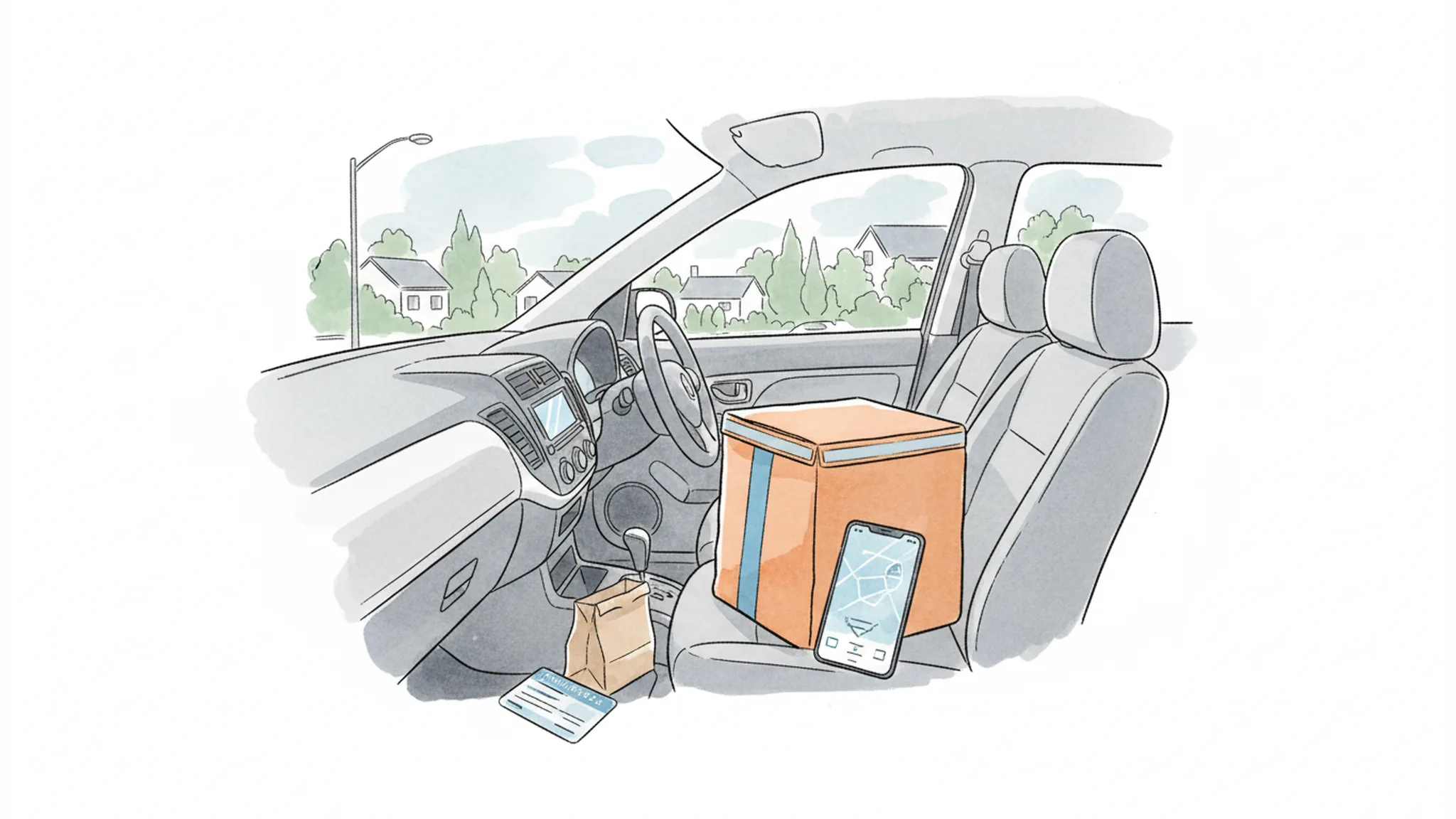
- food bags, grocery bags, receipts, or order labels in the vehicle;
- app screenshots showing active delivery, pickup, or drop-off;
- phone records and app activity logs;
- platform records for order acceptance, pickup, route, and delivery completion;
- GPS and navigation history;
- customer or restaurant records;
- dash camera or surveillance video; and
- insurance claim notes identifying delivery work.
Preserving this evidence early matters because app records and screenshots may be hard to reconstruct later.
Personal auto insurance may deny delivery-related crashes
Many delivery drivers assume their personal auto policy will cover any crash because the car is insured. That is not always true.
Personal auto insurers may investigate whether the vehicle was being used for delivery or business purposes. If a policy excludes that use, the insurer may deny coverage or reserve rights.
That denial does not automatically mean there is no claim. It may mean the injured person has to examine:
- the driver’s policy language;
- the platform’s insurance terms;
- whether a commercial endorsement exists;
- whether another household or vehicle policy applies;
- Oregon PIP or UM/UIM coverage; and
- whether the driver or platform failed to disclose important facts.
For a broader policy overview, see our Oregon auto insurance guide.
Platform coverage is not a magic answer
Delivery platforms may advertise or publish insurance information for active deliveries, but the details matter. Coverage may be contingent, limited to certain phases, dependent on the driver maintaining personal insurance, or subject to exclusions.
Do not assume:
- every food delivery app has the same insurance;
- coverage applies whenever the driver is logged in;
- the highest advertised limit applies to every crash;
- the platform will voluntarily disclose all records without a formal request; or
- the platform policy eliminates the need to pursue the at-fault driver.
The safer approach is to gather the policies and records, then map coverage based on the actual order timeline.
Oregon PIP, UM/UIM, and comparative fault can still matter
Oregon insurance rules may add another layer.
Oregon’s motor vehicle insurance statutes address personal injury protection benefits, including in ORS 742.520. UM/UIM coverage concepts are addressed in ORS 742.502. Comparative fault is addressed in ORS 31.600.
In plain English, that means the case may involve several separate questions:
- Who caused the crash?
- Which policy should receive notice or pay benefits first?
- Is the delivery driver uninsured or underinsured because a personal policy denied coverage?
- Does your own UM/UIM policy need to be notified?
- Are insurers trying to assign some fault to you or another driver?
Coverage coordination can affect deadlines, liens, and settlement strategy.
What if you were a passenger, pedestrian, cyclist, or another delivery worker?
Food delivery crashes do not only injure drivers in other cars.
The coverage analysis may look different if you were:
- a passenger in the delivery driver’s vehicle;
- a pedestrian hit in a parking lot, driveway, or crosswalk;
- a cyclist struck during pickup or drop-off;
- a restaurant worker or customer hit near a curbside pickup zone;
- another delivery worker injured while working.
If you were working at the time, Oregon workers’ compensation and third-party claim rules may need to be coordinated. ORS 656.154 addresses claims against negligent third persons in work-injury settings, while ORS 656.018 addresses employer exclusivity.
Common mistakes after a food delivery crash
Avoid these errors:
- assuming the driver’s personal auto policy will handle everything;
- assuming the platform policy automatically applies;
- failing to document food bags, order receipts, or app activity;
- waiting too long to preserve platform records;
- giving a recorded statement before coverage is mapped;
- signing a release that covers unknown entities or policies; and
- ignoring your own PIP or UM/UIM notice obligations.
For broader evidence steps after a crash, see our guide on what to save after adjuster calls.
Bottom line
“Was the driver on the app?” is often one of the important questions after a food delivery crash, but it is not the only one.
A thorough coverage analysis usually reviews:
- the exact order timeline;
- app, GPS, and route records;
- the driver’s personal policy;
- any platform policy and conditions;
- Oregon PIP and UM/UIM notice review; and
- careful documentation before insurers start shifting blame.
If a delivery driver injured you, an early personal-policy denial does not necessarily end the coverage investigation. It may simply mean the coverage question has not been fully answered yet.
Sources
Client-First Fee Promise
Client First = Bills First, Fees Second
Your unpaid medical bills do not have to make your lawyer's fee bigger. Johnson Law subtracts qualifying medical bills before calculating our fee, helping clients keep more of their settlement.
Applies to qualifying cases. Results vary.