Brake Failure After Repair in Oregon: Shop Negligence or Defective Parts?
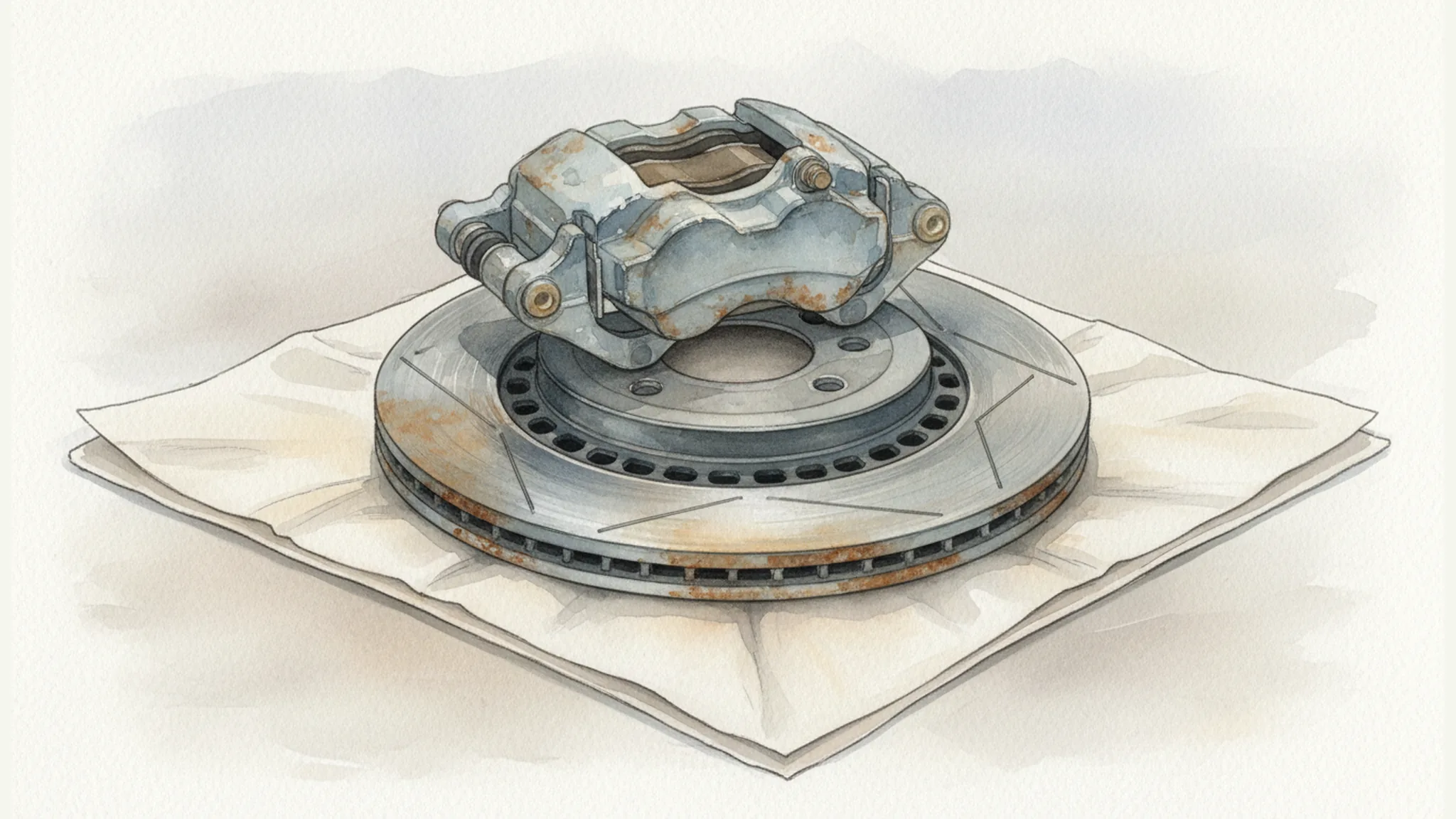
Brake Failure After Repair in Oregon: Shop Negligence or Defective Parts?
Educational disclaimer: This article provides general educational information about Oregon brake-failure, repair-negligence, product-liability, and evidence-preservation issues. It is not legal advice and does not create an attorney-client relationship. Brake-failure claims are fact-specific, and deadlines can vary based on the type of claim and the people or companies involved.
Key Takeaways
- Brake failure soon after repair does not automatically prove that a repair shop was negligent, but it is a strong reason to preserve the vehicle, failed parts, and service records immediately.
- Oregon cases may involve negligent brake service or installation, defective replacement parts, vehicle-system design or warning issues, or more than one responsible party.
- Estimates, invoices, work authorizations, parts lists, diagnostic notes, brake-fluid records, photos, tow-yard records, and removed components can become important evidence.
- Recalls and NHTSA complaints can help identify possible defect patterns, but they do not prove by themselves what caused a particular Portland crash.
- Oregon deadlines and fault allocation are fact-specific, especially when negligence, product liability, comparative fault, property damage, injury, or death claims overlap.
If Your Brakes Failed Soon After Service, Start With Evidence — Not Assumptions
When brakes fail days or weeks after service, it is natural to wonder whether the mechanic, dealership, parts seller, or manufacturer is responsible. The timing matters. A recent brake job can raise serious questions about inspection, installation, fluid service, part selection, and whether unsafe conditions were missed.
But timing alone is not proof. Under Oregon law, a brake-failure case may turn on technical evidence: what work was performed, what parts were installed, whether the parts were defective, whether the driver had warning signs, and whether the vehicle or failed components can still be inspected.
For Portland crashes, the practical first step is often preservation. Before authorizing repairs, salvage, or disposal, consider whether the vehicle, brake parts, diagnostic data, service paperwork, and tow-yard records need to be saved. Once brake components are replaced, discarded, or mixed with other parts, it can become much harder to determine what happened.
This is also the kind of crash that may be more complicated than a routine insurance claim. If there are severe injuries, disputed fault, a recent repair, a recalled component, or multiple possible defendants, compare the facts with these signs a crash may be more than a simple insurance claim.
The First Split: Bad Brake Service vs. A Defective Product
A post-service brake failure usually starts with a basic question: was the problem caused by the way the brakes were serviced, or by a product that failed even though it was installed and used as expected?
Those are different legal paths.
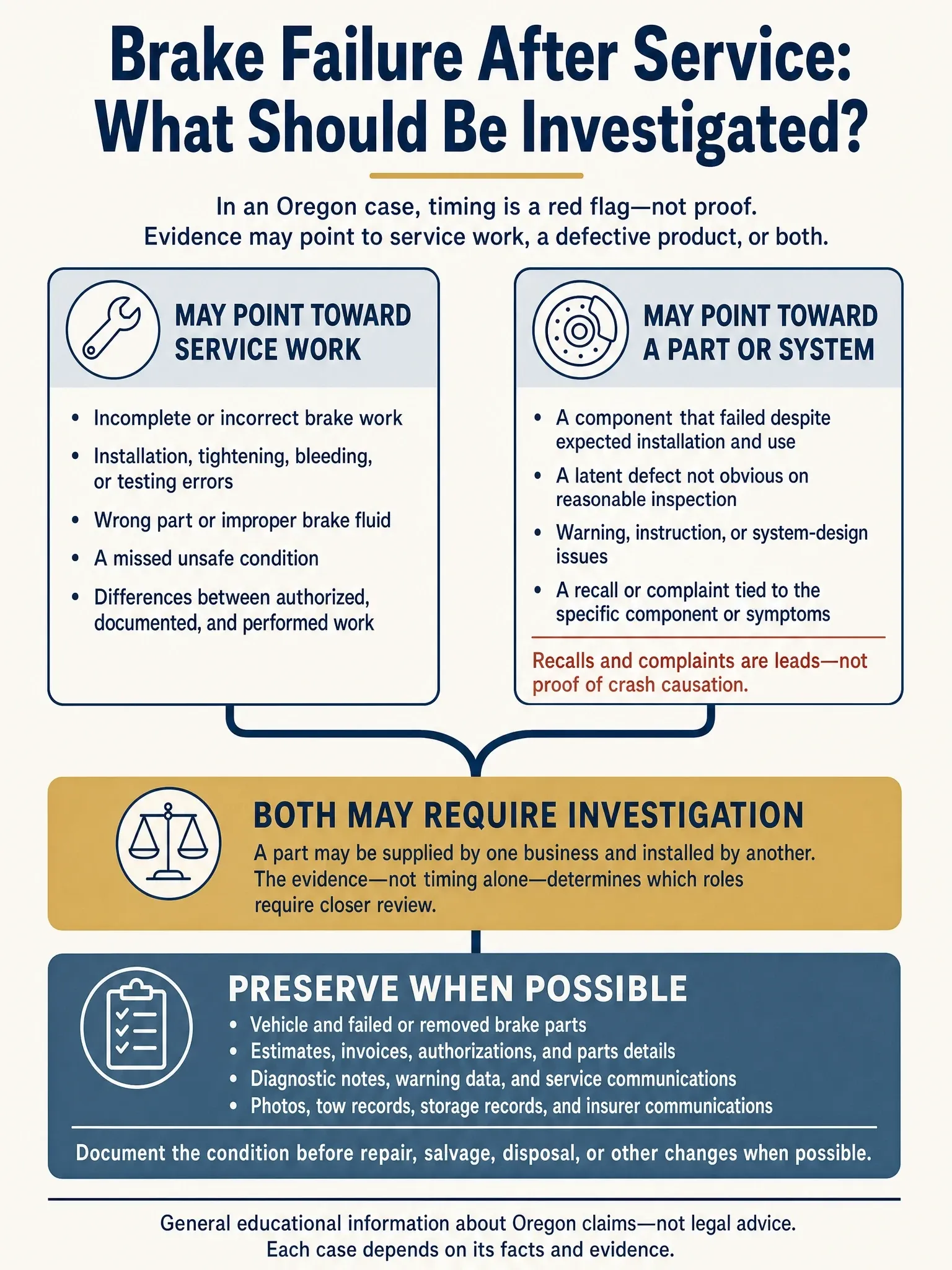
Oregon product-liability law applies to certain civil actions against a manufacturer, distributor, seller, or lessor of a product for injury, death, or property damage arising from a product defect, failure to warn, or failure to properly instruct in product use. Oregon also recognizes strict product liability for a seller or lessor of a product in a defective condition unreasonably dangerous to the user or consumer when the statutory requirements are met.
Negligent repair or service is different. A repair-shop claim may focus on whether a mechanic or shop failed to use reasonable care in inspecting, installing, maintaining, bleeding, adjusting, or documenting brake work. A shop may sometimes be both a service provider and a seller of a brake component, but that depends on the transaction and the evidence. It should not be assumed in every case.
What May Point Toward Repair-Shop Negligence
Repair-shop negligence may be investigated when the facts suggest that the service work itself created or missed the danger. Examples may include:
- incomplete or incorrect brake work;
- installation errors;
- use of the wrong part for the vehicle;
- wrong, contaminated, or noncompliant brake-system fluid;
- failure to identify an unsafe condition during inspection;
- failure to tighten, secure, bleed, or test components properly;
- parts changes not reflected in the estimate or invoice; or
- a mismatch between what the customer authorized and what the shop performed.
Oregon has statutes addressing vehicle repair-shop estimates, authorization, and related records. For example, Oregon law defines a vehicle repair shop as a business that, for payment, evaluates, maintains, or repairs a motor vehicle. Oregon law also requires vehicle repair shops to prepare estimates before beginning proposed work, provide a copy before final payment, and keep a copy. For estimates over certain thresholds, separate authorization may be required before specified evaluation, disassembly, repair, parts replacement, or certain cost-increasing changes.
Those records can matter because they may show what the shop said it would do, what it actually did, what parts it used, whether the work changed, and whether the customer or owner was told about an unsafe condition. Poor paperwork or missing authorizations do not automatically prove that the shop caused the crash, but they can become part of the investigation.
What May Point Toward a Defective Part or Vehicle-System Claim
Other cases are less about the mechanic’s work and more about the brake component or vehicle system. Potential product issues may involve brake pads, rotors, calipers, hoses or lines, master cylinders, brake fluid, wear indicators, warning systems, or broader brake-system design.
Oregon strict product-liability analysis is not the same as ordinary negligence. In McCathern v. Toyota Motor Corp., the Oregon Supreme Court described the standard under ORS 30.920 as a consumer-expectation test: the plaintiff must prove that, when the product left the defendant’s hands, it was defective and dangerous beyond what an ordinary consumer would expect.
Federal brake-system standards may also provide technical context. Federal Motor Vehicle Safety Standard No. 135 addresses light-vehicle service-brake and parking-brake systems and includes requirements related to safe braking performance, wear adjustment, warning indicators, reservoir capacity, and brake-system integrity. That does not mean every brake-failure case depends on proving a federal standards violation, and regulatory compliance does not necessarily end the Oregon legal analysis.
NHTSA recall searches and safety complaints can also be useful leads. A recall may suggest that a vehicle or equipment item has an unreasonable safety risk or fails to meet minimum safety standards. But a recall does not automatically prove that the recalled condition caused a specific crash in Portland. The same is true for public complaints or manufacturer communications: they may point investigators in the right direction, but the vehicle and parts still need case-specific review.
When Both Theories May Be Investigated
Some brake-failure cases involve both service conduct and product evidence. A wrong or defective part may be supplied by one business, installed by another, and then blamed on the vehicle owner or driver after a crash.
An older Oregon case, Hills v. McGillvrey, illustrates how multiple roles can matter in a brake-failure scenario. The case involved evidence that an undersized wheel bearing sold by an auto-parts business and installed by a mechanic caused heat, brake-fluid vaporization, loss of braking capacity, and a fatal collision; the mechanic admitted negligence, and the case also involved the auto-parts business. The case should not be treated as a one-size-fits-all rule for modern brake claims, but it shows why investigators often look at both the part supply chain and the repair work.
Oregon fault-allocation rules can also matter when more than one person or company may share responsibility. A case may involve a repair shop, dealership, parts seller, distributor, manufacturer, vehicle owner, driver, or another motorist. Sorting out those roles usually requires documents, physical evidence, and expert analysis.
Why “It Happened Right After Service” Is Important But Not Enough
A brake failure immediately after service is a red flag, not a final answer.
Oregon law recognizes that a brake system can fail suddenly and unexpectedly. In Freund v. DeBuse, the Oregon Supreme Court discussed a brake-equipment violation and held that evidence of an unexpected brake-drum failure with no prior warning could allow a jury to find that the defendant acted reasonably under the circumstances. That point is important: even where brake equipment standards matter, Oregon analysis can still be fact-specific.
Similarly, a brake defect may be latent, meaning it is not obvious from ordinary inspection. In Cornelius v. Bay Motors, the Oregon Supreme Court treated a used-car brake-defect strict-liability claim as turning on consumer expectations and whether the brake defect was latent and not discoverable by reasonable testing or visual inspection.
For an injured person, the practical lesson is simple: do not assume the shop is liable just because the brakes failed after service, and do not assume the shop is off the hook because a component may have failed. The question is what the evidence shows.
Oregon Brake Equipment Standards Can Matter
Oregon requires most motor vehicles to have brakes with two separate means of application, each effective on at least two wheels, and constructed so a failure in one part of the operating mechanism does not leave the vehicle without brakes on at least two wheels if the means are connected. Oregon law also requires brakes to be adequate to control, stop, and hold the vehicle and to be maintained in good working order.
Those statutes may be relevant in a brake-failure case, especially when a vehicle was driven with unsafe brakes or when someone claims the failure was sudden and unavoidable. Oregon also has an “improper brakes” offense for driving, moving, owning, or knowingly permitting operation of a vehicle that does not meet the brake-equipment requirements.
Still, equipment statutes do not automatically decide civil liability. Oregon negligence-per-se and equipment-violation issues require careful legal review, and a party may argue that the failure happened without prior warning or despite reasonable conduct.
Repair Records That Can Separate Shop Error From Part Defect
After a crash, repair paperwork can be just as important as the crash report. The goal is to reconstruct what work was requested, authorized, performed, and documented before the brake failure.
Records to preserve may include:
- the original estimate;
- the final invoice;
- work authorization forms;
- changed estimates or additional authorizations;
- parts lists and part numbers;
- labor descriptions;
- diagnostic notes and scan results;
- brake-fluid service notes;
- warranty documents;
- text messages, emails, voicemails, and app communications with the shop;
- photos or videos from before and after the repair;
- tow records and storage-yard records;
- post-crash repair estimates;
- insurer communications; and
- any document showing what happened to removed or replaced parts.
Oregon’s vehicle repair-shop statutes can make these documents especially relevant. An estimate may identify the proposed work, labor, parts or component systems, incidental charges, and total estimated cost or range. Authorization records may show whether the owner or designee approved evaluation, disassembly, repair, maintenance, parts replacement, or a cost-increasing change.
If an insurer or adjuster becomes involved quickly, keep claim records organized from the start. Johnson Law’s guide to what to save after the adjuster calls explains how to track claim-file records, communications, estimates, and insurer requests.
Again, paperwork problems are not the same as crash causation. A missing estimate may support questions about the shop’s practices, but the injury claim still needs proof that the brake issue caused or contributed to the crash.
Vehicle, Part, and Recall Evidence To Preserve Immediately
Brake-failure evidence is often physical. If the car is repaired, totaled, salvaged, or stripped for parts before anyone inspects it, key proof may disappear.
Preserve the Vehicle and Failed Components When Possible
When possible, preserve:
- the vehicle in its post-crash condition;
- brake pads, rotors, calipers, drums, shoes, hoses, and lines;
- the master cylinder and related hydraulic components;
- brake fluid samples or containers when relevant;
- wheel, tire, hub, and bearing assemblies;
- warning-light information;
- diagnostic scans or electronic data;
- removed parts from the recent brake service; and
- photos of the vehicle, wheels, brake assemblies, roadway, skid or scuff marks, fluid leaks, and warning indicators.
Oregon court rules allow discovery tools such as document requests, subpoenas, and inspection, testing, or sampling of tangible things within the scope of discovery. Those tools are most useful when the evidence still exists. That is why preservation decisions should be made early.
This is similar to other vehicle safety-system cases, such as when an airbag does not deploy in a serious crash. In both situations, the vehicle, electronic data, recalls, component condition, and expert inspection may matter. For a related example, see Johnson Law’s guide to vehicle defect evidence after a serious crash.
Check Recalls and Defect Information, But Keep Perspective
NHTSA’s recall tool allows searches for vehicles, tires, equipment, and related safety information. After a brake failure, useful searches may include:
- the vehicle’s VIN;
- the year, make, and model;
- the brake component or equipment category, where available;
- manufacturer communications or investigations; and
- public safety complaints involving similar symptoms.
NHTSA also accepts safety complaints from consumers. Those complaints can help the agency investigate possible defects and may become part of a public database after personally identifying information is removed.
But a recall search is not a substitute for preserving the vehicle. A recalled part may not be the part that failed. A complaint from another driver may involve a different cause. A specific Oregon injury case still requires proof of defect, causation, damages, and each party’s role.
Who Could Be Blamed In An Oregon Brake Failure Case?
Oregon brake-failure cases can involve more than one possible defendant or fault participant.
Possible Defendants or Fault Participants
Depending on the facts, investigation may look at:
- the repair shop or mechanic that performed the recent brake service;
- a dealership that sold, inspected, or serviced the vehicle;
- a parts seller or distributor;
- a brake-component manufacturer;
- the vehicle manufacturer;
- the vehicle owner;
- the driver;
- other motorists involved in the crash;
- settled parties; or
- third-party defendants brought into the case.
Oregon comparative-fault law generally reduces damages in proportion to a claimant’s fault and bars recovery only if the claimant’s fault is greater than the combined fault of the parties and other fault participants described in the statute. Oregon also generally makes defendants severally liable for their own percentage share of damages, subject to statutory procedures.
That means the case may not be as simple as “the shop pays” or “the manufacturer pays.” The factfinder may be asked to allocate fault among several people or entities.
Common Defense Themes
Defendants and insurers may argue that something other than shop error or product defect caused the crash. Common themes may include:
- the driver ignored brake warning lights;
- the driver continued driving after grinding, pulling, soft-pedal feel, fluid leaks, or other symptoms;
- speed, following distance, or road conditions caused or worsened the crash;
- the vehicle was overloaded or towing beyond safe limits;
- maintenance was missed or delayed;
- the failed component was old or unrelated to the recent service;
- the brake failure was sudden, latent, and not discoverable by reasonable care; or
- another driver caused the collision regardless of the brake condition.
Those arguments do not defeat every claim. They do show why early evidence preservation and technical review matter.
Oregon Deadlines Can Differ By Claim Type
Do not rely on a one-size-fits-all deadline for a brake-failure claim.
Oregon’s general personal-injury limitation statute requires many injury claims not otherwise enumerated to be filed within two years. That may be relevant to negligence claims against a repair shop or mechanic.
Product-liability claims have their own Oregon timing statute. ORS 30.905 generally includes a two-year discovery framework for personal injury or property damage tied to when the plaintiff discovers, or reasonably should discover, the injury or damage and the causal relationship to the product or defendant’s conduct. It also includes repose limits, including an ultimate-repose framework tied to product purchase or the equivalent repose period in another state in certain circumstances.
Death claims can involve different timing rules, including product-liability death provisions and Oregon wrongful-death analysis. Older vehicles, older components, rebuilt parts, used parts, and out-of-state manufacturers can create additional timing questions.
The practical point is to act before evidence changes or deadlines become disputed. If you suspect brake service or a defective brake part contributed to a crash, consider getting case-specific guidance promptly.
Portland Case Context: Local Evidence, Multnomah County, and Next Steps
There is no separate body of “Portland brake law” for these claims. The legal analysis is generally Oregon law. Portland and Multnomah County matter because that is where evidence, witnesses, repair shops, tow yards, crash scenes, medical treatment, and court venue may be located.
For a Portland-area crash, useful local evidence may include:
- the name and location of the shop that performed the brake service;
- tow-yard intake and storage records;
- crash-scene photos from Portland streets, intersections, hills, bridges, or parking areas;
- witness names and contact information;
- police or crash-report information where available;
- local repair estimates after the crash;
- insurer inspection records; and
- communications with the shop, dealership, or parts seller.
Multnomah County Circuit Court is Oregon’s Fourth Judicial District and has court locations in Portland, including the Multnomah County Courthouse. Whether a particular case belongs there depends on venue and case-specific facts.
If the crash involves injuries, Johnson Law’s Oregon car accident claims page provides broader context about car-wreck cases. This article stays focused on brake-service and brake-part evidence.
What To Do Now If You Suspect Brake Service Or Parts Caused A Crash
If you believe brake service or a defective part contributed to a crash, consider these practical steps:
- Save every repair document. Keep estimates, invoices, authorizations, parts lists, warranty documents, diagnostic notes, and communications.
- Do not discard parts. Ask the shop, tow yard, insurer, or salvage yard to preserve removed brake components when possible.
- Photograph the vehicle and parts. Include the wheels, brake assemblies, leaks, warning lights, odometer, dashboard messages, roadway, and visible damage.
- Record symptoms while memories are fresh. Note soft pedal feel, grinding, pulling, warning lights, burning smells, leaks, loss of pressure, or noises before the crash.
- Preserve tow-yard and insurer communications. These can show who had possession of the vehicle and when repairs, inspections, or disposal were discussed.
- Search for recalls and safety information. Use the VIN and vehicle details, but remember that recalls are leads, not proof.
- Avoid unnecessary alteration. If the vehicle must be moved or repaired, document its condition first and consider whether legal guidance is needed before evidence changes.
- Get case-specific advice promptly. Brake-failure cases can involve overlapping negligence, product-liability, comparative-fault, and deadline issues.
Johnson Law reviews Oregon crash claims involving disputed fault, vehicle-defect evidence, and serious injuries based on the facts and available records.
FAQ
Can I sue for brake failure after repair in Oregon?
Possibly. A claim may exist if evidence connects the brake failure to negligent service, negligent inspection, a defective product, another party’s conduct, or a combination of causes. The fact that brakes failed after service is important, but the case still requires proof of causation and damages.
Does brake failure right after service prove the mechanic was negligent?
No. It creates a reason to investigate, but it does not automatically prove negligence. Oregon law recognizes that brake failures may involve sudden, latent, or product-related issues. Records, physical parts, warning signs, and expert inspection often determine the stronger theory.
What records should I save after a brake-failure crash?
Save the estimate, invoice, work authorization, changed estimates, parts list, part numbers, diagnostic notes, brake-fluid records, warranties, communications with the shop, photos, tow records, post-crash repair estimates, insurer communications, and any information about removed or replaced parts.
What if the brake part was recalled?
A recall may support investigation of a defect theory, but it does not automatically prove that the recalled condition caused your crash. You still need to connect the recall or defect information to the specific vehicle, component, failure mechanism, and collision.
Who may be responsible if both a shop error and defective part contributed?
Depending on the evidence, responsibility may be evaluated among the repair shop, mechanic, dealership, parts seller, distributor, manufacturer, vehicle owner, driver, other motorists, settled parties, or third-party defendants. Oregon fault-allocation rules may require analyzing each role separately.
How long do I have to bring a brake-failure claim in Oregon?
Deadlines vary by claim type. Negligence, product-liability, property-damage, personal-injury, and death claims can involve different limitation and repose rules. Because evidence can disappear quickly and timing rules are date-sensitive, it is important to seek case-specific guidance promptly.
Sources and Further Reading
- Oregon Revised Statutes, ORS 30.900 to 30.920 — Oregon product-liability definitions, timing, and strict product-liability provisions.
- Oregon Revised Statutes, ORS 12.110 and ORS 12.115 — general personal-injury limitation and negligence repose provisions.
- Oregon Revised Statutes, ORS 31.600 to 31.610 — comparative fault and allocation of fault.
- Oregon Revised Statutes, ORS 815.085 and ORS 815.125 to 815.130 — brake-fluid and vehicle brake-equipment standards.
- Oregon Revised Statutes, ORS 646A.480 to 646A.495 — Oregon vehicle repair-shop estimate, authorization, and related record requirements.
- McCathern v. Toyota Motor Corp., 332 Or 59 (2001) — Oregon consumer-expectation framing for strict product liability.
- Freund v. DeBuse, 264 Or 447, 506 P2d 491 (1973) — Oregon brake-equipment violation and sudden-failure reasonableness analysis.
- Hills v. McGillvrey, 240 Or 476, 402 P2d 722 (1965) — older Oregon brake-failure scenario involving wrong-part supply and mechanic negligence.
- Cornelius v. Bay Motors Inc., 258 Or 564, 484 P2d 299 (1971) — latent brake defect and consumer-expectation context.
- 49 CFR 571.135, Federal Motor Vehicle Safety Standard No. 135 — light-vehicle brake-system standards.
- National Highway Traffic Safety Administration — recall search and safety complaint resources.
- Oregon Rules of Civil Procedure, Rules 43 and 55 — discovery, subpoenas, and inspection or testing of documents and tangible things.
- Oregon Judicial Department — Multnomah County Circuit Court information.
Client-First Fee Promise
Client First = Bills First, Fees Second
Your unpaid medical bills do not have to make your lawyer's fee bigger. Johnson Law subtracts qualifying medical bills before calculating our fee, helping clients keep more of their settlement.
Applies to qualifying cases. Results vary.