Can You Own a Zebra in Oregon? The Short Answer and the Rules That Matter

Potentially yes in parts of Oregon—but not everywhere. Oregon does not require a special state ownership permit merely because an animal is a zebra, and the Oregon Department of Fish and Wildlife (ODFW) lists zebras as noncontrolled wildlife. But local bans and zoning can change the answer. Bringing a zebra across the state line can trigger animal-health rules, and federal requirements may apply based on the species and what the owner plans to do.
A zebra is not the usual Oregon backyard-animal question, and the answer is not entirely black and white.
This article provides educational information, not legal advice. The overview is current to the research completed on August 21, 2026, but local codes, disease orders, and agency requirements can change.
The Statewide Answer: Oregon Does Not Require a Zebra Permit Just Because It Is a Zebra
First, Oregon’s narrow statutory definition of an “exotic animal” covers specified nondomestic cats, nonhuman primates, nondomestic nonwolf canids, specified bears, and crocodilians. It does not include zebras, equids, or the broader order Perissodactyla. The legacy permit and breeding restrictions associated with that definition therefore do not apply merely because an animal is a zebra. See ORS 609.305 and ORS 609.341.
Second, ODFW treats zebras as nonnative wildlife and lists “Zebra and Asses—Equidae—Equus All species” among its noncontrolled mammals. Under OAR Division 56, including OAR 635-056-0060, that classification means Division 56 does not require an ODFW permit to import, possess, sell, purchase, exchange, or transport a zebra.
“Noncontrolled” has a limited meaning. It answers the ODFW Division 56 permit question; it does not mean that zebra ownership is unrestricted, legal at every address, or exempt from other state, local, and federal laws.
Your Address May Change the Answer
Local law should be the next check—not an afterthought. ORS 609.205 allows Oregon cities and counties to prohibit the keeping of wildlife and defined exotic animals. Because ODFW treats zebras as wildlife, local wildlife restrictions may reach them.
Multnomah County Generally Prohibits Zebras
Multnomah County provides a concrete example of why the statewide answer is only “potentially.” The county expressly includes zebras in its definition of a “wild or exotic animal” and generally makes it unlawful to harbor or own one, subject to listed exceptions. The old grandfather provision was tied to a county license held on August 6, 1998; it should not be treated as a current application route. See Multnomah County Code Chapter 13, including MCC 13.154(A).
Whether that code applies depends on the exact address. “Near Portland” is not a sufficient legal description, and a listed exception should not be assumed.
Elsewhere, Check Both Animal Rules and Zoning
Even where no ordinance expressly names zebras, check:
- city and county prohibitions covering wildlife or particular animals;
- zoning rules governing whether the proposed use is allowed;
- lot-size, animal-number, structure, permit, and setback rules;
- sanitation, nuisance, and roaming provisions; and
- any conditions attached to the owner’s proposed activity.
A statewide classification cannot establish that a particular property is lawful for keeping a zebra. Ask the relevant planning or animal-control office about the exact address and proposed use before committing to an acquisition.
Bringing a Zebra Into Oregon Is a Separate Question
Permission to possess an animal is different from permission to bring it across Oregon’s border. Oregon’s general livestock-entry rule ordinarily requires a certificate of veterinary inspection (CVI) issued at origin and valid for 30 days. It also ordinarily requires an Oregon Department of Agriculture (ODA) import permit before entry, although qualifying electronic CVIs and certain movements may be exempt. See OAR 603-011-1100.
Rules addressing incoming Equidae also concern official identification and disease testing. OAR 603-011-1220 generally requires a negative official equine infectious anemia test within the 12 months before entry for “all horses, mules, asses, or other Equidae,” subject to narrow exceptions. ODA’s Oregon Import Requirements summarize CVI, import-permit, identification, and testing requirements while also directing wildlife and exotic-animal importers to contact the agency.
Do not assume that every zebra shipment follows one fixed pathway. Before arranging transportation, ask ODA:
- how it will classify the particular zebra for entry purposes;
- what official identification and CVI language it will accept;
- which disease tests apply;
- whether an approved electronic CVI or another provision removes the ordinary import-permit step; and
- whether any current disease order affects animals coming from the place of origin.
Disease controls can change quickly. For example, effective June 4, 2026, OAR 603-011-1223 added New World screwworm requirements for warm-blooded livestock entering from an infested state or active infested zone. The current zones and shipment-specific conditions must be checked at the time of movement.
These are interstate-entry rules. Buying or moving a zebra that is already inside Oregon does not, by itself, trigger the interstate CVI and import-permit package.
A Private Pet Is Different From a Zebra Business or Public Display
USDA’s role under the federal Animal Welfare Act generally depends on the owner’s activities. USDA does not issue a general federal zebra-pet permit, and a federal license does not override a local ban or zoning restriction.
Solely Private Ownership Usually Does Not Require an AWA License
Under 9 CFR 2.1(a)(3)(ix), a person who buys an animal solely for personal use or enjoyment and does not sell or exhibit animals falls within the cited exemption from Animal Welfare Act licensing. That exemption addresses federal licensing; it does not remove Oregon entry rules, local restrictions, or state animal-care duties.
Sales, Breeding, Exhibition, or Commercial Transport Can Change the Analysis
Covered dealing, brokering, resale, auctions, commercial breeding, and public exhibition may require USDA licensing depending on the conduct and available exemptions. Public display may be regulated even when a nonprofit conducts it. Selling offspring can also change the federal analysis, even though Oregon’s legacy ORS 609 breeding restriction does not apply merely because the animal is a zebra. See the Animal Welfare Act definitions, 9 CFR Parts 1 and 2, and USDA APHIS licensing guidance.
Businesses transporting covered animals for hire or taking custody during commercial transportation may face separate registration rules. Owner-accompanied personal pet transportation is treated differently under the AWA, but Oregon’s entry-health requirements remain separate. See USDA’s information on transporting animals in commerce.
Federal housing, care, veterinary-care, handling, recordkeeping, and transportation standards apply to regulated licensees and registrants—not as a universal federal code for an exempt private owner.
The Zebra’s Exact Species Can Matter Under Federal Law
“Zebra” is not specific enough for every federal question. The U.S. Fish and Wildlife Service lists Grevy’s zebra and Hartmann’s mountain zebra as threatened, while Cape/mountain zebra taxa are listed as endangered. Protected status may affect import, export, interstate sale, and other transactions. It does not necessarily make every instance of possession unlawful.
Before an acquisition, sale, breeding arrangement, transport, or international transaction, identify the exact species and provenance and obtain transaction-specific guidance from the U.S. Fish and Wildlife Service. Its ECOS listed-animals database is a starting point, not an answer for a particular animal and transaction.
Legal Ownership Still Requires Lawful Animal Care
Oregon’s criminal animal-neglect laws require “minimum care” for animals. See ORS 167.310, ORS 167.325, and ORS 167.330. The approved research did not identify a statewide zebra-specific rule prescribing acreage, fence height, diet, training, social arrangements, or a veterinary schedule.
General animal-care law applies, while local zoning, structures, sanitation, nuisance, and confinement rules may add requirements. Before acquiring a zebra, locate qualified veterinary and animal-care professionals and determine whether the planned facilities and care can comply with the laws that apply to the property and activity.
A Five-Step Check Before You Acquire a Zebra
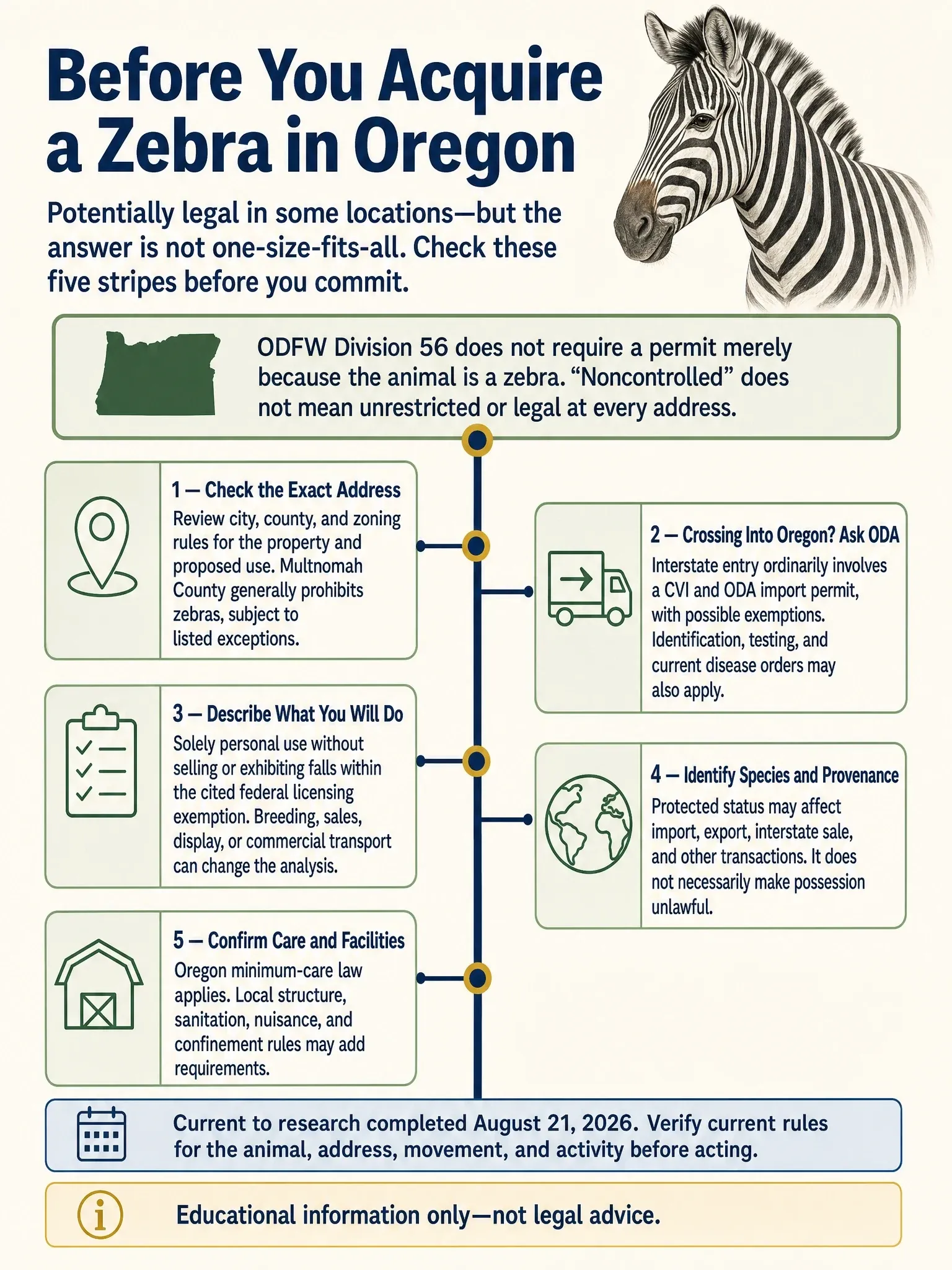
- Check the exact property. Review city, county, and zoning rules, beginning with any outright zebra or wildlife prohibition.
- Contact ODA before an interstate shipment. Get an answer for the particular animal, origin, documentation, identification, testing, permit or exemption, and current disease orders.
- Describe the activity to USDA APHIS. Be specific about private use, breeding, sales, brokering, public display, or transportation for hire; the label “owner” does not resolve the licensing question.
- Identify the species and provenance. Ask the U.S. Fish and Wildlife Service how protected-species law affects the proposed acquisition, sale, breeding, transport, import, or export.
- Confirm lawful care and facilities. Determine whether the proposed conditions can satisfy Oregon’s minimum-care law and all applicable local requirements.
The short answer remains: a zebra may be lawful in some Oregon locations, but there is no blanket statewide yes.
Where to Look for Legal Help
Johnson Law, P.C. does not handle exotic-animal ownership or permitting matters. People seeking an Oregon lawyer for this subject may contact the Oregon State Bar Lawyer Referral Service at 503-684-3763 or 800-452-7636. The Oregon State Bar lists its referral-service hours as 8:30 a.m. to 5 p.m., Monday through Friday, and says referred lawyers may charge up to $50 for an initial consultation of up to 30 minutes.
The referral service is separate from Johnson Law. A referral does not guarantee a particular legal answer, permit, or outcome.
This article is for educational information only and is not legal advice. Verify current requirements with the responsible agencies and qualified counsel before acquiring, moving, breeding, selling, displaying, or commercially transporting a zebra.
Source Notes
- Oregon classification and local authority: ORS Chapter 609 and ODFW Division 56.
- Interstate entry and animal health: ODA Division 11 rules and ODA Oregon Import Requirements.
- Local example: Multnomah County Code Chapter 13.
- Federal activity and species rules: 9 CFR Parts 1 and 2, 7 U.S.C. 2132, and U.S. Fish and Wildlife Service ECOS.