Oregon Charter and Intercity Bus Crashes: What Evidence May Show Carrier Maintenance and Company Control
Oregon Charter and Intercity Bus Crashes: What Evidence May Show Carrier Maintenance and Company Control
After a private intercity-bus, charter-bus, or motorcoach crash in Oregon, potentially relevant information may be held in more than one place. Depending on the operation and the records actually created, possible custodians may include the carrier, organizer, vehicle owner, repair shop, tire contractor, insurer, or technology vendor.
A practical investigation therefore starts with two tasks: identifying the actual trip and mapping the people and companies involved. Those facts help show which Oregon or federal passenger-carrier rules may apply and where relevant evidence may be found. They do not, by themselves, establish negligence or determine who is legally responsible.
This guide concerns private intercity, charter, and motorcoach operations. It does not cover school buses or generic freight-truck crashes. TriMet, MAX, and Portland Streetcar matters involve a different public-body framework; readers dealing with those systems can review our separate guide to TriMet, MAX, and Portland Streetcar injury claims.
This article provides general educational information, not legal advice. The rules that apply depend on the specific trip, carrier, vehicle, parties, and crash date.
First Confirm What Kind of Bus Trip Was Involved
The fact that a collision happened in Oregon does not answer whether the operation was interstate or exclusively intrastate. Nor does the word “charter” resolve whether the operator was for-hire or private, which federal passenger-carrier category applied, or which insurance and recordkeeping rules governed.
Oregon law separately defines for-hire and private carriers and generally requires authority and financial responsibility for covered commercial transportation. Oregon has also adopted many federal motor-carrier rules for covered intrastate operations, subject to Oregon-specific exceptions and an incorporation date. As of August 25, 2026, OAR 740-100-0010 incorporates listed federal amendments effective through April 1, 2026. A later federal amendment might govern an interstate operation without automatically governing an exclusively intrastate one through Oregon’s incorporation.
Interstate Character Depends on the Complete Journey
A bus does not necessarily have to cross Oregon’s border during the segment in question for federal interstate passenger-carrier rules to apply. According to FMCSA passenger-carrier guidance, an Oregon-only segment may still be part of interstate commerce when it was prearranged as part of a continuous journey beginning or ending outside Oregon. An unarranged local ride obtained only after a traveler arrives may be treated differently.
That makes the following documents important at the beginning of an investigation:
- the complete itinerary, not only the segment where the crash occurred;
- tickets, package documents, and booking confirmations;
- emails or messages describing origins, destinations, stops, or transfers; and
- agreements among the passenger group, organizer, tour operator, broker, and carrier.
The crash location is one fact. The full travel arrangement can be equally important.
Payment, Carrier Category, Vehicle Size, and Seating Are Separate Questions
Federal passenger-carrier classification can depend on direct or indirect compensation. Transportation bundled into a tour, hotel, recreation, or similar package may be for-hire transportation even if passengers did not separately pay the bus operator. Nonprofit status alone does not decide the issue.
Other questions must be examined separately: Was the operator for-hire or private? Was a private passenger carrier operating in furtherance of a business or as a nonbusiness operation? What was the bus’s weight? How many people was it designed or used to carry? Did operating-authority, commercial-driver-license, safety, insurance, and recordkeeping requirements apply?
These thresholds are not interchangeable. Under 49 CFR 390.5T, for example, weight and passenger capacity can bring an interstate passenger vehicle within the federal safety definition of a commercial motor vehicle. Different rules may use different triggers or contain exemptions. Classification should follow the actual facts rather than an assumption that every bus is regulated in the same way.
“Intercity,” “regular-route,” and “charter” also should not be treated as synonyms. Federal Part 374’s intercity-service provisions govern regular-route motor passenger carriers, while charter transportation has its own definition and may involve different commercial rules. Transportation actually performed by a federal, state, or local government is generally excepted from the FMCSRs, and Oregon law separately exempts many government-owned or government-operated vehicles from ORS chapter 825. By contrast, a public body’s purchase of service from a private carrier does not by label alone establish that the private carrier shares those exemptions. The operator, operating authority, route or charter arrangement, and specific rule must be checked.
Build a Basic Identity and Trip Record to Identify Potential Evidence Sources
Passengers and families can begin by recording information already available to them. This creates a working map of the operation without assuming a right to compel a company to produce records.
Identify the Carrier, Bus, Driver, Organizer, and Related Companies
Useful identifying details may include:
- the carrier’s legal name and any trade name shown on the bus, ticket, or website;
- USDOT and MC numbers, if displayed or listed;
- Oregon operating-authority information;
- the bus number, license plate, make or model, and other vehicle markings;
- the driver’s name;
- the vehicle owner or lessor, if different from the operator;
- the charter organizer, tour operator, broker, hotel, employer, or group leader involved in arranging the trip; and
- any known maintenance, inspection, roadside-service, or tire companies.
FMCSA’s SAFER Company Snapshot and Licensing & Insurance search may help confirm names, identifiers, authority, and public filing information. These databases are leads. Their data may be delayed, aggregated, or unrelated to the crash mechanism, and a search result is not proof that a company acted negligently.
Preserve Itinerary, Booking, Payment, and Charter Documents
Keep tickets, package descriptions, invoices, receipts, confirmations, emails, texts, route details, and charter documents already in your possession. Those materials may help answer:
- who arranged and paid for the transportation;
- whether transportation was sold separately or as part of a package;
- whether the Oregon segment was prearranged as part of a longer journey;
- which carrier was promised and which carrier or substitute arrived;
- who selected the route, stops, schedule, or vehicle; and
- what tasks each company said it would perform.
An organizer’s role in arranging or paying for a bus is relevant to the relationship map. It does not automatically make the organizer responsible for a crash.
Passenger and Boarding Records May Exist Without a Required Manifest
No blanket FMCSA rule requiring every intercity or charter bus to carry or retain a passenger-name manifest was verified in the materials reviewed for this article. That cautious finding should not be converted into a categorical statement that a roster is never required. A contract, a particular type of operation, or another trip-specific rule may matter.
It is also a mistake to stop searching because the carrier says it has no document called a “manifest.”
Look Beyond a Document Labeled “Manifest”
Passenger-related information may appear in:
- reservation lists and payment records;
- tickets, electronic ticket scans, and check-in records;
- seating charts or seat assignments;
- headcounts and group-leader lists;
- waiver forms;
- hotel rooming lists;
- organizer or employer records; and
- emergency-contact rosters.
Different pieces may be held by the carrier, charter organizer, tour operator, ticketing platform, hotel, employer, or group leader. These are possible trip records, not necessarily federally mandated carrier records.
Passenger Records Can Identify More Than Names
When available and corroborated, passenger and boarding records may help identify potential witnesses, show who boarded at a particular stop, or provide a starting point for understanding where passengers were seated. A list or scan should not be treated as conclusive proof of a person’s precise seat, what that person observed, how the crash happened, or what injury occurred.
The practical questions are whether a record existed, who created or controlled it, what it actually records, and how long the custodian keeps it.
Preserve Onboard and Vendor-Hosted Data Quickly
Electronic evidence may be stored on the bus, transmitted to the carrier, or hosted by an outside vendor. Retention and overwrite periods can be short. Promptly identifying the systems and custodians can matter even when access or production will require a later legal process.
Possible Systems Include Cameras, GPS, Telematics, Engine, Brake, Wi-Fi, Dispatch, and Ticketing Platforms
A motorcoach may have inward- or outward-facing video, GPS, telematics, engine-control, transmission, brake, Wi-Fi, dispatch, or electronic-ticketing data. But no particular system should be assumed to exist or to record a specific field.
NHTSA’s Part 563 event-data-recorder rule applies to certain light vehicles within its scope. It did not create a blanket federal requirement to install an event data recorder on every heavy motorcoach. Calling every possible bus data source a federally mandated “black box” obscures the real inquiry: the bus’s equipment, configuration, vendors, recorded fields, custody, download method, and overwrite settings.
Formal Logs and Surrounding Records May Corroborate the Trip
For covered passenger operations, 49 CFR 395.5 sets passenger-driver hours limits that differ from property-carrier limits. 49 CFR 395.8 generally requires covered carriers to retain records of duty status and supporting documents for at least six months after receipt.
Exceptions can apply, including an exception from the section’s duty-status record requirement for a private nonbusiness passenger carrier. Even when an ELD or formal duty-status record was not required, dispatch, payroll, fuel, toll, hotel, itinerary, GPS, and ticketing records may help reconstruct driving and working time. Passenger-carrier rules—not freight-driver assumptions—must guide the analysis.
A Preservation Request Is Not Compulsory Process
A tailored pre-suit preservation letter can ask a carrier, organizer, owner, repair or tire contractor, vendor, or insurer to prevent identified evidence from being erased, altered, repaired, discarded, or overwritten. It is not a subpoena, court order, discovery request, inspection right, or automatic entitlement to receive records or examine the bus.
After an Oregon civil action begins, ORCP 36, 43, and 55 provide mechanisms for party discovery and nonparty subpoenas, subject to issues such as relevance, privilege, privacy, proportionality, and possession, custody, or control. Preservation and production are separate steps. Our broader guide discusses additional considerations when preserving onboard and vendor-hosted crash evidence.
Maintenance Records Can Show Who Inspected, Repaired, or Deferred Work
Depending on the operation and records created, maintenance information may be held by the passenger carrier, bus owner or lessor, inspectors, repair shops, parts suppliers, or electronic-record vendors. The goal is to connect the specific bus and component to dated work, reported defects, decisions, and responsible custodians.
Carrier and Vehicle-Specific Records
When applicable, 49 CFR 396.3 requires a motor carrier to systematically inspect, repair, and maintain—or cause those tasks to be performed on—vehicles under its control. Vehicle-specific files may include:
- vehicle identity and owner, lessor, or maintenance-provider information;
- maintenance schedules and due dates;
- dated inspection, repair, and maintenance histories;
- annual inspection reports and inspector-qualification records;
- pre-trip observations, driver messages, and inspection-app entries;
- driver vehicle inspection reports when required;
- work orders, invoices, parts records, and technician notes; and
- records of tests for bus emergency equipment.
One bus-specific example is the requirement in section 396.3 to inspect pushout windows, emergency doors, and emergency-door marking lights at least every 90 days. Covered vehicles also require periodic inspections at least every 12 months, with separate retention and inspector-qualification provisions. Applicability, exceptions, and the rule version in effect for the operation and crash date must be checked.
The federal retention floors differ by record. When section 396.3(b) applies, vehicle-specific maintenance records are kept where the vehicle is housed or maintained for one year and for six months after the vehicle leaves the carrier’s control. A required DVIR and its repair certifications are retained for three months from preparation. A periodic-inspection report is retained for fourteen months, and evidence of an annual inspector’s qualifications is retained while that person performs inspections for the carrier and for one year afterward. These are regulatory minimums, not promises that every related invoice, message, vendor file, photograph, or electronic record will exist for the same period.
Section 396.3(b)‘s vehicle-specific record duty excludes a private motor carrier of passengers (nonbusiness) and applies when the carrier controls the vehicle for 30 consecutive days or more. The DVIR rule has separate exclusions, including for a private nonbusiness passenger carrier, a driveaway-towaway operation, and a carrier operating only one commercial motor vehicle. Those scope questions should be checked before treating a record as federally required.
Using an Outside Shop Does Not by Itself Resolve Maintenance Responsibility or Record Custody
A carrier can use an outside shop. The applicable regulatory text nevertheless directs the carrier to maintain or cause maintenance to be performed. That regulatory point does not, by itself, allocate Oregon tort responsibility among a carrier, vehicle owner, lessor, repair shop, inspector, or parts provider.
The evidence may show which entity promised to inspect a component, performed the work, received a defect report, approved or declined a repair, supplied a part, or returned the bus to service. Each role must be connected to the alleged failure and resulting harm; appearing in the service chain is not enough.
Ask Who Had Notice and Who Made the Repair Decision
Potentially relevant material includes work orders, invoices, technician notes, maintenance schedules, driver complaints, defect messages, service calls, parts orders, warranty claims, and communications assigning or declining work. Records showing a concern or decision can provide context about notice and responsibility. Their existence alone does not establish that a defect caused the crash or that any particular company breached a legal duty.
Tire-Failure Evidence Requires Both Records and the Physical Assembly
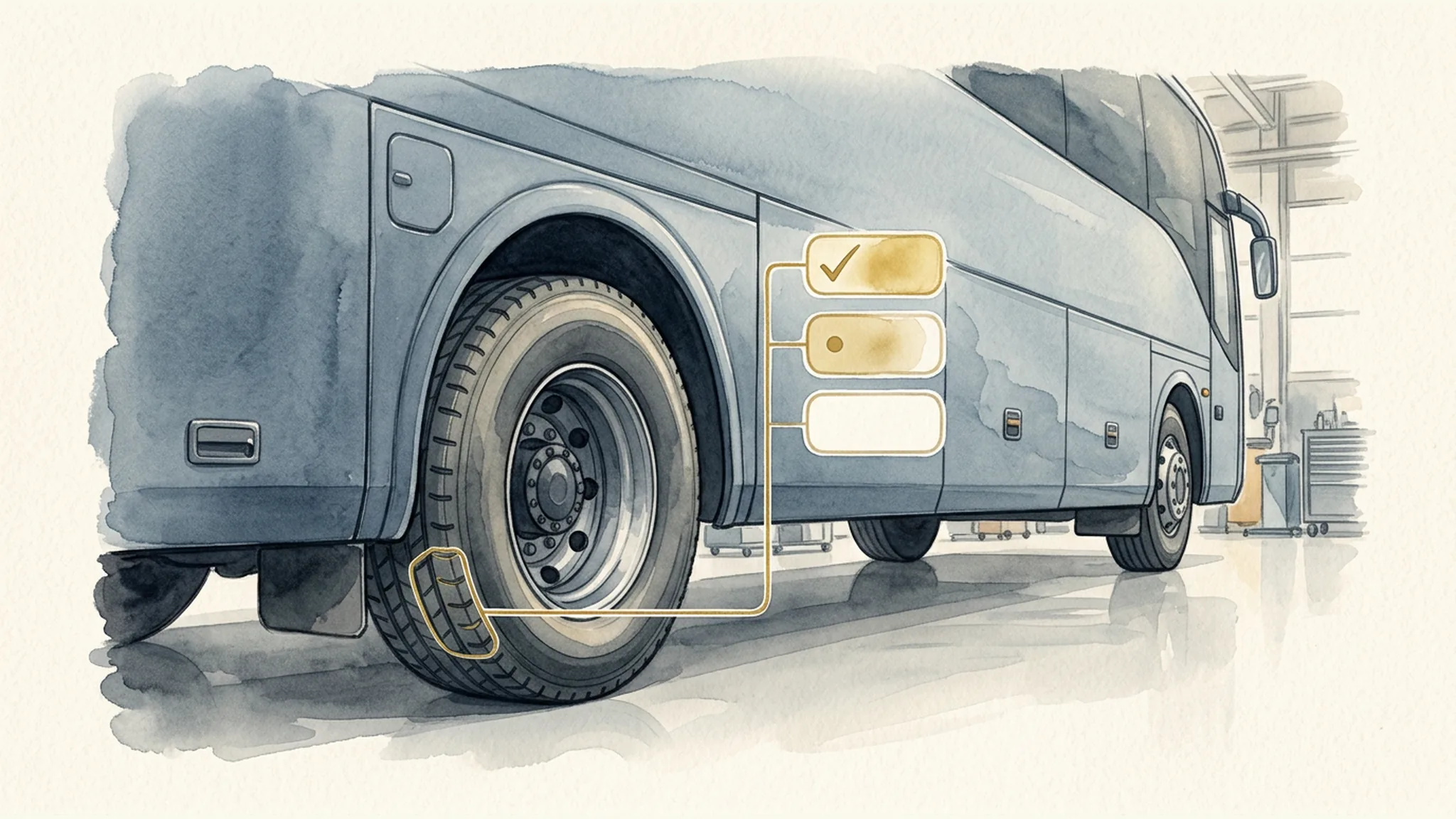
When tire failure is suspected, invoices are only part of the evidence. The tire and wheel assembly itself may be critical. Repairs, towing, storage, salvage, insurer inspections, or destructive testing can change or destroy relevant information if custody is not coordinated.
Document the Tire’s Position, Condition, History, and Custody
A tire-focused evidence plan may address:
- the tire’s position on the bus and the associated wheel;
- pressure, load, tread depth, and visible condition;
- age and DOT identification code;
- prior punctures, repairs, mounting, and balancing;
- whether the tire was retreaded and its retread history;
- service calls, inspection records, warranty materials, and purchase records;
- each transfer of physical custody; and
- an agreed protocol before any destructive examination.
Preserving the actual assembly can be as important as collecting maintenance records. A possible maintenance or service failure should also remain distinct from a possible product-defect theory unless the evidence supports one or both.
Bus-Specific Tire Rules May Supply Context When They Apply
49 CFR 393.75 prohibits operation on specified unsafe tire conditions, including exposed ply or belt material, tread or sidewall separation, a flat or audible leak, and cuts exposing ply or belt material. It requires at least 4/32-inch tread depth on a bus’s front tires and generally at least 2/32 inch at other positions. A bus may not use regrooved, recapped, or retreaded tires on its front wheels.
Those requirements may provide useful context when they govern the operation. A regulatory issue does not automatically prove negligence, a product defect, or causation.
Trace the Contractor and Product Chain Without Assuming Fault
Service or product records may be held by the carrier, owner or lessor, maintenance shop, tire seller or servicer, retreader, manufacturer, roadside-service provider, or warranty administrator. The evidence must show what each participant did and whether that conduct was causally related to the loss.
Our article on commercial-vehicle maintenance and tire evidence discusses related issues in the truck context. It is an analogy only; charter and intercity buses require a passenger-carrier and bus-specific analysis.
Contracts and Day-to-Day Conduct May Show Company Control
A single charter trip can involve an organizer, tour operator, carrier, bus owner, lessor, driver employer, and subcontracted carrier. Written agreements help describe those relationships, but day-to-day conduct can be equally important.
Vicarious liability, direct negligence, contractual responsibility, and regulatory responsibility are different questions. They should not be collapsed into a single “control” label.
Map the Organizer, Carrier, Owner or Lessor, and Subcontractor Relationships
Potentially relevant documents include the charter agreement, passenger-carrier service agreement, vehicle lease or interchange document, subcontract, dispatch records, invoices, insurance materials, and communications about substitutions.
When the federal passenger-vehicle lease rules apply, 49 CFR 390.403 can require a written agreement with vehicle, party, duration, possession, control, use, and compliance terms. But the rule has scope limits. 49 CFR 390.401 excludes certain service agreements between passenger carriers that each have active FMCSA passenger authority, as well as specified financial leases.
The old federal requirement to notify a charter group within 24 hours about certain subcontracted or leased arrangements was removed in 2019. That removal does not establish that no contract term, state rule, ticket provision, or voluntary disclosure applied to a particular trip.
Actual or Retained Control May Be Relevant Alongside Contract Labels
Under Oregon’s right-to-control analysis, an “independent contractor” label is evidence but is not necessarily decisive. Facts that may help describe actual or retained control include who:
- selected and could replace the driver or carrier;
- assigned the vehicle, route, schedule, stops, or rest periods;
- controlled dispatch;
- supervised loading or passenger handling;
- required reports or supplied equipment;
- received and addressed complaints;
- paid whom; and
- could stop unsafe work.
No one factor necessarily resolves status or liability. Our truck-specific discussion offers an adjacent example of how contract labels and actual operational control can differ, but freight, cargo, shipper, and truck-leasing assumptions should not be imported into a passenger-bus case.
Booking a Bus Does Not Automatically Make the Organizer Liable
An organizer is not automatically responsible merely because it booked or paid for the trip. A fact-specific analysis may consider what the organizer undertook or represented, what it knew, how it selected the carrier, what authority it retained or exercised, and whether a supported failure was causally connected to the crash or injury. That approach is consistent with Oregon’s general negligence framework, which focuses on whether conduct unreasonably created a foreseeable risk and whether the harm fell within that risk, unless another legal rule supplies or limits a more specific duty.
Direct claims based on an organizer’s own conduct are analytically different from a claim that it is vicariously responsible for someone else’s conduct. The same distinction applies when evaluating a carrier, owner, lessor, or contractor.
Reports, Carrier Files, and Insurance Records Can Fill Different Gaps
No single report or database is the complete crash record. Carrier reports, police materials, DMV filings, ODOT records, insurer documents, driver files, and federal databases are created for different purposes and have different access rules.
Crash Reports and Accident Registers Are Not Interchangeable
For a motor carrier subject to ORS chapter 825, OAR 740-100-0020 imposes reporting duties for defined reportable collisions. A covered carrier may need to notify ODOT of a fatality within 24 hours after learning of it and submit specified reports within 30 days.
A passenger carrier subject to 49 CFR 390.15 must keep an accident register for three years after each qualifying accident and retain state- or insurer-required accident reports for that period. These carrier records are not substitutes for a law-enforcement report, Oregon DMV collision report, ODOT motor-carrier report, 911/CAD record, or reconstruction file.
For this purpose, the federal definition of “accident” excludes an occurrence involving only boarding or alighting from a stationary motor vehicle. Tickets, scans, video, witness information, or other boarding records may still matter, but section 390.15 does not require an accident-register entry solely on that basis.
Oregon DMV-filed collision reports are generally confidential for state administrative and enforcement purposes. ORS 802.220 allows specified involved people or representatives to request certain identifying information. DMV says it cannot furnish the filer a copy of the report submitted, so a person who files should retain their own copy.
Driver, Authority, and Insurance Records Answer Different Questions
When 49 CFR 391.51 applies, a carrier’s driver qualification file includes specified application, motor-vehicle-record, road-test or equivalent, annual-review, and applicable medical or variance materials. Recruiting, training, dispatch, discipline, licensing, and medical-certification records may be stored separately, so the regulatory file should not be assumed to contain everything relevant to the driver.
Oregon and federal passenger-carrier insurance requirements also differ by operation. Oregon’s intrastate filing rules and federal interstate for-hire passenger limits are not interchangeable. Public insurance filings and regulatory minimums do not necessarily reveal all coverage available for a particular loss, which may involve policy language, endorsements, additional insureds, excess coverage, self-insurance, and multiple entities.
Practical Evidence Steps for Passengers and Families
A measured response can begin with preserving what already exists and identifying likely custodians. It need not begin with conclusions about fault.
Keep What Is Already in the Passenger’s Possession
Retain the ticket, itinerary, booking and payment records, organizer communications, photographs or videos already held, and any seat or boarding information. Keep the passenger’s own copy of any report submitted.
Also write down identifying details that may not appear together elsewhere: bus markings, carrier names, the driver’s name, pickup and destination information, stops, and the names of organizers or group leaders.
Identify Likely Custodians and Short-Lived Data
Likely custodians may include the carrier, organizer, owner or lessor, maintenance and tire contractors, ticketing platform, camera or telematics vendor, towing or storage company, and insurers. Time-sensitive categories may include onboard video, GPS and telematics data, dispatch and ticketing records, and the physical bus, tire, and wheel assembly.
Identifying a custodian does not create an automatic right to inspect, test, download, or receive the material. Preservation, production, access, custody, privacy, privilege, and testing protocols remain separate issues.
Get Claim-Specific Advice Rather Than Relying on a Universal Deadline
For an ordinary Oregon personal-injury claim, ORS 12.110(1) generally provides a two-year limitations period, while ORS 12.115 generally supplies a ten-year outer repose period for negligent injury. An Oregon wrongful-death action is brought by the personal representative and is governed by ORS 30.020’s discovery language and outer limits, including a limit no later than three years after death and any earlier applicable repose consequence. A tire or component product-liability claim is subject to the separate discovery and repose provisions in ORS 30.905. Accrual, repose, tolling, claimant status, contract theories, governing law, and the place of manufacture can change the analysis.
Public-body rules apply only when the claim falls within the Oregon Tort Claims Act—for example, a supported claim against a public body or its officer, employee, or agent. ORS 30.275 generally requires notice within 180 days for non-death claims and within one year for wrongful-death claims, and generally requires the action to be commenced within two years. A public body that organized or participated in a private charter can therefore raise a separate notice issue even though this article does not cover TriMet, MAX, Portland Streetcar, or school-bus operations. Public-body involvement does not convert a private carrier into a public body or automatically extend the public body’s rules to private defendants.
Timely, case-specific evaluation matters not only because a filing or notice period may apply, but because video, electronic data, business records, and physical components can disappear or change long before an ultimate limitations period expires.
Frequently Asked Questions
Is a Charter Bus Required to Have a Passenger Manifest?
No blanket FMCSA rule requiring every intercity or charter bus to carry or retain a passenger-name manifest was verified in the materials reviewed for this article. Operation-specific rules or contracts may differ. Reservation lists, ticket scans, check-in records, seating charts, headcounts, rooming lists, and organizer or emergency-contact records may still exist.
Does a Bus Trip Have to Cross Oregon’s Border for Federal Passenger-Carrier Rules to Apply?
Not necessarily. An Oregon segment may be part of interstate commerce if it was prearranged as part of continuous travel beginning or ending outside Oregon. The complete itinerary, tickets, package terms, and booking arrangements may help answer that question.
What Electronic Data Might Exist After a Motorcoach Crash?
Possible sources include camera, GPS, telematics, engine, transmission, brake, Wi-Fi, dispatch, and ticketing systems. The systems, data fields, custodians, access methods, and overwrite windows vary. Heavy motorcoaches do not universally have a federally mandated “black box.”
Who May Have Maintenance and Tire Records for the Bus?
Possible custodians include the carrier, bus owner or lessor, repair shop, inspector, tire seller or servicer, retreader, manufacturer, roadside-service provider, and warranty administrator. Holding a record or appearing in the service chain does not by itself make an entity liable.
Can a Charter Organizer Be Responsible for a Carrier’s Crash?
Responsibility is fact-dependent. Booking or paying for the bus is not enough by itself. Relevant evidence may include the organizer’s undertakings, representations, knowledge, carrier-selection process, actual or retained control, and whether a supported failure was causally connected to the crash or injury.
Does a Preservation Letter Give a Passenger the Right to Obtain or Inspect the Bus and Records?
No. A preservation letter asks a custodian to prevent the loss of identified evidence. It is not a subpoena, court order, discovery request, inspection right, or automatic production right.
The Evidence Map Depends on the Actual Trip and Relationships
A useful investigation sequence is to classify the complete trip, identify the carrier and related companies, preserve passenger and onboard records, protect maintenance and tire evidence, and compare the written agreements with the parties’ actual conduct.
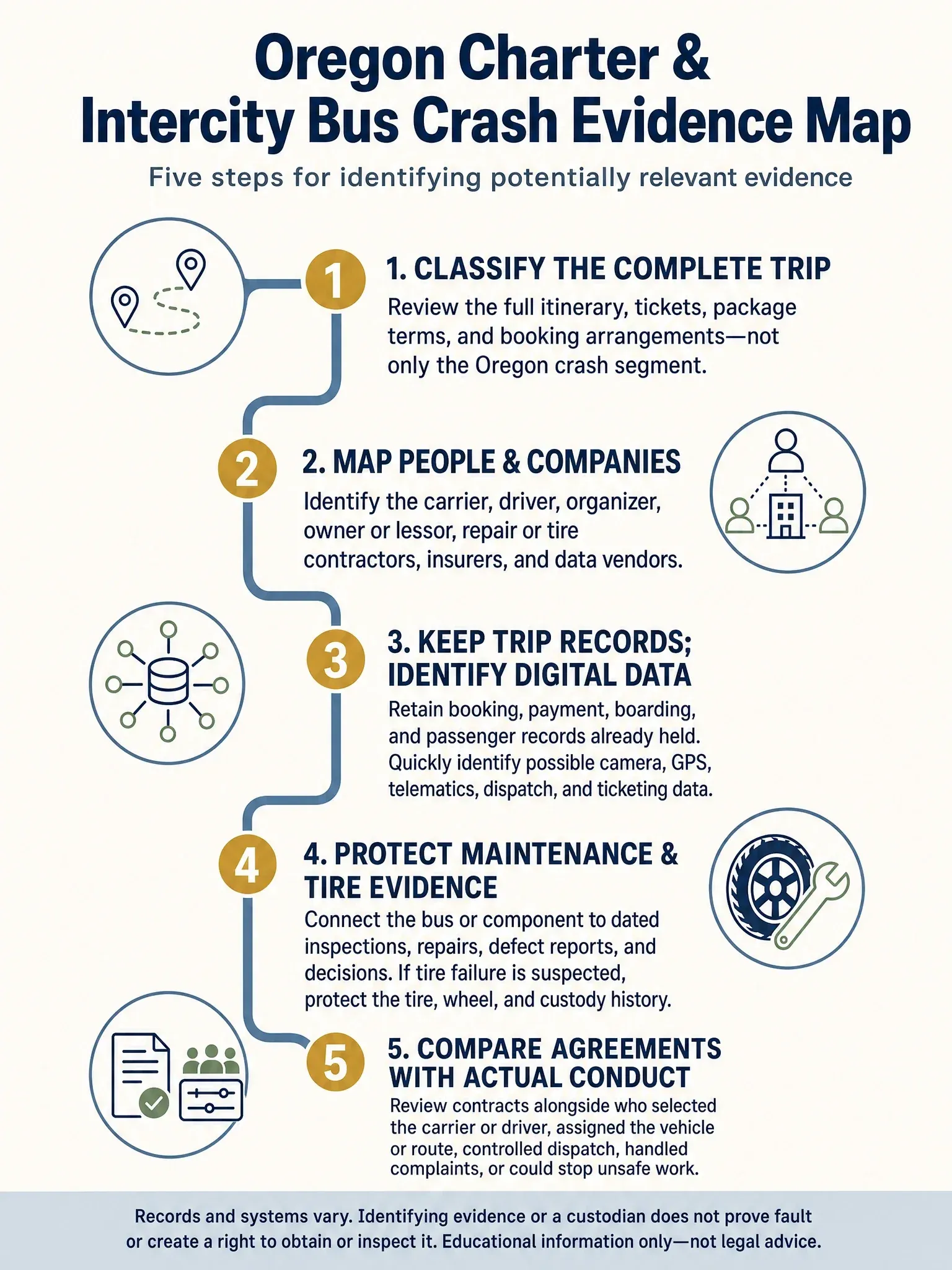
That process may clarify who held a record or performed a task. It does not mean that every identified company belongs in a claim or that responsibility is predetermined. Viable claims, causation, defenses, comparative fault, and available remedies all depend on the evidence and applicable law.
This article is for educational purposes only and is not legal advice. An Oregon lawyer can assess the specific trip, parties, evidence, and time limits that may apply to an individual matter.
Source Notes
Key authorities and government resources used for this article include:
- Oregon Revised Statutes chapter 825, including Oregon carrier definitions, authority, and financial-responsibility provisions.
- Oregon Revised Statutes chapter 12 and chapter 30, including the claim-specific limitations, repose, wrongful-death, product-liability, and public-body notice provisions discussed above.
- OAR division 740-100, including Oregon’s adoption of federal motor-carrier rules and carrier collision-reporting provisions.
- FMCSA Passenger Carrier Guidance Fact Sheet and Multi-Modal Passenger Transportation guidance on interstate trip character, compensation, and passenger-carrier classification.
- 49 CFR 390.5T, 395.5, and 395.8 on federal definitions, passenger-driver hours, and conditional duty-status recordkeeping.
- 49 CFR 396.3, 396.11, and related Part 396 provisions on inspection, maintenance, driver reports, and periodic inspections.
- 49 CFR 393.75 on bus tire condition, tread depth, and front-wheel restrictions.
- 49 CFR 390.401 and 390.403 on the scope and terms of certain passenger-vehicle lease and interchange arrangements.
- Oregon Rules of Civil Procedure 36, 43, and 55 on civil discovery, documents and electronically stored information, and subpoenas.
- Oregon DMV Collision Reporting and Responsibilities and ORS 802.220 regarding collision-report access and confidentiality.
Rules and agency materials can change. Their applicability should be checked against the crash date, the complete trip, the carrier and vehicle classification, and any relevant exemptions.
Client-First Fee Promise
Client First = Bills First, Fees Second
Your unpaid medical bills do not have to make your lawyer's fee bigger. Johnson Law subtracts qualifying medical bills before calculating our fee, helping clients keep more of their settlement.
Applies to qualifying cases. Results vary.