Child Injured at an Oregon Public School? Records, Evidence, and District Notice
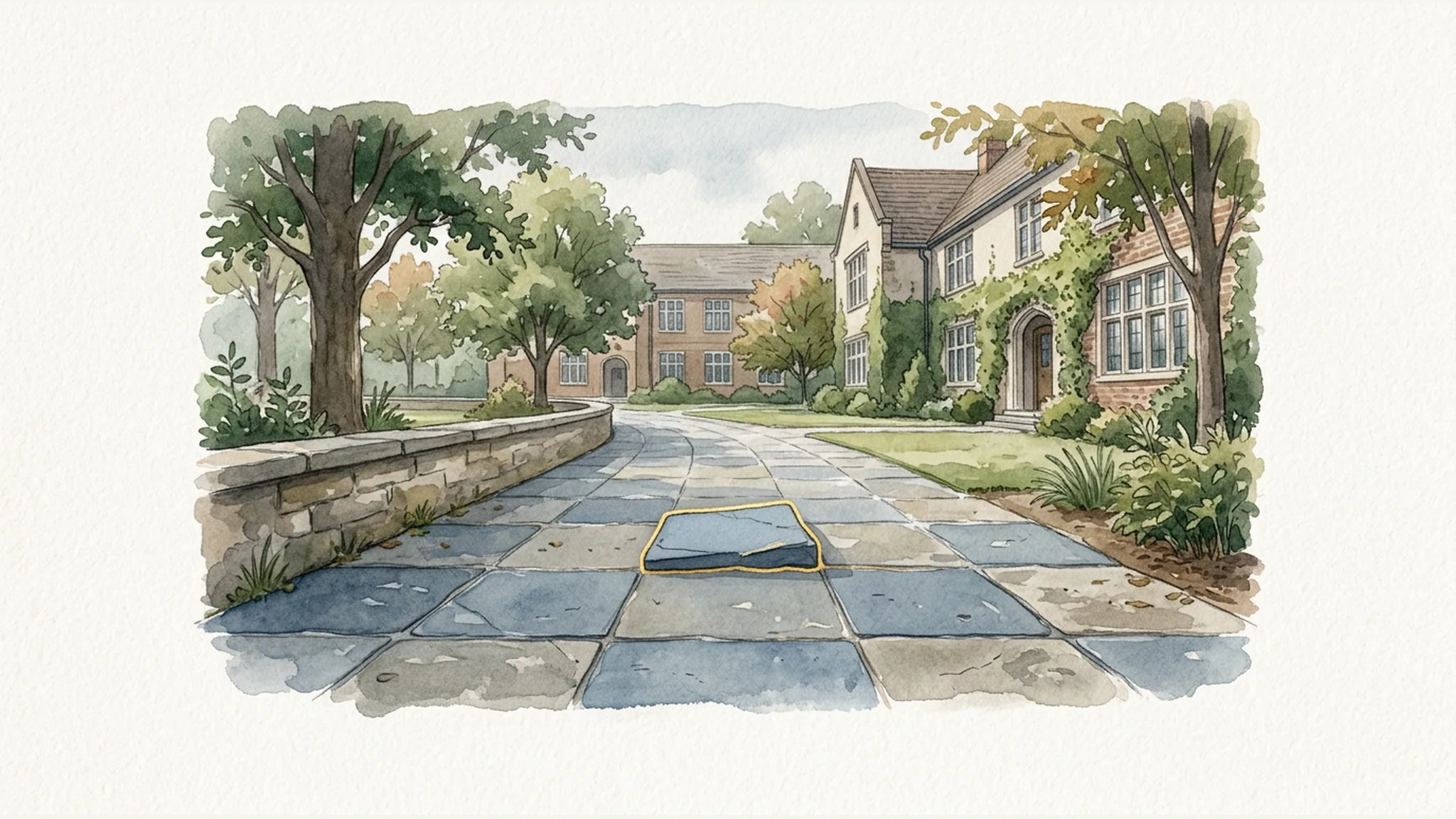
Child Injured at an Oregon Public School? Records, Evidence, and District Notice
After a child is injured at school, parents may be trying to manage medical needs, understand what happened, and communicate with several school employees at once. A useful first approach is to focus on the child’s needs, create a careful record of what the family knows, identify evidence that could change or disappear, and ask how the school documented the event.
It is also important to treat Oregon’s public-body notice rules as a separate issue. An internal incident report, nurse visit, or conversation with a principal may document an injury without satisfying the requirements for notice of a claim against the relevant public body.
This article focuses on district-operated Oregon public K-12 schools. A public-school setting does not by itself identify the entity responsible for operations, employees, premises, records, or tort-claim notice. Charter schools, education service districts, contractors, property owners, and shared programs may require a different analysis. This article does not address private-school claims. Injuries at private or Oregon-regulated daycare and child care facilities involve a different classification and records framework, discussed in our guide to Oregon daycare injury records, licensing information, and evidence preservation. This article also does not cover roadway, crosswalk, driver, or school-zone pedestrian crashes; those issues are discussed separately in our guide to child pedestrian crashes near an Oregon school.
What to Do First After an On-Campus School Injury
The circumstances will differ from one injury to another, but several early steps can help a family organize the facts without assuming that anyone was legally at fault.
Address the child’s immediate needs and keep a chronology
Write down the date, approximate time, location, and activity involved. Record what the child said, who may have witnessed the event, which school employees were present or became involved, and what the school communicated afterward. Keep later information in the same chronology, including any explanation of how the incident occurred.
A contemporaneous chronology is not proof of negligence. It is a practical way to preserve details before memories fade and to identify points that may need clarification.
Ask how the school documented the event
Depending on the circumstances, the school or district may have created an incident or injury report, nurse record, photographs, witness statements, communications, or investigation materials. Ask what documentation was created and retain copies of everything the family receives.
An incident report can be important evidence, but it does not automatically prove that the district or another entity was negligent. It also should not be assumed to satisfy Oregon’s separate tort-claim notice requirements.
Identify evidence that could change or be overwritten
Potentially relevant evidence may include video, photographs, reports, messages, witness information, supervision assignments, or records concerning a physical condition, inspection, repair, or maintenance. If a walkway, playground feature, building condition, or piece of equipment is involved, the condition may change through use, weather, or repair.
A focused pre-suit preservation request can ask the appropriate recipient not to delete, overwrite, alter, or discard identified records or other evidence. When a physical condition must be repaired for safety, the request may ask that it be photographed, measured, or otherwise documented beforehand when reasonably practicable and that relevant removed components be preserved when safe and lawful. But that request is not a subpoena, a court order, a civil discovery request, or a guarantee that the material exists or will be produced.
The Core Liability Question Is Reasonable Care, Not Automatic Responsibility
When a child is entrusted to educators’ care, Oregon law describes a special obligation to take reasonable precautions against foreseeable risks beyond those that might apply to other persons. The Oregon Supreme Court explained this standard in Fazzolari v. Portland School District No. 1J. A school does not guarantee that no student will ever be hurt, and an injury at school does not by itself make a district or another entity liable.
Foreseeable risk and reasonable precautions
Foreseeability does not require proof that someone predicted every step in the precise sequence that caused the injury. The inquiry instead considers the general type of incident and harm in context. Depending on their connection to the event, prior incidents, known hazards, warnings, and the probability and potential magnitude of harm may matter.
Those facts do not establish negligence automatically. A prior event or report is useful only if it is sufficiently connected to an issue such as notice of a risk, foreseeability, the reasonableness of the response, or another disputed question.
Why “it happened at school” is not enough
A potential public-school injury claim may involve duty, breach, causation, damages, timely notice, and possible immunities or defenses. Gathering records may help clarify these questions, but it does not establish each one.
Timing and school practices can also matter. In Fazzolari, the court allowed consideration of precautions for students who arrived early where the building was routinely open and early arrival was neither exceptional nor improper. That decision does not mean a district is responsible for every student on school property at every hour. The child’s age, reason for being present, timing, authorized activities, school practices, and warnings can all affect the analysis.
Supervision Evidence: Reconstruct Who Was Responsible and What Happened
When supervision is a concern, the goal is to reconstruct the setting rather than to begin with a conclusion that staffing was adequate or inadequate.
Relevant questions may include:
- How old was the child, and what activity was taking place?
- Where and when did the event occur?
- Was the child’s presence or activity authorized or expected?
- What risks had been reported or were known in that setting?
- What warnings, policies, or regular school practices applied?
- Who was assigned to supervise the area or activity?
- What supervision and response actually occurred?
There is no universal student-to-staff ratio in the supplied materials that can answer every school-injury question. Sport-specific, playground-specific, special-education, restraint, and other activity standards may require separate analysis.
Records that may help test a supervision account include schedules, assignments, policies, opening and closing practices, prior connected reports, witness statements, incident documentation, messages, photographs, video, and investigation materials. Whether a particular record exists, how the record holder classifies it, and whether it is available to a parent are separate questions.
Policy decisions and daily implementation are not the same
The Oregon Tort Claims Act can protect authorized policy-level judgments through discretionary immunity. Ordinary implementation may present a different issue. In Mosley v. Portland School District No. 1J, the Oregon Supreme Court distinguished potentially protected high-level staffing and resource-allocation choices from a failure to follow predetermined policy in responding to a particular safety concern.
That distinction is fact-specific. It does not establish that a particular staffing, security, supervision, or response decision is automatically immune—or automatically subject to liability.
Dangerous Conditions: Connect the Physical Hazard to the Injury
A dangerous-condition inquiry is related to, but different from, a supervision inquiry. The evidence must address both the condition itself and how it caused or contributed to the child’s injury.
A condition-focused inquiry should also identify who owned or possessed the property and who controlled inspection, maintenance, warnings, and repair. The school district may not be the only or proper entity.
Document the condition without creating another risk
When reasonably and safely possible, relevant material may include photographs, video, measurements, witness accounts, maintenance history, inspection records, repair requests, and prior reports or communications concerning the condition. Families should not enter restricted areas, disturb evidence, or interfere with needed repairs to collect this information.
The existence of an unsafe-looking feature is not enough by itself. In Fazzolari, the court rejected an allegation concerning concealing bushes because the evidence did not connect the bushes to the assault at issue. The narrow lesson is that the claimed condition must be connected to what happened.
Oregon cases also caution against treating every maintenance question as a protected policy decision. In Wright v. Scappoose School District No. 1J, the Court of Appeals treated an alleged failure to remove a known, nonfunctional fire-escape hazard as potentially ministerial rather than automatically protected by discretionary immunity. That was a pleading-stage decision, not a rule imposing liability for every school defect.
For adjacent information about dangerous-property-condition claims, see our premises liability practice page. A school-supervision claim, however, should not be reduced to an ordinary premises claim simply because the event occurred on school property.
Which School and District Records May Matter?
It helps to separate four different tools:
- a voluntary request to preserve identified evidence;
- a parent’s request to inspect the child’s education records;
- a request for existing, nonexempt public records; and
- compelled civil discovery or a subpoena after litigation begins.
They serve different purposes and are not interchangeable.
Incident, injury, and claim records
OAR 166-400-0055, Oregon’s school safety and risk-management retention rule, includes accident and injury reports and related documentation concerning student injuries on school property or during school-related activities.
If no claim is filed, nonemployee accident and injury records generally have a three-year minimum retention period. School-district tort-liability claim records may include reports, photographs, investigations, notices, statements, and audio or video. Those claim records generally have a 10-year minimum after final disposition when action is taken and a three-year minimum when no action is taken.
These are minimum retention rules for records within particular classifications. They do not establish that every video, draft, duplicate, message, photograph, or other possible item was created or still exists. They also do not determine whether an item must be disclosed. Classification can depend on how the district maintains and uses the record, and other schedules may apply.
Parent access to the child’s education records
Under Oregon’s student-record rules, a parent generally may inspect and review education records that are directly related to the child and maintained by or for the educational agency. Access must be provided without unnecessary delay and no later than 45 days after the request. The relevant rules include OAR 581-021-0220 and OAR 581-021-0270.
That does not mean every incident report, nurse note, statement, or video is necessarily the injured child’s education record. Classification depends on the content and how the item is maintained. Information concerning other students may also be withheld or redacted under student-record and privacy rules.
Public-records requests to the district
Oregon Public Records Law generally permits a person to inspect existing, nonexempt public records held by a public body. It does not require a school district to create a new narrative, conduct analysis, or answer questions that are not requests for existing records.
Under ORS chapter 192, a district generally must acknowledge a properly directed written request or complete its response within five business days. It must then complete the response as soon as practicable without unreasonable delay or provide a processing status and reasonable estimated completion date. This is not a promise that records will be produced within five—or even ten—business days. Clarification, fees, applicable exemptions, staffing, service impacts, and request volume may affect processing.
When a record contains both exempt and nonexempt material, Oregon law generally calls for separation and release of the nonexempt portion. But FERPA, Oregon student-record restrictions, privacy, personnel, attorney-client privilege, work product, criminal-investigation concerns, litigation-related exemptions, and other rules may affect a particular item. No school incident report or security video is categorically public or categorically exempt without a record-specific analysis.
Civil discovery and subpoenas are different
A student-record request or public-records request is not compelled civil discovery. Once litigation begins, ORCP 43 addresses production requests to parties, ORCP 55 governs subpoenas to nonparties, and ORCP 36 limits discovery to relevant, nonprivileged matters and permits protective orders.
ORS 192.345(1) conditionally exempts certain records concerning filed or reasonably likely litigation involving a public body, but the statute says that exemption does not limit discovery or deposition rights. That does not mean discovery guarantees unredacted production; a public-records exemption and a discovery privilege are simply not the same question.
Preservation Requests Help Identify Evidence, but They Do Not Compel Production
A focused preservation request can describe the child, date, approximate time, location, and event, then identify relevant categories such as video, incident documentation, communications, photographs, witness material, event-specific staffing records, and maintenance or condition records.
The request should be understood for what it is: a request not to delete, overwrite, alter, or discard identified records or other evidence. If a physical condition requires repair, the request may ask the recipient to document it beforehand when reasonably practicable and to preserve relevant removed components when safe and lawful. It is not an access request by itself. It is also not a subpoena, court order, ORCP 43 production request, or assurance that the requested material exists or will eventually be produced.
Oregon appellate authority leaves some questions about prelitigation destruction of evidence unresolved. Families should not be promised that deletion will necessarily produce sanctions, an adverse inference, dismissal, or an independent spoliation claim. Our overview of general evidence-preservation principles provides additional context, but the available steps and consequences remain fact-dependent.
Oregon Public-Body Notice Requires Separate Attention
An Oregon school district is a local public body under the Oregon Tort Claims Act. That classification creates an additional notice issue for a potential tort claim against a district. The correct public body or other entity still depends on who operated the school, employed the person involved, controlled the premises, and maintained the relevant records.
The general notice rule also applies to claims involving minors
For an ordinary, non-wrongful-death tort claim, ORS 30.275 generally requires notice within 180 days after the alleged loss or injury. For a minor’s ordinary tort claim, the statute may exclude no more than 90 days attributable to qualifying incapacity, including minority. Oregon cases therefore describe 270 days as the maximum minor notice period, but the start date and whether notice was otherwise satisfied depend on the specific discovery, recipient, communication, commencement, and payment facts.
Minority does not extend OTCA notice until age 18. The statute provides only a limited exclusion, so the applicable period should be evaluated from the specific facts.
The starting point can involve a fact-specific discovery analysis: when the claimant knew or reasonably should have known of legally cognizable harm, its cause, and a substantial possibility of tortious conduct by an identified responsible party. The claimant’s circumstances, including minority, matter. But the discovery rule should not be read as permission to wait when an injury and possible public-body involvement are already apparent.
An incident report is not automatically tort-claim notice
ORS 30.275 recognizes formal notice, actual notice, commencement of an action within the notice period, or payment of all or part of the claim by or for the public body. A school’s general awareness of an accident does not necessarily satisfy one of those methods.
Formal notice must be written, state that a damages claim is or will be asserted, describe the time, place, and circumstances so far as known, and identify the claimant and a mailing address. For a local public body, it must be mailed or personally delivered to a recipient authorized by the statute, such as the body at its principal administrative office, a member of its governing body, or designated general counsel.
A principal, teacher, nurse, coach, or front-office employee is not automatically an authorized formal-notice recipient. The relevant public body’s correct legal identity, the recipient, the communication’s content, and proof of delivery all matter.
Actual notice also requires more than knowledge that a child was hurt. A qualifying communication to an authorized formal-notice recipient or tort-claim administrator must convey the time, place, and circumstances and indicate to a reasonable person that a particular person intends to assert a claim. The Oregon Court of Appeals addressed this distinction in Heng-Nguyen v. Tigard-Tualatin School District 23J.
Because the claimant bears the burden of proving compliant notice, preserve copies of notices and attachments, reliable delivery proof, responses, claim numbers, and communications with any claims administrator, insurer, or risk pool. Our guide to Oregon Tort Claims Act notice requirements explains the formal- and actual-notice framework in more detail.
Notice and the lawsuit deadline are different
ORS 30.275 generally requires an OTCA action to be commenced within two years after loss or injury. Current ORS 12.160 may toll commencement of qualifying claims during minority, subject to a maximum extension of five years or one year after age 18, whichever occurs first. That possible tolling of the lawsuit-commencement deadline does not extend the applicable OTCA notice period.
In other words, a family should not use a potentially longer time to file a lawsuit as a reason to delay public-body notice. See our guide to Oregon injury deadlines involving minors and public bodies for general context.
A Practical Records-and-Evidence Checklist for Parents
Not every item below will exist, be available, or prove liability. The list is a way to organize a fact-specific inquiry.
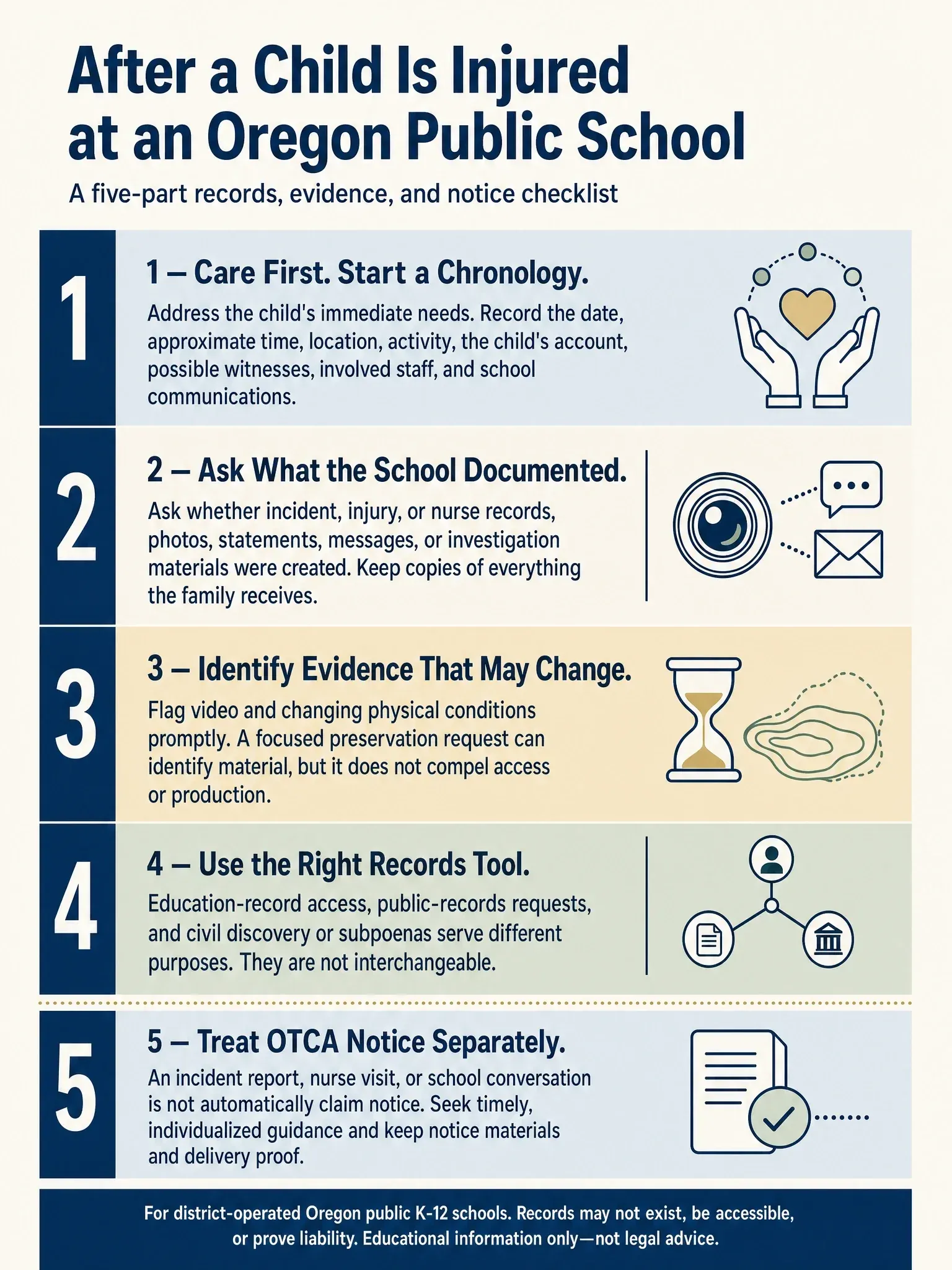
- Keep a chronology and copies of communications with the school, district, and any other involved entity.
- Record known witnesses and what the family understands about the time, place, activity, supervision, warnings, and physical setting.
- Ask what incident, injury, or nurse documentation was created.
- Identify potentially short-lived video or changing physical-condition evidence in a focused preservation request.
- If supervision is at issue, identify relevant schedules, assignments, policies, regular practices, prior connected reports, and event-specific communications.
- If a physical condition is at issue, identify who owned or possessed the property and controlled inspection, maintenance, warnings, and repair, along with photographs, measurements, witnesses, inspection and maintenance history, repair requests, prior connected reports, and evidence connecting the condition to the injury.
- Use the access mechanism appropriate for the item sought; do not treat education-record access, public-records requests, and civil discovery as interchangeable.
- Preserve any tort-claim notice, attachments, delivery proof, responses, claim numbers, and communications with a claims administrator, insurer, or risk pool.
- Seek timely, individualized guidance about OTCA notice instead of assuming the school’s internal paperwork completed that step.
What This Article Does Not Cover
This article does not analyze private-school claims because the public-body and OTCA framework may not apply in the same way. It also does not address roadway or school-zone pedestrian collisions, wrongful death, Title IX, IDEA or special-education duties, abuse-specific claims, restraint or seclusion, federal constitutional claims, or sport-specific standards. Those matters may involve different facts, legal duties, and deadlines.
Preserve the Facts and Treat Notice as a Separate Question
After an injury at a district-operated Oregon public school, the key questions may include what risk was foreseeable, which precautions were reasonable, whether supervision or a physical condition was connected to the injury, which entity was responsible for the relevant conduct or condition, what records exist, and whether public-body notice was timely and properly directed.
Timely attention may help preserve changing evidence and address OTCA notice while the relevant facts can still be evaluated. A review of the specific facts may help identify the relevant public body or other entity and distinguish a record-preservation step from legally sufficient claim notice. Johnson Law assists families with Oregon personal injury matters, including questions involving public bodies.
This article provides educational information only and is not legal advice. Reading it does not create an attorney-client relationship. Legal duties, record access, notice, accrual, immunity, and deadlines depend on the specific facts and current law.
Frequently Asked Questions
Is an Oregon public school automatically responsible when a child is injured on campus?
No. When a child is entrusted to educators’ care, Oregon’s framework asks whether reasonable precautions were taken against a foreseeable risk in the circumstances. Causation, damages, the responsible entity, timely public-body notice, and any applicable immunity or defense may also matter. An injury at school, standing alone, does not establish liability.
Does a school incident report count as Oregon Tort Claims Act notice?
Not automatically. A report may document the accident without communicating an intent to assert a damages claim, and it may not reach a recipient authorized under ORS 30.275. The content, recipient, context, method of notice, and proof of delivery require individual analysis.
How long does a parent have to give notice of a claim against an Oregon public school district?
For a minor’s ordinary injury claim, OTCA notice is generally required within 180 days after the alleged loss or injury, with no more than 90 days excluded for qualifying incapacity, including minority. Oregon cases therefore describe 270 days as the maximum minor notice period, but the start date and whether notice was otherwise satisfied depend on the specific discovery, recipient, communication, commencement, and payment facts. A minor may not wait until age 18 to give OTCA notice.
Can a parent obtain school video, an incident report, or witness statements?
Possibly. Access depends on whether the item exists, how it is maintained and classified, whether it is the child’s education record or an otherwise accessible public record, and what exemptions, privacy protections, redactions, privileges, or later discovery rules apply. A records request does not guarantee that every requested item must be produced.
What evidence may matter when supervision is at issue?
The inquiry may consider the child’s age, activity, location, timing, authorized presence, known risks, warnings, policies and regular practices, actual assignments and response, prior connected reports, witness accounts, communications, photographs, and available video. No single item necessarily proves inadequate supervision.
What should a parent document if a playground, walkway, building feature, or equipment condition contributed to the injury?
Potentially useful evidence may include photographs, video, measurements, witness accounts, inspection and maintenance history, repair requests, prior connected reports, and communications about the condition. The inquiry should also identify who owned or possessed the property and who controlled inspection, maintenance, warnings, and repair. It is necessary to connect the condition to what occurred; an unsafe-looking feature alone does not establish causation.
Sources and Further Reading
- ORS chapter 30—Oregon Tort Claims Act, including ORS 30.265 and 30.275
- Fazzolari v. Portland School District No. 1J, 303 Or 1, 734 P2d 1326 (1987)
- Mosley v. Portland School District No. 1J, 315 Or 85, 843 P2d 415 (1992)
- ORS chapter 192—Oregon Public Records Law
- OAR 166-400-0055—School Safety and Risk Management Records
- OAR 581-021-0270—Rights of Inspection and Review of Education Records
- Heng-Nguyen v. Tigard-Tualatin School District 23J, 275 Or App 724, 365 P3d 1173 (2015)
- ORS 12.160—Limitation for Minors and Persons Who Have Disabling Mental Conditions
Source note: The official online ORS chapters cited in the research materials were the 2025 edition and may not incorporate every 2026 session-law change. The prepublication legal review checked the core provisions against the 2026 update table on August 25, 2026, and found no 2026 amendment affecting the core provisions relied on here.
Client-First Fee Promise
Client First = Bills First, Fees Second
Your unpaid medical bills do not have to make your lawyer's fee bigger. Johnson Law subtracts qualifying medical bills before calculating our fee, helping clients keep more of their settlement.
Applies to qualifying cases. Results vary.